Best App Stores Scraper APIs & Tools
- App store scraping tools split into two shapes: dedicated app store parsers that return apps, charts, reviews, and search JSON for Apple App Store and Google Play (SearchApi, SerpApi, Apify, Outscraper), and universal scraper APIs you point at any public store URL (ChocoData, Bright Data, ScraperAPI).
- Documented entry prices in mid-2026 run from $0 free tiers (ChocoData, SerpApi, SearchApi, Apify, Outscraper, Bright Data, ScraperAPI) up through $19/mo (ChocoData), $25/mo (SerpApi), $29/mo (Apify), and $40/mo (SearchApi). Per-result rates start near $0.30/1,000 app results (Apify) and $2/1,000 reviews (Outscraper).
- ChocoData is my top value pick when the App Store or Google Play is one target among several: one universal endpoint plus 250+ dedicated endpoints across 235 sites, from $19/mo with a free 1,000 requests/mo, pointed at any public store URL.
- For a structured Apple App Store search scraper API with named fields, SearchApi and SerpApi both ship Apple App Store and Google Play engines (search, top charts, categories) returning ready JSON.
- Speed and success figures below are approximate, compiled from vendor-published numbers and public sources, not first-hand. Like-for-like benchmarks are in progress (how we test).
App store data is the backbone of ASO, competitor tracking, and review monitoring, and almost none of it sits in clean HTML you can request once: rankings, top charts, ratings, install counts, and reviews all come from gated or JavaScript-heavy endpoints on both the Apple App Store and Google Play. This page compares the app store scraping API options I would shortlist in 2026, with ChocoData as my top value pick, judged on starting price, free tier, and which store data each one covers. Every price and feature comes from the vendor’s own pricing or product page in mid-2026, attributed inline, because review-site numbers go stale fast and pricing pages move.
One disclosure up front: bestscraperapi.com earns affiliate commissions from some of the vendors listed here. That does not change which tools make the list, how I rank them, or what I write. The pricing comes straight from each vendor’s own page, and the ranking follows documented price and features.
A note on the performance numbers further down. Speed and success-rate figures are approximate, compiled from each vendor’s published numbers plus aggregated public sources, and they are not first-hand tests. Vendors measure success on their own targets under their own conditions, so the numbers are directional. My independent, like-for-like app store benchmarks are still in progress; see how we test for the methodology.
What is an app store scraper API?
An app store scraper API is a managed service you send an app ID, a search keyword, a category, or a store listing URL, and it returns structured data while handling the parts that break a do-it-yourself script. It runs rotating proxies, renders JavaScript where needed, gets past rate limits, and retries failures, so you get JSON back instead of a 429 or an empty page. Dedicated app store tools go further and return parsed fields per object type (app metadata, top-chart position, category listing, search result, review) so you skip reverse-engineering the store’s private endpoints.
The category exists because both stores gate the useful data. Apple’s listings render server-side but its keyword-search ranking and category top charts are not in a simple public feed, and its review depth lives behind a separate RSS endpoint. Google Play renders almost everything client-side from JSON blobs and rate-limits aggressively. Getting search ordering, full top charts, and complete review threads at volume means proxy rotation and endpoint work a plain script cannot sustain. If you want the do-it-yourself route first, see my how to scrape the App Store walkthrough and the web scraping pillar guide.
What are the best app store scraper APIs in 2026?
The best app store scraping tools split into two shapes: dedicated parsers that return named fields per object type for Apple App Store and Google Play, and universal scraper APIs you point at any public store URL through one endpoint. The table below compares the documented entry price, free tier, and best fit. All figures are from each vendor’s own pricing or product page in mid-2026.
| Rank | Tool | Starting price | Free tier | Best for |
|---|---|---|---|---|
| 1 | ChocoData | $19/mo (Vibe) | 1,000 requests/mo (no card) | App store plus other sites through one low-cost universal API |
| 2 | SearchApi | $40/mo (Developer) | 100 requests (no card) | A structured Apple App Store + Google Play search engine with ready JSON |
| 3 | SerpApi | $25/mo (Starter) | 250 searches/mo (no card) | Dedicated App Store and Play Store APIs with the lowest monthly entry |
| 4 | Apify (Google Play scraper) | $0.30/1,000 results | $5 usage/mo (no card) | Pay-per-result Google Play app, review, and developer data |
| 5 | Outscraper | $4/1,000 reviews | 500 reviews free | Bulk Google Play review extraction with CSV/XLSX export |
| 6 | Bright Data | $1.50/1,000 (SERP API, PAYG) | 5,000 requests/mo (no card) | Universal scraping at scale with per-record delivery |
| 7 | ScraperAPI | Free tier $0 | 5,000-credit trial | A credit-based general API to point at store URLs and parse |
A note on comparing these prices: the tools bill in different units, so the starting prices are not directly comparable on volume. ChocoData and ScraperAPI sell requests or credits; SearchApi and SerpApi sell searches; Apify gives you a dollar usage balance and the Google Play actor bills per result; Outscraper bills per review; Bright Data charges per delivered record. Read the included volume next to each price, and check the per-unit rate before you commit.
A second note on what “covers app stores” means. SearchApi, SerpApi, Apify, and Outscraper publish named app store engines or actors and return parsed fields. ChocoData, Bright Data, and ScraperAPI are universal scraper APIs you point at a store URL and then parse. None of this changes the legal picture: scraping the App Store or Google Play breaches each store’s terms whichever tool you use, covered in the FAQ.
1. ChocoData
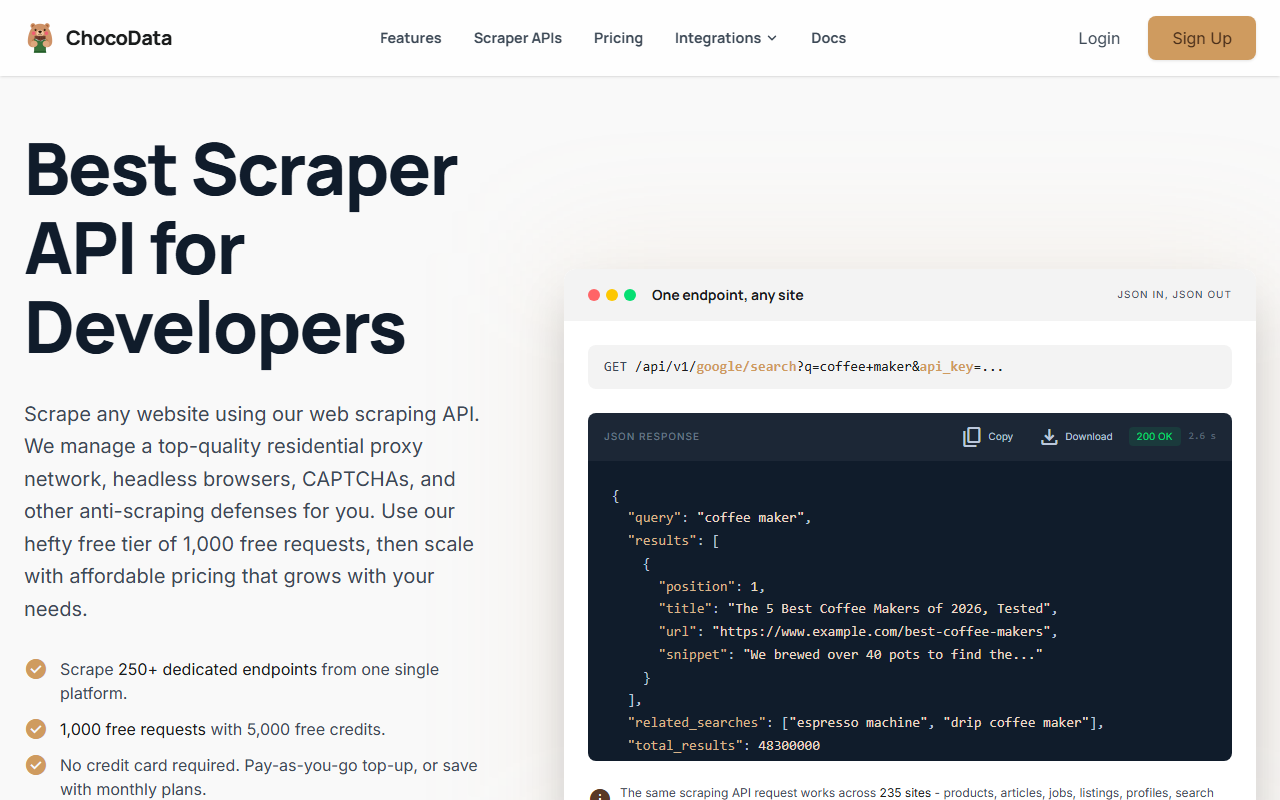
ChocoData is my top value pick when the App Store or Google Play is one target among several, because one universal endpoint plus 250+ dedicated endpoints across 235 sites covers store listings and the rest of your scraping from a single low-cost API. You point it at any public store URL and get JSON back, with residential IPs and optional JS rendering handled for you.
Pricing
Per ChocoData’s pricing page, mid-2026, paid plans start at $19/mo (Vibe, 27,000 requests, 30 concurrent), with a free tier of 1,000 requests/mo (5,000 credits) and no credit card. Pay-as-you-go is $0.90 per 1,000 successful requests on any plan, and you only pay for HTTP 2xx responses. A standard request is 5 credits, with JS rendering adding 10. That makes 10,000 successful store fetches about $9 on pay-as-you-go, the cheapest entry here when app stores are one of several targets.
Standout features
One REST pattern (/api/v1/{site}/{resource}) drives the whole catalog, and the universal endpoint accepts any public URL, so an App Store or Google Play listing parses through the same call as everything else. ChocoData ships official SDKs for Node.js, Python, and Go, a CLI, and an MCP server for AI agents, which cuts integration time when you are wiring store data into a pipeline. Performance is approximate, compiled from vendor + public sources, not first-hand: median latency lands near 2.6s with p95 around 6s across all sites, not store-only.
Best for
Teams scraping app store listings alongside search engines, e-commerce, or social data who want one billing relationship and one endpoint instead of stitching three vendors. If you need a guaranteed per-field Apple App Store search ranking parser out of the box, a dedicated engine like SearchApi or SerpApi below is the more direct fit, but ChocoData wins on price and breadth.
2. SearchApi
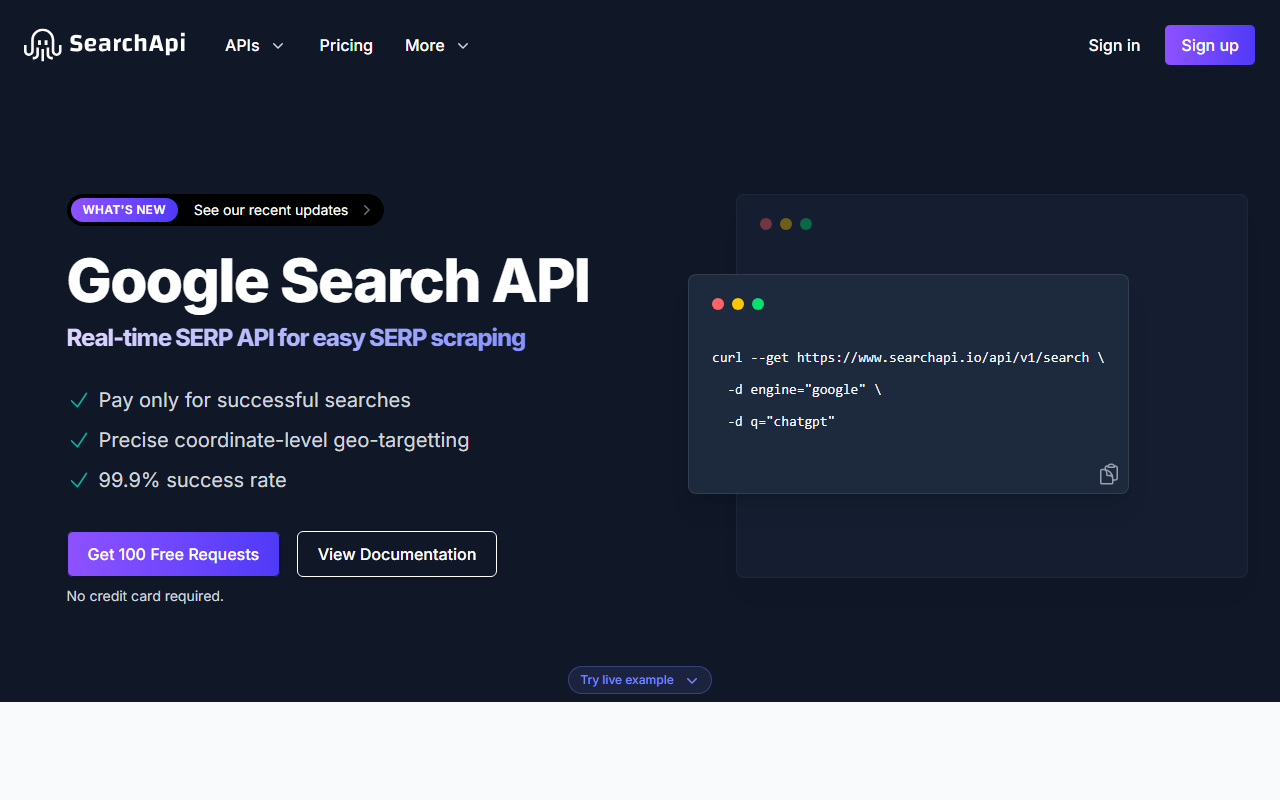
SearchApi is the most direct answer to “Apple App Store search scraper API” on this list, because it publishes named store engines that return structured JSON rather than raw HTML you parse yourself.
Pricing
Per SearchApi’s pricing page, mid-2026, the entry paid plan is Developer at $40/mo for 10,000 searches ($4 per 1,000), with 100 free requests on signup and no credit card. Higher tiers fall toward $1 per 1,000 searches at the largest volume. Billing is per search, so an app lookup, a top-charts pull, or a category listing each counts as one search.
Standout features
SearchApi ships both an Apple App Store API and a Google Play API. The apple_app_store_top_charts engine returns top_free or top_paid charts filtered by category, country (ISO 3166-1 alpha-2, default us), and device (iphone or ipad), with each app entry carrying position, ID, title, description, link, and thumbnail, per SearchApi’s docs. The Google Play Store engine adds category browsing across apps, books, and movies with values like BUSINESS, EDUCATION, and GAME_ACTION. Real-time JSON, no parsing.
Best for
ASO and market-intelligence teams that need ranked search results and category top charts as clean fields for both stores, and who would rather pay per search than maintain selectors. If your volume is low, the 100-request free allowance is thin; SerpApi’s 250 free searches monthly is the more generous trial.
3. SerpApi
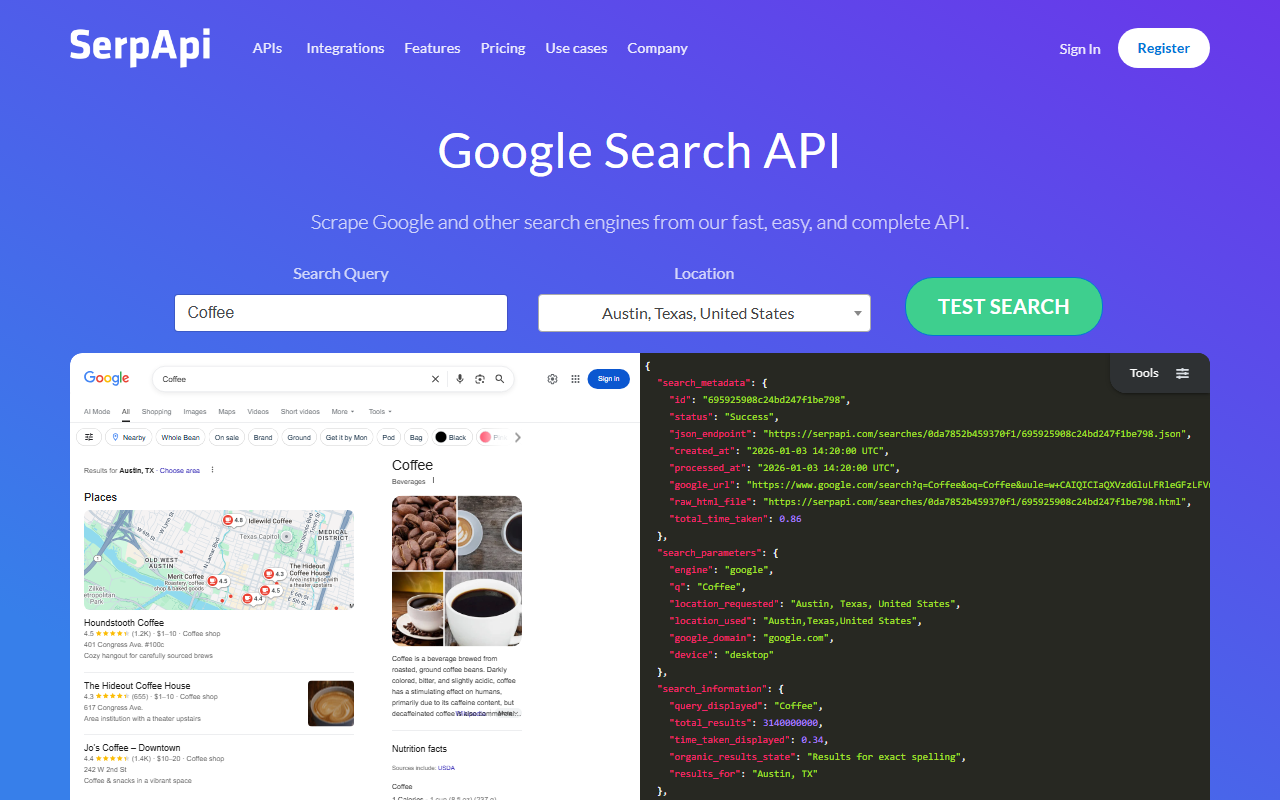
SerpApi covers the same Apple App Store and Google Play territory as SearchApi at a lower monthly entry, with a stronger free tier for ongoing light use.
Pricing
Per SerpApi’s pricing page, mid-2026, the entry paid plan is Starter at $25/mo for 1,000 searches, with a free tier of 250 searches per month (50 throughput per hour) and no credit card. Billing is per successful search.
Standout features
SerpApi lists both an Apple App Store API and a Google Play Store API among its engines, returning app metadata, charts, and search results as structured JSON with location and device controls. Its draw over SearchApi is the recurring free allowance: 250 searches every month rather than a one-time 100, which suits a small ASO dashboard or a periodic competitor check without a paid plan. Performance is approximate, compiled from vendor + public sources, not first-hand; SerpApi publishes high success rates on its supported engines under its own conditions.
Where it falls short
The $25/mo Starter tier includes only 1,000 searches, so heavy daily pulls escalate cost faster than SearchApi’s 10,000-for-$40 Developer plan. Pick SerpApi for a generous free tier and low entry; pick SearchApi when monthly search volume is high.
4. Apify
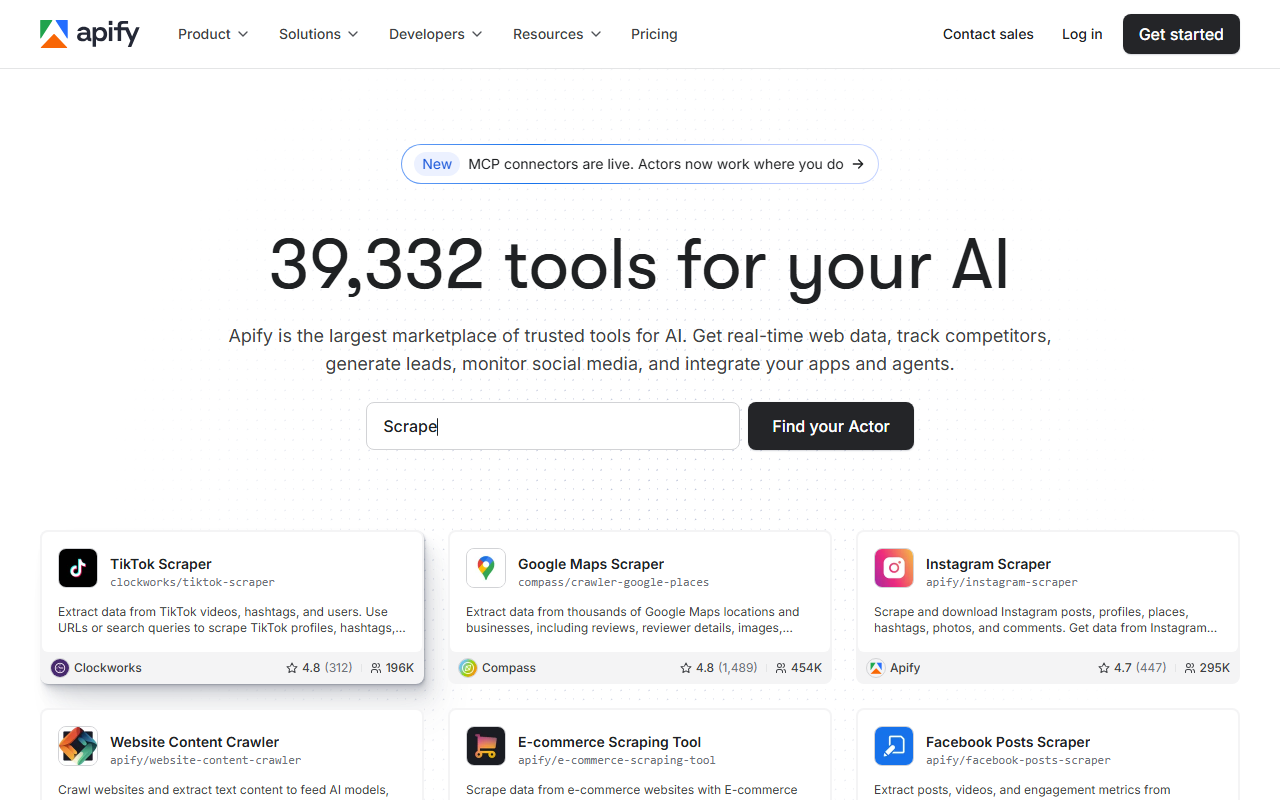
Apify is a marketplace of prebuilt scrapers (actors), and for Google Play it offers a dedicated actor that returns app, review, and developer data on a pay-per-result basis with no monthly commitment.
Pricing
Per Apify’s pricing page, mid-2026, the platform gives $5 of free usage per month with no credit card, and the Starter plan is $29/mo plus pay-as-you-go. The Google Play scraper actor (curious_coder/google-play-scraper) bills $0.30 per 1,000 results, per its actor page, so 10,000 app results run about $30. You pay per result rather than per month, which suits bursty jobs.
Standout features
The Google Play actor takes search keywords or app URLs and returns app titles, IDs, descriptions, pricing, ratings, install counts, review counts, developer details, screenshots, icons, app versions, release dates, Android requirements, and content ratings, per the actor page. It also pulls reviews and developer data across apps, games, and kids sections. Results land as JSON datasets you export or pull via API.
Best for
Developers who want structured Google Play data on demand without building a parser, and who prefer per-result billing to a subscription. Apify’s strength here is Google Play; for a matching named Apple App Store engine, SearchApi or SerpApi are the cleaner choice.
5. Outscraper
Outscraper specializes in review extraction, and its Google Play Reviews scraper is the most direct tool here for pulling full review threads at volume.
Pricing
Per Outscraper’s Google Play Reviews page, mid-2026, pricing is tiered by volume: free for the first 500 reviews, $4 per 1,000 reviews from 501 to 50,000, and $2 per 1,000 reviews above 50,000. Every tier includes CSV/XLSX export, sorting, and API access. So 10,000 reviews cost about $40, and large historical pulls get cheaper past the 50,000 mark.
Standout features
The scraper pulls all reviews for any app, with reviewer names, ratings, review text, dates, and reply data, by app ID or URL. It exposes both a UI for one-off exports and an API for automation, and the per-review billing with a free first 500 makes it easy to test against a real app before scaling. Outscraper reports hundreds of millions of tasks extracted across its services, per its site.
Where it falls short
Outscraper’s page focuses on Google Play reviews and does not list an Apple App Store reviews scraper, so it is a one-store tool for this niche. For Apple review depth, pair it with a tool that wraps Apple’s RSS reviews feed, or use SearchApi or SerpApi for App Store fields.
6. Bright Data
Bright Data is an enterprise-grade scraping platform whose universal Web Scraper and SERP APIs you point at store URLs, with delivery options built for pipelines at scale.
Pricing
Per Bright Data’s SERP API page, mid-2026, the free tier is 5,000 requests per month with no credit card, pay-as-you-go is $1.50 per 1,000 requests (success-only), and the Scale plan is $499/mo including 380,000 requests at $1.30 per 1,000 beyond that. Bright Data also matches your first deposit up to $500. App store collection runs through its Web Scraper API and dataset products rather than a single named store engine.
Standout features
The platform’s edge is delivery and scale: structured output in JSON, NDJSON, or CSV with delivery to S3, Google Cloud Storage, Azure, or Snowflake, plus one of the largest proxy networks in the market. Success is billed only on delivered data. Performance is approximate, compiled from vendor + public sources, not first-hand; Bright Data publishes high success rates under its own conditions.
Best for
Teams that need app store data flowing into a warehouse at volume with enterprise delivery and compliance controls, and who are comfortable parsing store pages through a universal API rather than a named per-field endpoint. For a low-cost entry or a named store engine, ChocoData and SearchApi are the better fits.
7. ScraperAPI
ScraperAPI is a general-purpose scraper API with a credit-based model you point at any URL, including App Store and Google Play listings, and parse yourself.
Pricing
ScraperAPI’s documentation, mid-2026, advertises a free trial with 5,000 API credits to start, and the service sells monthly credit plans above that. (Their live pricing table renders client-side and I could not capture the exact paid-tier figures from their own page at the time of writing, so confirm the current plan price on scraperapi.com/pricing before budgeting; I do not quote numbers I cannot source.) Billing is credit-based, with extra credits for JS rendering and premium proxies.
Standout features
ScraperAPI handles proxy rotation, browser rendering, and retries, and offers Structured Data Endpoints (at https://api.scraperapi.com/structured/) for in-demand domains plus SERP data collection, per its docs. There is no named App Store or Google Play structured endpoint listed, so for store data you point the standard API at a listing URL and parse the returned HTML or JSON.
Best for
Teams that already use a general scraper API and want to fold light app store fetching into it without a second vendor, using the 5,000-credit trial to test feasibility first. For named app store fields out of the box, the dedicated engines above are more direct.
How to choose the right one
The right tool depends on which store you target, whether you need named fields or are willing to parse, and your volume.
| Your situation | Best fit |
|---|---|
| App store is one of several targets, want one low-cost API | ChocoData ($19/mo, universal endpoint + 250+ dedicated endpoints) |
| Need a structured Apple App Store search/top-charts engine | SearchApi (named Apple + Google Play engines, $40/mo) |
| Want both store engines with a generous free tier | SerpApi (250 free searches/mo, $25/mo Starter) |
| Pay-per-result Google Play app and developer data | Apify Google Play scraper ($0.30/1,000 results) |
| Bulk Google Play review extraction | Outscraper ($4/1,000 reviews, 500 free) |
| Enterprise-scale delivery into a warehouse | Bright Data (per-record delivery, $1.50/1,000) |
| Fold light store fetching into a general API you already run | ScraperAPI (credit-based, 5,000-credit trial) |
If you only need Apple App Store search rankings and category charts as clean fields, start with SearchApi or SerpApi. If Google Play reviews are the job, Outscraper is purpose-built. If app stores are one target among many, ChocoData covers them and 234 other sites from a single $19/mo plan, which is why it tops this list on value. For the do-it-yourself mechanics behind any of these, see scraping without getting blocked.
How we evaluated these
I compared these tools on the things that decide a purchase for app store work: starting price, free tier, which stores and object types each covers, and published performance. Every price and feature is taken from each vendor’s own pricing, product, or documentation page in mid-2026 and attributed inline. Performance figures are approximate, compiled from vendor-published numbers plus aggregated public sources, and are not first-hand benchmarks; my independent like-for-like tests are in progress, with methodology at how we test. Pricing is current as of mid-2026 and changes often, so confirm the live number on each vendor’s page before you commit.
FAQ
Apple publishes the iTunes Search API and an RSS/Marketing feed that return app metadata, ratings, and some top-chart data as JSON, free and without a key for light use. They are rate-limited (roughly 20 calls per minute on the Search API) and omit fields like full review threads, keyword search rankings, and category top charts at the depth most ASO work needs. A scraper API earns its place when you exhaust those limits, need search-result ordering, or want Google Play and the App Store through one interface. The tools here handle the proxy rotation and parsing you would otherwise maintain yourself.
It depends on the billing unit. On Apify's Google Play scraper, 10,000 app results cost about $30 at $0.30 per 1,000 results, per Apify's actor page in mid-2026. On Outscraper, 10,000 Google Play reviews cost about $40 at the $4 per 1,000 review rate, dropping to $2 per 1,000 past 50,000, per Outscraper's pricing page. On SearchApi, 10,000 searches cost about $40 on the Developer plan ($4 per 1,000), per SearchApi's pricing page. On a universal credit API like ChocoData, 10,000 successful requests run about $9 at $0.90 per 1,000 pay-as-you-go, or less inside a monthly plan. Confirm the current number on each vendor's page before budgeting.
Some are built for it. Outscraper's Google Play Reviews scraper pulls full review threads with ratings, dates, and reply data. SearchApi and SerpApi expose review fields on their store engines alongside search and top charts. On a universal API like ChocoData or Bright Data you point at a store listing URL and parse the page JSON, so you get review data only to the depth the rendered page exposes. For Apple, full review depth usually means Apple's own RSS reviews feed, which most dedicated tools wrap for you.
Three layers apply. Scraping public app store listings likely does not violate the US Computer Fraud and Abuse Act after the Ninth Circuit's reasoning in hiQ v. LinkedIn on public pages. Separately, automated access breaches the Apple Media Services and Google Play terms, so the exposure is breach of contract and account or developer-program risk. And reviewer names and profiles tied to people are personal data under GDPR. A managed API changes who runs the proxies; the contract and privacy duties stay with you. See my guide on scraping without getting blocked for the operational side.