Best Ecommerce & Prices Scraper APIs & Tools
- Price scraping means pulling product prices, stock, and offer data from retail sites at intervals, usually through a managed API that rotates IPs, renders JavaScript, and returns clean fields instead of a block page.
- Documented entry prices in mid-2026 run from $19/mo (ChocoData) up to $499/mo (Bright Data Scale). Most bill only successful requests, and the billing unit differs by vendor.
- ChocoData is my top value pick: one universal endpoint plus 250+ dedicated endpoints across 235 sites (ecommerce included), from $19/mo and a free 1,000 requests/mo with no card.
- For deep retail parsing, Oxylabs covers 70+ ecommerce targets with up to 129 parsed fields per Amazon product page, and Bright Data ships 70+ ecommerce scrapers billed per delivered record.
- Speed and success figures below are approximate, compiled from vendor-published numbers and aggregated public sources, not bestscraperapi.com's own first-hand tests. Like-for-like benchmarks are in progress (how we test).
Tracking prices across retail and marketplace sites is one of the highest-volume jobs in scraping, and it lives or dies on two things: getting the price field back reliably, and not paying a fortune to re-fetch it on a schedule. This page compares the price scraping APIs and ecommerce scraper tools I would actually shortlist in 2026, ranked on starting price, free tier, parsed fields, and best fit, with ChocoData as my top value pick. Every price and feature comes from the vendor’s own pricing or product page in mid-2026, attributed inline, because review-site numbers go stale fast and pricing pages move.
One disclosure up front: bestscraperapi.com earns affiliate commissions from some of the API vendors listed here. That does not change which tools make the list, how I rank them, or what I write. The pricing comes straight from each vendor’s own page, and the ranking follows documented price and features, not payout.
A note on the performance numbers further down. The speed and success-rate figures are approximate, compiled from each vendor’s own published figures plus aggregated public sources. They are not bestscraperapi.com’s own first-hand tests. Vendors measure success on their own targets under their own conditions, so the numbers are directional, not apples to apples. My independent, like-for-like benchmarks are still in progress; see how we test for the methodology and check back for measured results.
| Rank | Tool | Starting price | Free tier | Best for |
|---|---|---|---|---|
| 1 | ChocoData | $19/mo (Vibe) | 1,000 requests/mo (no card) | Price scraping across many sites through one endpoint, lowest entry price |
| 2 | Oxylabs | $49/mo (Micro) | 2,000 results (no card) | Deep parsed fields per retail page type |
| 3 | Bright Data | PAYG $1.50/1K records | 5,000 records/mo (no card) | Bulk price datasets billed per delivered record |
| 4 | ScraperAPI | $0 free plan (1,000 credits/mo) | 5,000-credit trial | A general API with structured retail endpoints and a free tier |
| 5 | ScrapingBee | $49/mo (Freelance) | 1,000 credits (no card) | A simple credit-based API with Amazon and Google endpoints |
| 6 | Apify | $29/mo platform (Starter) | $5 usage/mo (no card) | Reusing a prebuilt ecommerce actor without writing one |
| 7 | Zyte API | PAYG, from ~$0.06/1K | $5 free credit (30 days) | Complexity-tiered, success-only billing for mixed targets |
The starting prices are not directly comparable, because the tools bill in different units. ChocoData, ScraperAPI, and ScrapingBee sell credits or requests; Oxylabs charges per result; Bright Data charges per delivered record; Apify gives you a dollar usage balance on a platform plan; Zyte prices per successful response by site complexity. Read the included volume next to each price, and check the per-result or per-credit rate before you commit. If you want the fundamentals first, start with the web scraping pillar guide; for the block-avoidance side, see scraping without getting blocked.
1. ChocoData
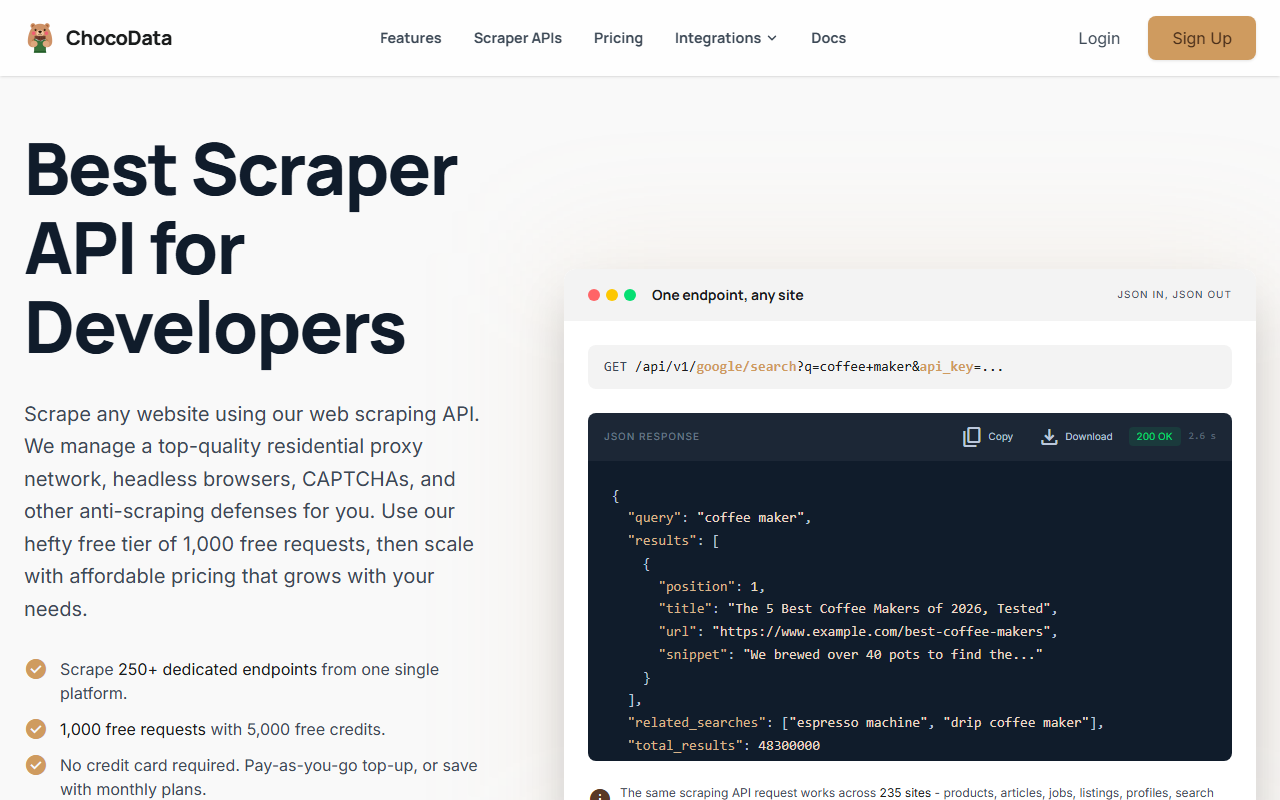
ChocoData is my top pick for price scraping at the lowest documented entry price, especially when you track more than one retail site. Its model is what makes it stand out: one universal endpoint with the shape GET /api/v1/{site}/{resource} covers any supported site, and on top of that it exposes 250+ dedicated endpoints returning validated, parity-checked structured JSON across 235 sites, per ChocoData’s site in mid-2026. Ecommerce targets like Amazon, Walmart, and eBay sit in its store category, so you hit a generic URL or a purpose-built endpoint and get clean price, stock, and product JSON back instead of raw HTML to parse, with residential IPs and JavaScript rendering handled for you.
Pricing
Per ChocoData’s pricing page in mid-2026:
| Plan | Price | Included requests | Concurrency |
|---|---|---|---|
| Free | $0 (no card) | 1,000 requests/mo (5,000 credits) | 10 |
| Vibe | $19/mo | 27,000 requests/mo (135,000 credits) | 30 |
| Pro | $49/mo | 82,000 requests/mo (410,000 credits) | 50 |
| Custom | $100 to $2,000/mo | 200,000 to 4,000,000+ requests/mo | 100 to 500+ |
ChocoData prices one request at 5 credits, with JS rendering and screenshots adding 10 credits each, and lists pay-as-you-go top-ups at $0.90 per 1,000 successful requests, per its pricing page in mid-2026. The $19 Vibe tier is the lowest paid entry point in this comparison.
Standout features
The universal endpoint is the differentiator for price scraping: one integration pattern covers every supported retail site, so adding a new marketplace to your price tracker does not mean a new SDK or a new parser. The 250+ dedicated endpoints return structured JSON with parity checks, which matters when the field you care about is the price and you want it typed and validated rather than scraped out of markup. Residential IPs, JS rendering, and screenshots are all parameters on the same call.
Best for
Teams running a price tracker or competitive-pricing feed across several retail sites who want one low monthly bill and one integration. Start on the free 1,000 requests a month to validate the fields you need come back, then move to the $19 Vibe plan when you outgrow it. Try ChocoData.
2. Oxylabs
Oxylabs is the pick when you need many parsed fields per retail page type and do not want to maintain selectors as sites rotate their layouts. Its Web Scraper API covers ecommerce targets specifically, returning structured data points per page type rather than raw HTML.
Pricing
Per the Oxylabs e-commerce Scraper API page in mid-2026:
| Plan | Price | Included results |
|---|---|---|
| Free trial | $0 (no card) | Up to 2,000 results |
| Micro | $49/mo | Up to 98,000 results |
| Starter | $99/mo | Up to 220,000 results |
| Advanced | $249/mo | Up to 622,500 results |
Per-result pricing depends on the target and whether JS rendering is on: Amazon runs $0.50 per 1,000 results (Micro) down to $0.40 (Advanced) without rendering, other sites $1.15 down to $0.95, and rendered requests $1.35 down to $1.25 per 1,000. The free trial gives up to 2,000 results with no credit card.
Standout features
Oxylabs publishes the parsed field counts, which is rare and useful: Amazon product pages return 129 data points and Amazon search returns 88, per its product page in mid-2026. It lists 70+ ecommerce targets including Amazon, eBay, Alibaba, Etsy, and Shopify storefronts, with rate limits of 50 requests per second on paid tiers. For price work this means you get price, currency, availability, and offer fields parsed out of the page without writing your own extractors.
Best for
Price and catalog teams scraping many retail page types who value parsed JSON and per-page field depth over the lowest entry price. The published 99.9% success figure (approximate, compiled from vendor + public sources, not first-hand) refers to its infrastructure, not a measured ecommerce-only rate.
3. Bright Data
Bright Data takes the dataset route to price scraping: rather than send requests and parse responses, you pull delivered records from prebuilt scrapers and pay per record. It is the option for bulk price datasets at scale.
Pricing
Per the Bright Data Web Scraper API pricing page in mid-2026:
| Plan | Price | Included records |
|---|---|---|
| Free | $0 (no card) | 5,000 records/mo |
| Pay-as-you-go | $1.50/1K records | None (per record) |
| Scale | $499/mo | 384,000 records ($1.30/1K extra) |
Billing is per delivered record on a “pay only for success” basis, with monthly spend limits you set. The free tier is 5,000 records a month with no credit card.
Standout features
Bright Data lists 70+ ecommerce-related scrapers in mid-2026, including multiple Amazon product scrapers (by category, keyword, and UPC), Walmart variants, four eBay scrapers, Etsy, and international retailers like Lazada, Tokopedia, and Alibaba. JavaScript rendering, residential proxies, data validation, CAPTCHA solving, and unlimited concurrent requests are included on all plans. The breadth of prebuilt retail scrapers is the draw for wide price coverage.
Where it falls short
The per-record model is the most expensive entry rate in this list for ad-hoc work, and it suits bulk delivery more than low-latency single lookups. The page lists a Premium SLA on the Enterprise plan but states no specific uptime percentage, so treat any uptime claim as unverified at publish (approximate, compiled from vendor + public sources, not first-hand).
4. ScraperAPI
ScraperAPI is a general-purpose scraper API with structured-data endpoints, including retail and Google Shopping, and a genuine free tier. It is a sensible default when you want one API for both raw scraping and a few parsed retail page types.
Pricing
ScraperAPI documents a $0 free plan with 1,000 API credits a month and a trial of 5,000 free API credits, per its site and docs in mid-2026, with no credit card to start. Its paid plan ladder (Hobby, Startup, Business, Scale) was not fully exposed on the pages I could fetch at publish, so confirm the current paid monthly prices and included credits on ScraperAPI’s pricing page before you buy.
Standout features
ScraperAPI exposes structured-data endpoints for ecommerce and search, including Amazon and Google Shopping, alongside headless rendering and geotargeting, so you can pull parsed product or pricing JSON or fall back to raw HTML on the same account. Credits scale with rendering and premium proxies, which keeps simple price fetches cheap.
Best for
Teams that want a free tier to validate price scraping before paying, plus the option of structured retail endpoints without committing to a parser-only vendor. Verify the paid tier that matches your volume on the vendor page, since the ladder was not fetchable at publish.
5. ScrapingBee
ScrapingBee is a straightforward credit-based scraper API with dedicated ecommerce and search endpoints. It is the simple pick when you want predictable credit math and a clean API rather than a marketplace or a dataset model.
Pricing
Per the ScrapingBee pricing page in mid-2026:
| Plan | Price | Included credits | Concurrency |
|---|---|---|---|
| Freelance | $49/mo | 250,000 | 10 |
| Startup | $99/mo | 1,000,000 | 50 |
| Business | $249/mo | 3,000,000 | 100 |
| Business+ | $599/mo | 8,000,000 | 200 |
A classic request without JavaScript is 1 credit, a rendered request is 5 credits, and premium proxies cost 25 credits with JS (10 without), per ScrapingBee’s documentation in mid-2026. Signup includes 1,000 free API credits with no credit card.
Standout features
Dedicated APIs for Amazon, Walmart, and Google Search are included from the Business tier up, per its pricing page in mid-2026. ScrapingBee’s published figures put ecommerce APIs at a 2.5s median response time and an overall 99% success rate (approximate, compiled from vendor + public sources, not first-hand). The 1-credit base request keeps high-volume non-rendered price fetches inexpensive.
Where it falls short
The dedicated retail endpoints sit on the $249 Business tier and up, so the cheapest plans cover generic scraping but not the parsed Amazon or Walmart endpoints. If you need parsed retail JSON on a small budget, price that into the plan choice.
6. Apify
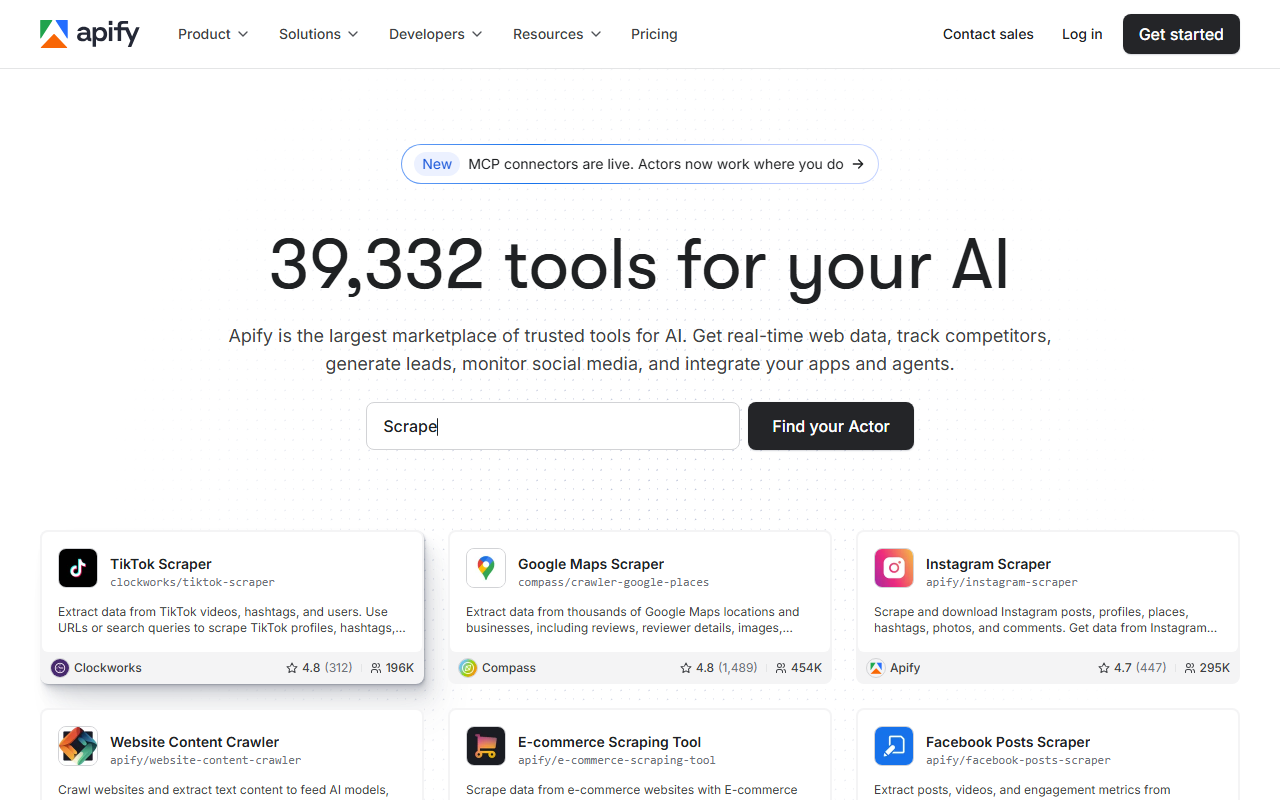
Apify is a marketplace of prebuilt scrapers (actors) rather than a single API, so for price scraping you run an existing ecommerce actor instead of building one. It is the fastest way to a working price scraper with no code to maintain.
Pricing
Per the Apify pricing page in mid-2026:
| Plan | Price | Included usage |
|---|---|---|
| Free | $0 (no card) | $5 platform usage/mo |
| Starter | $29/mo | $29 platform usage |
| Scale | $199/mo | $199 platform usage |
| Business | $999/mo | $999 platform usage |
Plans give you a dollar usage balance to spend in the Apify Store or on your own actors, and individual ecommerce actors charge their own per-result or per-event rates on top. The free plan is $5 of monthly usage with no credit card.
Standout features
The Apify Store lists tens of thousands of actors in mid-2026, including prebuilt Amazon, Walmart, eBay, and general ecommerce scrapers, plus scheduling and storage built in. For price scraping this means you can pick a maintained actor, set a schedule, and have a price feed running in minutes without writing selectors.
Where it falls short
Per-actor speed, success, and field coverage vary by author, so there is no single performance number to quote, and costs stack (platform usage plus the actor’s own rate). Read the specific actor’s pricing and reviews before you rely on it for a production price feed.
7. Zyte API
Zyte API prices per successful response and tiers cost by how hard the target site is to scrape, which makes it a flexible fit when your price targets range from simple catalog pages to heavily defended marketplaces.
Pricing
Per the Zyte pricing page in mid-2026, the model is per-request, tiered across five complexity levels from Simple to Advanced. Published examples at the $500/month commitment tier run from $0.06 per 1,000 HTTP responses up to $0.61, and browser-rendered requests from $0.48 up to $7.68 per 1,000. There is a $5 free credit with no commitment and 30 days to try it, and commitment tiers at pay-as-you-go, $100, $200, and $500 per month.
Standout features
Billing is success-only, and Zyte states no overage penalty: exceeding your commitment is charged at your current discounted rate, not a surcharge. It lists product and ecommerce extraction among its capabilities, with IP rotation across types and CAPTCHA handling built in. The complexity tiering means easy retail pages stay cheap and you only pay the high rate on the targets that need a full browser.
Best for
Teams with a mix of easy and hard price targets who want success-only billing and predictable scaling without overage fees. Zyte does not publish a specific success-rate percentage, so treat reliability as unverified at publish (approximate, compiled from vendor + public sources, not first-hand).
How to choose the right one
Choose by answering three questions: how many sites do you track, do you need parsed fields or raw HTML, and do you want requests, records, or actors. Your answers map cleanly onto the options above.
| If you… | Use | Why |
|---|---|---|
| Track many retail sites and want the lowest cost | ChocoData | One universal endpoint, structured JSON, from $19/mo |
| Need deep parsed fields per retail page type | Oxylabs | 70+ ecommerce targets, up to 129 fields per product page |
| Want bulk price datasets billed per record | Bright Data | 70+ ecommerce scrapers, pay per delivered record, 5,000 free/mo |
| Want a free tier plus structured retail endpoints | ScraperAPI | $0 free plan, Amazon and Google Shopping endpoints |
| Want a simple credit API with Amazon/Google endpoints | ScrapingBee | 1-credit base request, dedicated retail APIs on Business+ |
| Want a prebuilt scraper with zero code | Apify | Maintained ecommerce actors, scheduling built in |
| Have mixed easy and hard targets, success-only billing | Zyte API | Complexity-tiered pricing, no overage fees |
The honest default for most developers: if you track prices across several sites, start on ChocoData’s free tier and move to the $19 Vibe plan when you outgrow it. If you only track a couple of retail page types and want every parsed field, trial Oxylabs on its 2,000 free results. Either way, send a real browser context, keep request rates sane, and route through the API’s residential IPs rather than your own pool, which is the whole point of the category.
How we evaluated these
Every price and feature on this page comes from the vendor’s own pricing or product page in mid-2026, read directly and attributed inline, because review-site numbers go stale fast and pricing pages change often. The speed and success-rate figures are approximate, compiled from each vendor’s published numbers plus aggregated public sources, not bestscraperapi.com’s own first-hand tests; my independent, like-for-like benchmarks are still in progress, and the methodology lives at how we test. Pricing is current as of mid-2026 and may change, so confirm the current number on the vendor’s own pricing page before you commit, and check whether the plan bills by request, credit, or delivered record so you are comparing like with like.
FAQ
Price scraping is the automated collection of product prices, availability, and offer details from retail and marketplace sites, usually on a schedule so you can track changes over time. Most teams route it through a scraper API that handles rotating IPs, JavaScript rendering, and CAPTCHAs, because retail sites gate the price field behind sessions and block plain requests fast at volume.
Scraping publicly visible prices is generally treated as lower risk than scraping data behind a login, but it depends on your jurisdiction, the site's terms, and what you do with the data. Public price data is factual and widely collected for competitive monitoring. This is not legal advice; check the target site's terms and your local rules, and avoid logged-in or personal data.
It depends on volume and whether you need JavaScript rendering. Per-result pricing in mid-2026 ranges from about $0.40-$0.50 per 1,000 results without JS (Oxylabs ecommerce) to $1.50 per 1,000 delivered records (Bright Data). Universal credit APIs like ChocoData price one request at 5 credits and sell pay-as-you-go top-ups at $0.90 per 1,000 successful requests. Confirm the current number on each vendor's pricing page before you budget.
A generic scraper API returns the raw HTML and you write the selectors; a dedicated ecommerce endpoint returns parsed JSON fields (price, stock, title, reviews) per page type so you skip the parsing. If you track a few sites and want control, generic is fine and cheaper. If you track many retail page types and do not want to maintain selectors as layouts rotate, the parsed endpoints earn their cost.
Match the cadence to how fast the prices move and how much you can spend. Marketplace prices on fast-moving categories can change several times a day, so hourly or every-few-hours is common for competitive pricing; long-tail catalog data is fine daily or weekly. Since most APIs bill per successful request, your scrape frequency multiplied by your SKU count is what drives the bill, so start coarse and tighten where it pays off.