Best Email Scrapers (and the Legal Lines)
- An email scraper does one of two jobs: a finder queries a database of known business contacts (Hunter, Apollo, Snov.io), and a crawler pulls addresses off pages you point it at (ChocoData, ScrapingBee, the Apify Contact Details Scraper).
- Documented entry prices in mid-2026 run from free tiers (Hunter 50 credits/mo, Apollo free-forever) up to $299/mo (Hunter Scale). Finder tools bill per credit; crawlers bill per page or per request.
- ChocoData is my #1 pick for crawling contacts at scale: one universal endpoint plus 250+ dedicated endpoints, from $19/mo with a free 1,000 requests/mo and $0.90 per 1,000 successful pay-as-you-go.
- For a ready-made finder database, Hunter (100M+ public addresses, free 50/mo) and Apollo (free-forever tier) are the strongest starting points; Snov.io bundles a 7-tier verifier from $39/mo.
- Legal lines are real: scraping public pages is largely lawful in the US after hiQ v. LinkedIn, but sending the email is governed by CAN-SPAM (up to $53,088 per email) and GDPR (fines to 4% of global turnover).
An email scraper does one of two jobs, and conflating them wastes money. A finder queries a database of known business contacts and hands back a verified address; a crawler visits pages you point it at and extracts whatever addresses sit in the HTML. My #1 pick for the crawling job is ChocoData, and below I compare six tools across both jobs on the things that decide a purchase: starting price, free tier, standout features, and best fit. Then I cover the legal lines, because the address is the easy part and the send is where the fines live.
One disclosure up front: bestscraperapi.com earns affiliate commissions from some of the vendors listed here. That does not change which tools make the list, how I rank them, or what I write. Pricing comes straight from each vendor’s own page, and the ranking follows documented price and features.
TLDR comparison
All figures are from each vendor’s own pricing or product page in mid-2026, and pricing changes, so confirm the current number before you budget.
| Rank | Tool | Starting price | Free tier | Best for |
|---|---|---|---|---|
| 1 | ChocoData | $19/mo (Vibe) | 1,000 req/mo, no card | Crawling contacts off arbitrary sites at scale |
| 2 | Hunter | EUR 49/mo (Starter) | 50 credits/mo | B2B finder database for clean prospecting |
| 3 | Apollo | Free-forever, then per seat | Free-forever plan | Sales teams wanting data plus outreach in one |
| 4 | Snov.io | $39/mo (Starter) | Trial: 50 credits | SMB outbound with verification baked in |
| 5 | ScrapingBee | $49/mo (Freelance) | 1,000 credits | DIY crawls where you write the email regex |
| 6 | Apify Contact Details Scraper | $1.05/1,000 pages | $5 platform credit | One-off contact pulls from a known URL set |
A note on how these stack up: the finders (Hunter, Apollo, Snov.io) and the crawlers (ChocoData, ScrapingBee, Apify) solve different problems, so this is not a single ranked ladder. Within crawlers, ChocoData has the lowest documented entry price and earns the #1 slot on value. Within finders, Hunter and Apollo have the most generous free tiers. A second note on performance: any speed or success-rate figures below are approximate, compiled from vendor-published numbers plus aggregated public sources, and are not first-hand bestscraperapi.com tests. Independent benchmarks are pending; see how we test.
1. ChocoData
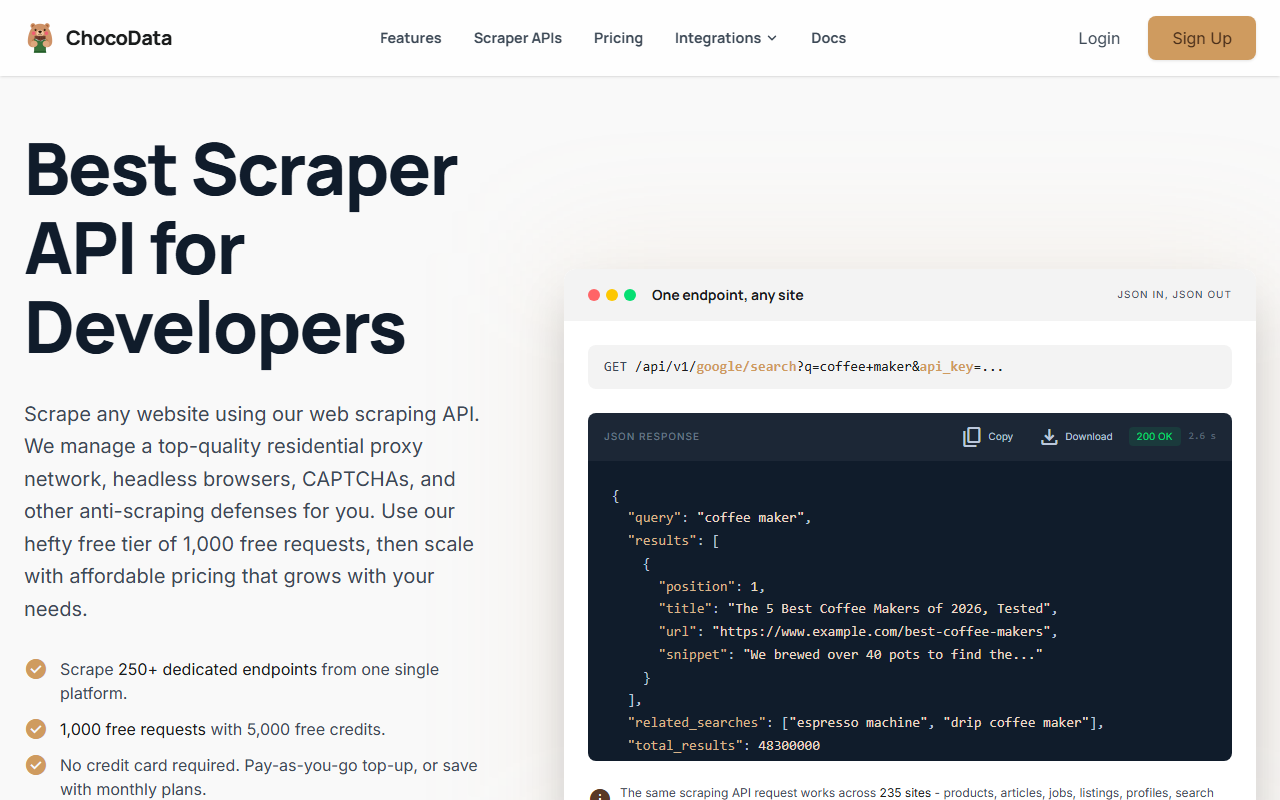
ChocoData is my #1 pick when you need addresses off sites a finder database does not cover, because it gives you one API to crawl anything plus structured parsers where they exist. Per ChocoData’s own pages in mid-2026, the platform exposes a universal endpoint where the same scraping API request works across 235 targets, alongside 250+ dedicated endpoints that return validated structured JSON. Every call follows the same /api/v1/{site}/{resource} shape, so you point it at a target and it handles residential proxy rotation, CAPTCHA clearing, and JavaScript rendering, then hands back clean JSON instead of a block page.
Pricing
Per ChocoData’s pricing page, mid-2026, the free tier gives 1,000 requests/month (5,000 credits) with no card and 10 concurrent threads. Vibe is $19/mo for 27,000 requests (30 threads), Pro is $49/mo for 82,000 requests (50 threads), and Custom runs $100 to $2,000/mo. One standard request is 5 credits; JavaScript rendering adds +10. Pay-as-you-go top-ups are $0.90 per 1,000 successful requests, and only 2xx responses are billed, so block pages do not cost you.
Standout features
The universal endpoint plus 250+ dedicated endpoints is the differentiator: you scrape unknown contact pages, directories, and listings through one consistent API, and where ChocoData already parses a site you get structured fields instead of raw HTML. On performance, ChocoData reports a median around 2.6 seconds end to end with p95 near 6 seconds (approximate, compiled from vendor plus public sources, not first-hand; independent benchmarks pending, see how we test).
Where it falls short
ChocoData is a general scraper API, not a purpose-built email database. It does not ship a “find this person’s address by name” lookup the way Hunter does. What you get is the raw crawling muscle to pull contact pages at scale, after which you parse and verify the addresses yourself. If your targets are well-known businesses you can name, a finder is the cleaner buy.
2. Hunter
Hunter is the cleanest standalone finder, and my top pick when your targets are businesses with a known name and domain. Per Hunter’s product pages, its Email Finder searches a database of over 100 million public email addresses, marks deliverable results with a green Verified shield, and returns a confidence score for the rest. Domain Search, Email Finder, Verifier, and an API are all available, including on the free plan.
Pricing
Per Hunter’s pricing page, mid-2026, the free plan includes 50 credits/month. Starter is EUR 49/mo (2,000 credits), Growth is EUR 149/mo (10,000 credits), and Scale is EUR 299/mo (25,000 credits), with roughly 30% off on annual billing. Verification credits are separate, billed at 0.5 credit per verified email. Hunter publishes prices in EUR, so convert before budgeting in USD.
Best for
Hunter fits clean B2B prospecting where you already know the company and want a scored, mostly verified address in one call. The free 50 credits/month is enough to trial the workflow, and the API on every tier means you can wire it into your own enrichment pipeline rather than working from the dashboard alone.
3. Apollo
Apollo bundles a large contact database with outreach, which suits sales teams that want data and sequences in one place rather than stitching a finder to a separate sender.
Pricing
Per Apollo’s pricing page, mid-2026, the headline draw is a free-forever Starter plan. Trial plans include 50 credits and 5 mobile credits, and non-paying accounts run under a Fair Use cap of roughly 10,000 credits/month. Paid tiers are priced per user per month and scale by credits and features; Apollo’s published table moves often, so check the current per-seat number on their page before you commit. Export credits are consumed when you push contacts outside Apollo, so model your export volume, not just the seat price.
Standout features
The pull is the all-in-one shape: a prospecting database, an email finder with verification, sequences, and CRM sync under one login. For a team already living in Apollo for outreach, sourcing addresses there avoids a second tool and a second bill.
Where it falls short
The credit model is where costs hide. Email and especially phone exports draw credits, and the Fair Use cap on free and lower tiers limits how far you can push before upgrading. If you only need addresses and not the outreach suite, a standalone finder like Hunter is simpler to reason about.
4. Snov.io
Snov.io is the SMB pick with verification built in, aimed at outbound teams that want finding, verifying, and sending in one subscription.
Pricing
Per Snov.io’s pricing page, mid-2026, the free Trial includes 50 credits and 100 recipients per 30-day renewal. Starter is $39/mo (1,000 credits, with 50% off the first month), and Pro tiers run $99 (5,000 credits), $189 (20,000), and $369 (50,000), with about 25% off on annual billing. All paid plans include the API and the verifier.
Standout features
The 7-tier email verifier, which Snov.io rates at 98%+ accuracy, is the reason to pick it over a bare finder: addresses come back already filtered for deliverability, which matters when you are paying per send and protecting domain reputation. Prospect, domain, and LinkedIn search are included across plans, so the finding side is covered too.
Best for
Snov.io fits a small team running its own cold outbound on a budget, where the verifier and the sender being in the same tool removes a hand-off. Higher Pro tiers scale recipients to 100,000/mo, so it grows with a list without forcing an enterprise contract.
5. ScrapingBee
ScrapingBee is the DIY crawler pick: a general scraping API you point at pages and parse yourself, which suits engineers who would rather write their own email-extraction logic than rent a contact database.
Pricing
Per ScrapingBee’s pricing page, mid-2026, the free trial gives 1,000 API credits with no card. Freelance is $49/mo (250,000 credits, 10 concurrent requests), Startup is $99/mo (1,000,000 credits, 50 concurrent), Business is $249/mo (3,000,000 credits, 100 concurrent), and Business+ is $599/mo (8,000,000 credits, 200 concurrent). JavaScript rendering and premium-proxy calls consume more credits per request.
Standout features
ScrapingBee ships JavaScript rendering in headless Chrome, rotating and premium proxies, geotargeting, and CSS/XPath extraction rules, so you can pull the page and select the fields in one call. ScrapingBee states a 99% success rate on standard requests (approximate, compiled from vendor plus public sources, not first-hand; independent benchmarks pending, see how we test). For writing your own extraction, pair it with the patterns in my web scraping guide.
Where it falls short
There is no email database and no built-in deliverability check. You supply the URLs, write the regex or selectors, and verify the matches yourself. That control is the point for a developer, and the wrong fit if you wanted a turnkey “give me this company’s contacts” lookup.
6. Apify Contact Details Scraper
The Apify Contact Details Scraper (the vdrmota/contact-info-scraper actor) is the pay-as-you-go option for one-off pulls from a known set of URLs, with no subscription to commit to.
Pricing
Per its Apify store page, mid-2026, the actor is priced at $1.05 per 1,000 scraped pages on a pay-per-event model. Apify’s platform free plan provides $5 of prepaid credits, enough for roughly 2,500 pages to trial it. Lead enrichment and social-profile enrichment carry extra charges, with discounts on higher subscription tiers.
Standout features
Point it at a list of URLs and it extracts emails, phone numbers, and social handles (LinkedIn, X, Instagram, Facebook, YouTube, TikTok, and more) from each page. The pay-per-page model means a small job costs cents, which is ideal when you have a fixed list of company pages and just want their contacts once.
Where it falls short
It returns raw matches with no deliverability check, so every address needs verifying before you send. And because it works from URLs you supply, it does not discover targets the way a finder database does; you bring the list, it harvests what is on the page.
Where are the legal lines on email scraping?
The legal lines split into two questions people wrongly merge: can you collect the address, and can you send to it. Collecting and sending are governed by different laws, and you can be clear on one while violating the other.
On collecting, US law is relatively permissive for public data. In hiQ Labs v. LinkedIn, the Ninth Circuit held in 2022 that automated capture of data from publicly accessible pages (ones that do not require an account) does not violate the Computer Fraud and Abuse Act’s “without authorization” clause. The practical caveat: hiQ still lost on other grounds, ultimately settling, paying damages, and agreeing to destroy the scraped data. So scraping public pages avoids CFAA liability, while breach-of-contract (a site’s terms) and other claims remain in play. For the fuller picture, see my web scraping guide and the scraping without getting blocked guide.
On personal data of EU residents, GDPR governs collection regardless of where you scrape from. Article 6 requires a lawful basis: usually either consent or legitimate interests, the latter applying except where overridden by the rights and freedoms of the data subject. Get it wrong and Article 83 sets fines up to EUR 20 million or 4% of total worldwide annual turnover for breaching basic principles, with a lower tier of EUR 10 million or 2%.
On sending, the rules tighten and vary by region:
| Regime | Who it covers | Core rule for cold email | Headline penalty |
|---|---|---|---|
| CAN-SPAM (US, FTC) | Commercial email to US recipients | Opt-out model: honor unsubscribes, no false headers, label as ad, include a physical postal address | Up to $53,088 per email |
| GDPR (EU) | Personal data of EU residents | Need a lawful basis to process the address at all | Up to 4% of global turnover |
| CNIL / ePrivacy (France, B2C) | Email to individuals | Prior consent (opt-in) required before sending | Per GDPR fine tiers |
| CNIL / ePrivacy (France, B2B) | Professional addresses | No prior consent needed, but the person must be able to object, and the message must relate to their job | Per GDPR fine tiers |
Two specifics worth pinning down. The CAN-SPAM maximum of $53,088 per violating email is the inflation-adjusted figure from the FTC’s own compliance guide (updated January 2024), and it applies per email, so a bad blast scales fast. And France’s CNIL draws a sharp B2C/B2B line: individuals must consent in advance, professional addresses can be emailed without prior consent provided the recipient can object and the pitch relates to their profession, and generic addresses (info@, contact@) need no consent at all. Other EU states apply the same ePrivacy logic with local variations, so check the destination country.
How to choose the right one
Match the tool to the job in front of you.
- You can name the companies and want clean, scored addresses. Use a finder. Hunter for a standalone database (free 50/mo, then EUR 49), Apollo if you want data and outreach together (free-forever tier), Snov.io for SMB outbound with verification baked in ($39 to start).
- You need addresses off sites no database covers. Use a crawler. ChocoData is my #1 pick at $19/mo with a free 1,000 requests and one universal endpoint; ScrapingBee fits when you want to write the extraction logic yourself ($49/mo).
- You have a fixed list of pages and want their contacts once. The Apify Contact Details Scraper at $1.05/1,000 pages avoids a subscription.
- You are running real cold outbound at volume. Whatever finds the address, budget your real effort for verification and for staying on the right side of CAN-SPAM and GDPR, because that is where an email program succeeds or gets fined.
None of this is legal advice; if you are scaling cold outreach, run your process past counsel.
How we evaluated these
I shortlisted tools by job (finder versus crawler), then pulled starting price, free tier, and headline features from each vendor’s own pricing or product page, attributed inline. Any speed or success-rate figures are approximate, compiled from vendor-published numbers plus aggregated public sources, and are not first-hand tests; my independent, like-for-like benchmarks are still in progress, with the methodology at how we test. All pricing is current as of mid-2026 and changes often, so confirm the live number before you buy.
FAQ
In the US, scraping addresses from public pages is largely lawful after hiQ v. LinkedIn, where the Ninth Circuit held that accessing publicly available data does not violate the CFAA. Collecting personal data on EU residents triggers GDPR, which needs a lawful basis. And sending the email is regulated separately by CAN-SPAM (US) and ePrivacy rules (EU), regardless of how you got the address.
A finder (Hunter, Apollo, Snov.io) queries a pre-built database of known business contacts by name or domain and returns a verified address with a confidence score. A crawler or scraper API (ChocoData, ScrapingBee, the Apify Contact Details Scraper) visits pages you choose and extracts whatever addresses are in the HTML. Finders are cleaner for B2B prospecting; crawlers cover arbitrary sites a database does not index.
Finder tools do. Hunter marks verified addresses with a green shield and gives a confidence score for the rest; Snov.io runs a 7-tier verifier it rates at 98%+ accuracy. Raw crawlers like the Apify Contact Details Scraper return whatever text matches an email pattern, so run those through a separate verifier before sending anything.
It depends on the job. Finder databases start free (Hunter 50 credits/mo, Apollo free-forever) and paid tiers run from roughly $39 to $299/mo by credit volume. Crawlers bill by page or request: ChocoData starts at $19/mo with a free 1,000 requests, the Apify Contact Details Scraper is $1.05 per 1,000 pages, and ScrapingBee starts at $49/mo. All figures are from each vendor's own pages in mid-2026 and change often.