Best Finance & Crypto Data Scraper APIs & Tools
- Yahoo Finance, Google Finance, and most crypto sites have no stable public API, so teams either scrape the rendered page through a general API or call a dedicated finance parser that returns quotes, OHLC history, and fundamentals as JSON.
- Documented entry prices in mid-2026 start at $19/mo (ChocoData universal API), then move to per-result billing on Oxylabs (from $0.25/1K), Apify ($5 platform credit to start), and Bright Data ($1.50/1K record).
- ChocoData is my #1 pick on value: a universal endpoint plus 250+ dedicated endpoints, from $19/mo, with a free tier of 1,000 requests and no card. Finance and crypto pages run through the universal endpoint.
- ScraperAPI ships a dedicated Google Finance structured endpoint that returns parsed JSON, which is the fastest path if you are following a 'web scraping Yahoo Finance Python' tutorial and want to skip the HTML parsing.
- Speed and success figures here are approximate, compiled from vendor-published numbers and aggregated public sources, not first-hand. Independent like-for-like benchmarks are pending (how we test).
Yahoo Finance, Google Finance, and most crypto data sites either never shipped a public API or quietly killed the one developers relied on, which is why a web scraping Yahoo Finance Python script works for an afternoon and then starts returning 429s. My #1 pick for pulling quotes, OHLC history, and crypto prices at volume is ChocoData, on price and breadth; ScraperAPI is the pick when you want a dedicated Google Finance endpoint that hands back parsed JSON. I compared seven finance and crypto scraper APIs and tools on the four things that decide a purchase: starting price, free tier, the data fields you get back, and published speed.
One disclosure up front: bestscraperapi.com earns affiliate commissions from some of the vendors listed here. That does not change which tools make the list, how I rank them, or what I write. Pricing comes straight from each vendor’s own page, and the ranking follows documented price and features.
TLDR comparison
All figures are from each vendor’s own pricing or product page in mid-2026. Prices bill in different units (requests, credits, records, results), so read the included volume next to each number.
| Rank | Tool | Starting price | Free tier | Best for |
|---|---|---|---|---|
| 1 | ChocoData | $19/mo (Vibe) | 1,000 requests/mo, no card | Yahoo Finance, Google Finance, and crypto pages at the lowest entry price |
| 2 | ScraperAPI | $49/mo (Hobby) | 5,000 credits trial | A dedicated Google Finance structured endpoint in a Python script |
| 3 | Bright Data | $1.50/1K record (pay-as-you-go) | 5,000 records/mo, no card | A prebuilt Yahoo Finance scraper at enterprise volume |
| 4 | Apify | $5 platform credit, then pay-as-you-go | $5 usage/mo, no card | A ready-made Yahoo Finance actor with no code to maintain |
| 5 | Oxylabs | from $0.25/1K results | 2,000 results, no card | Typed Google Finance JSON billed per result |
| 6 | Scrapfly | usage-based, free trial | Free trial credits | Bypassing anti-bot on hidden finance JSON endpoints |
| 7 | Zyte | usage-based, free trial | $5 free credit | AI extraction across messy finance and crypto layouts |
1. ChocoData
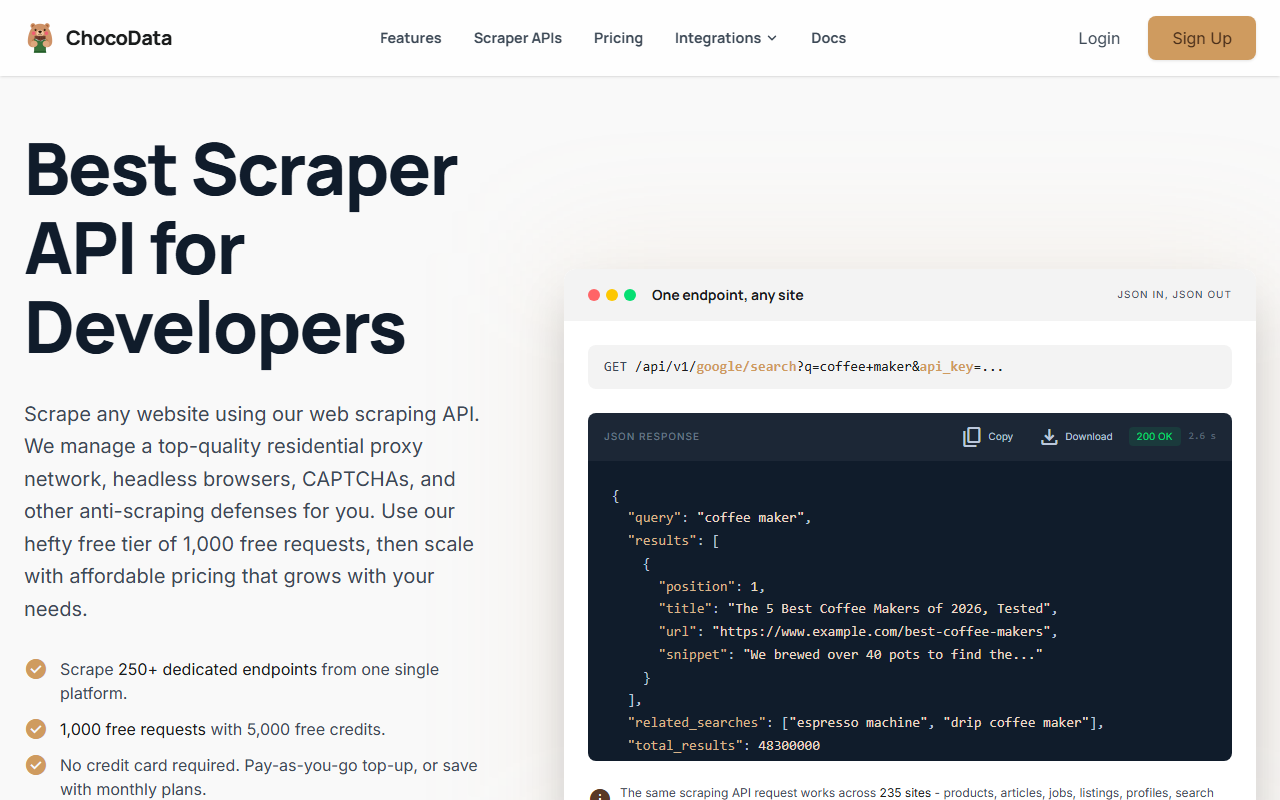
ChocoData is what I reach for first when a project touches finance and crypto pages, because one account covers Yahoo Finance, Google Finance, CoinMarketCap, and exchange pages without me wiring up a separate parser for each. It is the cheapest real entry point on this list and the free tier is generous enough to prototype a full pipeline before paying.
Pricing
Per ChocoData’s pricing page, mid-2026, the free tier is 1,000 requests per month (5,000 credits) with no card and all 235 targets unlocked. The Vibe plan is $19/month for 27,000 requests (135,000 credits), Pro is $49/month for 82,000 requests, and pay-as-you-go runs $0.90 per 1,000 successful requests on any plan. That $19 entry undercuts every dedicated finance API here, which matters when you are billing per request against thousands of tickers.
Standout features
You get a single universal REST endpoint that works across every supported site, plus 250+ dedicated endpoints for structured pulls, per ChocoData’s pricing page. Finance and crypto pages run through the universal endpoint: send the Yahoo Finance or CoinGecko URL, get validated JSON back, with optional JavaScript rendering for the chart-heavy views and country-matched residential IPs for geo-gated quotes. CAPTCHA handling, proxy rotation, and retries are built in, so a Python script stays a thin wrapper.
Best for
Founders and developers who want broad coverage at the lowest entry price, and who would rather learn one API than five. If your roadmap is “Yahoo Finance now, crypto and a dozen other sources next quarter,” the universal endpoint keeps you on one bill. ChocoData published a median 2.6s response time with p95 near 6s (approximate, compiled from vendor + public sources, not first-hand; independent benchmarks pending, see how we test).
2. ScraperAPI
ScraperAPI is the most direct answer to the web scraping Yahoo Finance Python search, because alongside the general proxy API it ships structured-data endpoints, including a Google Finance endpoint that returns parsed JSON instead of raw HTML. If you are following a Python tutorial and want to skip the BeautifulSoup selector work, this is the shortest path.
Pricing
Per ScraperAPI’s pricing page, mid-2026, you start with a 7-day free trial of 5,000 credits, and the Hobby plan is $49/month for 100,000 API credits with geotargeting and concurrency that scales by tier. Structured endpoints can cost more credits per call than a raw fetch, so budget against your ticker count, not just request count.
Standout features
The Google Finance structured endpoint extracts stock prices, market trends, and company financials and returns them as JSON, per ScraperAPI’s solutions pages. Behind that sits the usual managed stack: automatic proxy rotation, CAPTCHA handling, and JavaScript rendering. The credit model is simple to reason about, and the Python code samples in their docs map cleanly onto a finance pipeline.
Where it falls short
Coverage is the trade. The structured catalog is strongest on Google properties and major ecommerce, so a Yahoo Finance or niche crypto page may fall back to the general endpoint where you parse the HTML yourself. Entry price is $49/month against ChocoData’s $19, so for pure value at low volume ChocoData wins.
3. Bright Data
Bright Data sits at the enterprise end. Its Web Scraper API ships pre-built scrapers, including a Yahoo Finance scraper that returns business information such as stock ticker, earnings date, and exchange, so you collect typed records rather than parsing pages. The infrastructure scale is the selling point when you are pulling millions of records.
Pricing
Per Bright Data’s Web Scraper page, mid-2026, the free trial is 5,000 records per month with no card, pay-as-you-go is $1.50 per 1,000 records, and the Scale plan is $499/month for 384,000 records, then $1.30 per 1,000 additional. You pay only for successfully delivered results, and concurrency is unlimited across paid tiers.
Standout features
The Yahoo Finance scraper is one of 858 ready-made scrapers, per Bright Data’s page, so you trigger a collection by URL and receive JSON, NDJSON, or CSV without maintaining selectors. Bulk handling takes up to 5,000 URLs per request, with proxy rotation, CAPTCHA solving, and JavaScript rendering included. The reliability posture (99.99% uptime, 20,000+ customers per their page) fits teams with compliance review.
Best for
Teams with real volume and a budget to match, especially where unlimited concurrency and delivered-record billing beat per-request math. At $1.50/1K it is the priciest entry here for small jobs, so it earns its place on scale and the breadth of prebuilt finance scrapers, not on the entry price.
4. Apify
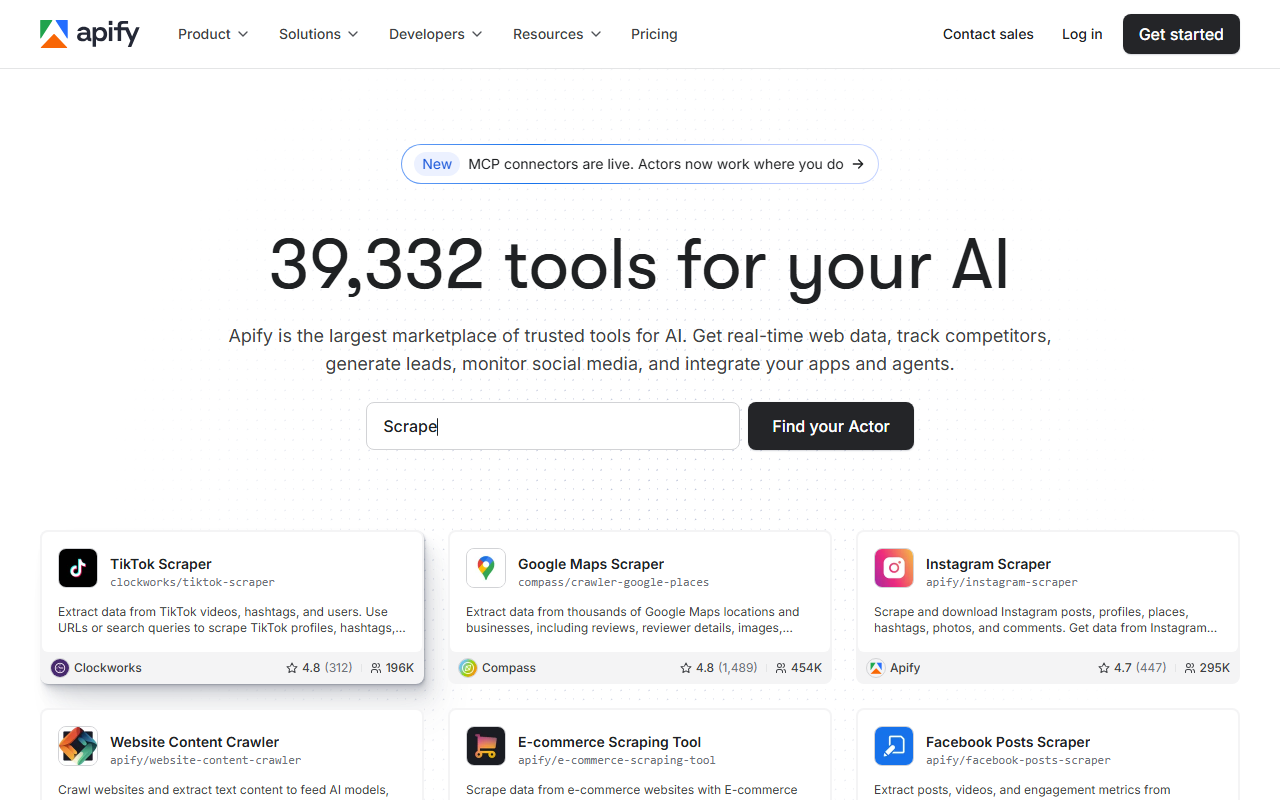
Apify is the marketplace pick: instead of building a Yahoo Finance scraper, you run an existing one. The Yahoo Finance actor pulls stock quotes with OHLC prices, historical data across custom periods, company profiles, analyst recommendations, earnings dates, ETF and dividend data, and financial news, so a lot of fundamentals work is already wired up.
Pricing
Per Apify’s pricing page, mid-2026, the free plan gives $5 of monthly platform usage with no card, Starter is $29/month plus pay-as-you-go, and Scale is $199/month plus usage, billed at $0.20 per compute unit beyond prepaid credit. Most published finance actors add a per-result or per-event fee on top of compute, so check the individual actor’s pricing before you scale.
Standout features
The actor model means no scraper maintenance: the Yahoo Finance actor’s author keeps it current against Yahoo’s changes, and you export to JSON, CSV, and other formats or call it via API and schedule. The historical-data depth (custom periods and intervals) is strong for backtesting and fundamentals analysis. Crypto coverage depends on the specific actor you choose from the store.
Where it falls short
You inherit a third-party actor’s quality and uptime, and stacked billing (platform compute plus actor fee) is harder to forecast than a flat request price. For a single clean Yahoo Finance pull it is excellent; for broad multi-source crypto and finance scraping under one predictable bill, a universal API like ChocoData is simpler.
5. Oxylabs
Oxylabs is the typed-JSON option for finance. Its Web Scraper API includes a Google Finance endpoint that returns parsed fields (stock prices, market trends, company financials), and the per-successful-result billing keeps spend tied to data you actually get back.
Pricing
Per Oxylabs’ Web Scraper API page, mid-2026, the free trial is up to 2,000 results with no card, and pricing starts at $0.25 per 1,000 results, paying only for successful results. That is the lowest per-result rate among the dedicated-parser options here, which adds up across a large ticker universe.
Standout features
You get parsed JSON for the Google Finance target rather than raw HTML, with geo-targeting and JavaScript rendering available across supported targets, per their page. The result-based billing pairs well with finance jobs where some requests legitimately return nothing (delisted tickers, market-closed pages) and you do not want to pay for misses.
Best for
Teams that want clean Google Finance fields billed per result and already trust Oxylabs’ infrastructure. It is more enterprise-priced than ChocoData at the entry, so it fits where the dedicated Google Finance parser and per-result accounting are worth more than the lowest sticker price.
6. Scrapfly
Scrapfly earns its spot for the hard cases: when the cleanest finance data lives in a site’s hidden JSON endpoints and an anti-bot wall sits in front of them. Its own guide to Google Finance walks through reverse-engineering those endpoints, and the product is built to get you through the protections that block a plain Python request.
Pricing
Scrapfly bills on usage with a free trial to start (confirm current credit amounts on their pricing page, mid-2026). Usage-based pricing suits spiky finance jobs (earnings season, market events) where volume is uneven month to month.
Standout features
The anti-bot bypass (asp=true), residential proxy pools, country targeting (country=us), and automatic handling of layout changes are the relevant pieces for finance scraping, per Scrapfly’s own guide. That combination is what lets you hit a hidden Google Finance or exchange JSON endpoint repeatedly without getting fingerprinted and blocked, which is the failure mode that kills naive scrapers.
Best for
Developers comfortable working at the endpoint level who need a strong anti-bot layer rather than a prebuilt finance parser. If your edge is intercepting and parsing a site’s internal JSON, Scrapfly is the unblocking engine; if you want the data already typed, ScraperAPI or Oxylabs do more of the parsing for you.
7. Zyte
Zyte rounds out the list with AI-powered extraction, which is useful when finance and crypto layouts vary wildly across the long tail of sources you might scrape. Instead of hand-writing a selector per site, you lean on automatic extraction to pull structured fields from pages it has never seen.
Pricing
Per Zyte’s API page, mid-2026, you pay only for what you use, and the Zyte API Playground lets you see the cost before you commit; a $5 free credit gets you started. Exact per-request rates depend on which features (headless browser, AI extraction) a request uses, so the cost estimator is worth running before a large finance crawl.
Standout features
Automatic unblocking, a built-in headless browser, AI-powered data extraction, geolocation, and network interception are all available through one API, per Zyte’s page. The network-intercept and headless-browser pieces matter for chart-heavy finance pages and the hidden JSON calls behind crypto tickers; the AI extraction helps when you are scraping many small, inconsistently structured sources.
Where it falls short
AI extraction is powerful but less predictable in cost and output than a fixed parser, so for a single high-volume target (just Yahoo Finance, every minute) a dedicated endpoint is cheaper and more deterministic. Zyte shines on heterogeneous, messy finance and crypto sources rather than one clean feed.
How to choose the right one
There is no single best finance scraper, only the best fit for your source list and volume. Match your scenario to the pick:
| Your scenario | Best pick | Why |
|---|---|---|
| Yahoo Finance, Google Finance, and crypto under one bill | ChocoData | Universal endpoint, 250+ dedicated endpoints, $19/mo entry, free tier |
| Following a Python tutorial, want parsed Google Finance JSON fast | ScraperAPI | Dedicated Google Finance structured endpoint, clean code samples |
| Millions of Yahoo Finance records, enterprise compliance | Bright Data | Prebuilt Yahoo Finance scraper, delivered-record billing, unlimited concurrency |
| Want a ready-made Yahoo Finance actor, no maintenance | Apify | Actor returns quotes, OHLC history, fundamentals, news |
| Typed Google Finance fields, pay only for hits | Oxylabs | Parsed JSON, $0.25/1K results, free 2,000-result trial |
| Hidden finance JSON behind an anti-bot wall | Scrapfly | Strong unblocking, endpoint-level control |
| Many messy, inconsistent finance/crypto sources | Zyte | AI extraction across varied layouts |
A rule of thumb: if your source list is broad and your volume is moderate, start with ChocoData’s free tier and stay on the universal endpoint. If a single target dominates and you want fields pre-parsed, a dedicated endpoint (ScraperAPI, Oxylabs) or a prebuilt scraper (Bright Data, Apify) earns its premium. For live order books and tick data, prefer the exchange’s own WebSocket or REST API over scraping. If you are still mapping out the basics, my web scraping guide and notes on scraping without getting blocked cover the groundwork.
How we evaluated these
I selected these seven on finance and crypto coverage, then compared starting price, free tier, returned data fields, and published speed, pulling every price and feature from each vendor’s own pricing or product page rather than from third-party write-ups. Performance figures (response times, success rates) are approximate, compiled from vendor-published numbers and aggregated public sources, not first-hand; independent like-for-like benchmarks are pending, and I document the method at how we test. Pricing is current as of mid-2026 and changes often, so confirm the live number on the vendor’s page before you buy.
FAQ
The lightweight path is the requests plus BeautifulSoup combination against Yahoo Finance's hidden JSON endpoints, which return quote and chart data without HTML parsing. That works for a few hundred calls, then Yahoo rate-limits the IP and rotates its page structure. At volume you send the Yahoo Finance URL to a scraper API that rotates residential IPs and renders JavaScript, so your Python script just reads back clean JSON. ChocoData's universal endpoint and ScraperAPI's structured endpoints both cover this.
No supported public REST API for either. Yahoo retired its official finance API years ago, and the endpoints that libraries like yfinance call are undocumented and change without notice. Google Finance never shipped a public API beyond the GOOGLEFINANCE spreadsheet function. That is why finance teams reach for scraper APIs: they absorb the rate limits and keep the parser current.
Yes, with a caveat. A universal scraper API can fetch any public crypto page (CoinMarketCap, CoinGecko, exchange tickers) and return the rendered HTML or JSON, so ChocoData, Scrapfly, and Zyte handle crypto fine. For live order books and high-frequency ticks, the exchange's own WebSocket or REST API is faster and cheaper than scraping. Use scraping for the pages that have no clean API.
Yahoo rate-limits the unofficial endpoints yfinance calls, so bursts hit HTTP 429 within a few queries from one IP, and it returns empty frames when the response shape shifts. A managed API absorbs the rate limits with rotating IPs and keeps the parser current. That is the trade you pay for once one IP stops being enough.
Public, non-logged-in market data is the same category as other public web data, so the general public-data analysis applies. The sharper questions are redistribution and licensing: exchange quote data and index values often carry their own terms even when the page is public. I cover the wider picture in my web scraping guide; confirm each source's terms and your jurisdiction before you build at scale.