Best Food Delivery Sites Scraper APIs & Tools
- ChocoData is my top value pick for restaurant data scraping through an API: one universal endpoint plus 250+ dedicated endpoints across 235 sites, from $19/mo with 1,000 free requests/mo and no card.
- The Apify Tripadvisor Scraper is the no-code leader for restaurant profiles, returning cuisine, price level, hours, menu dishes, and amenities from $2.00/1,000 results; its Yelp Scraper runs from $1.00/1k businesses.
- Documented entry pricing in mid-2026: Apify $2.00/1k Tripadvisor results, Bright Data $1.50/1k records, Oxylabs from $0.50/1k results, Scrapfly $30/mo, ScrapingBee $49/mo.
- No vendor here ships a turnkey DoorDash, Uber Eats, or Grubhub endpoint, so those targets go through a universal API plus your own parser; Yelp and Tripadvisor have the richest off-the-shelf restaurant coverage.
- Speed and success figures here are approximate, compiled from vendor-published numbers and aggregated public sources, not first-hand. Like-for-like benchmarks are pending (how we test).
Food delivery and restaurant platforms hold some of the most commercially useful data on the public web: live menus, item prices, delivery fees, ratings, and review streams that move daily. The practical question is which tool pulls that reliably at volume without you babysitting proxies and a headless browser. My top value pick is ChocoData for the API route, and the standout for no-code restaurant profiles is the Apify Tripadvisor Scraper; this page ranks both alongside Bright Data, Oxylabs, Scrapfly, and ScrapingBee on starting price, free tier, which restaurant data they return, and best fit. Every price and feature comes from the vendor’s own pricing or product page in mid-2026, attributed inline, because review-site numbers go stale fast.
One disclosure up front: bestscraperapi.com earns affiliate commissions from some of the vendors listed here. That does not change which tools make the list, how I rank them, or what I write. Pricing comes straight from each vendor’s own page, and the ranking follows documented price and features, not payout.
A note on the performance numbers further down. The speed and success-rate figures are approximate, compiled from each vendor’s published figures plus aggregated public sources. They are not bestscraperapi.com’s own first-hand tests. Vendors measure on their own targets under their own conditions, so the numbers are directional rather than apples to apples. My independent, like-for-like food delivery benchmarks are pending; see how we test for the methodology.
| Rank | Tool | Starting price | Free tier | Best for |
|---|---|---|---|---|
| 1 | ChocoData | $19/mo (Vibe) | 1,000 requests/mo, no card | One API for delivery pages plus every other source |
| 2 | Apify | $2.00/1k results (Tripadvisor) | $5/mo platform credit | No-code Yelp and Tripadvisor restaurant data |
| 3 | Bright Data | $1.50/1k records | 5,000 records/mo, no card | Pre-collected Yelp datasets and enterprise volume |
| 4 | Oxylabs | $49/mo (Micro), from $0.50/1k | 2,000 results, no card | One universal API pointed at arbitrary delivery URLs |
| 5 | Scrapfly | $30/mo (Discovery) | 1,000 credits, no card | Anti-bot bypass for location-gated delivery menus |
| 6 | ScrapingBee | $49/mo (Freelance) | 1,000 credits, no card | Simple universal API with JS rendering built in |
Pricing per each vendor’s pricing or product page, mid-2026. Per-result and per-credit rates assume the entry tier; most vendors drop the unit price on higher plans. Confirm the current number at the source before you budget.
1. ChocoData
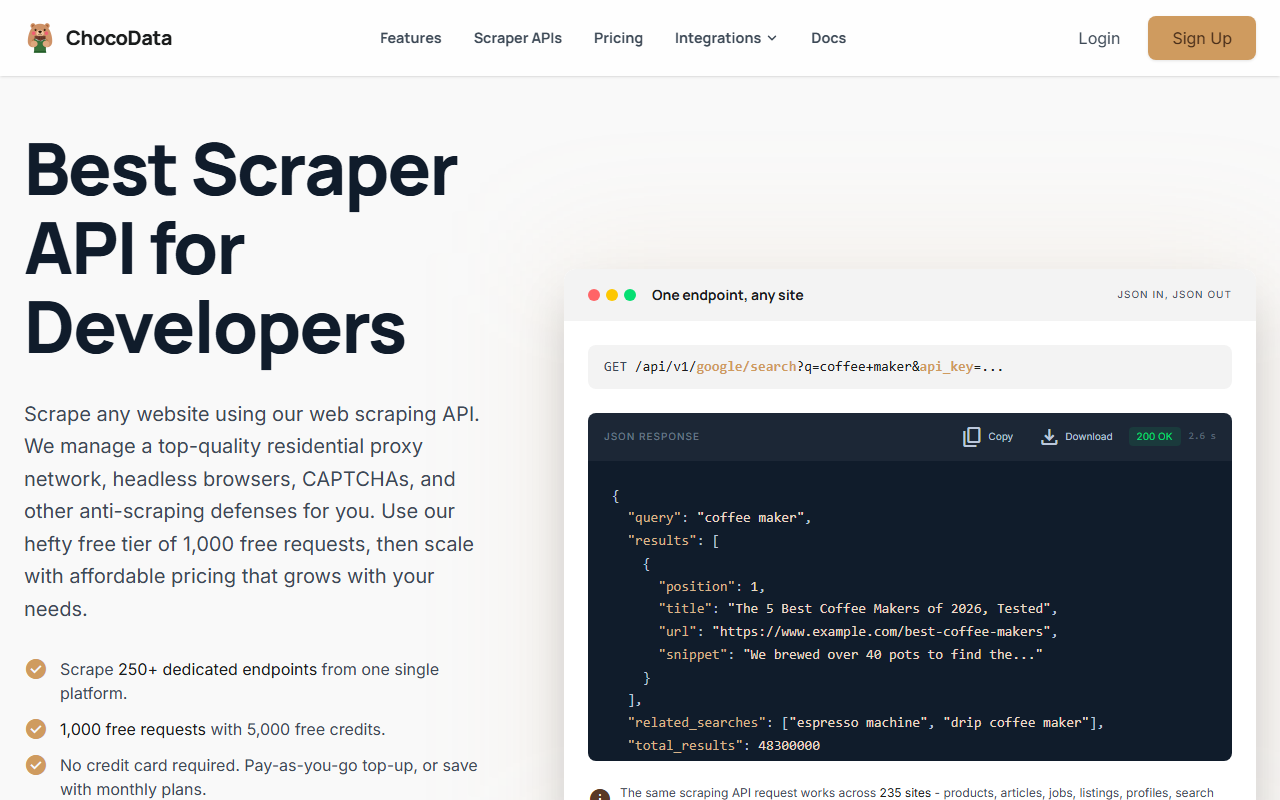
ChocoData is my top pick for restaurant and food delivery data through a real API, because it returns structured data at the lowest documented entry price in this list, and the same integration covers every other source you scrape. You point it at a delivery URL, restaurant listing, or review stream through one universal endpoint, so you are not stacking a separate single-purpose tool to do it.
Pricing
Per ChocoData’s pricing page in mid-2026, the Free plan gives 1,000 requests a month (5,000 credits) with no credit card, and paid plans start at $19/mo (Vibe) for 27,000 requests, then $49/mo (Pro) for 82,000. ChocoData bills 5 credits per request, adds 10 for JavaScript rendering and 10 for a screenshot, and charges only 2xx responses, so a delivery fetch that hits a CAPTCHA redirect does not count against you. Because delivery menus need rendering, budget 15 credits per rendered page rather than 5. Pay-as-you-go top-ups run $0.90 per 1,000 successful requests on any plan. For a workload that touches delivery apps plus e-commerce, search, maps, or social data, one $19/mo entry price for the whole surface beats stacking single-purpose tools.
Standout features
ChocoData exposes a single universal endpoint, /api/v1/{site}/{resource}, across 235 supported sites in 17 categories, plus 250+ dedicated endpoints that return validated structured JSON (per its site, mid-2026). Country-matched residential IPs handle the geo-gating that delivery menus rely on, and automatic JavaScript rendering loads the lazy-loaded menu, pricing, and availability that a raw HTTP request returns empty. One honest caveat: the published catalog does not list DoorDash, Uber Eats, Grubhub, or Deliveroo as named dedicated endpoints, so for those you use the universal endpoint and parse the menu JSON yourself.
Best for
Developers and founders who want delivery and restaurant data through a clean API at the lowest entry price ($19/mo), who can parse the menu JSON themselves on the universal endpoint, and who also scrape other sources through the 250+ dedicated endpoints. If a covered platform like Tripadvisor is your only target and you want zero scraper code with parsed cuisine, price-level, and menu fields, a dedicated actor fits better; for one integration across the whole web, ChocoData is the value pick. Try ChocoData.
2. Apify
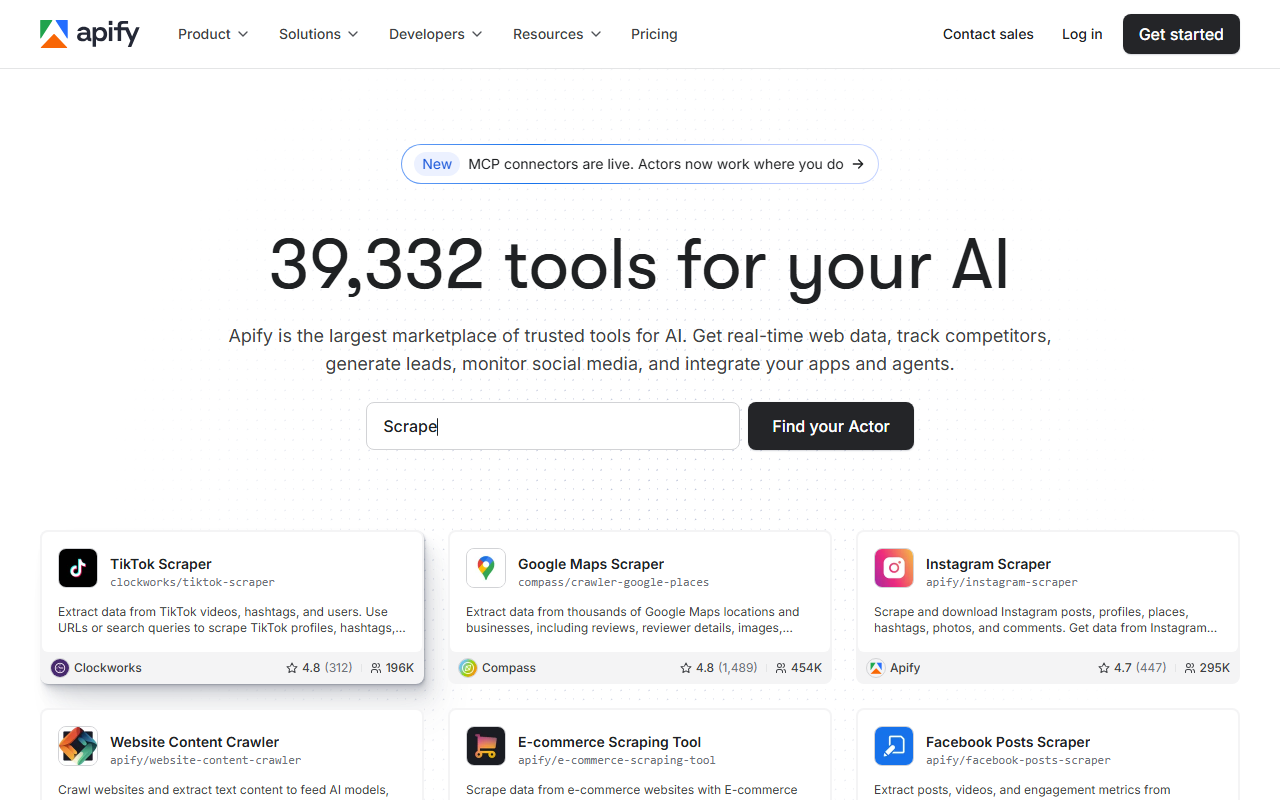
Apify is the no-code leader for restaurant data because its Store ships parsed actors for the platforms with the richest off-the-shelf coverage, Yelp and Tripadvisor, on a pay-per-result model where failed scrapes are not billed. You send a query or URL and get clean JSON with no scraper logic to write, which makes it the right pick for marketers, founders, and analysts rather than engineers.
Pricing
Per the Apify actor pages in mid-2026, the Tripadvisor Scraper costs from $2.00 per 1,000 results and the Yelp Scraper from $1.00 per 1,000 businesses, both on pay-per-result pricing, and the per-result price drops on higher subscription tiers. The platform Free plan includes $5 in monthly platform credit with no card (per Apify’s pricing page, mid-2026), with Starter at $29/mo, Scale at $199/mo, and Business at $999/mo. If recipe and menu content is your project rather than venue profiles, the Recipes Scraper rents for $12.00/mo plus usage (per its Store page, mid-2026).
Standout features
The Tripadvisor Scraper is the stronger restaurant pick: per its actor page in mid-2026 it returns name, address, cuisines, dishes, priceLevel, priceRange, hours, features (takeout, seating, wifi, wheelchair access), dietaryRestrictions, latitude/longitude, and review tags. That covers menu, pricing-band, and amenity fields a raw delivery scrape would make you parse by hand. The Yelp Scraper returns business name, address, phone, rating, and review text, averaging about 240 results per search. The Recipes Scraper pulls ingredients, instructions, prep/cook/total time, servings, and a nutrients object across 500+ recipe sites including Allrecipes and Food Network.
Best for
No-code users who want parsed Yelp or Tripadvisor restaurant data with zero scraper code and a small free credit to start. For the platform overall, see my Apify review. For DoorDash, Uber Eats, or Deliveroo, Apify’s Store hosts third-party delivery actors on the same pay-per-result model, but vet each one individually for maintenance and cost rather than assuming first-party support.
3. Bright Data
Bright Data suits teams that want pre-collected restaurant datasets or enterprise record volume rather than a build-it-yourself API. It leans on a large pre-built scraper library plus a dataset marketplace, so you can buy Yelp data outright or point a Universal source at arbitrary URLs.
Pricing
Per Bright Data’s Web Scraper API page in mid-2026, the product lists 858 pre-built scrapers, prices pay-as-you-go at $1.50 per 1,000 records, and includes a free tier of 5,000 records per month with no credit card. The Scale plan is $499/mo for 384,000 records plus $1.30 per 1,000 additional, and Enterprise is custom with volume discounts. Its dataset marketplace separately sells Yelp Businesses and Yelp Reviews datasets (business id, name, rating, review content, replies), so you can purchase pre-collected restaurant data instead of running a live scrape.
Standout features
The named scraper library skews to LinkedIn, Amazon, Airbnb, and Booking rather than delivery apps, but the Universal source fetches any URL with rendering, and the Yelp datasets give you parsed business and review fields without writing a scraper. Bright Data references 99.99% uptime in general infrastructure marketing and states you “pay only for what’s successfully delivered” rather than publishing an API-specific success-rate figure for delivery targets.
Best for
Teams that want bulk pre-collected Yelp data from the marketplace, or enterprise record volume through one provider. For DoorDash or Uber Eats menus, you are back on the Universal source plus your own parser, the same trade-off every universal API here carries.
4. Oxylabs
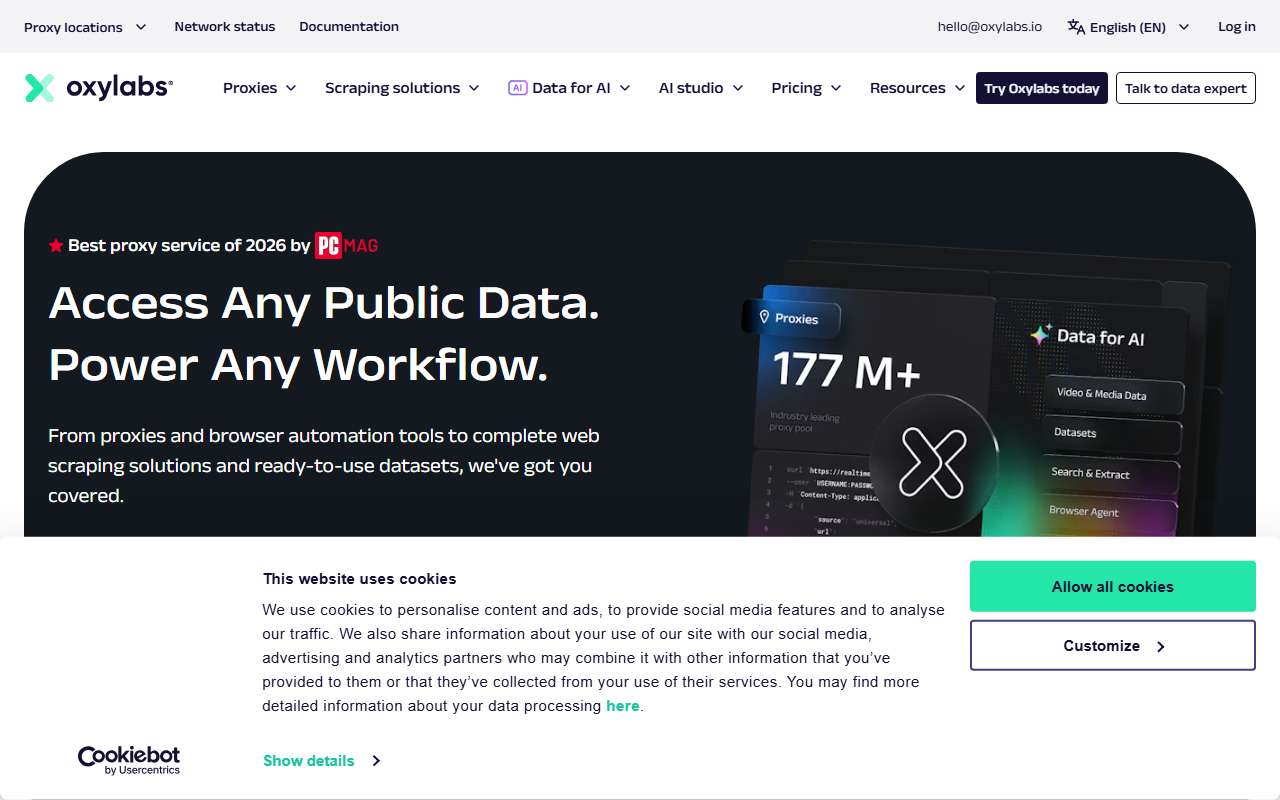
Oxylabs fits teams that want to point one universal API at arbitrary delivery and restaurant URLs they are willing to parse. The Web Scraper API exposes a Universal source for any public website, with JavaScript rendering and parsed or raw output, so location-gated delivery pages come back rendered.
Pricing
Per Oxylabs’ Web Scraper API pricing page in mid-2026, plans run Micro at $49/mo (up to 98,000 results, from $0.50/1k), Starter at $99/mo (up to 220,000 results, from $0.45/1k), and Advanced at $249/mo (up to 622,500 results, from $0.40/1k), with a free trial of up to 2,000 results and no credit card. The per-result rate varies by target and whether rendering is needed: the page lists “Other” targets at $1.15/1k without JS and $1.35/1k with JS on the Micro plan, which is the bracket delivery pages fall into.
Standout features
The Universal source handles any URL including delivery and restaurant pages, with a 50 requests/second rate limit on paid plans and parsed JSON or raw HTML output. Oxylabs publishes general reliability language (a 99.9% figure tied to its datacenter proxies) rather than a delivery-specific success-rate number. The trade-off versus a parsed Yelp or Tripadvisor actor: a universal call returns the page, so you own the parsing for menus and prices.
Best for
Teams comfortable parsing their own output who want broad URL coverage and per-result pricing that falls with volume. Less suited to non-engineers who want restaurant fields handed back ready to use.
5. Scrapfly
Scrapfly is the pick when the wall is anti-bot rather than parsing: location-gated delivery menus that hide behind aggressive protection. It is a universal scraping API with managed proxies and anti-bot bypass, so you point it at a delivery URL and it handles the block layer.
Pricing
Per Scrapfly’s pricing page in mid-2026, the Free tier gives 1,000 API credits on signup with no credit card, and paid plans run Discovery at $30/mo (200,000 credits), Pro at $100/mo (1,000,000 credits), Startup at $250/mo (2,500,000 credits), and Enterprise at $500/mo (5,500,000 credits). Credit cost per request depends on the features you enable: JavaScript rendering, anti-scraping protection (ASP), residential proxies, and country targeting each add to the per-call credit cost, so a rendered, geo-pinned delivery fetch costs more credits than a plain request.
Standout features
The Web Scraping API bundles managed proxies plus anti-bot bypass (ASP), JavaScript rendering, and country targeting, which is the combination location-gated delivery menus demand. An interactive cost estimator on the pricing page lets you model the credit cost of a rendered, geo-targeted call before you commit, useful when delivery pages need the full feature stack. Output is the page or rendered HTML, so you parse the menu fields yourself.
Best for
Developers scraping delivery platforms whose main obstacle is anti-bot detection and geo-gating, and who want one configurable API rather than parsed actors. Like the other universal APIs here, it returns the page, not pre-parsed restaurant fields.
6. ScrapingBee
ScrapingBee is the simplest universal API on this list: one endpoint, JavaScript rendering, and proxy handling, aimed at developers who want minimal setup over a deep feature matrix. You point it at a delivery or restaurant URL and parse the returned HTML.
Pricing
Per ScrapingBee’s pricing page in mid-2026, new users get 1,000 free API credits with no credit card, and paid plans run Freelance at $49/mo (250,000 credits, 10 concurrent), Startup at $99/mo (1,000,000 credits, 50 concurrent), Business at $249/mo (3,000,000 credits, 100 concurrent), and Business+ at $599/mo (8,000,000 credits, 200 concurrent). JavaScript rendering, premium proxies, and geotargeting are bundled from the Business plan up, which matters because delivery menus need rendering and often a geo-pinned IP, so price the Business tier rather than Freelance for these targets.
Standout features
The draw is simplicity: a single API call with optional JavaScript rendering and premium-proxy parameters, and concurrency that scales with the plan. For location-gated delivery pages you enable rendering and geotargeting, both available on the higher tiers. Output is raw or rendered HTML, so you own the menu and pricing parsing.
Best for
Developers who want a straightforward universal API with JS rendering and a clean integration, and who are fine parsing delivery output themselves. Budget the Business tier ($249/mo) if your targets need rendering plus geotargeting.
How do these tools compare on speed and success rate?
The honest answer is that nobody publishes like-for-like food delivery numbers, so treat the figures below as directional. The table compiles each vendor’s own published performance claims plus aggregated public sources. These are approximate, compiled from vendor-published figures and aggregated public sources, and are NOT bestscraperapi.com’s own first-hand tests. Vendors measure on different targets under different conditions, so the columns are not directly comparable.
| Tool | Published latency (approx.) | Success / reliability claim (approx.) | Source basis |
|---|---|---|---|
| ChocoData | Median 2.6s, p95 6s, p99 ~10s | Bills 2xx only; figures include proxy, CAPTCHA, retries, parsing | ChocoData site |
| Apify (Yelp / Tripadvisor) | Varies with result volume per search | Pay-per-result, so failed scrapes are not billed | Apify actor pages |
| Bright Data | Not published per target | 99.99% uptime referenced in general marketing | Bright Data page |
| Oxylabs | Not published per target | 99.9% figure tied to datacenter proxies, no delivery-specific % | Oxylabs page |
| Scrapfly | Not published per target | General anti-bot bypass language, no delivery-specific % | Scrapfly page |
| ScrapingBee | Not published per target | General reliability language, no delivery-specific % | ScrapingBee page |
Two caveats before you lean on these. First, delivery latency depends heavily on whether the request needs full JavaScript rendering and a geo-pinned proxy to load a location’s menu, so any single number hides a wide spread. Second, these are self-reported by each vendor on their own conditions. My independent, same-target food delivery benchmark across providers is pending at how we test; check back for measured numbers rather than trusting any vendor’s self-report, including the ones above.
How to choose the right one
Match the tool to your target rather than the headline price. The quick guide:
- You scrape delivery pages plus many other sources, and can parse JSON. ChocoData. One universal endpoint at the lowest documented entry price ($19/mo) covers delivery URLs and 235 other sites.
- You want parsed restaurant profiles with zero scraper code. Apify Tripadvisor Scraper for cuisine, price level, hours, menu dishes, and amenities; Apify Yelp Scraper for business and review fields.
- You want pre-collected Yelp data or enterprise volume. Bright Data’s dataset marketplace and 858-scraper library.
- You want one universal API pointed at arbitrary delivery URLs. Oxylabs Universal source, with per-result pricing that falls with volume.
- Your main wall is anti-bot detection and geo-gating. Scrapfly’s ASP plus managed residential proxies.
- You want the simplest possible universal API. ScrapingBee, one endpoint with JS rendering on the Business tier.
- You are building the extractor yourself. Pair any universal API with the DIY fundamentals: rotate IPs, render JavaScript, geo-pin the delivery address, and respect rate limits. My guides on scraping without getting blocked and the web scraping pillar guide cover that path.
For DoorDash, Uber Eats, or Grubhub specifically, no vendor here ships a turnkey parsed endpoint, so plan on a universal API plus your own parser, or a vetted community actor.
How we evaluated these
I ranked these tools on documented starting price, free-tier generosity, which restaurant and delivery data they return, and best-fit scenario, pulling every price and feature from each vendor’s own pricing or product page in mid-2026 and attributing it inline. The performance figures are approximate, compiled from vendor-published numbers and aggregated public sources, and are not first-hand; my independent like-for-like benchmarks are pending, with the methodology at how we test. Pricing is current as of mid-2026 and changes frequently, so confirm the number on the vendor’s own page and check whether a plan bills per result, per record, or per credit before you budget.
FAQ
None of the vendors here publishes a turnkey DoorDash or Uber Eats endpoint in mid-2026. The practical route is a universal scraper API (ChocoData's universal endpoint, Oxylabs' Universal source, or Scrapfly) pointed at the delivery URL, which handles proxies and JavaScript rendering while you parse the menu JSON yourself. Apify's Store also hosts third-party delivery actors, but vet each one individually for upkeep and per-result cost.
Scraping publicly visible restaurant data such as names, addresses, menus, and ratings sits in the same gray area as other public-web scraping; the bigger risks are each platform's terms of service and copying personal data from reviews. I cover the landscape in my is-web-scraping-legal guide. This is not legal advice; check your jurisdiction and the data you collect.
Delivery menus are location-gated and heavily JavaScript-rendered: prices, availability, and the menu itself change with the delivery address, and the pages lazy-load behind anti-bot checks. A plain HTTP request usually returns an empty shell, so you need JavaScript rendering and often a geo-pinned proxy for a usable result, which is why managed APIs charge a rendering premium on these pages.
A dedicated actor, like the Apify Tripadvisor or Yelp scraper, returns parsed restaurant fields out of the box and bills per result. A universal scraper API, like ChocoData, Oxylabs, or Scrapfly, hands back the page (or structured JSON on supported targets) and bills per request, so you point it at any delivery URL and parse the shape yourself. Use the first when a covered platform is your only target; use the second when delivery data is one source among many.