Best Free Web Scraping Tools
- A truly free web scraper comes in three shapes: open-source libraries that cost $0 forever (BeautifulSoup, Scrapy, Playwright), free no-code plans (Octoparse), and scraper-API free tiers you run without a card.
- My top free pick overall is ChocoData: 1,000 requests/mo with no card, a universal endpoint plus 250+ dedicated endpoints returning structured JSON, and a $19/mo step up when you outgrow it.
- Open-source libraries are unlimited and free forever. You run the proxies, the browser, and the anti-bot yourself. Free API tiers do that infrastructure for you and cap you on monthly volume instead.
- Free API allowances in mid-2026 range from 1,000 requests/credits (ChocoData, ScrapingBee) to a $5 usage balance (Apify) to a 5,000-credit 7-day trial (ScraperAPI). The unit differs by vendor, so read each table carefully.
- Performance figures here are approximate, compiled from vendor + public sources, not first-hand. My independent like-for-like benchmarks are in progress (how we test). Free tiers change often, so confirm at the source.
A free web scraper is any tool that pulls public web data at no cost, and there are three honest versions of it: open-source libraries you run yourself, free no-code plans, and the free tiers of managed scraper APIs. My top free pick overall is ChocoData, on the strength of a 1,000-request monthly tier with no card and structured JSON output, but the right free tool depends on whether you write code and how hard your target fights back. I compared seven options across all three categories on free allowance, documented limits, and what you actually get for $0.
One disclosure up front: bestscraperapi.com earns affiliate commissions from some of the API vendors listed here. That does not change which tools make the list or what I write. The open-source libraries pay me nothing, and they sit high on this list because for a lot of jobs they are the right free answer.
A second note on the performance numbers further down. The speed and success-rate figures are approximate, compiled from each vendor’s own published figures plus aggregated public sources, and they are not first-hand. Each vendor measures on its own targets under its own conditions, so treat every figure as directional. My independent, like-for-like benchmarks are still in progress; see how we test for the methodology, and confirm current limits at the source.
| Rank | Tool | Starting price | Free tier | Best for |
|---|---|---|---|---|
| 1 | ChocoData | $19/mo (Vibe) | 1,000 req/mo, no card | Structured JSON from named sites, no infra to run |
| 2 | BeautifulSoup | Free (MIT) | Unlimited, no card | Parsing HTML from small or static sites |
| 3 | Scrapy | Free (BSD) | Unlimited, no card | Large crawls and pipelines at scale |
| 4 | Playwright | Free (Apache 2.0) | Unlimited, no card | JavaScript-heavy, dynamic pages |
| 5 | Octoparse | $99/mo (Standard) | Free-forever no-code plan | Non-coders who need a visual scraper |
| 6 | ScrapingBee | $49/mo (Freelance) | 1,000 credits, no card | DIY crawls with rendering handled for you |
| 7 | Apify | $29/mo (Starter) | $5 usage/mo, no card | A prebuilt scraper for one named site |
1. ChocoData
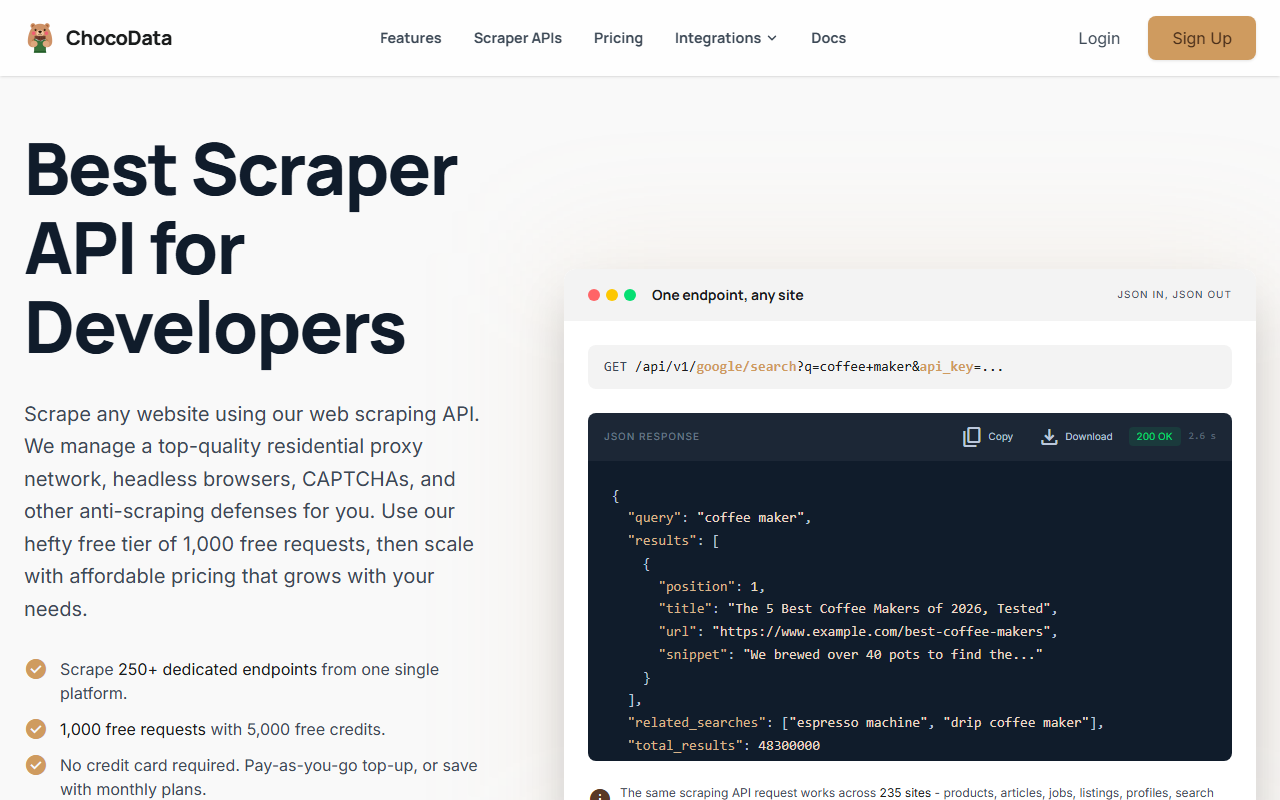
ChocoData is my top free pick because it gives you a real managed scraper API with no credit card, and it returns clean JSON instead of raw HTML you have to parse. The free plan covers 1,000 requests per month (5,000 credits) at 10 concurrent requests, per ChocoData’s pricing page, mid-2026. That is enough to build and test a real integration before you spend a cent.
Pricing
The free tier is 1,000 requests/mo (5,000 credits) with no card. When you outgrow it, Vibe is $19/mo for 27,000 requests and Pro is $49/mo for 82,000, with custom tiers running from $100 to $2,000/mo for 200,000 up to 4,000,000+ requests, per ChocoData’s pricing page, mid-2026. One request costs 5 credits, JS rendering and screenshots add 10 credits each, and pay-as-you-go top-ups are $0.90 per 1,000 successful requests, billing only 2xx responses.
Standout features
ChocoData exposes one universal endpoint shaped GET /api/v1/{site}/{resource} that covers any supported site, plus 250+ dedicated endpoints returning validated, parity-checked structured JSON, across 453 total endpoints and 235 sites, per ChocoData’s site, mid-2026. Residential proxy routing, anti-bot handling, automatic retries, and HTML parsing are included on every tier, free one included. So on the free plan you hit a generic URL or a purpose-built product or search endpoint and get clean JSON back.
Best for
Developers and founders who want proxies, browser rendering, and anti-bot handled, and who want structured JSON without a credit card. ChocoData’s homepage publishes a median latency of 2.6s (p95 6s, p99 ~10s) end to end across the 235 supported sites; it does not publish a headline success rate (approximate, compiled from vendor + public sources, not first-hand). The combination of a no-card free tier and structured output is why it leads this list. Try ChocoData.
2. BeautifulSoup
BeautifulSoup is the gentlest free entry point into scraping: a Python library that turns a page of HTML into navigable objects in a few lines. It is the right first tool when your target is static and does not fight back, and it stays free forever because it runs on your own machine.
Pricing
Free under the MIT license, with no quota and no card, forever. Your only cost is the compute it runs on, which for most jobs is your laptop. Pair it with Requests to fetch pages and you have a complete static-scraping stack at $0. See the BeautifulSoup guide for working code.
Standout features
BeautifulSoup parses messy, real-world HTML and lets you search by tag, class, CSS selector, or text. It does not fetch pages or run JavaScript on its own, so you bring Requests for fetching and a browser tool when a page renders client-side. For static product pages, articles, and directories, it is fast and forgiving.
Where it falls short
No JavaScript rendering, no proxy management, no anti-bot handling. The moment a site rate-limits you or serves content via JavaScript, you are writing that infrastructure yourself, which is the subject of a separate guide on scraping without getting blocked. At that point a managed free tier often costs less of your time.
3. Scrapy
Scrapy is the free workhorse for real crawls. Where BeautifulSoup parses one page, Scrapy is a full framework for crawling thousands, with concurrency, retries, throttling, and item pipelines built in. It is “free and BSD-licensed” per scrapy.org, mid-2026.
Pricing
Free under the BSD license, unlimited, no card. You run it on your own machine or a server you control, so the only cost is hosting if you schedule large crawls. That makes it the cheapest way to crawl at volume if you are comfortable in Python.
Standout features
An asynchronous engine crawls many pages at once with retries, throttling, and caching handled for you, per scrapy.org, mid-2026. Item pipelines clean and store data as it comes in, and middlewares let you slot in proxies or custom headers. It is built for structured, repeatable crawls rather than one-off page grabs. See the Scrapy guide to get started.
Where it falls short
Scrapy does not render JavaScript on its own; you add a plugin or a headless browser for dynamic sites. The learning curve is steeper than BeautifulSoup, and you still supply your own proxies and anti-bot strategy. For heavily defended targets, that operational load is real.
4. Playwright
Playwright is the free pick for JavaScript-heavy pages. It drives a real browser, so content that only appears after scripts run is content you can scrape. It is open source and free, automating Chromium, Firefox, and WebKit per playwright.dev, mid-2026.
Pricing
Free under the Apache 2.0 license, unlimited, no card. Installation is an npm or pip command away, with no payment at any point. As with the other libraries, your cost is the machine it runs on plus any proxies you choose to add.
Standout features
Playwright automates Chromium, Firefox, and WebKit in headless or headed mode across Linux, macOS, and Windows, per playwright.dev, mid-2026. Auto-waiting for elements, network interception, and screenshot capture make it strong for dynamic sites and single-page apps. When a page builds itself with JavaScript, Playwright renders it the way a user’s browser would. See the Python scraping guide for examples.
Where it falls short
Running a real browser is heavier than parsing HTML, so Playwright uses more CPU and memory and runs slower per page than Requests plus BeautifulSoup. You still manage proxies and anti-bot yourself, and scaling many concurrent browsers gets resource-hungry fast. For high-volume rendered scraping, a managed free tier may be the lighter path.
5. Octoparse
Octoparse is the strongest free no-code option for people who do not write Python. You point and click to select the data you want and it builds the extraction rules visually, with no card required to start. This is the right free pick for an analyst or marketer who needs structured data without code.
Pricing
The Free plan is $0 with no card: it covers 10 tasks, exports up to 50,000 rows per month, runs locally on your own machine, and keeps the last few runs of history, per Octoparse’s pricing page, mid-2026. Paid tiers add cloud extraction and scheduling, with Standard at roughly $99/mo and Professional higher; confirm the current rate on the pricing page, because Octoparse lists annual-billed and monthly rates differently and changes them.
Standout features
A visual point-and-click builder, prebuilt templates for common sites, and export to Excel, CSV, or JSON cover most non-coder needs on the free plan. Cloud extraction, IP rotation, CAPTCHA solving, and scheduling start on the paid Standard tier, per Octoparse’s pricing page, mid-2026. The template library is a fast way to scrape a popular site without building a task from scratch.
Where it falls short
The free plan runs extractions locally, not in the cloud, so your machine has to stay on for long jobs, and IP rotation and scheduling are paid-only. Row and task caps mean it suits learning and small one-off jobs rather than production pipelines. Heavily defended sites will still need the paid anti-bot features.
6. ScrapingBee
ScrapingBee is a clean managed API with a no-card free trial, aimed at developers who want rendering and proxies handled but are happy to parse the result themselves. It is a solid free tier to evaluate when you write code and want infrastructure off your plate.
Pricing
The free trial gives 1,000 API credits with no card required, per ScrapingBee’s pricing page, mid-2026. The cheapest paid plan is Freelance at $49/mo for 250,000 credits at 10 concurrent requests. Credits are consumed per call, and turning on JavaScript rendering or premium proxies costs more credits per request, so a free allowance stretches further on simple fetches than on rendered ones.
Standout features
Headless Chrome rendering, rotating and premium proxies, geotargeting, and CSS/XPath extraction rules are the core, per ScrapingBee’s pricing page, mid-2026. You can return rendered HTML or extract specific fields, which keeps simple jobs simple. ScrapingBee publishes a 99% success rate and a 2.5s median latency on its Amazon API (approximate, compiled from vendor + public sources, not first-hand).
Where it falls short
The free credit pool is a trial allowance rather than a clearly advertised recurring monthly tier, so confirm renewal terms before you build on it. Credits drain faster once rendering is on, and there is no structured-JSON endpoint model like ChocoData’s, so you still write the parsing for arbitrary sites.
7. Apify
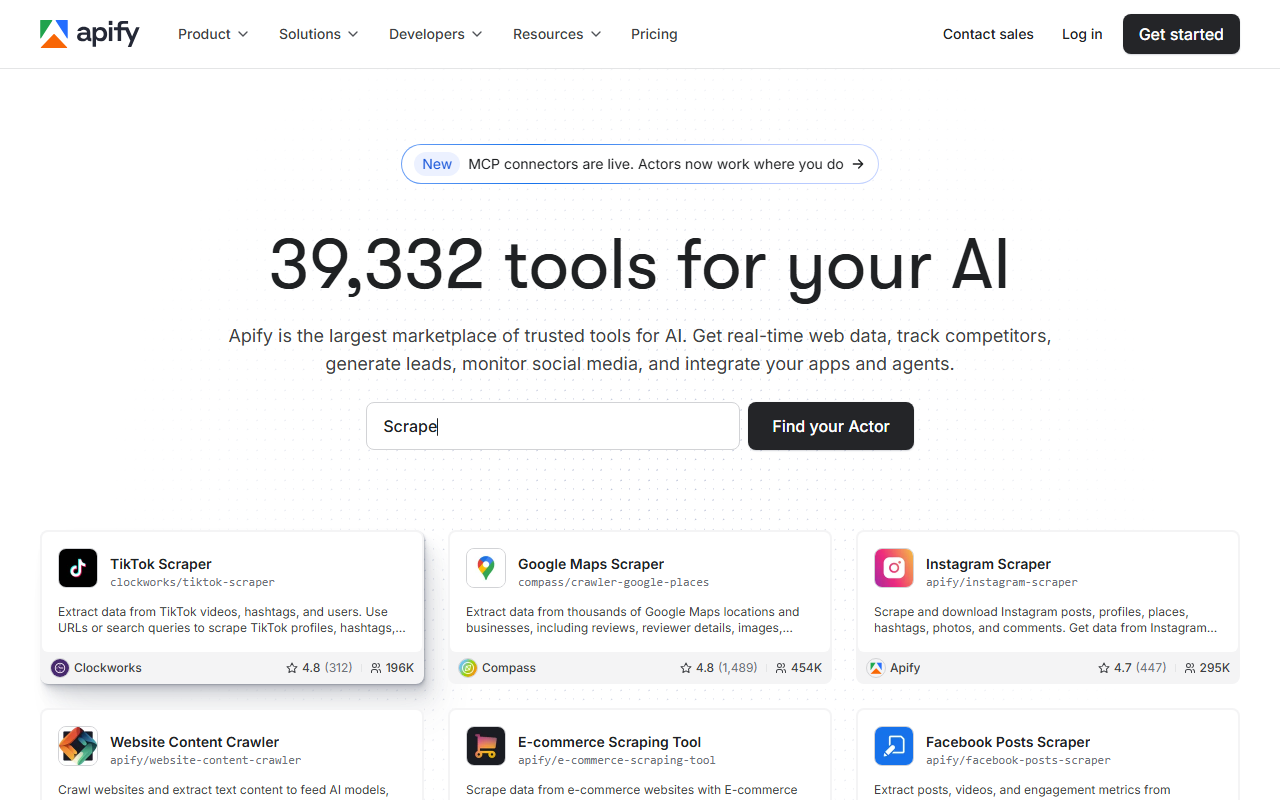
Apify is the best free option when you want a prebuilt scraper for one specific site rather than to build your own. Its store hosts thousands of ready-made Actors, and the free plan gives you a small monthly budget to run them with no card.
Pricing
The Free plan gives $5 of monthly platform usage to spend in the Apify Store or on your own Actors, with no credit card required, per Apify’s pricing page, mid-2026. The cheapest paid plan is Starter at $29/mo plus pay-as-you-go. Note that unused usage does not roll over and expires at the end of each billing cycle.
Standout features
A marketplace of prebuilt Actors covers many popular sites, so you can run a maintained scraper instead of writing one, per Apify’s pricing page, mid-2026. Proxy access (limited to platform use on the free plan), scheduling, and integrations are built in. For a named target with an existing Actor, this is the fastest path from zero to data.
Where it falls short
Performance and reliability vary by Actor, since each is a separate scraper, so there is no single success or latency number to quote. The $5 free budget is modest and burns quickly on heavier Actors, and costs depend on the specific Actor’s pricing model. For a custom target with no Actor, you are back to building.
How to choose the right one
Choose by answering two questions: do you write code, and how hard do your targets fight back. Your answers map cleanly onto the seven tools above, so you rarely need to try them all.
| If you… | Use | Why |
|---|---|---|
| Write Python and scrape simple or static sites | BeautifulSoup or Scrapy | Free forever, full control, no quota |
| Need JS-rendered pages and code yourself | Playwright | Real browser renders dynamic content locally, free |
| Do not write code | Octoparse free plan | Visual point-and-click, 50,000 rows/mo free |
| Need proxies and anti-bot handled, and want JSON | ChocoData free tier | 1,000 requests/mo, no card, structured JSON from named sites |
| Want rendering handled but will parse yourself | ScrapingBee trial | 1,000 credits, no card, headless Chrome |
| Want a prebuilt scraper for one named site | Apify free tier | $5/mo usage against marketplace Actors |
The honest default for most developers: start with a free library, and move to a scraper-API free tier at the exact point where you spend more time fighting blocks than parsing data. If you write code and your targets are not heavily defended, BeautifulSoup or Scrapy will carry you a long way at $0. If you need proxies and anti-bot handled and want structured JSON without a credit card, ChocoData’s free tier is where I would start. For the fundamentals first, read the web scraping pillar guide.
How we evaluated these
I compared each tool on its documented free allowance, whether a card is required, what the free tier actually includes, and the price of the first paid step, pulling pricing and features from each vendor’s own pricing or product page. Performance figures are approximate, compiled from vendor-published numbers plus aggregated public sources, and are not first-hand; my independent, like-for-like benchmarks are still in progress, with methodology at how we test. Every price and limit on this page is current as of mid-2026 and free tiers change often, so confirm the current allowance on the vendor’s own page, and check whether a free tier renews monthly or expires as a trial, before you commit.
FAQ
For static or small sites, yes. BeautifulSoup plus Requests parses millions of pages a month at zero cost as long as the target does not block you, and Scrapy crawls at scale for free. The free path breaks down when a site uses heavy JavaScript, rate limits, or anti-bot walls, because then you spend your hours fighting blocks. A scraper-API free tier removes that work and caps you on monthly volume instead.
All three open-source libraries (BeautifulSoup, Scrapy, Playwright) need no card because they run on your own machine. Among managed APIs in mid-2026, ChocoData (1,000 requests/mo), ScrapingBee (1,000 credits), and Apify ($5 usage) all advertise no-card free tiers on their own pages. Octoparse has a free-forever no-code plan with no card.
It depends on the vendor. ChocoData and Apify document recurring monthly free allowances (1,000 requests and $5 usage respectively) rather than one-off trials. ScraperAPI advertises a 7-day trial with 5,000 credits, which is time-limited. Read each pricing page for whether the free tier renews monthly or expires, because vendors word this differently and change it often.