Best Glassdoor Scraper APIs & Tools
- Scraping Glassdoor splits two ways: dedicated actors that return parsed jobs, salaries, company ratings and reviews (Apify and Bright Data lead here), and universal scraper APIs you point at any Glassdoor URL (ChocoData, Oxylabs, Scrapfly, ScraperAPI).
- Documented entry points in mid-2026: Apify Glassdoor Jobs Scraper at $25/mo plus usage, Bright Data per delivered record from $1.50/1k, free tiers at $0 (ChocoData, Bright Data, Scrapfly, ScraperAPI, Oxylabs trial), paid from $19/mo (ChocoData).
- ChocoData is my top value pick for the API route: one universal endpoint plus 453 dedicated endpoints across 235 sites, from $19/mo with 1,000 free requests/mo and no card.
- Apify is the pick for no-code Glassdoor jobs and company data; Bright Data for parsed datasets billed per record. Both need rotating residential IPs to clear Glassdoor's Cloudflare wall, which every tool here bundles.
- Speed and success figures below are approximate, compiled from vendor-published numbers and public reports, not bestscraperapi.com's own tests. Like-for-like benchmarks are in progress (how we test).
Glassdoor holds the data founders, recruiters, and market researchers keep asking for: job listings, salary ranges, company ratings, and employee reviews by employer and location. The practical question is which tool pulls that reliably without you babysitting Cloudflare challenges and login walls. This page compares the Glassdoor scraper APIs and actors I would actually shortlist in 2026, ranked on what decides a purchase: starting price, free tier, which Glassdoor data they return, and best fit. My top pick for most teams is ChocoData, on price and the breadth of one universal endpoint. Every price and feature comes from each vendor’s own pricing or product page in mid-2026, attributed inline, because review-site numbers go stale and pricing pages move.
One disclosure up front: bestscraperapi.com earns affiliate commissions from some of the vendors listed here. That does not change which tools make the list, how I rank them, or what I write. The pricing comes straight from each vendor’s own page, and the ranking follows documented price and features.
A second note on the performance numbers further down. The speed and success-rate figures are approximate, compiled from each vendor’s own published figures plus aggregated public reports. They are not bestscraperapi.com’s own first-hand tests. Vendors measure on their own targets under their own conditions, so the numbers are directional rather than apples to apples. My independent, like-for-like Glassdoor benchmarks are in progress; see how we test for the methodology.
| Rank | Tool | Starting price | Free tier | Best for |
|---|---|---|---|---|
| 1 | ChocoData | $19/mo (Vibe) | 1,000 requests/mo, no card | One API for Glassdoor plus every other source |
| 2 | Apify | $25/mo + usage (Glassdoor Jobs Scraper) | “Try for free” credit | No-code Glassdoor jobs, salaries, and company data |
| 3 | Bright Data | $1.50/1k records (PAYG) | 5,000 records/mo, no card | Parsed Glassdoor datasets billed per record |
| 4 | Oxylabs | from $0.25/1k results | 2,000 results trial, no card | Teams already on an Oxylabs stack |
| 5 | Scrapfly | $30/mo (Discovery) | 1,000 credits, no card | Clearing Glassdoor’s Cloudflare wall at scale |
| 6 | ScraperAPI | $0 Free tier (paid on a slider) | 5,000 credits for 7 days | A familiar credit-based general API |
Pricing per each vendor’s pricing or product page, mid-2026. The tools bill in different units, so the starting prices are not directly comparable on volume: ChocoData and ScraperAPI sell requests or credits, Apify rents an actor plus usage, Bright Data charges per delivered record, Oxylabs charges per result, and Scrapfly sells credits whose cost varies by the features you enable. Read the included volume next to each price before you budget.
1. ChocoData
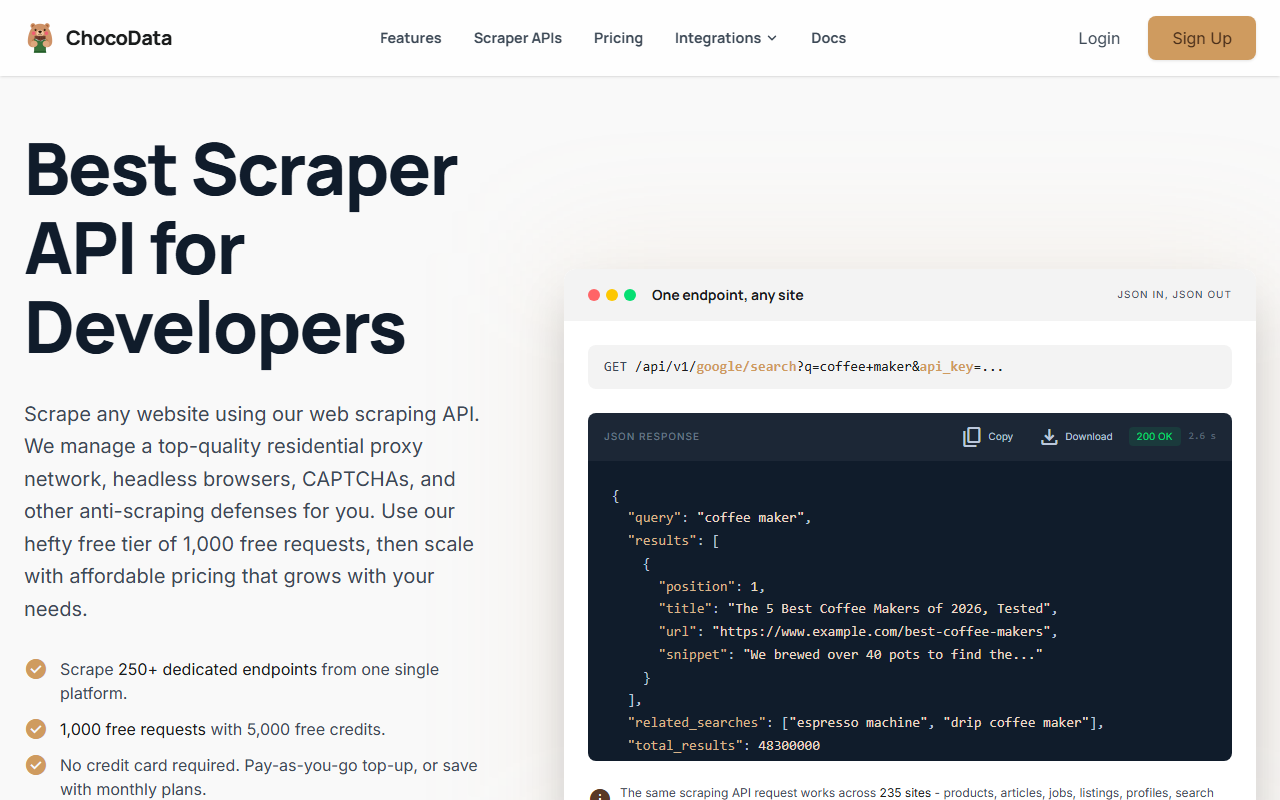
ChocoData is my top value pick for scraping Glassdoor through a real API rather than a no-code actor, because it exposes one universal endpoint plus 453 dedicated endpoints and publishes the lowest paid entry price in this list. You point the universal endpoint at any Glassdoor listing, salary, or company URL and get the page back with residential IPs and JavaScript rendering handled for you, so you scrape Glassdoor alongside every other source through the same integration instead of bolting on a separate Glassdoor-only tool.
Pricing
Per ChocoData’s pricing page in mid-2026, the Free plan is $0 for 1,000 requests/mo (5,000 credits) with 10 concurrent requests and no credit card. Paid starts at $19/mo (Vibe) for 27,000 requests with 30 concurrency, then $49/mo (Pro) for 82,000 requests, with Custom plans from $100 to $2,000/mo. Pay-as-you-go top-ups run $0.90 per 1,000 successful requests on any plan, and ChocoData bills only 2xx responses, so blocked Glassdoor fetches do not burn your quota.
Standout features
ChocoData runs a single REST pattern across 235 supported sites, with 250+ of its endpoints returning validated structured JSON, per its site in mid-2026. It handles residential proxy rotation, CAPTCHA clearing, headless-browser detection, and JavaScript rendering, which is exactly the stack Glassdoor’s Cloudflare wall demands. One caveat worth stating plainly: ChocoData does not list a Glassdoor-specific dedicated endpoint on its site in mid-2026, so for Glassdoor you would use the universal route and parse the fields you need; confirm the current target list in its docs.
Best for
Teams whose Glassdoor workload also touches job boards, search, or company data elsewhere. Paying one $19/mo entry price for the whole surface beats stacking single-purpose tools, and the free 1,000 requests/mo let you validate Glassdoor parsing before you spend. A universal request looks like this (illustrative, not a tested run):
curl "https://api.chocodata.com/api/v1/universal?url=https://www.glassdoor.com/Reviews/example.htm&api_key=YOUR_KEY"Confirm the exact path, parameters, and which targets are exposed in ChocoData’s own docs before you build against it. Try ChocoData.
2. Apify
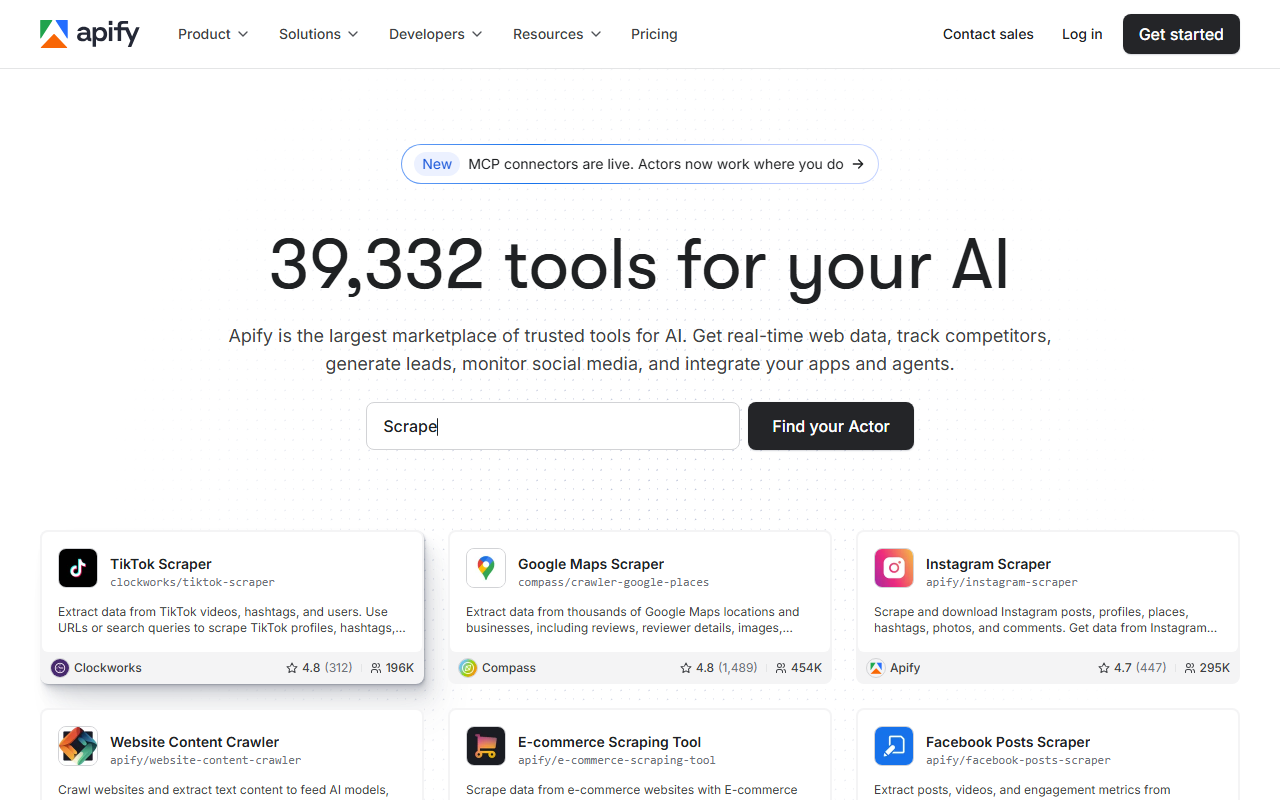
Apify is the pick for no-code Glassdoor data because its store hosts dedicated Glassdoor actors that return parsed jobs, salaries, and company profiles without you writing a line of scraper logic. You feed an actor a search or a Glassdoor URL, set a result limit, and get JSON back, with proxies and rendering handled inside the platform.
Pricing
Apify bills a platform subscription plus usage. Per its pricing page in mid-2026, the Free plan gives $5/mo of platform credit with no card, then Starter is $29/mo, Scale $199/mo, and Business $999/mo, each including matching credit to spend in the store or on your own actors. On top of that, individual actors can carry a rental fee: the bebity Glassdoor Jobs Scraper lists $25/mo plus usage with a “Try for free” option, per its actor page in mid-2026. Budget both the subscription and the per-actor charge.
Standout features
The Glassdoor Jobs Scraper returns a deep field set, over 570 fields per its page, including job title, description, posted date, job types, location, salary (currency, pay period, min and max), and company information such as size, revenue, headquarters, founding date, and industry. You get API access via JavaScript, Python, and CLI, plus REST and an MCP server. For jobs plus company context in one run, it is the fastest path from query to clean records.
Best for
Recruiters, founders, and analysts who want Glassdoor jobs and company data with zero scraper code and a low entry fee to test. For a fuller look at the platform, see my Apify review.
3. Bright Data
Bright Data is the pick when you need consistent parsed Glassdoor fields delivered in bulk, because it ships dedicated Glassdoor scrapers and datasets rather than a generic fetch. You target companies, jobs, or reviews and get structured records, billed only for what is successfully delivered.
Pricing
Per Bright Data’s Web Scraper pricing in mid-2026, the model is pay-per-record: a Free tier gives 5,000 records/mo with no card, pay-as-you-go runs $1.50 per 1,000 records, and the Scale plan is $499/mo for 384,000 records with $1.30 per 1,000 extra. There is no charge for failed deliveries, and concurrency is unlimited across tiers. Confirm the exact Glassdoor dataset on its site, since dataset coverage and per-record pricing can differ by collector.
Standout features
Bright Data’s infrastructure page cites a 99.99% uptime figure and access to 400M+ residential IPs across 195 countries, which is the kind of pool Glassdoor’s anti-bot defenses force you onto. Its scrapers return parsed fields per object rather than raw HTML, and you can choose by-URL or by-discovery collection where a collector supports it. It does not publish a per-request success rate on this page.
Best for
Review mining, salary benchmarking, or building a company dataset rather than one-off lookups. The per-record model fits projects where you care about clean, delivered rows. For a fuller breakdown, see my Bright Data review.
4. Oxylabs
Oxylabs exposes a Web Scraper API with a “Universal Source” for URLs not on its prebuilt list, which is the route for Glassdoor since Glassdoor is not among its named targets. It suits teams that want one API across many sites and may already run other Oxylabs products.
Pricing
Per Oxylabs’ Web Scraper API page in mid-2026, pricing starts from $0.25 per 1,000 results on a pay-only-for-successful-results basis, with a free trial of up to 2,000 results and no credit card. If you also need search data, its SERP-focused tier is a separate line. The pay-per-result model means blocked Glassdoor requests do not count against you.
Standout features
The Web Scraper API includes JavaScript rendering for dynamic content and dedicated parsers for 100+ websites (Amazon, Google, eBay, Target, and more), though Glassdoor is not on that named list, so you would use the Universal Source and parse fields yourself. Residential IPs and structured output where supported round it out.
Where it falls short
I could not confirm a Glassdoor-specific success rate on Oxylabs’ live pages at publish, so treat reliability for this target as unverified and test it yourself. The entry pricing is competitive per result, but the absence of a dedicated Glassdoor parser means more parsing work than a purpose-built actor.
5. Scrapfly
Scrapfly leans on anti-bot bypass, which is precisely the part of Glassdoor that breaks DIY scripts: the Cloudflare challenge. You point it at a Glassdoor URL with bypass and rendering enabled and let it handle the fingerprinting.
Pricing
Per Scrapfly’s pricing page in mid-2026, the Free tier gives 1,000 API credits with no credit card, Discovery is $30/mo for 200,000 credits, with extra credits at $5.00 per 10,000. Higher tiers run up from there. Credit cost per request depends on the features you enable (JavaScript rendering, anti-scraping protection, residential proxies, country targeting), so estimate cost against your Glassdoor settings before you budget.
Standout features
Its Anti Scraping Protection (asp=True) handles anti-bot bypass, proxy rotation, and browser fingerprinting automatically, with JavaScript rendering (render_js=True) and country targeting as options, per its documentation in mid-2026. It also offers an Extraction API with LLM-driven structured extraction (prompt plus JSON schema), useful for pulling fields out of Glassdoor pages without hand-written selectors.
Best for
Teams whose main Glassdoor pain is the Cloudflare wall at scale, and who want LLM-assisted extraction on top of the fetch. The credit model rewards keeping heavy features off when a target does not need them.
6. ScraperAPI
ScraperAPI is a familiar credit-based general API that takes a URL and returns HTML or structured JSON, handling proxy rotation and anti-bot retries. There is no dedicated Glassdoor endpoint, so you point it at Glassdoor URLs and parse the fields yourself, leaning on rendering and premium proxies for the harder pages.
Pricing
ScraperAPI bills by API credit. Per its docs in mid-2026, the confirmed tiers are Free ($0, 1,000 credits, 5 threads), Professional ($975/mo, 10.5M credits, 300 threads), and Advanced ($1,975/mo, 21.5M credits, 500 threads). The lower paid tiers (commonly Hobby, Startup, Business) are set on a slider on the pricing page, and I could not confirm their exact prices from a primary source, so I am not printing numbers I cannot verify. The free trial is 5,000 credits for 7 days.
Standout features
A plain GET costs 1 credit, JavaScript rendering or premium proxies cost 10, and ultra-premium costs 30, per its docs, on a pool of 40M+ proxies. That credit math matters for Glassdoor: a Cloudflare-protected page usually needs rendering or premium routing, so your effective request budget is a fraction of the headline credit number. ScraperAPI only deducts credits for successful requests.
Where it falls short
The common gripe devs raise is that render and premium requests burn 10x credits, so real Glassdoor costs climb fast once you need the bypass. Geotargeting on lower tiers is limited to US and EU regions; the full country list unlocks on Business and up. See my ScraperAPI review for the full credit breakdown.
How to choose the right one
Match the tool to your job rather than the headline price. The table below maps the common Glassdoor jobs onto the option I would shortlist for each.
| If you… | Use | Why |
|---|---|---|
| Scrape Glassdoor plus many other sites and want low cost | ChocoData | One universal endpoint, structured JSON, from $19/mo with 1,000 free requests |
| Want Glassdoor jobs, salaries, and company data with zero code | Apify | Dedicated actor, 570+ fields, $25/mo plus usage, free to try |
| Need parsed Glassdoor records delivered in bulk | Bright Data | Dedicated scrapers, per-record billing, 5,000 free records/mo |
| Already run an Oxylabs stack | Oxylabs | Universal Source for Glassdoor URLs, pay only for success, 2,000 free |
| Keep hitting Cloudflare blocks on Glassdoor at scale | Scrapfly | ASP bypass, JS rendering, LLM extraction; 1,000 free credits |
| Already use a credit-based general API | ScraperAPI | Familiar model, 5,000-credit trial; watch the 10x render cost |
The honest default for most developers: if Glassdoor is one of several sources you pull, start on ChocoData’s free 1,000 requests and move to the $19 Vibe plan when you outgrow it. If Glassdoor is your only target and you want zero code, try the Apify Glassdoor Jobs Scraper on its free option. If you need deep, parsed salary and review data delivered in bulk, Bright Data’s per-record model fits. If Glassdoor’s Cloudflare wall is your main pain, Scrapfly’s ASP is built for exactly that.
If you are building the extraction yourself instead of buying it, the same fundamentals apply: rotate residential IPs, render JavaScript where Glassdoor loads content client-side, and respect the rate limits that trigger challenges. My guides on web scraping and scraping without getting blocked cover the DIY path you can pair with or substitute for an API.
How we evaluated these
I shortlisted these tools on documented Glassdoor relevance, then pulled every price and feature from each vendor’s own pricing or product page in mid-2026, attributing each figure inline rather than copying other review sites. The speed and success-rate notes are approximate, compiled from vendor-published numbers plus aggregated public sources, and are not bestscraperapi.com’s own first-hand tests; my independent, like-for-like Glassdoor benchmarks are in progress, with the methodology at how we test. One reminder that matters for budgeting: every figure here is current as of mid-2026 and scraper-API pricing changes frequently, so confirm the live number on the vendor’s own page and check whether a plan bills per result, per record, per request, or per credit before you commit.
FAQ
Glassdoor retired its public partner API for most new applicants years ago, and the legacy endpoints are effectively closed to general developers. There is no self-serve official API that returns jobs, salaries, and reviews at volume today, so teams that need that data scrape the public pages instead. Check Glassdoor's current terms and your own legal position before you collect data at scale.
Glassdoor sits behind Cloudflare, gates a lot of salary and review content behind a login or a contribution wall, and rate-limits aggressively. A single IP pulling listing, salary, and review pages gets challenged or blocked fast. Every API on this page bundles rotating residential IPs, JavaScript rendering, and retries so you do not run that proxy pool yourself.
Yes, with the right tool. Dedicated scrapers like Apify's Glassdoor actors and Bright Data's Glassdoor datasets return company profiles, salary ranges, and review text as parsed fields, not just job posts. A universal API returns whatever the target page renders, so for deep review or salary history you want a scraper built to paginate those sections rather than a single raw fetch.