Best Flight & Fare Scraper APIs & Tools
- Scraping Google Flights means querying an API that loads the results client-side, parses the itinerary, price, layover, and carbon fields, and returns clean JSON instead of the React DOM you would otherwise scrape by hand.
- Two shapes win here: dedicated Google Flights endpoints (SerpApi, SearchApi) that take origin, destination, and dates and hand back structured fares, and universal scraper APIs (ChocoData, Bright Data, Oxylabs) that reach the same data plus the rest of the web.
- Documented entry prices in mid-2026 run from $19/mo (ChocoData) and $25/mo (SerpApi) up to $49/mo (Oxylabs). Most bill only successful searches.
- ChocoData is my top value pick: one universal endpoint plus 250+ dedicated endpoints, from $19/mo with a free 1,000 requests/mo and pay-as-you-go at $0.90 per 1,000.
- Speed and success figures below are approximate, compiled from vendor + public sources, not first-hand. Like-for-like benchmarks are pending (how we test).
Google Flights is one of the most useful public fare sources and one of the most awkward to scrape, so the practical question is rarely “can I get the data” but “which API hands me parsed itineraries instead of a blank React shell.” This guide compares the APIs I would shortlist for scraping Google Flights in 2026 on what actually decides a purchase: starting price, free tier, the flight data fields each one returns, and published speed. My top pick is ChocoData for value, with SerpApi and SearchApi as the dedicated flight specialists. Every price and feature comes from the vendor’s own pricing or product page in mid-2026, attributed inline, because review-site numbers go stale fast and pricing pages move.
One disclosure up front: bestscraperapi.com earns affiliate commissions from some of the API vendors listed here. That does not change which tools make the list, how I rank them, or what I write. The pricing comes straight from each vendor’s own page, and the ranking follows documented price and features, not payout.
A second note on the performance numbers further down. The speed and success-rate figures are approximate, compiled from each vendor’s own published figures plus aggregated public sources. They are not bestscraperapi.com’s own first-hand tests. Vendors measure success on their own targets under their own conditions, so the numbers are directional, not apples to apples. My independent, like-for-like flight benchmarks are pending; see how we test for the methodology and check back for measured results.
What is a Google Flights scraper API?
A Google Flights scraper API is a managed service you send a route and date to (or a Google Flights URL), and it returns the fare data while handling the parts that break a DIY script. It runs rotating residential proxies, executes the client-side JavaScript that builds the price grid, retries failures, and parses the result, so you get structured JSON back instead of an empty page. The dedicated ones go further and return typed objects for each itinerary, layover, airline, and price-insight section so you skip writing selectors entirely.
This category exists because two things make Google Flights hard to scrape directly. First, the results are rendered entirely client-side: Google Flights ships a near-empty HTML document and builds the itinerary list in the browser from signed XHR responses, so a plain requests.get() finds no prices in the markup and you need a headless browser or a server-side renderer. Second, the endpoint expects valid request tokens, a real browser fingerprint, and a residential IP, and currency plus available fares shift by locale, so a cold datacenter IP from the wrong region gets throttled or returns nothing useful. I walk through both problems with code in the companion guide on how to scrape Google Flights. If you want the fundamentals first, start with the web scraping pillar guide, and for the blocking side specifically see scraping without getting blocked.
What are the best Google Flights scraper APIs in 2026?
The best APIs for scraping Google Flights split into two shapes: dedicated Flights endpoints that take origin, destination, and dates and return parsed fares, and universal scraper APIs that reach the same data plus the rest of the web through one interface. The table below compares the documented entry price, free tier, and best fit for each. All figures are from each vendor’s own pricing or product page in mid-2026, and pricing changes, so confirm before you buy.
| Rank | Tool | Starting price | Free tier | Best for |
|---|---|---|---|---|
| 1 | ChocoData | $19/mo (Vibe) | 1,000 requests/mo (no card) | Best value: flights plus the rest of the web through one endpoint |
| 2 | SerpApi | $25/mo (Starter) | 250 searches/mo (no card) | The richest dedicated Google Flights JSON, cheapest entry |
| 3 | SearchApi | $40/mo (Developer) | 100 searches (no card) | Dedicated Flights endpoint with a $2M legal guarantee |
| 4 | Bright Data | $1.5/1K (pay-as-you-go) | 5,000 requests/mo (no card) | Sub-second SERP API that lists Google Flights as a vertical |
| 5 | Oxylabs | $49/mo (Micro) | 2,000 results (no card) | Travel-vertical parsing on a large residential network |
| 6 | Apify (Google Flights Scraper) | $12/mo actor + usage | $5 usage/mo (no card) | Reusing a prebuilt flight actor without writing one |
A note on comparing these prices: the tools bill in different units, so the starting prices are not directly comparable on volume. ChocoData sells requests or credits; SerpApi and SearchApi sell searches; Bright Data bills per successful request; Oxylabs charges per delivered result; Apify charges a monthly actor rental plus platform usage. Read the included volume next to each price, and check the per-search or per-result rate at your tier before you commit.
1. ChocoData
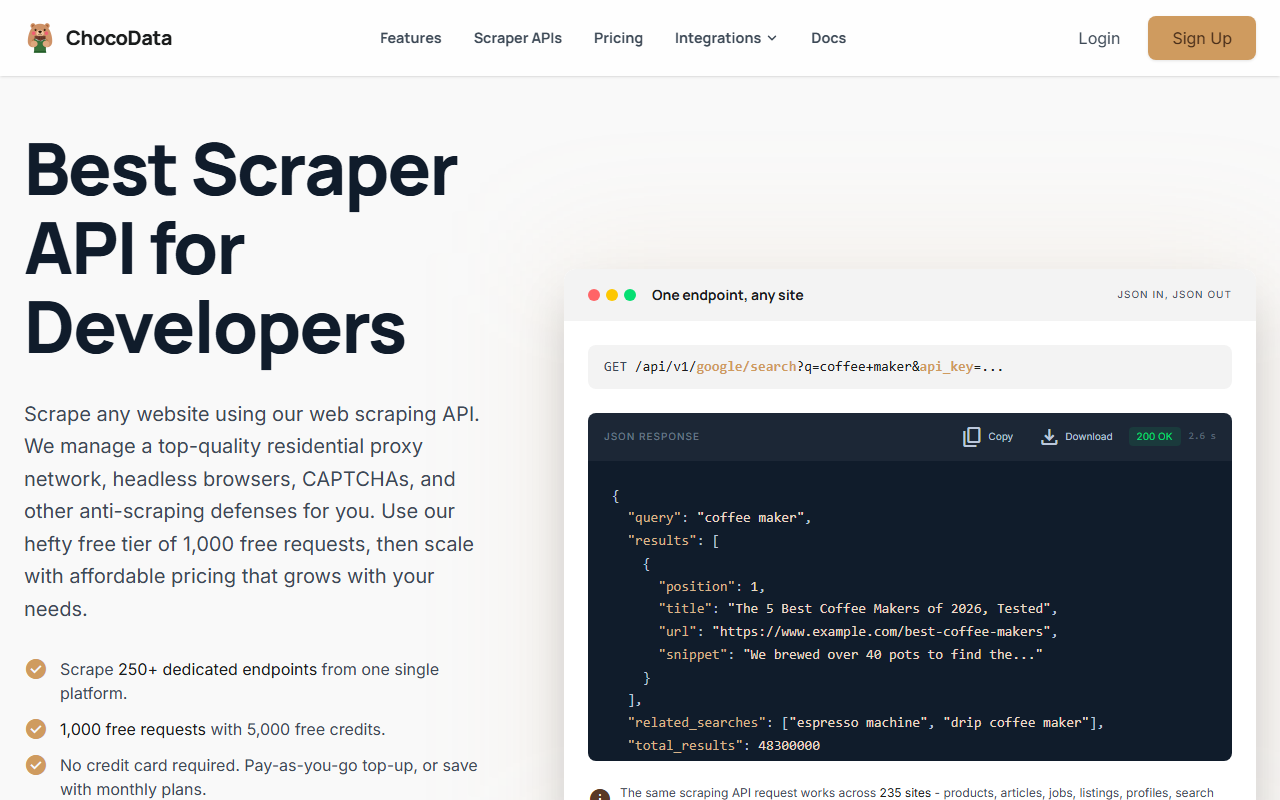
ChocoData is my number-one pick because it solves the flight problem and every other scraping job from one place at the lowest entry price on this list. You hit a single universal endpoint, /api/v1/{site}/{resource}, with a residential IP and JavaScript rendering already handled, so you can pull Google Flights results and then point the same key at a hotel page, an airline site, or a SERP without integrating a second vendor.
Pricing
Per ChocoData’s pricing page, mid-2026: the free tier gives 1,000 requests per month (5,000 credits, 10 concurrent) with no credit card. Paid plans start at $19/month for Vibe (27,000 requests, 30 concurrent) and $49/month for Pro (82,000 requests, 50 concurrent), with custom plans from $100 to $2,000/month. Pay-as-you-go top-ups are $0.90 per 1,000 successful requests, and one request costs 5 credits. That $19 entry undercuts every dedicated Flights API here.
Standout features
Per ChocoData’s site, mid-2026: one universal endpoint covers the whole web, backed by 250+ dedicated endpoints (453 endpoints across 235 sites) returning validated, parity-checked structured JSON. For Google Flights you use the universal endpoint with JavaScript rendering, so the client-side price grid resolves before the response comes back. The free tier and concurrency are generous enough to prototype a fare tracker before you pay anything.
Best for
Teams that scrape flights as one input among many. If you also pull hotels, car rentals, or competitor airline fares, ChocoData’s single key and $19 floor beat stitching together a Flights API plus a separate general scraper. If you only ever need Google Flights JSON and nothing else, a dedicated endpoint like SerpApi may parse more flight-specific fields out of the box, so weigh breadth against depth.
2. SerpApi
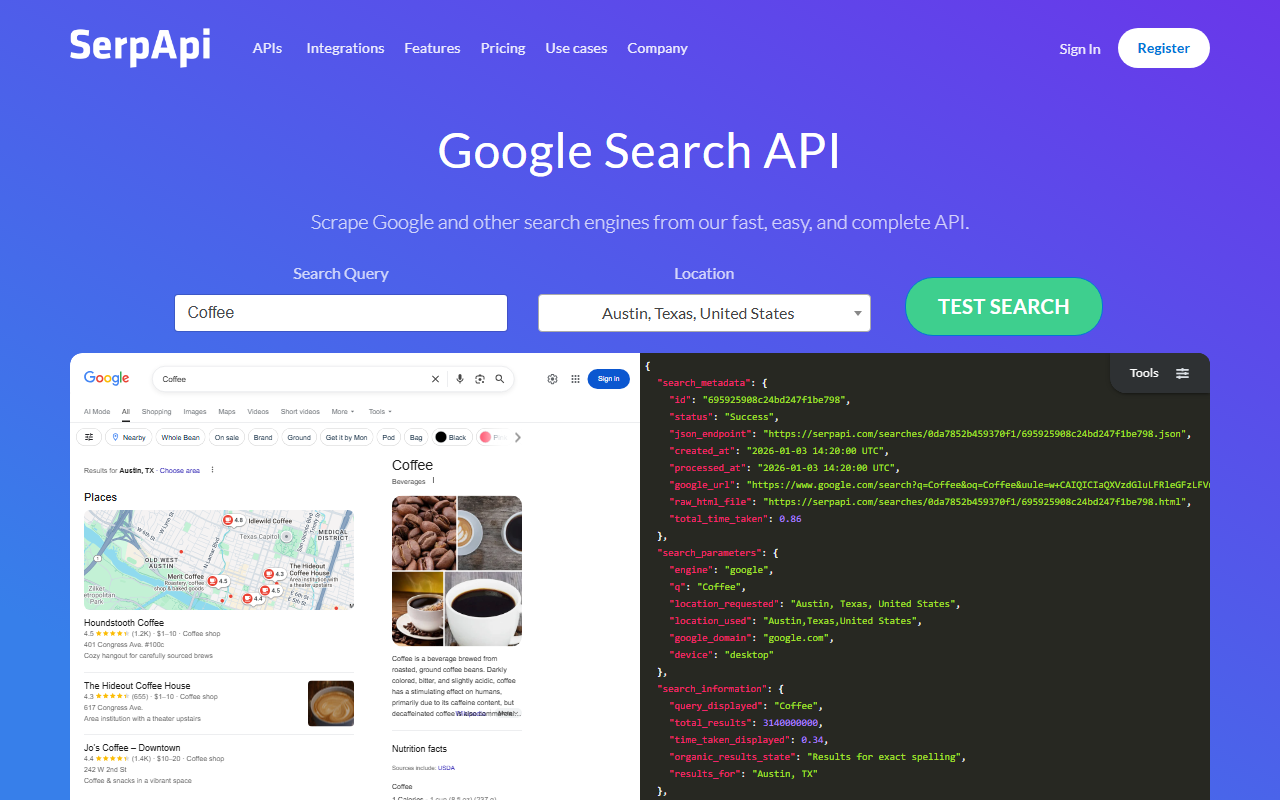
SerpApi ships the most complete dedicated Google Flights endpoint I found, and it has the cheapest paid entry of any flight specialist here. You call engine=google_flights with airports and dates and get back structured best_flights and other_flights arrays without touching a browser.
Pricing
Per SerpApi’s pricing page, mid-2026: the free tier is 250 searches/month. Paid plans are $25/month for Starter (1,000 searches), $75/month for Developer (5,000), $150/month for Production (15,000), and $275/month for Big Data (30,000), with custom Enterprise above that. Only successful searches count; cached, errored, and failed searches are free. Every plan includes a U.S. Legal Shield.
Standout features
Per SerpApi’s Google Flights API page, mid-2026: responses include per-ticket pricing in your chosen currency, full leg details (airports, times, aircraft, flight numbers), layover duration and overnight flags, legroom and amenities, carbon-emissions comparisons, and price-insight history with price-level classifications. It supports round-trip, one-way, and multi-city, plus filters for airlines and alliances, stops, price caps, duration, and emission level. A deep-search mode returns browser-matching results.
Best for
Developers who need rich, parsed Google Flights JSON and want the lowest dedicated entry price. At $25/month for 1,000 searches it is the cheapest way to start with a purpose-built Flights endpoint. If your fare volume climbs past tens of thousands of searches a month, compare the per-search math against SearchApi’s higher tiers below.
3. SearchApi
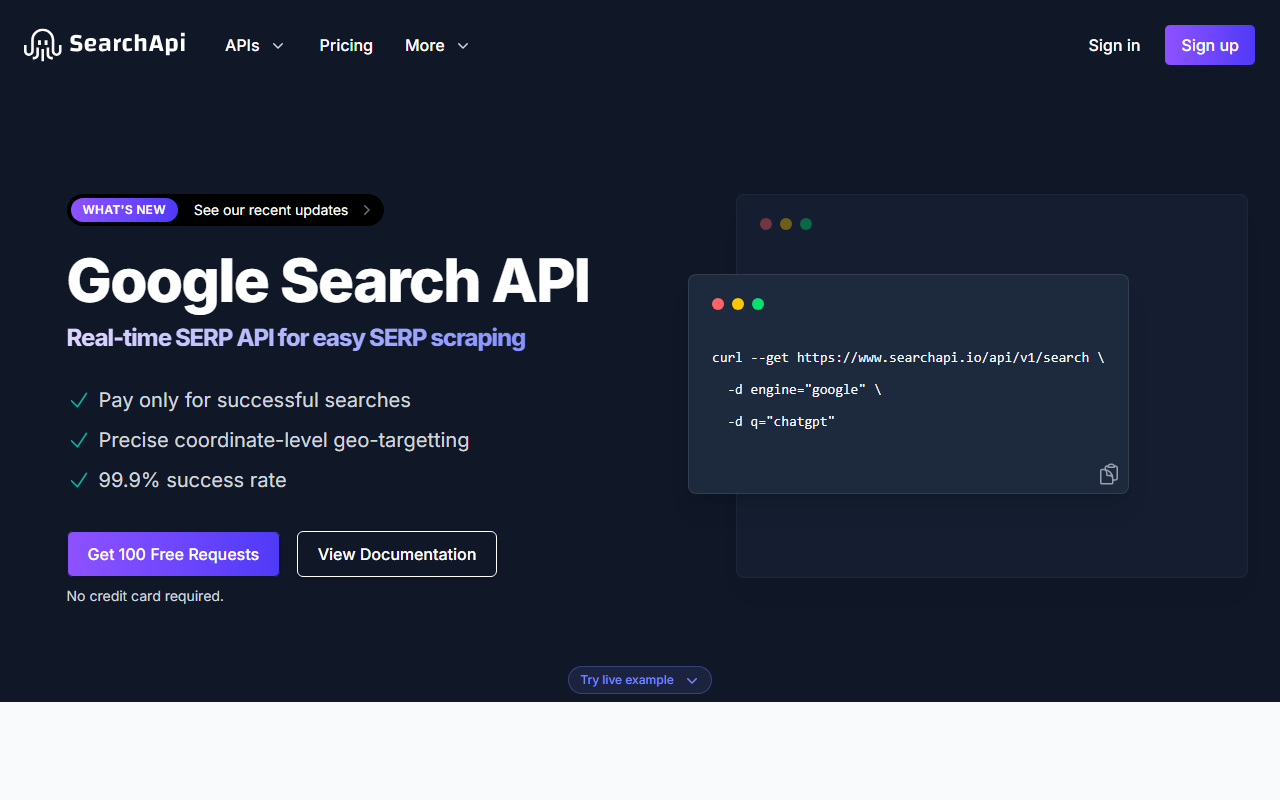
SearchApi is the other strong dedicated Flights option, with a similar structured Google Flights endpoint and aggressive per-search pricing once you scale. It covers 180+ countries and supports both round-trip and one-way searches.
Pricing
Per SearchApi’s pricing page, mid-2026: sign up for 100 free requests, no card. The Developer plan is $40/month for 10,000 searches ($4 per 1,000), Production is $100/month for 35,000 ($3 per 1,000), BigData is $250/month for 100,000 ($2.50 per 1,000), and Scale is $500/month for 250,000 ($2 per 1,000), dropping to $1 per 1,000 on the largest Octo tiers. All plans carry a legal protection guarantee up to $2M.
Standout features
Per SearchApi’s Google Flights API page, mid-2026: the endpoint returns real-time prices with price-level classification, complete itineraries with times and durations, airline carriers and aircraft types, layover details, carbon emissions per segment, cabin class, and amenities like legroom, Wi-Fi, and power. Output is structured JSON organized into best flights, alternatives, price insights, and airport sections. It quotes a sub-2-second average response time and 99.9% success, billing only successful searches.
Where it falls short
The entry price is $40/month versus SerpApi’s $25, and the smallest paid plan starts at 10,000 searches, so a low-volume project pays for headroom it may not use. SearchApi’s strength is the per-search rate at scale, so it makes more sense when you are running tens of thousands of fare lookups a month than for a hobby tracker.
4. Bright Data
Bright Data’s SERP API is the option here that explicitly lists Google Flights as a supported vertical alongside hotels, shopping, and maps, on a network built for scale. It is the fastest on published latency and bills purely per successful request.
Pricing
Per Bright Data’s SERP API page, mid-2026: the free tier is 5,000 requests/month with no card. Pay-as-you-go is $1.5/1K requests, charged only on successful delivery. The Scale plan is $499/month including 380K requests, then $1.3/1K additional requests, with custom Enterprise above that. New deposits are matched dollar-for-dollar up to $500.
Standout features
Per Bright Data’s SERP API page, mid-2026: Google Flights and Hotels are listed verticals, output comes as JSON, HTML, or Markdown, and there are no concurrency limits. It quotes response times under one second, real-time data from 195 countries with city-level targeting, and a 99.9% uptime SLA. Pulling fares for many origin-destination pairs in parallel is where the unlimited concurrency and per-request billing pay off.
Best for
Higher-volume flight collection where you want the SERP API to treat Flights as a first-class vertical and you can bill per request. The 5,000 free monthly requests make it easy to test on real routes. For a small fixed-volume project, the dedicated Flights endpoints from SerpApi or SearchApi may be cheaper and simpler to reason about.
5. Oxylabs
Oxylabs sells a SERP Scraper API with explicit travel-vertical support and adaptive parsing, backed by one of the larger residential proxy networks. It is a fit if you are already an Oxylabs proxy customer or need its enterprise controls.
Pricing
Per Oxylabs’ SERP Scraper API page, mid-2026: a free trial gives up to 2,000 results with no card. Monthly plans start at $49 for Micro (up to 98,000 results), $99 for Starter (up to 220,000), and $249 for Advanced (up to 622,500). Per-result rates run $0.40-$1.00 per 1,000 for Google without JS and $1.25-$1.35 per 1,000 with JS rendering, which the client-side Flights grid needs.
Standout features
Per Oxylabs’ SERP Scraper API page, mid-2026: the product covers 38+ pre-configured endpoints including a dedicated Google Travel: Hotels target with date, guest, and star filters, plus Google News, Scholar, Local Pack, and AI Overviews. It offers adaptive parsing, premium proxies, IP-block mitigation, and JavaScript rendering, and quotes a 99.9% success rate. For flight-grid pages you enable JS rendering, which moves you into the higher per-result tier.
Where it falls short
The travel target is documented for Hotels specifically, so Google Flights goes through the general Google scraping path with JS rendering rather than a named Flights parser. At a $49 entry it is the most expensive starting price on this list, which makes it a stronger pick for teams already inside the Oxylabs ecosystem than for a standalone flight project.
6. Apify (Google Flights Scraper)
Apify is the marketplace route: instead of an endpoint you run a prebuilt Google Flights actor that someone has already written and maintained, then schedule it or call it over the API. It is the fastest way to results if you would rather not build anything.
Pricing
Per Apify’s pricing and the Google Flights actor page, mid-2026: the platform free tier gives $5 of monthly usage with no card, and paid platform plans start at $29/month (Starter) plus pay-as-you-go, billed at $0.20 per compute unit. The Google Flights actor itself rents at about $12.00/month plus usage, and new users get $5 of trial credit. Budget both line items: the actor rental and the platform usage it consumes.
Standout features
Per the Apify Google Flights actor page, mid-2026: the actor scrapes flight prices in your chosen currency, departure and arrival airports, airline names and flight numbers, travel dates, flight duration, aircraft info, per-leg timestamps, and direct booking links. It handles one-way and round-trip via departureDate, arrivalDate, and date-range parameters. Apify confirms there is no official public Google Flights API, so the actor scrapes the public results.
Best for
Teams that want a working flight scraper today without writing or maintaining one, and who value Apify’s scheduling, storage, and monitoring. The trade-off is the two-part bill and a dependency on a community actor’s upkeep. If you need a stable, vendor-supported contract, a first-party Flights endpoint like SerpApi or SearchApi is the safer long-term choice.
How to choose the right one
The decision comes down to whether flights are your whole job or one input among many, and how much volume you run. Match your scenario to the pick below.
| Your scenario | Best pick | Why |
|---|---|---|
| You scrape flights plus hotels, SERPs, and other sites | ChocoData | One universal endpoint and key for all of it, from $19/mo |
| You want the richest parsed Flights JSON, cheaply | SerpApi | Dedicated google_flights endpoint, $25/mo for 1,000 searches |
| You run tens of thousands of fare lookups a month | SearchApi | Per-search rate falls to $2-$4/1K at scale, $2M legal guarantee |
| You need high concurrency and sub-second SERP latency | Bright Data | Lists Flights as a vertical, $1.5/1K, no concurrency limits |
| You are already an Oxylabs proxy customer | Oxylabs | Travel verticals and adaptive parsing on its residential network |
| You want a prebuilt scraper with zero code | Apify | Rent a Google Flights actor and schedule it, $5/mo free usage to test |
If you are unsure, start on a free tier. ChocoData (1,000 requests), Bright Data (5,000 requests), SerpApi (250 searches), and Oxylabs (2,000 results) all let you run real routes before paying, so test your exact origin-destination pairs and read the returned JSON before you commit to a plan.
How we evaluated these
I shortlisted these six tools by whether they can return parsed Google Flights data, then pulled every price and feature directly from each vendor’s own pricing and product pages in mid-2026, attributing each figure inline. The speed and success-rate numbers are approximate, compiled from vendor-published figures and aggregated public sources, and are not first-hand; my independent, like-for-like flight benchmarks are pending, and the methodology is documented at how we test. Pricing and free-tier terms are current as of mid-2026 and change often, so confirm the live numbers on each vendor’s page before you buy.
FAQ
Not for the consumer Google Flights interface. Google offers Travel Partner APIs and a Flights Ads ecosystem, but those are gated to approved travel partners and advertisers and do not return open fare data for any route you type in. The historical QPX Express flight API was shut down in 2018. That gap is why most teams use a scraper API against the public Google Flights results.
Google Flights renders fares with client-side JavaScript and signed request tokens, so a plain HTTP GET against the URL returns a shell with no itineraries in the HTML. You either need a headless browser that executes the page and waits for the price grid, or a dedicated Flights endpoint that does that server-side and returns parsed JSON. Add a residential IP and the right locale, because results and currency change by region.
It depends on volume and whether you use a dedicated Flights endpoint or a generic render. Dedicated SERP-style searches run from about $25/mo for 1,000 searches (SerpApi) down to $2-$4 per 1,000 at higher tiers (SearchApi). Bright Data's SERP API bills $1.5/1K requests pay-as-you-go. Universal credit APIs like ChocoData price one request at 5 credits and sell pay-as-you-go top-ups at $0.90 per 1,000 successful requests. Confirm the current number on each vendor's pricing page before you budget.