Best Google Images Scraper APIs & Tools
- Google image scraping needs an API that handles the
tbm=ischimage tab, returns full-resolution source URLs (not just Google thumbnails), and survives Google's anti-bot layer at volume. - ChocoData is my top value pick: a universal endpoint plus 250+ dedicated endpoints, Google search and image results in clean JSON, from $19/mo with a free 1,000 requests/mo, per its pricing page.
- Documented entry prices in mid-2026 run from $0 free tiers (ChocoData, Oxylabs trial, Bright Data, Apify, ScraperAPI, ScrapingBee) and $19/mo (ChocoData) up to $40-$49/mo for SearchApi, Oxylabs, and ScrapingBee starter plans.
- Purpose-built Google Images endpoints (SearchApi, Oxylabs) return 19+ parsed fields including original dimensions, source domain, and filters for size, color, type, and usage rights. Universal APIs return the page payload you parse yourself.
- Speed and success figures below are approximate, compiled from vendor-published numbers and aggregated public sources, not first-hand. Like-for-like benchmarks are in progress (how we test).
Google Images is one of the harder search surfaces to scrape: the image tab loads through JavaScript, full-resolution files live on the source domain rather than Google, and the anti-bot layer throttles datacenter traffic fast. This page compares the Google image scraping APIs I would actually shortlist in 2026 on the things that decide a purchase: starting price, free tier, which image fields they return, and published speed. My top pick for most teams is ChocoData, a universal scraper API with Google search and image results in clean JSON from $19/mo. Every price and feature below comes from the vendor’s own pricing or product page in mid-2026, attributed inline, because review-site numbers go stale fast.
One disclosure up front: bestscraperapi.com earns affiliate commissions from some of the vendors listed here. That has no bearing on which tools make the list, how I rank them, or what I write. The pricing comes straight from each vendor’s own page, and the ranking follows documented price and features, not payout.
A second note on the performance numbers further down. The speed and success-rate figures are approximate, compiled from each vendor’s own published figures plus aggregated public sources. They are not bestscraperapi.com’s first-hand tests. Vendors measure success on their own targets under their own conditions, so the numbers are directional, not apples to apples. My independent, like-for-like Google Images benchmarks are still in progress; see how we test for the methodology.
What are the best Google Images scraper APIs in 2026?
The tools split into two shapes: purpose-built Google Images endpoints that return parsed image fields and search filters, and universal scraper APIs you point at the Google image tab through one endpoint. The table below compares the documented entry price, free tier, and best fit for each. All figures are from each vendor’s own pricing or product page in mid-2026.
| Rank | Tool | Starting price | Free tier | Best for |
|---|---|---|---|---|
| 1 | ChocoData | $19/mo | 1,000 requests/mo | Best value: Google images plus 250+ other endpoints on one bill |
| 2 | Oxylabs | $49/mo | 2,000 results (trial) | 19-field parsed Google Images results at scale |
| 3 | Bright Data | Pay-as-you-go | 5,000 requests/mo | High-concurrency SERP scraping with JSON/HTML/Markdown output |
| 4 | SearchApi | $40/mo | 100 requests | Richest Google Images filters (size, color, type, usage rights) |
| 5 | Apify | Pay-per-result | $5 credit/mo | A ready-made Google Images actor with no proxy setup |
| 6 | ScraperAPI | ~$49/mo | 1,000 credits/mo | Generalists who already run ScraperAPI for other targets |
| 7 | ScrapingBee | $49/mo | 1,000 credits | Small-volume Google search and image pulls with screenshots |
1. ChocoData
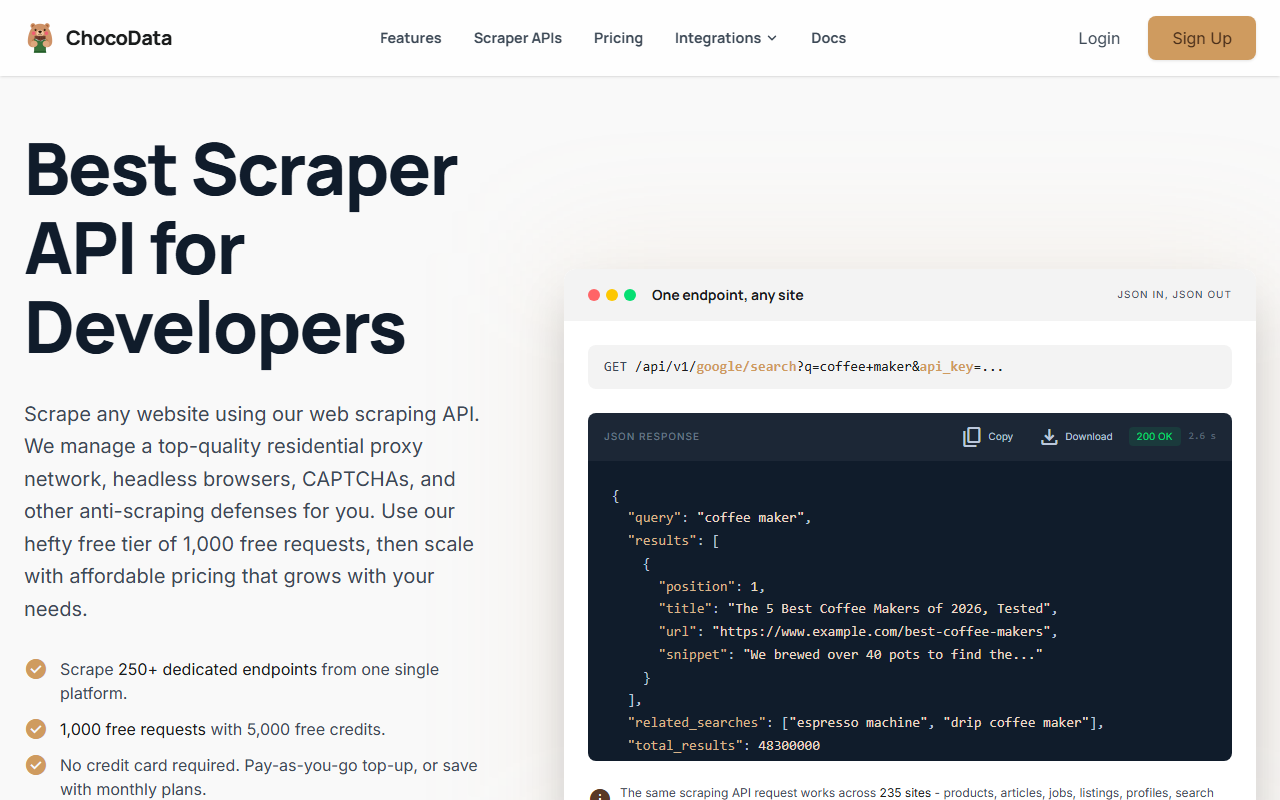
ChocoData is my number-one pick for Google image scraping because it covers the job at the lowest real entry price while also handling every other target you are likely to add later. You send a Google image-tab URL or query through one universal endpoint and get clean JSON back, with proxy rotation, CAPTCHA handling, and anti-bot evasion managed for you. For teams whose image scraping is one piece of a larger pipeline, putting it on the same bill as 250+ other endpoints is the practical win.
Pricing
Per ChocoData’s pricing page in mid-2026, the free plan gives 1,000 requests/month (5,000 credits) with no credit card and all targets included. Paid plans start at the Vibe tier at $19/mo for 27,000 requests/month (an effective $0.70 per 1,000), with Pro at $49/mo for 82,000 requests ($0.60 per 1,000) and custom plans dropping to a flat $0.50 per 1,000. Pay-as-you-go top-ups run $0.90 per 1,000 successful requests on any plan. That $19 entry and free tier undercut every dedicated Google Images endpoint here.
Standout features
Per ChocoData’s own pages, the universal endpoint covers 235 sites, and there are 250+ dedicated endpoints returning structured JSON, including search engines for Google search and image results. Billing is on successful requests, and the page lists residential proxy rotation, CAPTCHA solving, and anti-bot handling as built in. Published performance is a median 2.6-second response time with a p95 of 6 seconds (approximate, compiled from vendor + public sources, not first-hand; independent benchmarks pending, see how we test).
Best for
Teams that want Google image results plus the freedom to scrape Amazon, Walmart, SERPs, and arbitrary sites without adding vendors or contracts. If your image scraping is steady but moderate, the $19/mo plan or the free tier covers a real workload, and you parse the image-tab JSON yourself rather than relying on a fixed schema. It fits less well if you need a vendor-maintained, fully parsed Google Images schema with built-in size and color filters out of the box, which is where the dedicated endpoints below earn their premium.
2. Oxylabs
Oxylabs sells a dedicated Google Image Search API inside its broader SERP Scraper API, aimed at teams pulling parsed image results at scale. You provide a search term, credentials, and a payload, and get structured JSON back without managing the unblocking yourself. It is the most enterprise-leaning of the parsed-image options here.
Pricing
Per Oxylabs’ Google Images product and pricing pages in mid-2026, there is a free trial of up to 2,000 results with no credit card. Paid plans start at Micro at $49/mo (up to 98,000 results, from $0.50 per 1,000), Starter at $99/mo (from $0.45 per 1,000), and Advanced at $249/mo (from $0.40 per 1,000). Pricing varies by target: Google Image results are listed at $1.00 per 1,000 results, dropping to $0.90 in higher tiers.
Standout features
Per the Oxylabs product page, the Google Image Search API returns 19 data points including organic image listings with URLs, thumbnails, source domains, position rankings, and titles, all parsed to JSON. It handles large-scale collection and real-time results, with the unblocking and proxy layer included. Published response times are competitive (approximate, compiled from vendor + public sources, not first-hand; independent benchmarks pending, see how we test).
Where it falls short
The entry economics are weaker than ChocoData’s: $49/mo to start versus $19, and the trial is capped at 2,000 results rather than a recurring free tier. The $1.00 per 1,000 Google Image rate is also above ChocoData’s effective per-request cost. Oxylabs earns its place when you need the parsed 19-field schema and enterprise support, and you are scraping images at a volume where the per-result rate and dedicated infrastructure matter more than the entry price.
3. Bright Data
Bright Data’s SERP API handles real-time search engine scraping across Google, Bing, DuckDuckGo, Yandex, Baidu, Yahoo, and Naver, and supports Google Images via the tbm=isch parameter. It is built for high-concurrency workloads and flexible output formats, which suits teams folding image search into a wider SERP pipeline.
Pricing
Per Bright Data’s SERP API page in mid-2026, there is a free tier of 5,000 requests/month with no credit card. Pay-as-you-go is $1.50 per 1,000 requests with unlimited concurrency and spend limits, the Scale plan is $499/mo for 380,000 included requests ($1.30 per 1,000 additional), and Enterprise is custom with volume discounts. New users also get a dollar-for-dollar deposit match up to $500. You pay only for successful delivery.
Standout features
Per the product page, data is delivered in JSON, HTML, or Markdown, response times are quoted under one second, geo-targeting spans 195 countries for free, and there are no limits on concurrent requests. Google Images support runs through the standard tbm=isch image query, so you get the image-tab results in your chosen format. The Markdown output is useful if you are feeding results into an LLM pipeline rather than a parser.
Where it falls short
For pure Google image scraping, the $1.50 per 1,000 pay-as-you-go rate sits above ChocoData and Oxylabs, and the recurring Scale plan starts at $499/mo. Image results are not parsed into a fixed 19-field schema the way Oxylabs and SearchApi do it; you work with the JSON, HTML, or Markdown payload. Bright Data is the pick when concurrency, country coverage, and output flexibility outweigh the per-request cost.
4. SearchApi
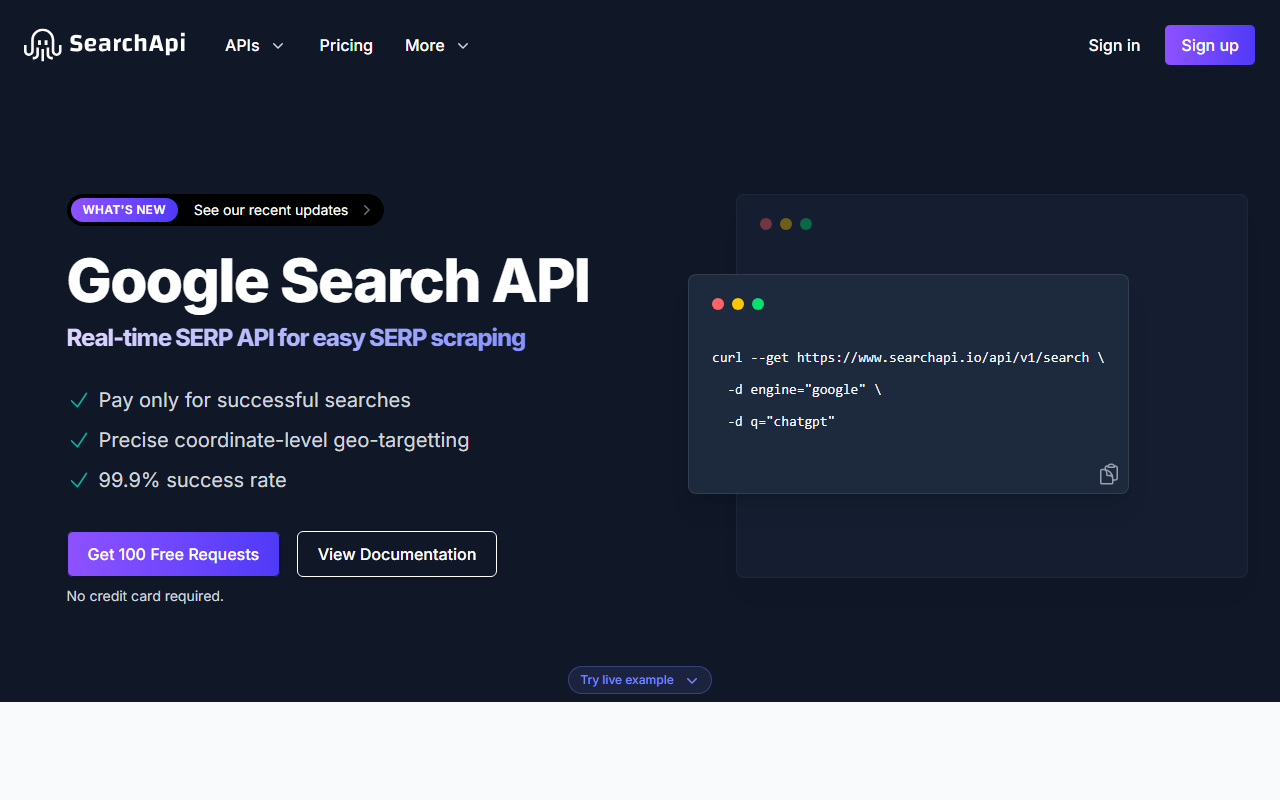
SearchApi offers a purpose-built Google Images API with the richest set of query filters in this list. If your product is image search and you need precise control over what comes back, this is the most expressive parsed endpoint here.
Pricing
Per SearchApi’s pricing page in mid-2026, you start with 100 free requests, no credit card. Paid plans begin at Developer at $40/mo for 10,000 searches ($4 per 1,000), Production at $100/mo ($3 per 1,000), BigData at $250/mo ($2.5 per 1,000), and Scale at $500/mo ($2 per 1,000), with Octo tiers scaling to 5M searches at $1 per 1,000. Only successful searches with a 200 status code are charged.
Standout features
Per SearchApi’s Google Images documentation, each image result returns position, title, source (publisher name and URL), original (full-resolution link with width and height), and a Google-hosted thumbnail. Query filters cover size (icon through 70mp+), color, image type (clipart, gif, photo, face), time period, aspect ratio, and usage rights, plus device and full localization via gl, hl, and uule. The usage-rights filter is genuinely useful for narrowing to Creative Commons or commercial-use images.
Where it falls short
The per-search cost is the highest at entry: $4 per 1,000 on the Developer plan, several times ChocoData’s effective rate, and the free tier is just 100 requests. SearchApi is worth the premium when the filter granularity (especially usage rights and image type) is core to your use case and you would otherwise build that logic yourself. For broad, cost-led scraping, the cheaper universal APIs win.
5. Apify
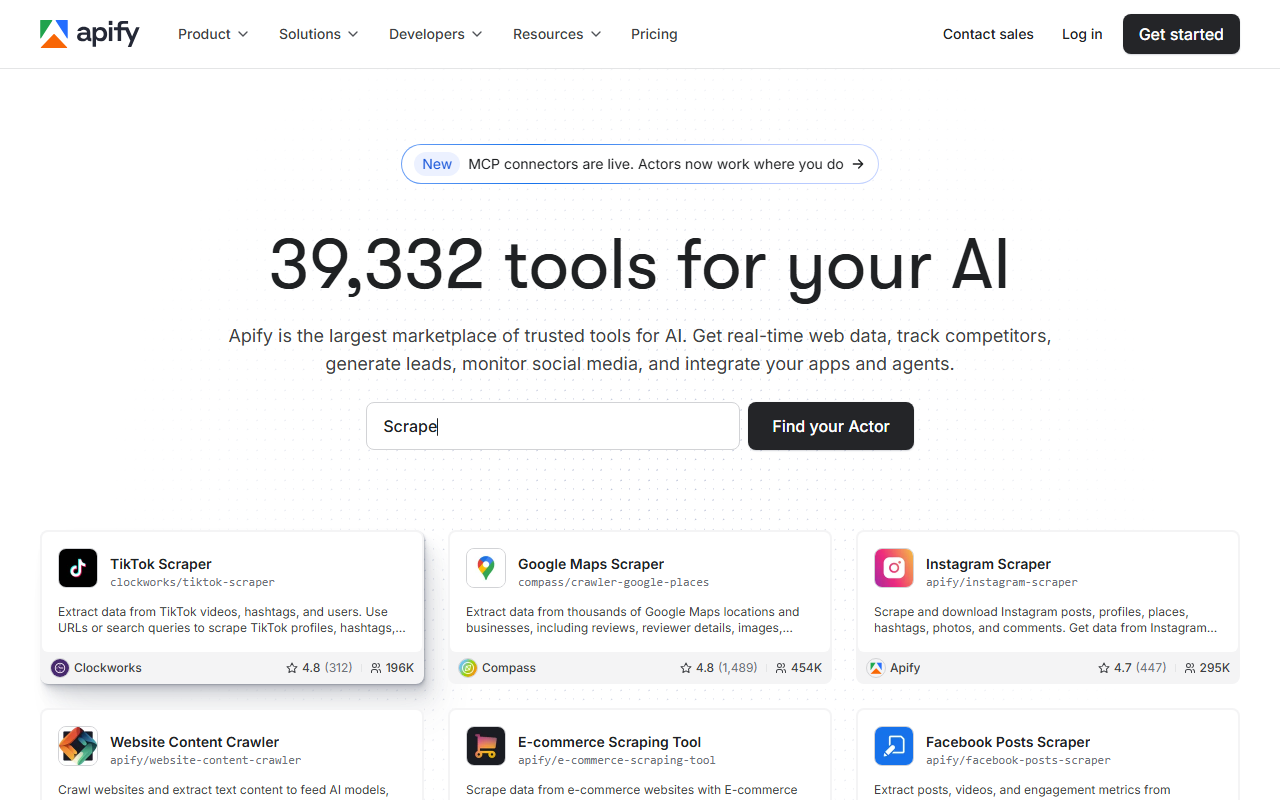
Apify hosts the hooli Google Images Scraper, a ready-made actor that returns image data without you provisioning any proxies or writing extraction logic. It is the fastest way to get Google image results flowing if you do not want to manage infrastructure at all.
Pricing
Per the actor’s page on Apify in mid-2026, pricing is pay-per-event from $1.90 per 1,000 scraped images, charged per image result returned. The Apify Free plan gives $5 in platform credits every month to test actors before paying for usage. There is no separate monthly rental quoted for this actor beyond the per-result usage.
Standout features
Per the actor page, the scraper extracts image URLs and thumbnail URLs, image dimensions (width and height), source website and page title, the page URLs where images appear, thumbnail dimensions, and the search query used. It runs on Apify’s managed platform, so scheduling, storage, and integrations (webhooks, API, dataset exports) come included. For a quick proof of concept, the $5 monthly credit is enough to validate the output shape.
Where it falls short
At $1.90 per 1,000 images, this is the priciest per-result rate in the list, and the $5 monthly credit is a test allowance rather than a usable free tier. The actor is community-published (hooli) rather than a first-party Apify product, so longevity and support depend on the maintainer. Apify fits when convenience and the surrounding platform (scheduling, storage, integrations) matter more than the per-image cost.
6. ScraperAPI
ScraperAPI is a general-purpose scraper API that handles Google search and image results through its proxy and unblocking layer. It is a reasonable choice if you already run it for other targets and want to keep image scraping on the same account.
Pricing
Per ScraperAPI’s documentation in mid-2026, the free plan gives 1,000 credits/month, and the free trial is 5,000 credits for the first 7 days. Only three tiers are spelled out with exact figures in the docs: Free at $0 (1,000 credits), Professional at $975/mo (10.5M credits), and Advanced at $1,975/mo (21.5M credits). The lower paid tiers (commonly labeled Hobby around $49/mo, Startup, and Business) are set on a slider, and ScraperAPI does not publish their exact credit counts as primary figures, so confirm them on the ScraperAPI pricing page before buying.
Standout features
ScraperAPI bills only successful requests, per its docs, and offers dedicated structured endpoints for targets like Amazon, Google, and Walmart that return parsed JSON. Geo-targeting covers a 70-entry country list on Business and above, with US/EU regions on lower tiers. Credits are multiplied for heavier requests: plain requests cost 1 credit, JavaScript rendering costs 10, and ultra-premium costs up to 30, which is the number that actually decides your effective budget.
Where it falls short
Google image scraping often needs rendering, and the 10x render multiplier erodes the credit allowance quickly, so the headline credit counts overstate your real request budget. Country-level geo-targeting is gated to Business and up, and the 7-day, 5,000-credit trial is short for evaluating a heavy image workload. ScraperAPI makes most sense as a generalist tool you already use, rather than a dedicated image-scraping buy.
7. ScrapingBee
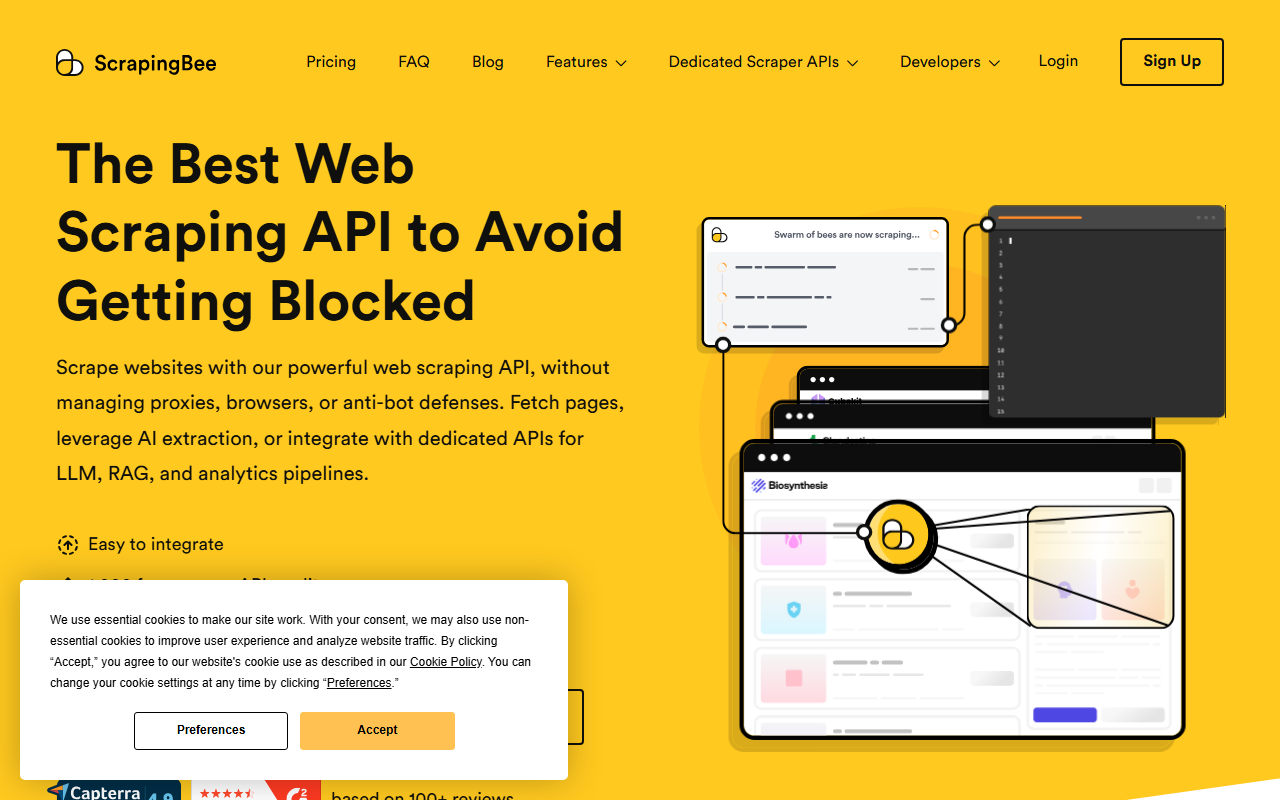
ScrapingBee is a developer-friendly scraping API with a built-in Google Search API that returns image results among other SERP data. It suits small-volume pulls where you also want screenshots or JavaScript rendering on the same platform.
Pricing
Per ScrapingBee’s pricing page in mid-2026, the free trial is 1,000 API credits with no credit card. Paid plans are Freelance at $49/mo (250,000 credits), Startup at $99/mo (1,000,000 credits), Business at $249/mo (3,000,000 credits), and Business+ at $599/mo (8,000,000 credits), with a custom tier on request. The Google Search API is included across plans; ScrapingBee does not list a separate per-search price on the pricing page, so the cost is the credits each request consumes.
Standout features
Per ScrapingBee’s documentation, the Google API returns structured JSON, and image search results include image URL, title, domain source, and position ranking. The platform also bundles screenshots and extraction rules, so you can capture the rendered page alongside the parsed data. For developers who want one API for general scraping plus occasional Google image pulls, the combined feature set is convenient.
Where it falls short
The image result schema is thinner than the dedicated endpoints: four fields (URL, title, domain, position) versus the 19 Oxylabs parses or the dimensions and filters SearchApi exposes. The $49/mo entry matches Oxylabs and ChocoData’s Pro tier but with a smaller free trial than ChocoData’s recurring 1,000 requests/month. ScrapingBee is the pick for light, mixed-use scraping rather than high-volume, deeply parsed image collection.
How to choose the right one
The decision comes down to how much parsing you want to own and how image scraping fits your stack.
| Your situation | Best fit | Why |
|---|---|---|
| Image scraping is one target among many | ChocoData | $19/mo and a free tier, plus 250+ other endpoints on one bill |
| You need parsed 19-field results at scale | Oxylabs | Dedicated Google Images API, $0.40-$1.00 per 1,000 results |
| You need size/color/type/usage-rights filters | SearchApi | Richest Google Images query filters of any tool here |
| High concurrency and flexible output formats | Bright Data | JSON/HTML/Markdown, unlimited concurrency, 195 countries |
| Zero infrastructure, quick proof of concept | Apify | Ready-made actor, $5 monthly test credit |
| You already run a generalist scraper API | ScraperAPI or ScrapingBee | Keep image pulls on an account you already pay for |
For most teams, start with ChocoData’s free tier to confirm the image-tab JSON gives you the fields you need, then move to a dedicated endpoint only if you require a vendor-maintained schema or specific filters. If image search is your entire product, the per-field parsing from SearchApi or Oxylabs can be worth the higher per-request cost. For the fundamentals of building any of these into a pipeline, see the web scraping pillar guide, and for the do-it-yourself route read scraping without getting blocked.
How we evaluated these
I compared each tool on starting price, free tier, the image fields it returns, and published speed, pulling every pricing and feature figure from the vendor’s own pricing or product page in mid-2026 and attributing it inline. Performance numbers are approximate, compiled from vendor-published figures and aggregated public sources rather than first-hand tests, and my independent, like-for-like Google Images benchmarks are still in progress; see how we test for the methodology. Pricing is current as of mid-2026 and changes often, so confirm the live numbers on each vendor’s page before you buy.
FAQ
You can get both, and the distinction matters. Google Images results carry a Google-hosted thumbnail URL and a separate original source URL with the real width and height. Dedicated endpoints like SearchApi and Oxylabs parse the original link and its dimensions for you, so you can fetch the full-resolution file from the publisher's site afterward. A universal scraper API returns the rendered image-tab payload, and you extract the same fields yourself. Google does not host the full-resolution copy, so every tool ultimately points you at the source domain for the real file.
At mid-2026 list rates it varies by billing model. On a universal credit API like ChocoData, 100,000 successful requests cost about $90 at the $0.90/1,000 pay-as-you-go rate, or less inside a monthly plan, with each request returning one results page. Oxylabs prices Google Image results at roughly $1.00 per 1,000 results ($0.90 in higher tiers), so about $90-$100. SearchApi runs $1.5-$4 per 1,000 searches depending on plan, and Apify's hooli Google Images Scraper bills from $1.90 per 1,000 scraped images. Re-check each vendor's pricing page before budgeting, because billing units (request, search, result, image) differ.
There are two layers. Scraping public Google results pages likely does not violate the US Computer Fraud and Abuse Act after the Ninth Circuit's hiQ v. LinkedIn reasoning on public data, but automated querying breaches Google's Terms of Service whichever tool you use. Separately, the images themselves are usually copyrighted: a search result is not a license to republish. Most teams scrape image metadata and URLs for indexing, research, or monitoring, then handle rights at the point of use. SearchApi exposes a usage-rights filter so you can narrow to Creative Commons or commercial-use images. See my [is-web-scraping-legal](/is-web-scraping-legal) guide for the full framing.
Both work, and the right answer depends on how much parsing you want to own. A purpose-built Google Images endpoint (SearchApi, Oxylabs) returns position, title, source, original dimensions, and thumbnail as named JSON fields, plus query filters for size, color, type, and time. A universal scraper API (ChocoData, ScraperAPI, ScrapingBee) fetches the rendered image-tab HTML or JSON and leaves the field extraction to you. If image search is your whole product, the dedicated endpoint saves selector maintenance; if it is one target among many, a universal API keeps everything on one bill.