Best Google Maps Scraper APIs & Tools
- ChocoData is my top value pick: one universal endpoint plus 250+ dedicated endpoints across 235 sites, from $19/mo with 1,000 free requests/mo and no card.
- The Apify Google Maps Scraper is the no-code leader at $1.50/1,000 places, and it bypasses Google's ~120-result-per-area cap that a single SERP call cannot beat.
- Documented entry pricing in mid-2026: Apify $1.50/1k places and $0.30/1k reviews, Outscraper 500 places free then $3/1k, Oxylabs Google Local from $0.90/1k, Bright Data $1.50/1k, Scrape.do $29/mo.
- Tools split into two shapes: dedicated Maps actors that return parsed place and review fields, and universal scraper APIs you point at a Maps or Local SERP.
- Speed and success figures here are approximate, compiled from vendor-published numbers and aggregated public sources, not first-hand. Like-for-like benchmarks are pending (how we test).
Google Maps is one of the richest free datasets on the web: business names, addresses, phone numbers, ratings, opening hours, and millions of reviews. The practical question is which tool pulls it reliably at volume without you babysitting proxies. My top value pick is ChocoData for the API route, and the standout for no-code work is the Apify Google Maps Scraper; this page ranks both alongside Outscraper, Oxylabs, Bright Data, and Scrape.do on starting price, free tier, which Maps data they return, and best fit. Every price and feature comes from the vendor’s own pricing or product page in mid-2026, attributed inline, because review-site numbers go stale fast.
One disclosure up front: bestscraperapi.com earns affiliate commissions from some of the vendors listed here. That does not change which tools make the list, how I rank them, or what I write. Pricing comes straight from each vendor’s own page, and the ranking follows documented price and features, not payout.
A note on the performance numbers further down. The speed and success-rate figures are approximate, compiled from each vendor’s published figures plus aggregated public sources. They are not bestscraperapi.com’s own first-hand tests. Vendors measure on their own targets under their own conditions, so the numbers are directional rather than apples to apples. My independent, like-for-like Google Maps benchmarks are pending; see how we test for the methodology.
| Rank | Tool | Starting price | Free tier | Best for |
|---|---|---|---|---|
| 1 | ChocoData | $19/mo (Vibe) | 1,000 requests/mo, no card | One API for Maps plus every other source |
| 2 | Apify Google Maps Scraper | $1.50/1k places | $5/mo platform credit | No-code place data without scraper code |
| 3 | Apify Google Maps Reviews Scraper | $0.30/1k reviews | $5/mo platform credit | Bulk review and reputation datasets |
| 4 | Outscraper | $3/1k (501+) | 500 places, no card | Maps-only specialist with a big free tier |
| 5 | Oxylabs | $49/mo (Micro) | Up to 2,000 results, no card | Teams already on a SERP API stack |
| 6 | Bright Data | $1.50/1k (pay-as-you-go) | 5,000 requests/mo, no card | Enterprise scale with an SLA |
| 7 | Scrape.do | $29/mo (Hobby) | 1,000 requests/mo, no card | Low-cost ready-made Maps endpoint |
Pricing per each vendor’s pricing or product page, mid-2026. Per-result and per-credit rates assume the entry tier; most vendors drop the unit price on higher plans. Confirm the current number at the source before you budget.
1. ChocoData
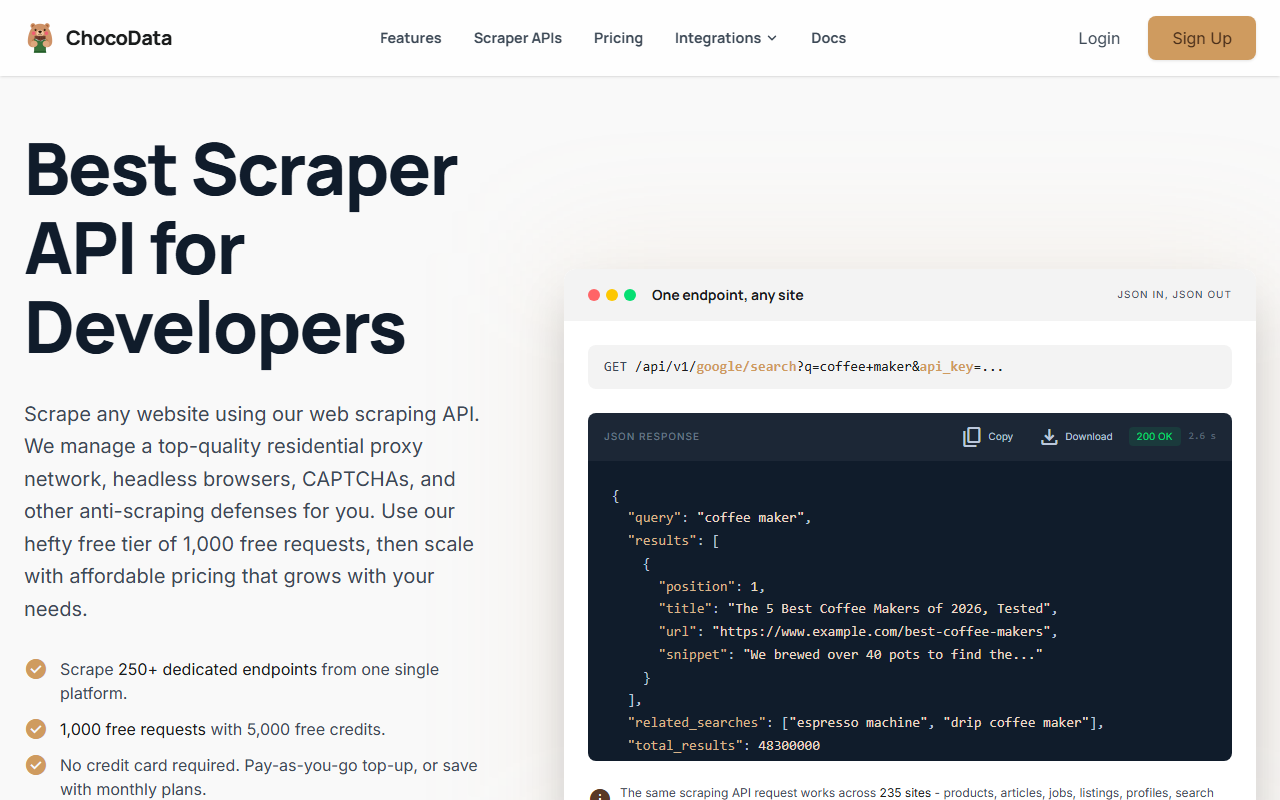
ChocoData is my top pick for Google Maps data through a real API, because it returns structured place and SERP data at the lowest documented entry price in this list, and the same integration covers every other source you scrape. You point it at Maps through either the universal endpoint or a dedicated scraper, so you are not bolting on a separate Maps-only tool to do it.
Pricing
Per ChocoData’s pricing page in mid-2026, the Free plan gives 1,000 requests a month (5,000 credits) with no credit card, and paid plans start at $19/mo (Vibe) for 27,000 requests, then $49/mo (Pro) for 82,000. ChocoData bills 5 credits per request, adds 10 for JavaScript rendering, and charges only 2xx responses, so failed Maps fetches do not count. Pay-as-you-go top-ups run $0.90 per 1,000 successful requests on any plan. For a workload that touches Maps plus e-commerce, search, or social data, one $19/mo entry price for the whole surface beats stacking single-purpose tools.
Standout features
ChocoData exposes a single universal endpoint, /api/v1/{site}/{resource}, across 235 supported sites, plus 250+ dedicated endpoints that return validated structured JSON (per its site, mid-2026). Google Search is among the supported scrapers, and queries come back as clean structured data rather than raw HTML you have to parse. Country-matched residential IPs handle location-specific results, so a query for “coffee shops” returns the local listings a nearby user would see.
Best for
Developers and founders who want Maps data through a clean API at the lowest entry price ($19/mo), and who also scrape other sources. If Maps is your only target and you want zero scraper code with automatic deduplication past Google’s 120-result cap, a dedicated actor like Apify fits better; for one integration across the whole web, ChocoData is the value pick. Try ChocoData.
2. Apify Google Maps Scraper
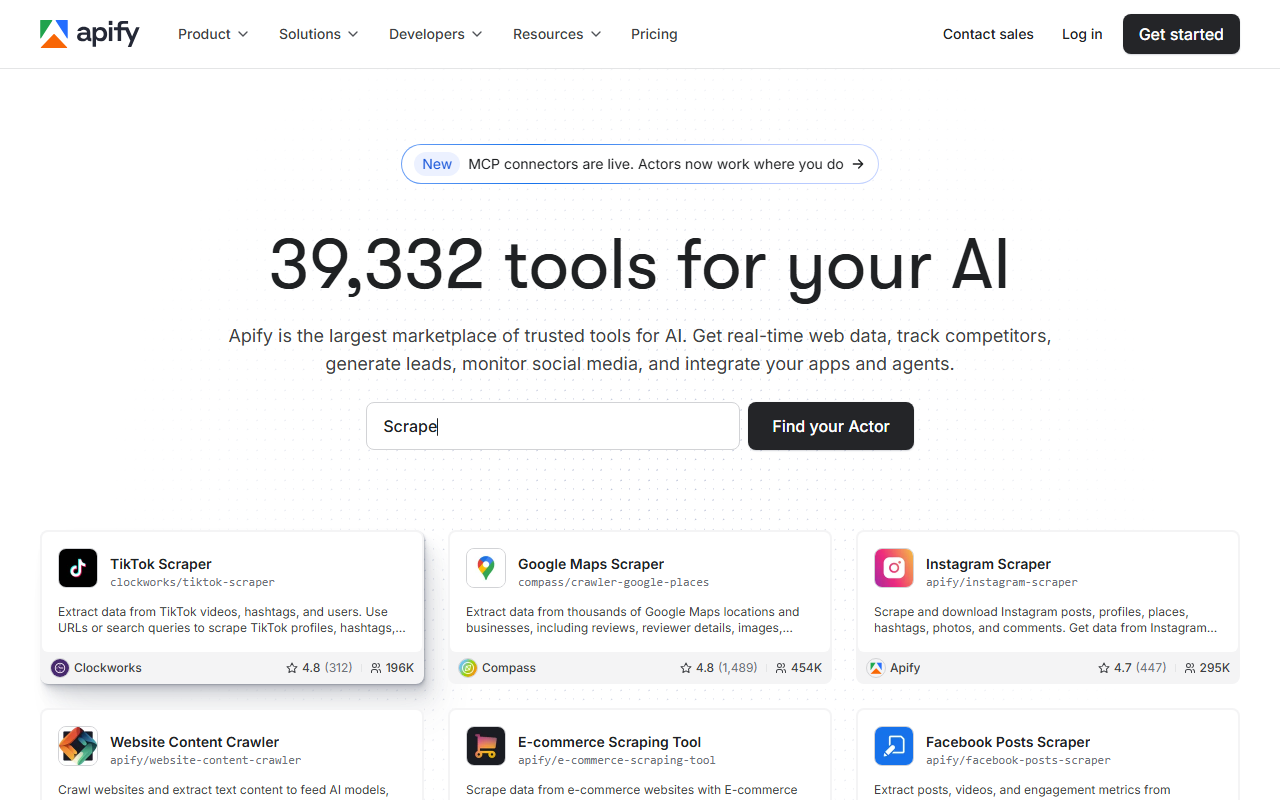
The Apify Google Maps Scraper is the no-code leader for place data, and it is the tool most people mean when they search for an “apify google maps scraper.” It returns full place records without you writing a line of scraper logic, and it solves Google’s hardest Maps limit out of the box.
Pricing
Per Apify’s actor page in mid-2026, the scraper costs $1.50 per 1,000 scraped places on a pay-per-result model, so you are charged for results rather than platform compute, and the per-result price drops on higher subscription tiers. The Apify Free plan includes $5 in platform credits per month with no card (per Apify’s pricing page, mid-2026), enough to test a few thousand places before you commit; the Starter plan is $29/mo for $29 of usage. Unused monthly usage does not roll over, so size the plan against real volume.
Standout features
The 120-result workaround is the feature that matters most. Google’s Maps front end caps a single search at about 120 places; the actor expands past that limit through systematic pagination across the area, so you can pull every pizzeria in a city rather than the first 120. Per Apify’s page, it returns place name, category, place ID and URL, address and exact coordinates, phone, website, average rating, review count and distribution, opening hours, popular times with live occupancy, menu links, and price brackets, and exports to JSON, CSV, Excel, XML, or HTML. Optional enrichment add-ons pull business contacts and lead fields (work email, job title, LinkedIn) from linked sites, billed on top.
Best for
Marketers, founders, and students who want place and lead data with no scraper code and a small free credit to start. It is the only option here that automatically beats Google’s 120-result cap. For a deeper look at the platform, see my Apify review.
3. Apify Google Maps Reviews Scraper
Pricing
Apify splits reviews into a separate actor. Per its page in mid-2026, the Google Maps Reviews Scraper costs $0.30 per 1,000 scraped reviews on the same pay-per-result model, and it runs on the same $5/mo free platform credit. Apify notes the $29/mo Starter plan covers roughly 58,000 reviews a month. If review mining is your whole project, this is the cheaper, more focused tool than running the place scraper.
Standout features
Per Apify’s page, the actor returns review text, star rating, published date, review ID and URL, the reviewer’s name, profile URL, review count and local-guide status, attached review images, per-service detailed ratings, and the owner’s response text, plus place metadata. A “Reviews Origin” filter targets Google-native reviews only, which improves coverage on hotels that pull in third-party reviews. Exports cover JSON, XML, CSV, Excel, and HTML, and there are SDKs plus Make, Zapier, and Google Sheets integrations.
Where it falls short
There is no guaranteed maximum result count per place, and Apify recommends capping pulls at around 1,000 reviews per place to limit resource use, so very high-review locations need batching. Date filtering is also limited: only the “Newest” sort works reliably. For place discovery rather than reviews, the standard Google Maps Scraper above is the right actor.
4. Outscraper
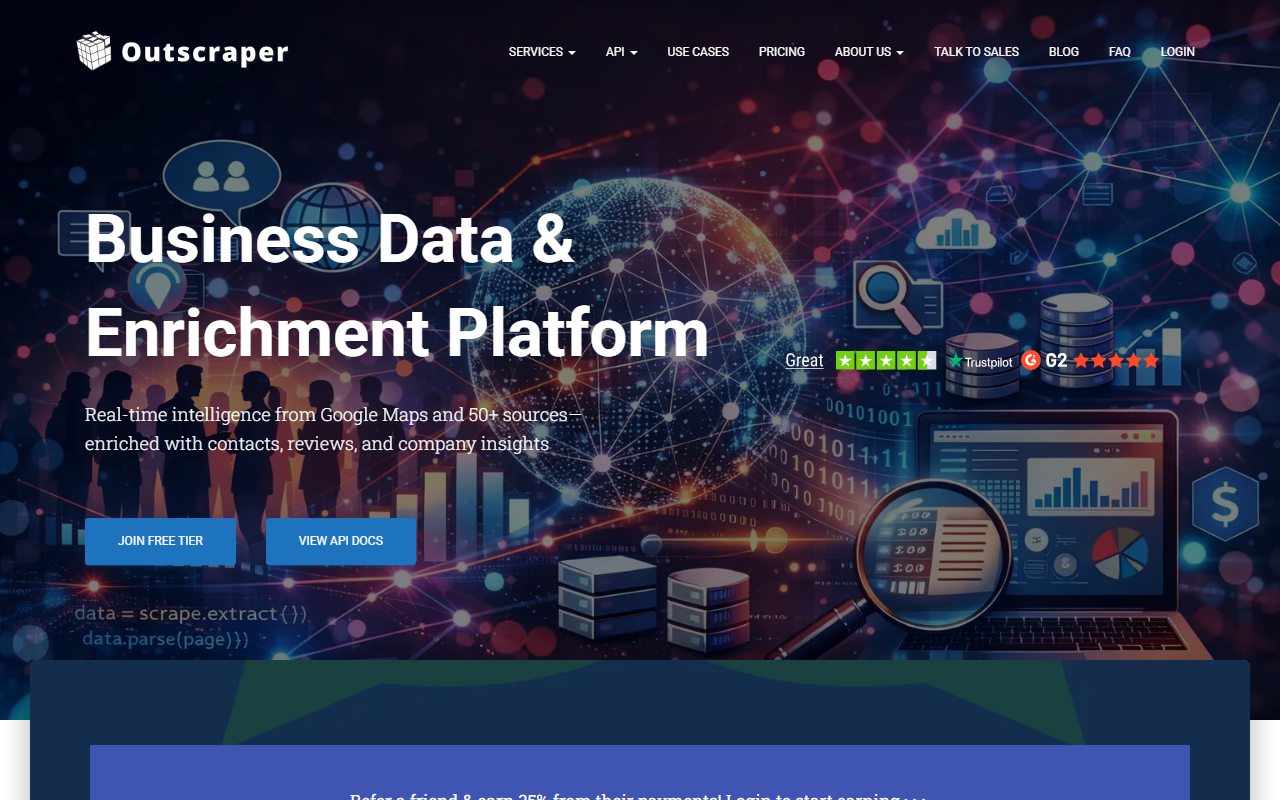
Outscraper is a Google Maps specialist with the most generous free tier in this list, which makes it a low-friction way to pull a few hundred places before paying anything. It does places, reviews, and contact enrichment, and exposes an API for automation.
Pricing
Per Outscraper’s Google Maps scraper page in mid-2026, the first 500 businesses (places) are free, then usage from 501 to 100,000 places bills at $3 per 1,000 records, dropping to $1 per 1,000 above 100,000. It is pay-as-you-go with no monthly commitment, and API access is included on the paid tiers. The free 500 places need no credit card, so testing on your exact target list costs nothing.
Standout features
Per Outscraper’s page, the scraper returns 50+ default columns: business name, phone, website, full address with city, state, postal code, and country, latitude and longitude, rating, review count, photo count, business status, working hours, price range, and Maps, reviews, and reservation links. Enrichment columns add emails, social links, and website metadata. It scrapes reviews separately too, and exports to CSV, Excel, Parquet, or JSON.
Best for
Lead-gen and local-data projects that want a Maps-focused tool with a real free allowance and a simple per-record price. The trade-off versus ChocoData is scope: Outscraper is built for Maps and a few adjacent Google sources, so if you scrape many unrelated sites you still need a general API alongside it.
5. Oxylabs
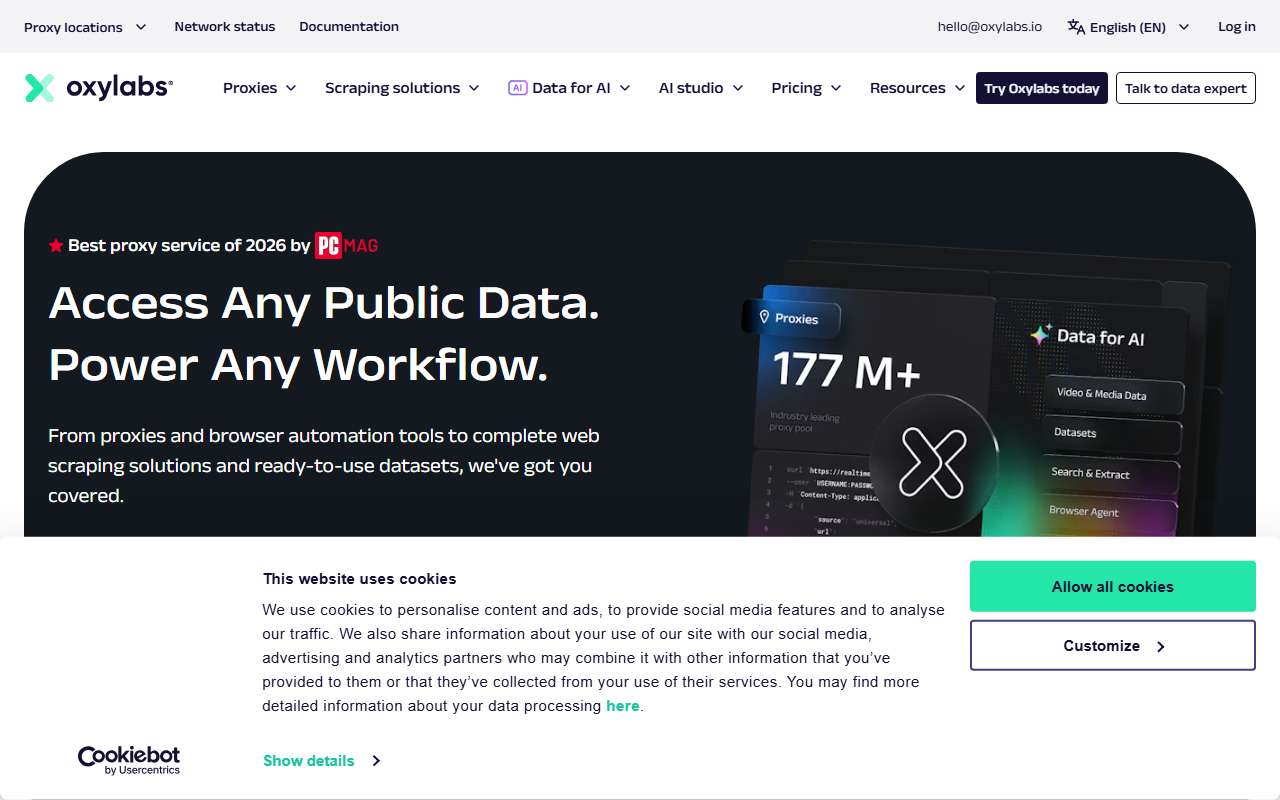
Oxylabs treats Google Maps as a search type inside its general SERP Scraper API, which suits teams that already run a SERP stack and want Local results folded into it. It is an enterprise-leaning tool with deep parsing across Google verticals.
Pricing
Per Oxylabs’ SERP Scraper API page in mid-2026, the free trial includes up to 2,000 results with no credit card, and paid plans start at $49/mo (Micro) for up to 98,000 results, then $99/mo (Starter) for 220,000. Google without JavaScript rendering runs about $0.90 per 1,000 results at the Starter tier, and adding rendering pushes it to roughly $1.30 per 1,000. Budget for the rendered rate if you need the full dynamic Local result.
Standout features
Oxylabs exposes a “Google: Local Search” target that retrieves location-based results for restaurants, hotels, and services (per its SERP page, mid-2026), alongside Web Search, News, Images, Scholar, Trends, Finance, and Jobs. It parses Google deeply with location, language, and domain targeting, and covers four engines overall (Google, Bing, Baidu, Yandex). The pull is depth and reliability for teams standardizing on one SERP API.
Best for
Teams that already run a SERP API and want Google Local through the same key, with the option of the other Google verticals. The trade-off versus a dedicated Maps actor: a single Local call returns one query’s results and hits the same ~120-place ceiling, so for exhaustive area coverage you still need the grid approach Apify automates.
6. Bright Data
Bright Data’s SERP API is the enterprise-scale option, with the broadest engine coverage here and an SLA to match. Maps is one of its many supported search types, and it is priced for volume buyers.
Pricing
Per Bright Data’s SERP API page in mid-2026, the free trial is 5,000 requests a month with no credit card, pay-as-you-go is $1.50 per 1,000 requests on a pay-only-for-success basis, and the Scale plan is $499/mo for 380,000 requests. The pay-as-you-go rate is among the higher per-request prices in this list, so the entry economics favor those who can commit to Scale.
Standout features
Bright Data lists Maps as a SERP search type alongside Shopping, Hotels, Images, Trends, Reviews, News, Flights, Ads, Videos, and Jobs (per its SERP page, mid-2026). Output comes as JSON, HTML, or Markdown, and billing is success-only. On performance, Bright Data cites response times under 1 second for standard requests, a 99.9% uptime SLA, and a 99.99% success rate in async mode (its own figures, approximate, compiled from vendor + public sources, not first-hand).
Best for
Enterprise teams that need wide engine coverage, an uptime SLA, and global targeting at scale. Smaller projects will find the per-request price and the $499/mo Scale plan steep next to ChocoData or Scrape.do, and a single Maps call hits the same 120-result ceiling as any SERP API.
7. Scrape.do
Scrape.do is a low-cost scraping API with a ready-made Google Maps endpoint, which makes it a budget-friendly way into Maps scraping without writing parsers. It competes hard on price.
Pricing
Per Scrape.do’s pricing page in mid-2026, the free tier is 1,000 successful API credits a month with no credit card, and paid plans start at $29/mo (Hobby) for 250,000 credits, then $99/mo (Pro) for 1,250,000. Per-credit pricing runs from $0.11 down to $0.06 per 1,000 credits across tiers, and you are charged only for successful responses. That puts Scrape.do among the cheapest paid entries here.
Standout features
Scrape.do ships a dedicated Google Maps Scraper among its Ready Scraper APIs, alongside ready endpoints for Google Search, Shopping, Flights, Hotels, News, Trends, and Play Store (per its pricing page, mid-2026), so common Google targets work without custom parsing. All plans include datacenter and residential proxies, CAPTCHA handling, JavaScript rendering, and geo-targeting.
Where it falls short
Scrape.do publishes less detail on Maps parsing depth and the 120-result cap than the dedicated actors do, and it is less established than Oxylabs or Bright Data. For straightforward Maps queries at a low price it holds up well; for exhaustive area coverage with automatic deduplication, the Apify actor goes further.
How to choose the right one
Match the tool to your job rather than the headline price.
- You scrape Maps plus many other sites: ChocoData. One universal endpoint covers Maps and 234 other targets at the lowest entry price ($19/mo).
- You want place data with zero scraper code: the Apify Google Maps Scraper at $1.50/1k places, the only option here that automatically beats Google’s 120-result cap.
- You want bulk reviews and reputation data: the Apify Google Maps Reviews Scraper at $0.30/1k reviews, or Outscraper’s separate review export.
- You want a Maps specialist with a big free tier: Outscraper, 500 places free then $3/1k.
- You already run a SERP API stack: Oxylabs for Google Local through the same key, or Bright Data when an enterprise SLA matters.
- Lowest cost for a ready-made Maps endpoint: Scrape.do at $29/mo.
If you are building the extraction yourself instead of buying it, the same fundamentals apply: rotate residential IPs, render JavaScript, and respect the rate limits that trigger Google’s CAPTCHA wall. My guides on web scraping and scraping without getting blocked cover the DIY path you can pair with or substitute for an API.
How we evaluated these
I shortlisted these seven tools on the criteria that decide a Google Maps purchase: documented starting price, free tier, the Maps data each one returns (places, reviews, contacts), coverage of Google’s 120-result cap, and best fit by scenario. Every price and feature here is pulled from each vendor’s own pricing or product page in mid-2026 and attributed inline, because review-site numbers go stale fast. The speed and success-rate language is approximate, compiled from vendor-published figures plus aggregated public sources, and is not first-hand; my independent, like-for-like benchmarks are pending at how we test. Pricing is current as of mid-2026 and changes frequently, so confirm the live number on the vendor’s own page, and check whether a plan bills per place, per review, per request, or per credit so you are comparing like with like.
FAQ
Yes, the Google Places API returns place details as JSON, but it meters per call, caps reviews at five per place, and its terms restrict storing and redisplaying the data. Anyone who needs full review history or bulk place extraction uses a scraper against the public Maps pages instead. Check Google's Places API terms for your use case before deciding.
Google's Maps front end caps a single search at roughly 120 places. Dedicated actors like the Apify Google Maps Scraper work around it by splitting the search area into a geographic grid, querying each cell, and deduplicating. A raw SERP API call against one query hits the same 120 ceiling, so for exhaustive area coverage you want a tool that automates the grid.
Scraping publicly visible Maps data such as business names, addresses, and ratings sits in the same gray area as other public-web scraping; the bigger risks are Google's terms of service and copying personal data inside reviews. I cover the landscape in my is-web-scraping-legal guide. This is not legal advice; check your jurisdiction and the data you collect.
Apify splits Maps into two actors. The Google Maps Scraper pulls place records (name, address, phone, rating, hours, popular times) at $1.50 per 1,000 places. The Google Maps Reviews Scraper pulls full review streams (text, star rating, date, reviewer, owner response) at $0.30 per 1,000 reviews. Use the first for place discovery and lead lists, the second for review mining and reputation tracking.