Best Google Scholar Scraper APIs & Tools
- Google Scholar has no official API and is one of the harder Google surfaces to scrape: it throws CAPTCHAs fast, rate-limits by IP, and renders no clean JSON. A managed API handles the proxies and parsing so a Python script stays a few lines.
- Documented entry prices in mid-2026 run from $19/mo (ChocoData) and $25/mo (SerpApi) up through $40-$49/mo (SearchApi, Oxylabs). Bright Data bills per request from $1.50/1K, and Apify community actors bill per result.
- ChocoData is my top value pick: one universal endpoint plus 250+ dedicated endpoints, from $19/mo with a free 1,000 requests/mo and no card.
- For deep citation data, SerpApi ships dedicated Google Scholar, Scholar Author, and Scholar Case Law engines, and SearchApi exposes a
google_scholarengine from $40/mo. - Speed and success figures below are approximate, compiled from vendor-published numbers and aggregated public sources, not first-hand tests. Like-for-like benchmarks are in progress (how we test).
Google Scholar is the largest free index of academic papers, citations, and patents, which makes it the obvious source for literature reviews, citation graphs, and research-trend datasets. The catch is access: there is no official API, the results page hides behind aggressive anti-bot defenses, and a plain Python script gets CAPTCHA-walled within a few pages. This guide compares the Google Scholar scraper APIs I would actually shortlist in 2026 on the four things that decide a purchase: starting price, free tier, which citation fields they parse, and published speed. My top value pick is ChocoData, which fetches Scholar through one universal endpoint from $19/mo. Every price and feature here comes from the vendor’s own pricing or product page in mid-2026, attributed inline, because review-site numbers go stale fast.
One disclosure up front: bestscraperapi.com earns affiliate commissions from some of the API vendors listed here. That does not change which tools make the list, how I rank them, or what I write. Pricing comes straight from each vendor’s own page, and the ranking follows documented price and features, not payout.
A second note on the performance numbers further down. The speed and success-rate figures are approximate, compiled from each vendor’s own published figures plus aggregated public sources. They are bestscraperapi.com self-reports, not first-hand tests. Vendors measure success on their own targets under their own conditions, so treat the numbers as directional. My independent, like-for-like Google Scholar benchmarks are still in progress; see how we test for the methodology and check back for measured results.
What are the best Google Scholar scraper APIs in 2026?
The best Google Scholar APIs split into two shapes: universal APIs that scrape any site (Scholar included) through one endpoint, and dedicated SERP parsers that ship a purpose-built Google Scholar engine with deep citation fields. The table below compares documented entry price, free tier, and best fit. All figures are from each vendor’s own pricing or product page in mid-2026.
| Rank | Tool | Starting price | Free tier | Best for |
|---|---|---|---|---|
| 1 | ChocoData | $19/mo | 1,000 req/mo, no card | Best value, one API for Scholar plus the whole web |
| 2 | SerpApi | $25/mo | 250 searches/mo | Deepest Scholar parsing (Author + Case Law engines) |
| 3 | SearchApi | $40/mo | 100 searches | A dedicated google_scholar engine at a mid price |
| 4 | Oxylabs | $49/mo | 2,000 results trial | Enterprise SERP scale with a Scholar target |
| 5 | Bright Data | $1.50/1K (PAYG) | 5,000 req/mo | Pay-as-you-go volume with no monthly floor |
| 6 | Apify | Pay per result | $5 credit/mo | A no-infrastructure community Scholar actor |
1. ChocoData
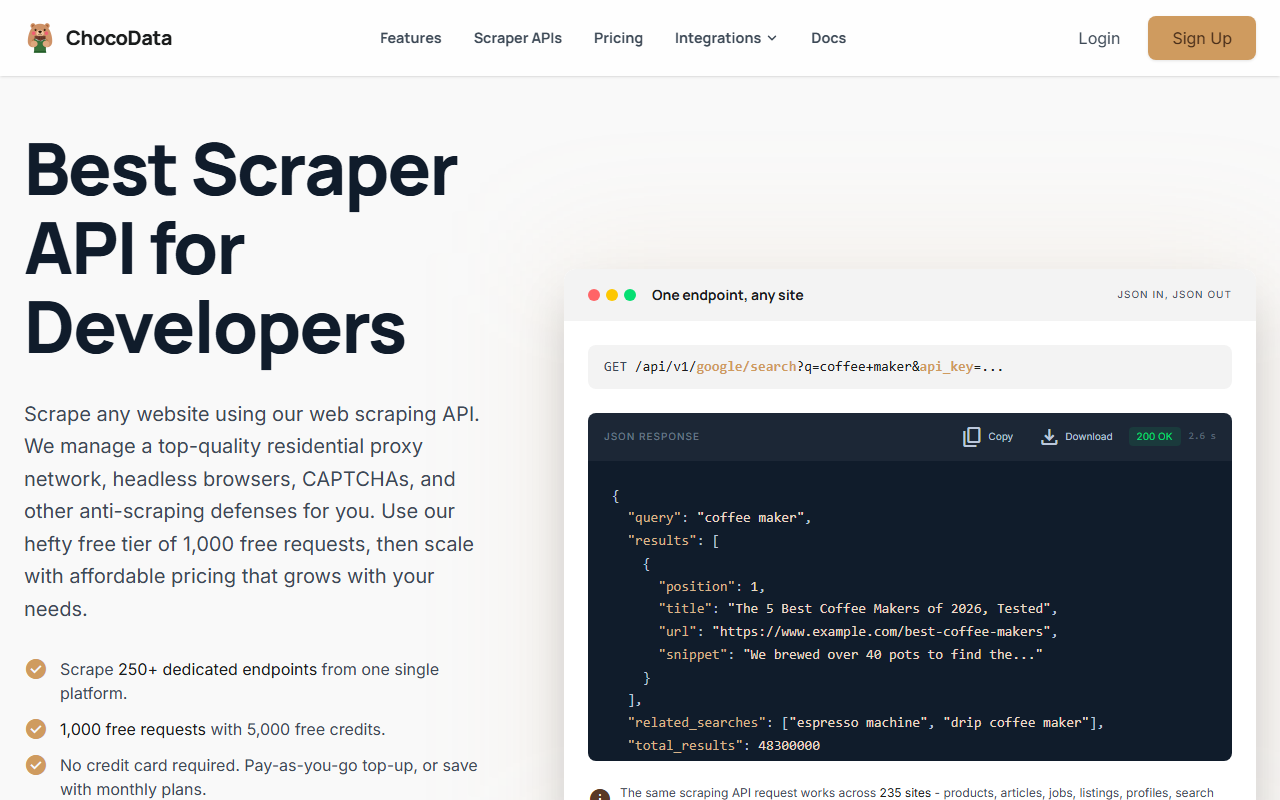
ChocoData is my top pick for Google Scholar because it solves the access problem cheaply and then keeps working for everything else you scrape. One universal endpoint handles Scholar, the rest of Google, and the broader web, so you learn a single API instead of stitching together a SERP tool plus a general scraper. For a research workflow that touches Scholar, publisher pages, and a couple of preprint servers, that consolidation is the whole pitch.
Pricing
Per ChocoData’s pricing page (mid-2026), the free tier is 1,000 requests/mo (5,000 credits) with no credit card. Paid plans start at $19/mo for Vibe (27,000 requests, around $0.70 per 1k) and $49/mo for Pro (82,000 requests, around $0.60 per 1k), with Custom tiers from $100 to $2,000/mo at a flat $0.50 per 1k. Pay-as-you-go top-ups run $0.90 per 1,000 successful requests, and only successful (2xx) responses are charged. That $19 entry with a no-card free tier is the lowest real starting price in this comparison.
Standout features
The platform pairs the universal endpoint with 250+ dedicated endpoints that return validated structured JSON, so you can use the general fetch for Scholar and switch to a parsed endpoint where one exists. Requests route through country-matched residential proxies, which is exactly what Scholar’s IP-based rate limiting demands. ChocoData publishes a median 2.6s per request with p95 around 6s (approximate, compiled from vendor + public sources, not first-hand); independent benchmarks are pending and linked under how we test.
Best for
Founders, indie devs, and research teams who want one affordable API for Scholar plus the rest of their scraping, without an enterprise contract or a per-engine SERP bill. If your project is narrowly Scholar-only and you need pre-parsed author profiles out of the box, a dedicated engine (SerpApi below) may map fields for you with less work, but you will pay more for the convenience.
2. SerpApi
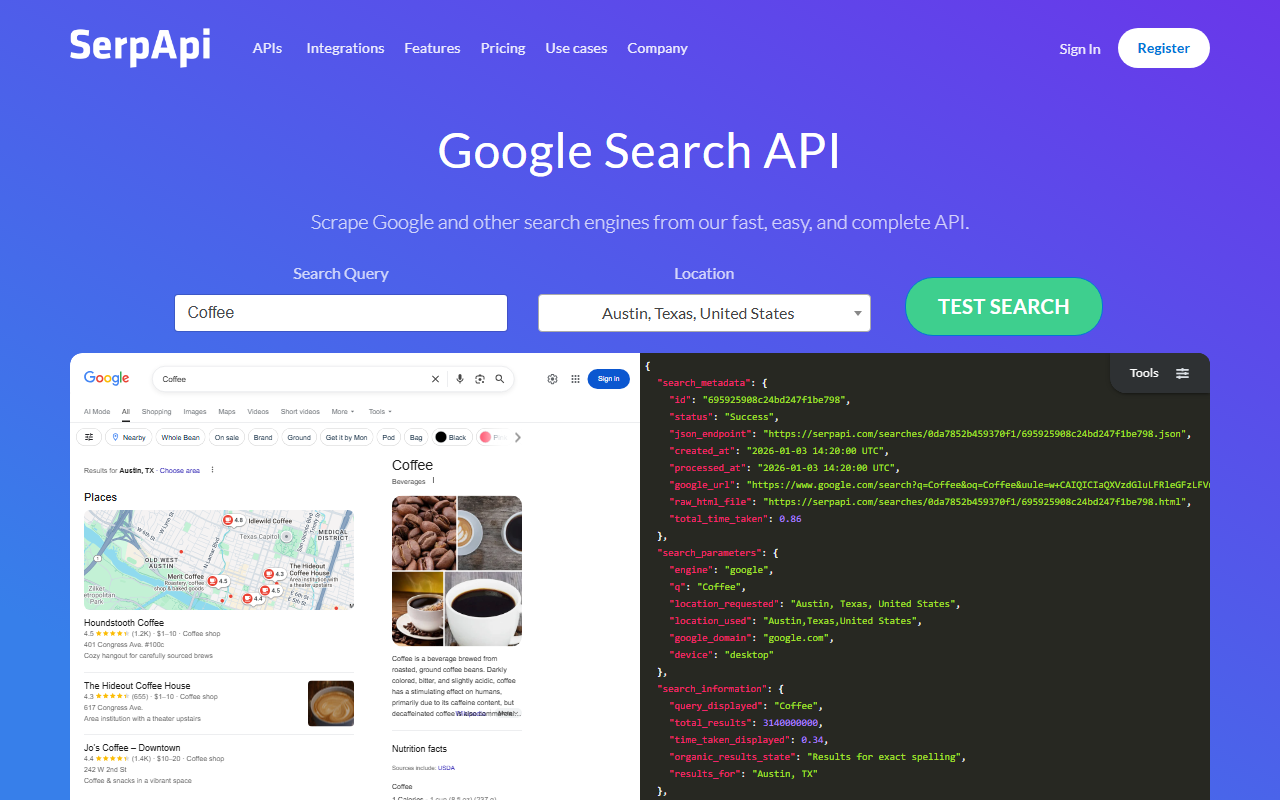
SerpApi is the specialist for anyone whose project lives and dies on citation depth. It ships not one but three Scholar engines: a Google Scholar API for results, a Scholar Author API for profile and publication history, and a Scholar Case Law API for legal opinions. If you are building a citation graph or an author-tracking tool, that breakdown saves real parsing work.
Pricing
Per SerpApi’s pricing page (mid-2026), the free plan is 250 searches/mo at 50 requests/hour. Paid plans are month-to-month: Starter at $25/mo (1,000 searches), Developer at $75/mo (5,000 searches), Production at $150/mo (15,000 searches), and Big Data at $275/mo (30,000 searches), with Enterprise on request. All plans include what SerpApi calls a U.S. Legal Shield, and the $25 Starter is the cheapest dedicated-engine entry on this list.
Standout features
The Scholar engines return named JSON fields for title, authors, publication, year, cited-by count, versions, and related-articles links, plus the dedicated Author and Case Law variants no other vendor here matches. SerpApi publishes high success rates and sub-3s typical response times on its SERP engines (approximate, compiled from vendor + public sources, not first-hand). Independent figures are pending; see how we test.
Where it falls short
Pricing is per search and search-only, so SerpApi does not double as a general web scraper the way ChocoData does. If your workflow also needs to fetch publisher pages or arbitrary URLs, you will run a second tool alongside it. For pure Scholar and SERP work, though, the engine depth is the best in this group.
3. SearchApi
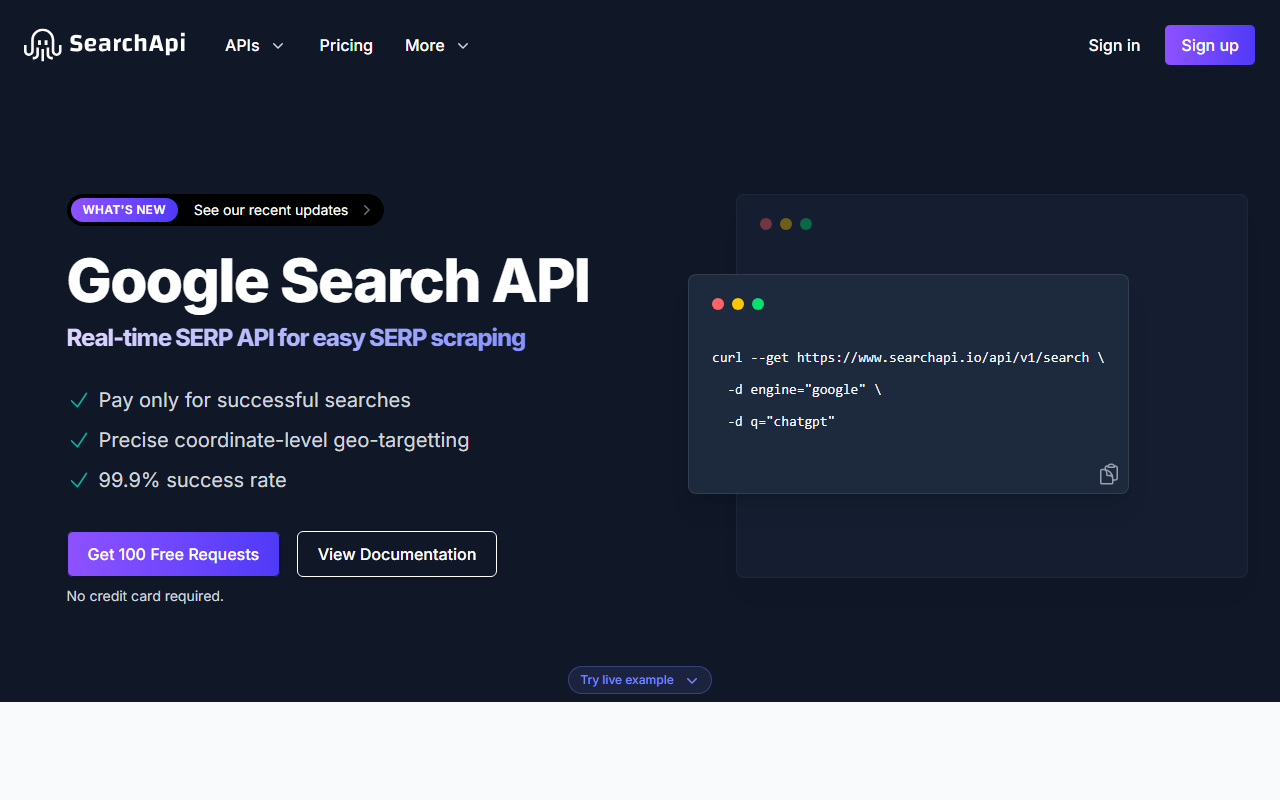
SearchApi sits between the universal APIs and the premium SERP specialists. It exposes a dedicated google_scholar engine that returns parsed results, so you get named fields without building a parser, at a price below the enterprise tier. For a mid-budget Scholar project that wants structure without a heavy contract, it is a clean fit.
Pricing
Per SearchApi’s pricing page (mid-2026), there is a free allotment of 100 requests and no card required to start. Paid plans begin at $40/mo for Developer (10,000 searches, $4 per 1k) and $100/mo for Production (35,000 searches, $3 per 1k), scaling up through BigData at $250/mo (100,000 searches) and Scale at $500/mo (250,000 searches). The Production tier and above add what SearchApi calls a Legal Protection Guarantee and a 99.9% SLA.
Standout features
The google_scholar engine returns the standard Scholar fields (title, link, snippet, authors, publication info, cited-by, versions) as parsed JSON, so a Python call gets usable data immediately. SearchApi advertises a 99.9% SLA on paid plans and fast response times across its engines (approximate, compiled from vendor + public sources, not first-hand). Independent benchmarks are pending and linked under how we test.
Best for
Teams that specifically want a parsed Scholar engine and a per-search model, but find SerpApi’s deepest features more than they need. The free tier is small at 100 requests, so plan to upgrade quickly once you move past testing.
4. Oxylabs
Oxylabs is the enterprise-scale option for SERP work, with a Scraper API that lists Google Scholar as a supported target. The draw is reliability and scale: a large proxy pool, an SLA, and the kind of throughput a high-volume research pipeline needs. It is heavier than the cheaper picks, and that is the point.
Pricing
Per Oxylabs’ SERP Scraper API page (mid-2026), there is a free trial of up to 2,000 results with no card. Paid plans start at Micro for $49/mo, then Starter at $99/mo and Advanced at $249/mo, with per-1k Google results priced around $1.00 (Micro), $0.90 (Starter), and $0.80 (Advanced). JavaScript-rendered results add roughly $1.25 to $1.35 per 1k across tiers, so factor that in for any rendered Scholar fetch.
Standout features
The API lists Google Scholar as a target with raw HTML output and parsing available through Oxylabs’ own parser, and its general Google Web Search endpoint returns parsed JSON across a wide field set. The residential and datacenter proxy pool is among the largest in this group, which matters for Scholar’s IP throttling. Oxylabs publishes high success rates on its SERP targets (approximate, compiled from vendor + public sources, not first-hand); independent figures are pending, see how we test.
Where it falls short
At $49/mo to start, plus render surcharges, it is priced for teams with real volume rather than solo researchers. Scholar parsing leans on the Oxy Parser rather than a fully pre-built named-field engine like SerpApi’s, so confirm the output shape against your needs during the trial.
5. Bright Data
Bright Data is the pay-as-you-go choice when you do not want a monthly commitment. Its SERP API bills per request with no required base plan, so a one-off Scholar pull or a spiky workload only costs what you use. For irregular research jobs, that pricing shape is the most flexible here.
Pricing
Per Bright Data’s SERP API page (mid-2026), pay-as-you-go is $1.50 per 1,000 requests with a free tier of 5,000 requests/mo and no card. A Scale plan at $499/mo includes 380,000 requests and drops additional requests to $1.30 per 1k, with Enterprise volume pricing on request. New accounts are offered a first-deposit match up to $500.
Standout features
The SERP API supports Google across global domains and returns parsed results, backed by one of the largest proxy networks in the industry, which directly addresses Scholar’s blocking. Bright Data publishes strong success and uptime numbers across its SERP product (approximate, compiled from vendor + public sources, not first-hand). Independent benchmarks are pending and linked under how we test.
Where it falls short
Bright Data’s product page does not call out a dedicated Google Scholar engine the way SerpApi and SearchApi do, so confirm Scholar coverage and the parsed output for that surface before you build. The platform and dashboard are also more enterprise-oriented, which is more setup than a single-endpoint API if all you need is Scholar.
6. Apify
Apify is the no-infrastructure route: instead of an API you wire up yourself, you run a prebuilt Google Scholar actor from the Apify Store and collect the dataset. For a one-time scrape or a non-developer who wants results without managing proxies, it is the lowest-friction option on this list.
Pricing
Per Apify’s pricing page (mid-2026), the Free plan includes $5 of monthly platform credit at $0.20 per compute unit, with Starter at $29/mo and Scale at $199/mo (each adding matching platform credit at a lower per-unit rate). Community Google Scholar actors, such as the widely used marco.gullo Google Scholar Scraper, bill on a pay-per-result or pay-per-usage basis on top of platform usage, so confirm the actor’s rate on its store page before a large run.
Standout features
A community Scholar actor returns titles, document types, links, authors, publication details, year, citation counts, related-article links, and version data, exportable to JSON, CSV, Excel, or HTML. You get a scheduled, hosted scraper with no proxy management, and the $5 free credit covers testing. Performance depends on the individual actor rather than a platform-wide SLA (approximate, compiled from vendor + public sources, not first-hand); see how we test.
Where it falls short
Compute-unit billing is harder to forecast than a flat per-search price, and you depend on a community maintainer keeping the actor current as Scholar’s HTML shifts. For a programmatic, always-on pipeline, a first-party API (ChocoData or a dedicated SERP engine) gives you more predictable cost and a clearer support path.
How to choose the right one
The right tool depends on what your Scholar project actually needs. Quick guidance by scenario:
| Your situation | Best fit | Why |
|---|---|---|
| You scrape Scholar plus other sites and want one cheap API | ChocoData | Universal endpoint, $19/mo, free 1,000 req/mo |
| You need author profiles or case law, not just results | SerpApi | Dedicated Scholar, Author, and Case Law engines |
| You want a parsed Scholar engine at a mid budget | SearchApi | google_scholar engine from $40/mo |
| You run high-volume research at enterprise scale | Oxylabs | Large proxy pool, SLA, Scholar target |
| Your workload is spiky and you hate monthly floors | Bright Data | $1.50/1K pay-as-you-go, no base plan |
| You want results with zero code or infrastructure | Apify | Prebuilt hosted Scholar actor, $5 free credit |
If you are still learning the basics, start with the web scraping pillar guide, and since Scholar blocks hard, read scraping without getting blocked before you write a line of Python against it.
How we evaluated these
I selected these six tools for documented Google Scholar or general SERP support, then compared each on starting price, free tier, parsed citation fields, and published performance, pulling every price and feature from the vendor’s own pricing or product page in mid-2026 and attributing it inline. Performance figures are approximate, compiled from vendor-published numbers plus aggregated public sources, and are not first-hand benchmarks yet; my independent, like-for-like tests are in progress and documented at how we test. Pricing is current as of mid-2026 and can change, so confirm the live numbers at each vendor before you commit.
FAQ
No. Google has never published a Google Scholar API, and the export options on scholar.google.com are limited to per-result BibTeX or RIS citations, not bulk queries. For structured fields at volume you scrape the public results page, which is what every tool on this list does. Semantic Scholar and OpenAlex offer free scholarly APIs over their own corpora, but they are not Google Scholar and their coverage and ranking differ.
Scholar runs aggressive anti-bot defenses with a low tolerance for automated traffic. A handful of fast requests from one IP triggers a CAPTCHA wall or a temporary block, and the page returns no clean JSON, only HTML you have to parse. A managed API rotates residential IPs, solves or avoids the CAPTCHAs, and returns parsed fields, which is why a DIY requests script stalls within a few pages while an API keeps going.
The better parsers return the title, result link, snippet, author list, publication and year, the cited-by count, links to all versions and to related articles, and any PDF resource link. SerpApi and SearchApi expose these as named JSON fields, and SerpApi adds dedicated Author profile and Case Law engines. A thin universal call returns the same data once you map it, but you do more of the field mapping yourself.
For tiny jobs, yes. The open-source scholarly library scrapes scholar.google.com directly and works for a few queries before Scholar blocks your IP, at which point you are buying proxies and solving CAPTCHAs anyway. Most free tiers here cover small runs without that hassle: ChocoData gives 1,000 requests/mo with no card, and SerpApi gives 250 searches/mo. I walk through the DIY path and where it breaks in my Google Scholar guide.