Best Google Search (SERP) Scraper APIs & Tools
- Google scraping through an API means sending a query to a managed endpoint that runs the headless browser, rotates residential IPs, solves CAPTCHAs, and returns parsed SERP JSON instead of the consent gate a raw request gets back.
- ChocoData is my top value pick: one universal endpoint plus 250+ dedicated endpoints, Google Search among them, from $19/mo with 1,000 free requests/mo and no card.
- Documented entry prices in mid-2026: ChocoData $19/mo, SerpApi $25/mo, Scrape.do $29/mo, ScraperAPI $49/mo, ScrapingBee $49/mo, Oxylabs $49/mo. Bright Data bills $1.50/1k pay-as-you-go.
- SerpApi is the SERP specialist: 250 free searches/mo, six Google engines, and a U.S. legal shield, per its pricing page.
- Speed and success figures here are approximate, compiled from vendor-published numbers and aggregated public sources, not first-hand. Like-for-like benchmarks are pending (how we test).
Google is the highest-value scraping target on the web and the hardest to hold: rank tracking, ad monitoring, and AI-answer research all start with the live SERP, and Google blocks naive requests within a few queries. This page compares the Google search scraper APIs I would actually shortlist in 2026, on the things that decide a purchase: starting price, free tier, which SERP result types they parse, and best fit. My top value pick is ChocoData, and the comparison runs through SerpApi, Oxylabs, Bright Data, ScraperAPI, ScrapingBee, and Scrape.do. Every price and feature comes from the vendor’s own pricing or product page in mid-2026, attributed inline, because review-site numbers go stale fast.
One disclosure up front: bestscraperapi.com earns affiliate commissions from some of the vendors listed here. That does not change which tools make the list, how I rank them, or what I write. Pricing comes straight from each vendor’s own page, and the ranking follows documented price and features, not payout.
A note on the performance numbers further down. The speed and success-rate figures are approximate, compiled from each vendor’s published figures plus aggregated public sources. They are not bestscraperapi.com’s own first-hand tests. Vendors measure on their own targets under their own conditions, so the numbers are directional rather than apples to apples. My independent, like-for-like Google SERP benchmarks are pending; see how we test for the methodology.
| Rank | Tool | Starting price | Free tier | Best for |
|---|---|---|---|---|
| 1 | ChocoData | $19/mo (Vibe) | 1,000 requests/mo, no card | One API for Google plus every other source |
| 2 | SerpApi | $25/mo (Starter) | 250 searches/mo | SERP specialists who want six Google engines |
| 3 | Oxylabs | $49/mo (Micro) | Up to 2,000 results | Teams needing AI Overviews and deep parsing |
| 4 | Bright Data | $1.50/1k (pay-as-you-go) | 5,000 requests/mo | Enterprise scale with an SLA |
| 5 | ScraperAPI | $49/mo (Hobby) | 5,000 credits, 7-day trial | General scraping with SERP folded in |
| 6 | ScrapingBee | $49/mo (Freelance) | 1,000 credits | Small teams already using ScrapingBee |
| 7 | Scrape.do | $29/mo (Hobby) | 1,000 requests/mo | Low-cost ready-made Google endpoints |
Pricing per each vendor’s pricing or product page, mid-2026. Pay-as-you-go and per-result rates assume the entry tier; most vendors drop the unit price on higher plans. Confirm the current number at the source before you budget.
1. ChocoData
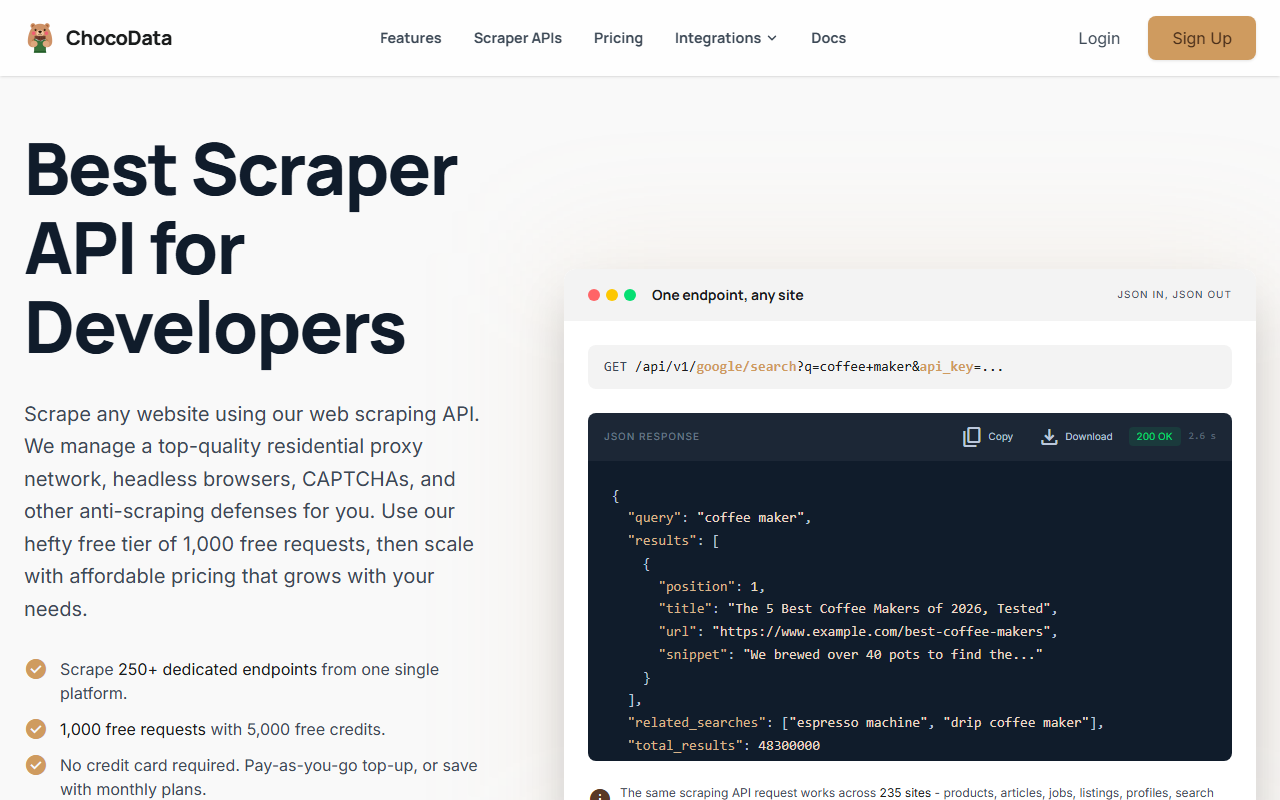
ChocoData is my top pick for Google scraping because it returns SERP data through one clean API at the lowest documented entry price in this list, and the same integration covers every other source you scrape. You point it at Google through either the universal endpoint or the dedicated Google scraper, and you are not bolting on a separate SERP-only tool to do it.
Pricing
Per ChocoData’s pricing page in mid-2026, the Free plan gives 1,000 requests a month (5,000 credits) with no credit card, and paid plans start at $19/mo (Vibe) for 27,000 requests, then $49/mo (Pro) for 82,000. ChocoData bills 5 credits per request, adds 10 for JavaScript rendering, and charges only 2xx responses, so failed SERP fetches do not count. Pay-as-you-go top-ups run $0.90 per 1,000 successful requests on any plan. For a workload that touches Google plus e-commerce or social data, one $19/mo entry price for the whole surface beats stacking single-purpose tools.
Standout features
ChocoData exposes a single universal endpoint, /api/v1/{site}/{resource}, across 235 supported sites, plus 250+ dedicated endpoints that return validated structured JSON (per its site, mid-2026). Google Search is among the supported scrapers, and SERP queries come back as clean structured data with position, title, URL, snippet, related searches, and total result count. Country-matched residential IPs handle location-specific results, so a query for “coffee shops” returns the SERP a local user would see.
Best for
Developers and founders who want Google SERP data through a real API at the lowest entry price ($19/mo), and who also scrape other sources. If Google is your only target and you want vertical-specific engines like Scholar or Flights, a specialist like SerpApi may fit better, but for one integration across the whole web, ChocoData is the value pick. Try ChocoData.
2. SerpApi
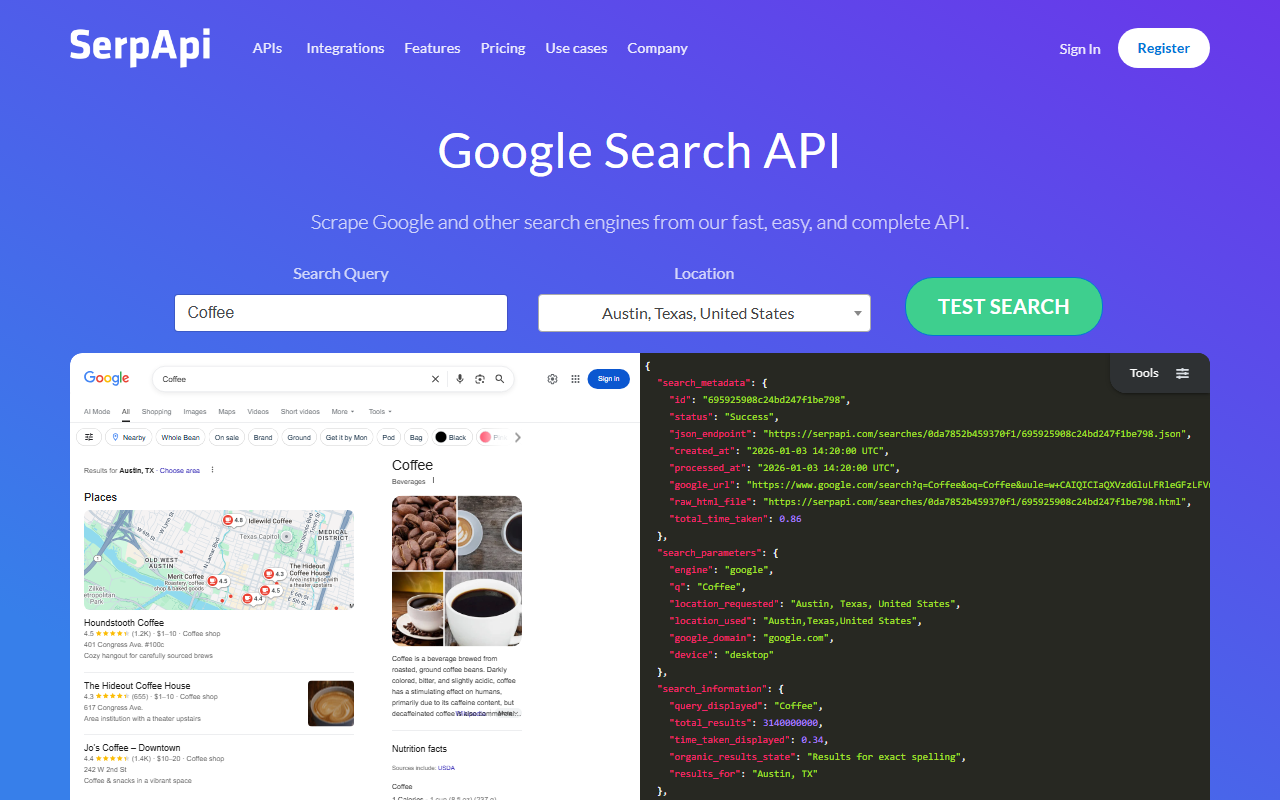
SerpApi is the SERP specialist of the group: it does Google search results and the engines around them, and little else, which is exactly what some buyers want. If your entire job is ranking data, ads, and Google verticals, a tool built only for that is worth a look.
Pricing
Per SerpApi’s pricing page in mid-2026, the free tier includes 250 searches a month at $0, and the cheapest paid plan is Starter at $25/mo for 1,000 searches. Contracts are month to month with no lock-in, and an Enterprise tier covers custom volume. The per-search model is simple to budget against, though it gets expensive at high volume compared with the credit-based APIs here.
Standout features
SerpApi covers six Google engines: Search, Images, Maps, News, Shopping, and Scholar (per its pricing page, mid-2026). The Google Search API returns organic results, the knowledge graph, local results, shopping results, related questions, “people also search for,” and direct answer boxes (per its Search API page). Location targeting is granular: a city-level location parameter, lat/lon coordinates, the UULE encoded-location parameter, and gl/hl/cr filters. SerpApi also includes a U.S. legal shield across plans, which is unusual in this space.
Best for
SEO teams and rank-tracking products that live inside Google and want clean, well-documented engine coverage with a legal backstop. The trade-off is scope and unit cost: it is Google-only, and at scale the per-search price runs higher than ChocoData’s credit model.
3. Oxylabs
Oxylabs sells a dedicated SERP Scraper API aimed at teams that need deep, current SERP parsing, including the AI features Google keeps adding. It is an enterprise-leaning tool with the parsing depth to match.
Pricing
Per Oxylabs’ SERP Scraper API page in mid-2026, the free trial includes up to 2,000 results with no credit card, and paid plans start at $49/mo (Micro) for up to 98,000 results, then $99/mo (Starter) for 220,000. Google without JS rendering runs $0.40 to $1.00 per 1,000 results depending on tier; adding JS rendering pushes it to roughly $1.25 to $1.35 per 1,000. Budget for the JS-rendered rate if you need the full dynamic SERP.
Standout features
Oxylabs parses Google deeply: organic results, ads, knowledge panels, featured snippets, the local pack, related questions, recipes, and video results, with up to 269 data points for Google Web Search (per its SERP page, mid-2026). It documents AI Mode and AI Overviews parsing, which most competitors have not caught up to, plus Images, News, Scholar, Trends, Finance, Jobs, Shopping, and Google Lens. It covers four engines overall (Google, Bing, Baidu, Yandex) with location, language, and domain targeting.
Best for
Teams that need the richest Google parsing available, especially AI Overviews and AI Mode, and can justify the JS-rendered per-result rate. If you only need plain organic results, a cheaper tool covers it; Oxylabs earns its price when you need the full SERP surface parsed.
4. Bright Data
Bright Data’s SERP API is the enterprise-scale option, with the broadest engine coverage here and an SLA to match. It is priced for volume buyers rather than hobbyists.
Pricing
Per Bright Data’s SERP API page in mid-2026, the free trial is 5,000 requests a month with no credit card, pay-as-you-go is $1.50 per 1,000 requests on a pay-only-for-success basis, and the Scale plan is $499/mo for 380,000 requests plus $1.30 per 1,000 additional. There is a first-deposit match up to $500. The entry economics favor those who can commit to the Scale plan; the pay-as-you-go rate is among the higher per-request prices in this list.
Standout features
Bright Data covers seven engines (Google, Bing, DuckDuckGo, Yandex, Baidu, Yahoo, Naver) across 195 countries with city-level targeting (per its SERP page, mid-2026). Google search types include Shopping, Maps, Hotels, Images, Trends, Reviews, News, Flights, Ads, Videos, and Jobs. Output comes as JSON, HTML, or Markdown, results reflect real user searches, and billing is success-only.
Best for
Enterprise teams that need wide engine coverage, an uptime SLA, and global city-level targeting at scale. Smaller projects will find the per-request price and the $499/mo Scale plan steep next to ChocoData or Scrape.do.
5. ScraperAPI
ScraperAPI is a general-purpose scraping API that folds SERP collection into its broader product through structured data endpoints. If you already scrape the open web with it, adding Google is a small step.
Pricing
Per ScraperAPI’s pricing page in mid-2026, the free trial includes 5,000 API credits over 7 days, and paid plans start at $49/mo (Hobby) for 100,000 API credits. Higher tiers scale credits and concurrency from there. The credit model means a JS-rendered SERP request costs more credits than a plain fetch, so size your plan against the request type you actually need.
Standout features
ScraperAPI offers structured data and SERP data collection: “Get structured JSON data from in-demand domains” and “Collect search data for any query in seconds,” with a dedicated path for SEO agencies wanting first-party SERP data (per its SERP solution page, mid-2026). The Google Search endpoint returns organic results, knowledge graph, local results, shopping, related questions, and answer boxes. The pull is integration breadth: one API for Google plus the rest of your scraping.
Best for
Teams already running ScraperAPI for general scraping who want SERP data through the same key, rather than a Google-only specialist. If Google is your primary target and you want the deepest SERP parsing, Oxylabs or SerpApi go further.
6. ScrapingBee
ScrapingBee is a developer-friendly scraping API with a Google Search API available on its mid and upper tiers. It suits small teams that value a simple integration over the lowest unit price.
Pricing
Per ScrapingBee’s pricing page in mid-2026, the free trial is 1,000 API credits with no credit card, and paid plans start at $49/mo (Freelance) for 250,000 credits. The Google Search API is included from the Startup plan ($99/mo) and up, so reaching the SERP feature costs more than the entry price suggests. Plan for the $99/mo tier if Google search is the reason you are signing up.
Standout features
ScrapingBee’s Google Search API returns structured SERP JSON, and the broader API handles JavaScript rendering, proxy rotation, and CAPTCHA handling across the open web (per its pricing page, mid-2026). Concurrency scales from 10 requests on Freelance to 200 on Business+. The appeal is a clean, well-documented API that developers get running quickly.
Best for
Small dev teams already on ScrapingBee, or those who want a straightforward general API with Google search as one capability. Note the Google Search API sits on the $99/mo Startup plan, so for SERP-first projects on a budget, ChocoData or Scrape.do start cheaper.
7. Scrape.do
Scrape.do is a low-cost scraping API with ready-made Google endpoints, which makes it a budget-friendly entry into Google scraping without much setup. It competes hard on price.
Pricing
Per Scrape.do’s pricing page in mid-2026, the free tier is 1,000 successful API credits a month with full feature access and no credit card, and paid plans start at $29/mo (Hobby) for 250,000 credits, then $99/mo (Pro) for 1,250,000. Per-credit pricing runs from $0.11 down to $0.06 per 1,000 credits across tiers, and you are charged only for successful responses. That puts Scrape.do among the cheapest paid entries here.
Standout features
Scrape.do ships dedicated Ready Scraper APIs for Google Search, Maps, Shopping, Flights, Hotels, News, Trends, and Play Store (per its pricing page, mid-2026), so common Google targets work without writing parsers. All plans include datacenter and residential proxies, CAPTCHA handling, JavaScript rendering, and geo-targeting across 160+ countries.
Where it falls short
Scrape.do is less established than Oxylabs or Bright Data, and it publishes less detail on SERP parsing depth and AI-feature coverage. For deep, current SERP features like AI Overviews, the specialists document more. For straightforward Google search at a low price, it holds up well.
How to choose the right one
Match the tool to your job rather than the headline price.
- You scrape Google plus many other sites: ChocoData. One universal endpoint covers Google and 234 other targets at the lowest entry price ($19/mo).
- Google is your entire product (rank tracking, SERP monitoring): SerpApi for six clean engines and a legal shield, or Oxylabs when you need AI Overviews and the deepest parsing.
- You need AI Overviews or AI Mode parsed: Oxylabs documents both today; confirm the specific feature on its docs before committing.
- Enterprise scale with an SLA and global city targeting: Bright Data, if you can commit to the Scale plan.
- You already run a general scraping API: ScraperAPI or ScrapingBee, so SERP rides the same key (mind ScrapingBee’s $99/mo gate for Google search).
- Lowest cost for ready-made Google endpoints: Scrape.do at $29/mo.
If you are building the extraction yourself instead of buying it, the same fundamentals apply: rotate residential IPs, render JavaScript, and respect the rate limits that trigger Google’s CAPTCHA wall. My guides on web scraping and scraping without getting blocked cover the DIY path you can pair with or substitute for an API.
How we evaluated these
I shortlisted these seven tools on the criteria that decide a Google SERP purchase: documented starting price, free tier, the SERP result types each one parses, engine and vertical coverage, and best fit by scenario. Every price and feature here is pulled from each vendor’s own pricing or product page in mid-2026 and attributed inline, because review-site numbers go stale fast. The speed and success-rate language is approximate, compiled from vendor-published figures plus aggregated public sources, and is not first-hand; my independent, like-for-like benchmarks are pending at how we test. Pricing is current as of mid-2026 and changes frequently, so confirm the live number on the vendor’s own page, and check whether a plan bills per search, per request, or per credit so you are comparing like with like.
FAQ
Google sells the Custom Search JSON API, but it indexes a search engine you configure rather than the live public SERP, caps at 100 free queries a day, and does not return the ads, local pack, or rich features that a SERP scraper does. Anyone who needs the real ranking a user sees, with full SERP features, uses a scraper against the public results. Check Google's Custom Search terms for your use case before deciding.
Scraping publicly visible search results sits in the same gray area as other public-web scraping; the main constraints are Google's terms of service and any copyrighted snippets you store. I cover the landscape in my is-web-scraping-legal guide. This is not legal advice; check your jurisdiction and the data you collect.
Google fingerprints the TLS handshake, headers, and behavior of every request, serves a consent or CAPTCHA wall to anything that looks automated, and rate-limits by IP within a handful of queries. A SERP API gets around it with residential IPs, a real headless browser, and CAPTCHA solving, which is why the managed route holds up at volume where a plain script does not.
Coverage varies by vendor and changes as Google ships new SERP features. Oxylabs documents AI Overviews and AI Mode parsing on its SERP page, and most vendors here parse the local pack, knowledge panel, and related questions. Confirm the specific feature you need on the vendor's own docs, since SERP parsers lag Google's layout changes by weeks.