Best Google Shopping Scraper APIs & Tools
- Google Shopping scraping means routing a Shopping query through a managed API that rotates IPs, sets a locale, and returns parsed product, price, and seller fields as JSON instead of a consent wall or CAPTCHA.
- Documented entry prices in mid-2026 run from $19/mo (ChocoData) and $29/mo (Apify platform) up to $499/mo (Bright Data Scale). Most bill only successful requests.
- ChocoData is my #1 value pick: one universal endpoint plus 453 dedicated endpoints across 235 sites, from $19/mo with a free 1,000 requests/mo and no card.
- For a dedicated structured Shopping endpoint, SearchApi.io and ScraperAPI return a parsed
shopping_resultsarray; Oxylabs and Bright Data reach Shopping through their SERP APIs. - Speed and success figures below are approximate, compiled from vendor-published numbers and public sources, not first-hand. Like-for-like benchmarks are pending (how we test).
Google Shopping is one of the highest-value targets in e-commerce scraping and one of the more annoying to fetch directly: results are JavaScript-rendered, gated behind consent and CAPTCHA walls, and personalized by location and currency. My #1 pick for most people is ChocoData, and below I compare it against five other tools I would actually shortlist (SearchApi.io, ScraperAPI, Oxylabs, Bright Data, and an Apify actor) on starting price, free tier, the structured fields each returns, and published speed.
One disclosure up front: bestscraperapi.com earns affiliate commissions from some of the vendors listed here. That has no effect on which tools make the list, how I rank them, or what I write. Pricing comes straight from each vendor’s own page in mid-2026, and the ranking follows documented price and features, not payout.
TLDR comparison
| Rank | Tool | Starting price | Free tier | Best for |
|---|---|---|---|---|
| 1 | ChocoData | $19/mo (Vibe) | 1,000 requests/mo, no card | Shopping plus other targets at the lowest entry price |
| 2 | SearchApi.io | $40/mo (Developer) | 100 requests, no card | A clean dedicated Shopping endpoint with simple per-search pricing |
| 3 | ScraperAPI | Free plan, paid from higher | 1,000 credits/mo + 5,000-credit trial | A structured Shopping endpoint plus a free tier to test |
| 4 | Oxylabs | $49/mo (Micro) | 2,000 results, no card | Deep Google SERP parsing where Shopping is one of many result types |
| 5 | Bright Data | PAYG $1.50/1K | 5,000 requests/mo, no card | Per-request delivery and city-level localization at scale |
| 6 | Apify (epctex actor) | $29/mo platform (Starter) | $5 usage/mo, no card | Reusing a prebuilt actor without writing or hosting one |
The tools bill in different units, so these starting prices are not comparable on volume. ChocoData and ScraperAPI sell credits; SearchApi.io bills per search; Oxylabs charges per Google result; Bright Data charges per request; Apify charges a monthly actor rental plus platform usage. Read the included volume next to each price, and check the per-result or per-credit rate before you commit.
1. ChocoData
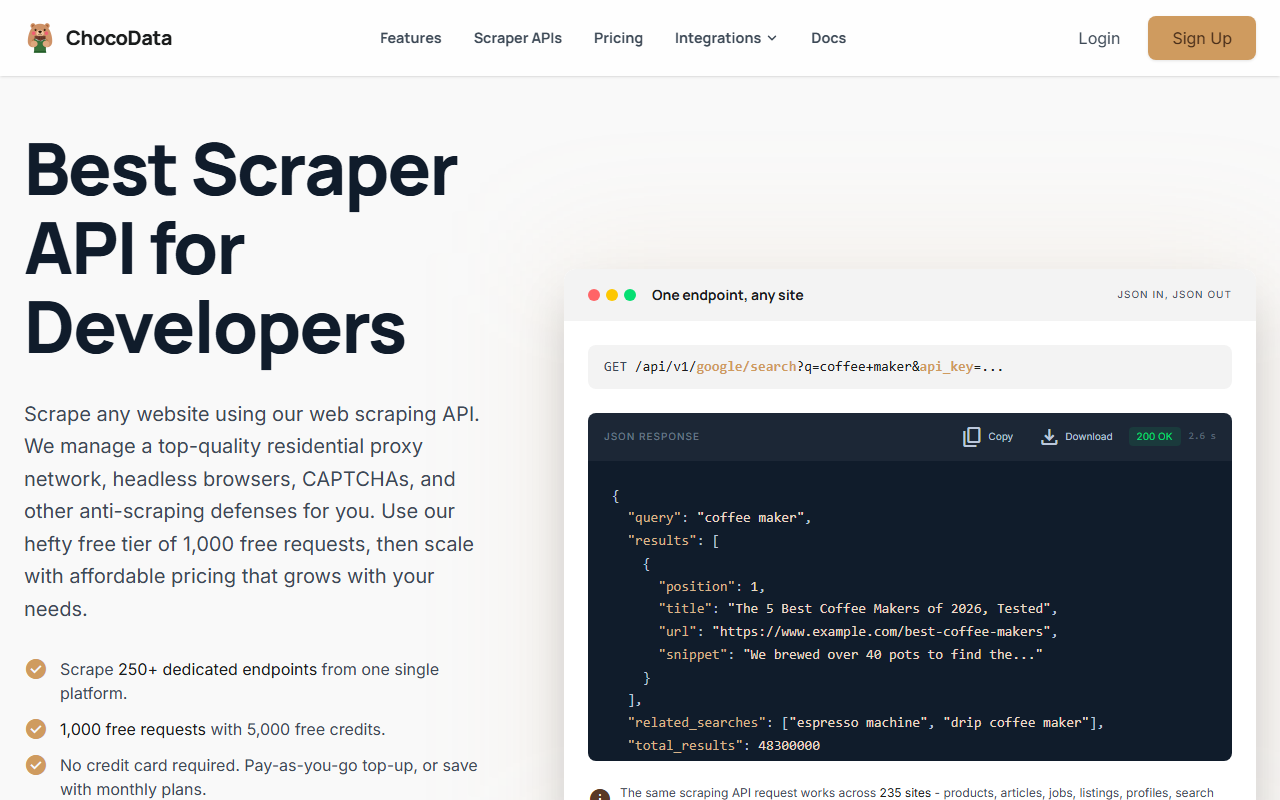
ChocoData is my top pick for pulling structured product data out of Google Shopping at the lowest documented entry price, especially if you also scrape other sites. One universal endpoint with the shape GET /api/v1/{site}/{resource} covers any supported site, and on top of that it exposes 453 endpoints across 235 sites, per ChocoData’s site in mid-2026, with 250+ returning validated, parity-checked structured JSON. Google Search is among the supported scrapers (its homepage shows a /api/v1/google/search?q=coffee+maker example), so you query the SERP and Shopping grid alongside every other source through one integration instead of bolting on a separate Shopping-only tool.
Pricing
Per ChocoData’s pricing page in mid-2026, the Free plan gives 1,000 requests/mo (5,000 credits) with 10 concurrency and no card; Vibe is $19/mo for 27,000 requests at 30 concurrency; Pro is $49/mo for 82,000 requests; and Custom runs $100 to $2,000/mo for 200,000 to 4M+ requests. One request costs 5 credits, JS rendering and screenshots add 10 credits each, and only 2xx responses are billed. Pay-as-you-go top-ups are $0.90 per 1,000 successful requests. The $19 Vibe tier is the lowest paid entry point in this comparison.
Standout features
The draw is the single universal endpoint plus a free tier that needs no credit card, so you can validate a Google Shopping workload on the 1,000 free monthly requests before paying anything. Residential IPs and JavaScript rendering are handled for you, the structured JSON is parity-checked against the live page, and failed requests cost nothing because billing is 2xx-only. For latency, the homepage publishes a median of 2.6s (p95 6s, p99 ~10s) measured across all 235 supported sites.
Best for
Developers, founders, and marketers who scrape Google Shopping as one of several targets and want the cheapest documented entry price. If your pipeline also touches Amazon, eBay, search engines, or social data, paying one $19/mo entry price for the whole surface beats stacking single-purpose tools. Try ChocoData.
2. SearchApi.io
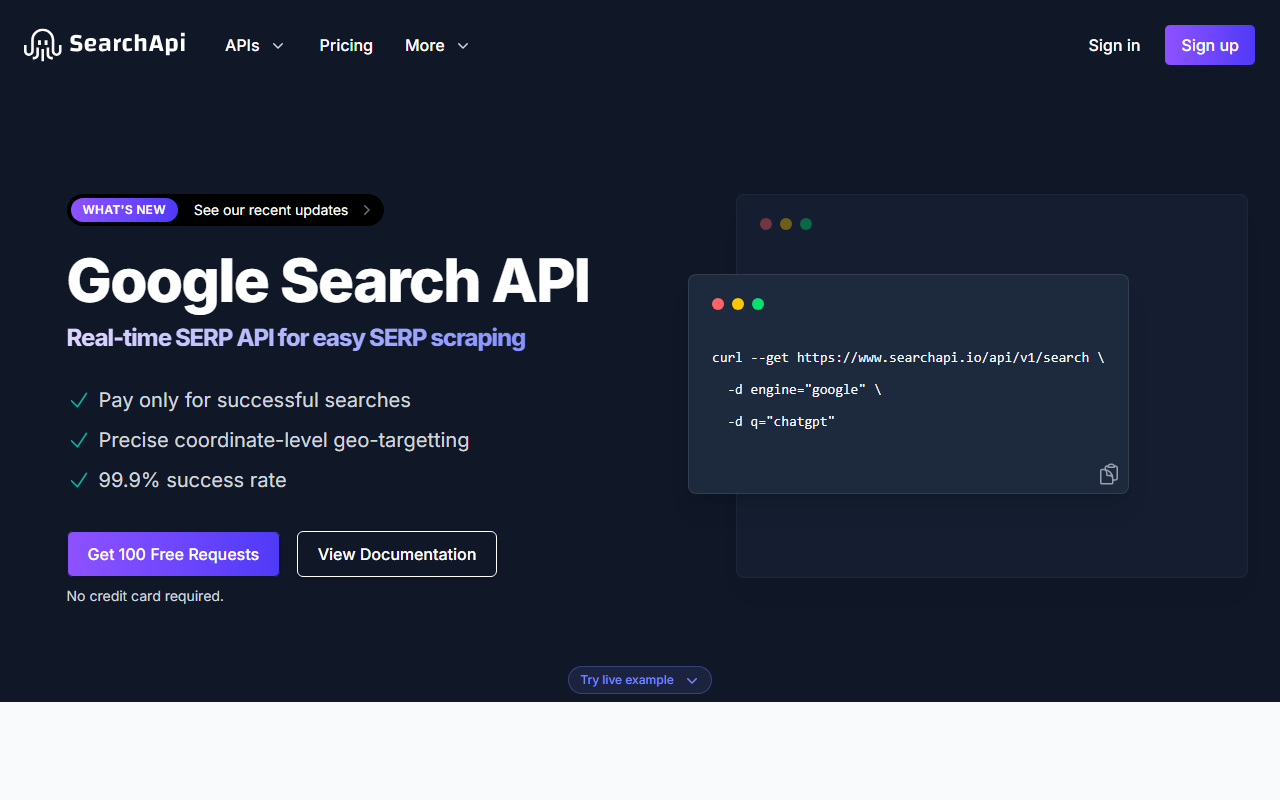
SearchApi.io runs a clean, dedicated Google Shopping API that returns a parsed product array per query, which suits you when Shopping is your main target and you want a parsed result out of the box rather than selectors to maintain.
Pricing
Per SearchApi.io’s pricing page in mid-2026, Developer is $40/mo for 10,000 searches ($4/1K), Production is $100/mo for 35,000 ($3/1K), BigData is $250/mo for 100,000 ($2.50/1K), and Scale is $500/mo for 250,000 ($2/1K), with larger Octo tiers above that. New users get 100 free requests with no card. Billing is pay-per-success: only searches that return a 200 status incur charges.
Standout features
You call the API with engine=google_shopping, q, plus locale parameters location, gl, and hl, and get JSON back (per its Google Shopping page, mid-2026). All plans include a 99.9% SLA, higher tiers add team management and legal protection coverage, and the rate limit caps you at 20% of monthly credits per hour. The per-search model makes cost forecasting simple: you know exactly what 10,000 Shopping queries cost.
Best for
Teams that want a dedicated Shopping endpoint with predictable per-search pricing and a small free allowance to trial it. The entry price is higher than ChocoData’s, so it earns the #2 slot when a parsed Shopping array is the whole job rather than one target among many.
3. ScraperAPI
ScraperAPI exposes a dedicated structured Google Shopping endpoint and pairs it with a genuine free plan, which makes it an easy tool to test before you commit a budget.
Pricing
ScraperAPI documents a $0 free plan with 1,000 credits a month plus a 5,000-credit trial in its docs in mid-2026. The credit cost per Shopping request and the cheapest paid monthly price were not exposed on the pages I could fetch, so confirm both on ScraperAPI’s pricing page before you budget. Treat the free allowance as the headline and the paid tiers as TBC.
Standout features
The endpoint is https://api.scraperapi.com/structured/google/shopping (per ScraperAPI’s docs, mid-2026). It takes query plus optional tld (com, co.uk, de, fr, and more), country_code for geotargeting, and Google parameters uule, hl, gl, tbs, and start. The response carries a shopping_results array with position, title, source, price, extracted_price, thumbnail, delivery_options, and delivery_options_extracted_price, alongside ads, top_features, filtered_results, related_searches, and pagination. ScraperAPI advertises a 99.9% success rate on its datacenter proxies, which is a proxy-network claim rather than a Shopping-endpoint figure.
Best for
Teams that want a structured Shopping endpoint plus a real free tier to validate the parse on. The unknown paid price is the only reason it sits at #3 rather than higher; the endpoint itself is well documented.
4. Oxylabs
Oxylabs reaches Google Shopping through its SERP Scraper API, which parses the whole results page, so it fits teams that want Shopping folded into deep parsing of organic, paid, and Product Listing Ads results.
Pricing
Per Oxylabs’ Google SERP page in mid-2026, pricing is $1.00 per 1,000 results without JavaScript rendering and $1.35 per 1,000 with it; the cheapest plan is Micro at $49/mo, with published subscription rates from roughly $0.50/1K results upward depending on volume. The free trial covers up to 2,000 results with no card.
Standout features
The SERP API parses Google Product Listing Ads with product titles, pricing, and seller names, and returns structured JSON (also HTML, CSV, TXT, Markdown, PNG), per its page in mid-2026. Geotargeting uses a geo_location parameter (for example California,United States) on Oxylabs’ large proxy network. Oxylabs advertises a 99.9% success rate on its datacenter proxies, a service-wide claim rather than a Shopping-only measured figure.
Best for
Teams that need the full Google SERP parsed, not just the Shopping grid, and want Product Listing Ads alongside organic and paid results in one call. If Shopping is the only thing you want, a dedicated endpoint is cheaper to start.
5. Bright Data
Bright Data treats Google Shopping as one search type inside its SERP API and bills per request, which suits teams that think in delivered requests and need fine-grained localization at scale.
Pricing
Per Bright Data’s SERP API page in mid-2026, pricing is pay-as-you-go at $1.50 per 1,000 requests, the Scale plan is $499/mo for 380,000 requests plus $1.30 per 1,000 extra, and the free tier is 5,000 requests a month with no card. There is no limit on concurrent requests.
Standout features
The SERP API returns Shopping results in JSON (brd_json=1), Markdown (data_format=markdown), or raw HTML, per its page in mid-2026. It supports 195 countries with city-level geotargeting, which matters because Shopping prices and sellers change by city, and unlimited concurrency lets you fan out without managing a connection pool. Bright Data publishes a 99.9% uptime SLA and claims the “highest success rate in the industry” without a percentage.
Best for
Per-request delivery and city-level localization at high volume, with an uptime SLA that matters to enterprise buyers. The per-request price is higher than the cheapest per-result options, so it earns its slot on scale and geo precision rather than entry cost.
6. Apify (epctex Google Shopping Scraper)
Apify is the prebuilt-actor route: instead of calling an API, you run a community-built scraper. The epctex Google Shopping Scraper is the move when you want a working Shopping scraper in minutes without writing or hosting one.
Pricing
The actor charges $30/mo rental plus Apify platform usage, per its actor page in mid-2026. It runs on Apify’s platform, which starts with a Free plan giving $5 of monthly usage with no card, and a Starter plan at $29/mo with $29 of included usage, per Apify’s pricing page. Note that prepaid usage does not roll over and expires at the end of the billing cycle, so budget both the rental and the platform line.
Standout features
Per the actor page in mid-2026, it returns product names, descriptions, images, shopping IDs, current and original prices, merchant names and affiliate links, review scores and counts, result position, optional sponsored listings, and comparison prices from multiple merchants. Output supports JSON, XML, CSV, Excel, and HTML. The author reports scraping 100 listings in about 2 minutes at roughly 0.05 to 0.1 compute units when blocking is minimal, which is throughput rather than a success rate.
Best for
Anyone who wants a no-build Shopping scraper inside an existing Apify workflow and is comfortable that per-actor speed and reliability depend on the community author rather than a vendor SLA.
How to choose the right one
Choose by answering three questions: do you scrape only Google Shopping or other sites too, do you want a parsed product array or to host your own scraper, and how much volume you need. Your answers map onto the options above.
| If you… | Use | Why |
|---|---|---|
| Scrape Shopping plus other sites and want low cost | ChocoData | One universal endpoint, structured JSON, from $19/mo, free 1,000 req/mo |
| Want a clean dedicated Shopping endpoint, simple pricing | SearchApi.io | shopping_results JSON, success-only billing, $40/mo |
| Want a structured Shopping endpoint with a free tier | ScraperAPI | /structured/google/shopping, 1,000 free credits/mo |
| Need deep parsing of the whole Google SERP | Oxylabs | SERP Scraper API parses Shopping plus organic, paid, PLA |
| Want per-request delivery and city-level geo at scale | Bright Data | $1.50/1K, unlimited concurrency, 5,000 free/mo |
| Want a prebuilt scraper with zero hosting | Apify | epctex Shopping actor, no code to maintain |
The honest default for most developers: if Shopping is one of several targets, start on ChocoData’s free 1,000 requests and move to the $19 Vibe plan when you outgrow it. If you only need the Shopping grid and want a parsed array out of the box, trial SearchApi.io’s 100 free requests or ScraperAPI’s free plan. Either way, set the locale explicitly (gl, hl, and a Google domain), render JavaScript, and route through the API’s residential IPs rather than your own, which is the whole point of the category. My scraping without getting blocked guide covers the block-avoidance side, the web scraping pillar guide covers the fundamentals, and the how to scrape Google Shopping walkthrough shows the DIY path.
How we evaluated these
Every price and feature on this page comes from each vendor’s own pricing, product, or documentation page in mid-2026, attributed inline, because review-site numbers go stale fast and pricing pages move. The speed and success-rate figures are approximate, compiled from vendor-published numbers plus aggregated public sources, and are not first-hand: each vendor measures on its own targets under its own conditions, so a 99.9% from one and a “highest success rate” claim from another are not measured the same way. My independent, like-for-like Google Shopping benchmarks are pending; see how we test for the methodology. Treat every figure here as a snapshot that can change, and confirm the current number on the vendor’s own page before you commit.
FAQ
Not for scraping public Shopping pages. The Content API for Shopping is for merchants managing their own product feeds in Merchant Center, and the Shopping ads APIs are for advertisers. Neither returns the public Shopping SERP for an arbitrary query, which is why people use a scraper API against the rendered results.
A raw request to a Shopping query gets a consent wall, a CAPTCHA, or a 429 within a few calls, and the results are JavaScript-rendered and personalized by location. A scraper API rotates residential IPs, renders the page, sets gl/hl/location, and parses the product grid into JSON so you skip both the blocking and the selector maintenance.
Set the locale parameters the API exposes. Most use a country code (gl), a language (hl), and a location string or UULE token, plus a Google domain (tld) like co.uk or de. Prices, currency, and sellers all change with locale, so set it explicitly rather than trusting the default com result.