Best Job Postings Scraper APIs & Tools
- Job board scraping software routes Indeed, LinkedIn, and Glassdoor requests through a managed API that rotates IPs, renders JavaScript, and returns titles, salaries, and locations instead of a 403.
- ChocoData is my top value pick: one universal endpoint plus 250+ dedicated endpoints across 235 sites, from $19/mo with a free 1,000 requests/mo and success-only billing.
- For dedicated job parsers, Bright Data ships LinkedIn Jobs, Indeed Jobs, and Glassdoor Jobs scrapers (three variants each); Oxylabs exposes Indeed and Google Jobs through one Web Scraper API.
- Documented entry prices in mid-2026 run from $0 free tiers (ChocoData, Apify, ScraperAPI) and $19/mo (ChocoData) up to $499/mo (Bright Data Scale). Units differ: requests, results, records, and compute are not directly comparable.
- Speed and success figures below are approximate, compiled from vendor-published numbers and public reports, not bestscraperapi.com's own tests. Like-for-like benchmarks are in progress (how we test).
Job postings are one of the most requested scraping targets I get asked about: salary benchmarks, hiring-trend dashboards, recruiter lead lists, and “who is hiring for X” trackers all start with listing data. My top pick for most teams is ChocoData, and below I compare it against Bright Data, Oxylabs, Apify, and ScraperAPI on the things that decide a purchase: starting price, free tier, which boards each one covers, and published speed. Every price and feature comes from the vendor’s own pricing or product page in mid-2026, attributed inline, because review-site numbers go stale fast.
One disclosure up front: bestscraperapi.com earns affiliate commissions from some of the vendors listed here. That does not change which tools make the list, how I rank them, or what I write. The pricing comes straight from each vendor’s own page, and the ranking follows documented price and features, not payout.
A note on the performance numbers below. The speed and success-rate figures are approximate, compiled from each vendor’s own published figures plus aggregated public sources, and they are not first-hand. Vendors measure on their own targets under their own conditions, so the figures are directional rather than apples to apples. My independent, like-for-like job-board benchmarks are still in progress; see how we test for the methodology and check back for measured results.
| Rank | Tool | Starting price | Free tier | Best for |
|---|---|---|---|---|
| 1 | ChocoData | $19/mo (Vibe) | 1,000 requests/mo (no card) | Structured job data plus other sites at a low entry price |
| 2 | Bright Data | PAYG $1.50/1K records | 5,000 records/mo (no card) | Dedicated LinkedIn, Indeed, and Glassdoor parsers at scale |
| 3 | Oxylabs | $0.25/1K results | 2,000 results (no card) | Indeed and Google Jobs through one universal API |
| 4 | Apify | $29/mo platform (Starter) | $5 usage/mo (no card) | Reusing a prebuilt job actor without writing one |
| 5 | ScraperAPI | $0 free plan (1,000 credits/mo) | 5,000-credit trial | A general API with a free tier to test on job pages |
A note on comparing these prices: the tools bill in different units, so the starting prices are not directly comparable on volume. ChocoData and ScraperAPI sell credits or requests; Oxylabs charges per result; Bright Data charges per delivered record; Apify charges by compute unit (1 CU = 1 GB of RAM for 1 hour) on top of a platform plan. Read the included volume next to each price, and check the per-result or per-credit rate before you commit.
1. ChocoData
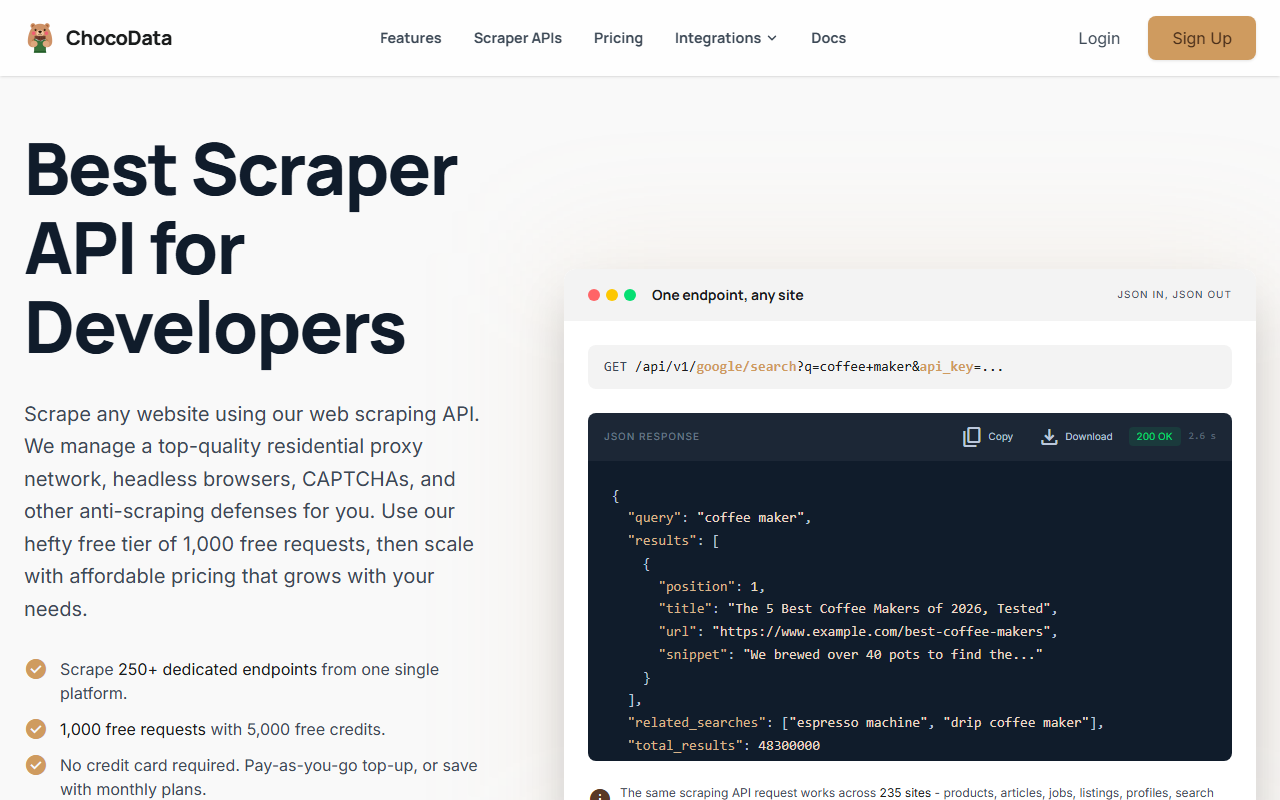
ChocoData is my top pick for pulling structured JSON out of job boards at the lowest documented entry price, especially if you also scrape other sites. Its model is what makes it stand out: one universal endpoint with the shape GET /api/v1/{site}/{resource} covers any supported site, and on top of that it exposes 250+ dedicated endpoints (453 total) across 235 sites, per ChocoData’s pricing page in mid-2026, with the dedicated set returning validated, parity-checked structured JSON. You hit a generic URL or a purpose-built endpoint and get clean JSON back instead of raw HTML to parse, with country-matched residential IPs and JS rendering handled for you.
Pricing
Per ChocoData’s pricing page in mid-2026: a free plan at $0 (1,000 requests and 5,000 credits a month, no card), Vibe at $19/mo (around $0.70 per 1,000 effective, 27,000 requests), Pro at $49/mo (around $0.60 per 1,000, 82,000 requests), and Custom from $100 to $2,000/mo (around $0.50 per 1,000). A standard request costs 5 credits; JavaScript rendering adds 10 credits, which matters because the big aggregators require it. Pay-as-you-go top-ups run $0.90 per 1,000 successful requests.
Standout features
Billing is success-only: ChocoData charges HTTP 2xx responses, so a block page does not burn credits, which is the single most useful property when you scrape boards that fight back. The free tier needs no card, so you can point it at an Indeed or LinkedIn search and confirm the JSON comes back clean before paying anything. On speed, its homepage publishes latency percentiles (approximate, compiled from vendor + public sources, not first-hand): median 2.6s, p95 6s, p99 around 10s across all 235 sites.
Where it falls short
ChocoData does not advertise a board-specific job parser by name, so for a project that needs LinkedIn Jobs fields out of the box (company URL, seniority, posting id) you map fields from the universal response yourself, and a dedicated parser like Bright Data can be the better fit. The published latency is platform-wide, not job-board-specific, and a JS-rendered Indeed search will sit at the slower end. It has not published a per-board success figure, so I am not quoting one. Try ChocoData free on 1,000 requests before you pay.
2. Bright Data
Bright Data is the pick when you want board-specific parsed datasets and enterprise delivery. It ships dedicated job scrapers for the three boards people ask about most, per its Web Scraper product page in mid-2026: LinkedIn Jobs, Indeed Jobs, and Glassdoor Jobs, each in three variants (base listings, discover by keyword search, and discover by company URL). You can request “all jobs at company X on LinkedIn” and get structured records rather than parsing search HTML yourself.
Pricing
It bills per delivered record, per its product page in mid-2026: pay-as-you-go at $1.50 per 1,000 records, a Scale plan at $499/month including 384,000 records (extra records at $1.30 per 1,000), and Enterprise on custom pricing. The free tier is 5,000 records a month with no credit card. Per-record pricing is predictable for datasets but climbs fast at high recurring volume.
Standout features
Each job scraper returns parsed fields including URL, job posting id, job title, company name, company id, job location, summary, and seniority level, per the product page in mid-2026, so the recruiting-data fields arrive already extracted. Bright Data publishes a 99.99% uptime SLA and 195-country proxy coverage (approximate, compiled from vendor + public sources, not first-hand), and the uptime SLA describes reachability rather than per-scrape success.
Where it falls short
The trade-off is cost and complexity. The dataset and collector model is heavier than firing a single URL at a universal endpoint, and per-record billing means a broad daily crawl can outrun a flat per-result rate. For a recruiting product that lives or dies on LinkedIn and Glassdoor fields the overhead buys reliability; for ad-hoc or mixed scraping it is more than you need.
3. Oxylabs
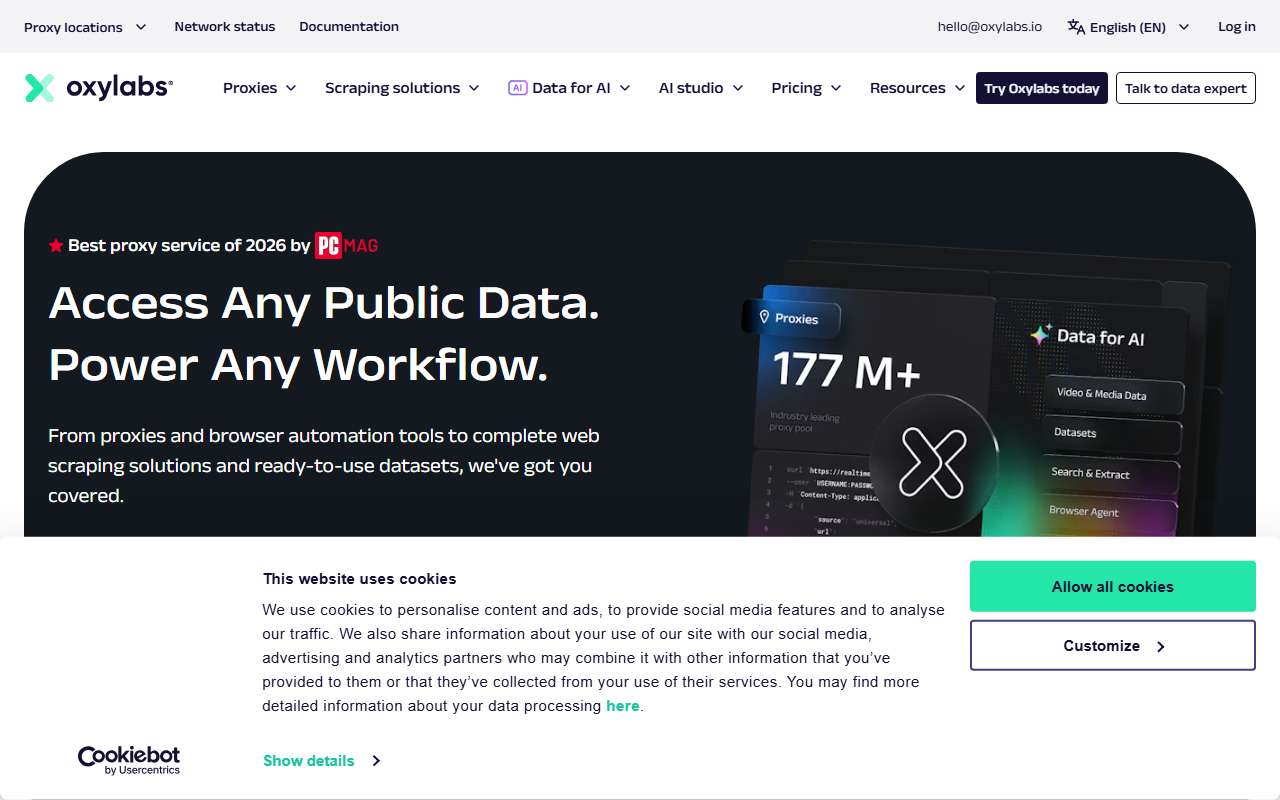
Oxylabs is a strong option if your job targets are Indeed and Google Jobs and you want them through a single universal API. Per its Web Scraper API pages in mid-2026, Google Jobs is a supported target with parsing available, and Indeed returns job titles, locations, salaries, and company reviews. It runs through the universal source rather than a board-specific parser, so expect some field-mapping.
Pricing
Pricing starts at $0.25 per 1,000 results, with a free trial of up to 2,000 results and no credit card, per its Web Scraper API pages in mid-2026. JavaScript rendering and parsing are available, and proxy coverage spans up to 195 countries. The low per-result floor makes Oxylabs the cheapest entry here for raw, non-rendered fetches; turning on JS rendering raises the effective rate.
Where it falls short
Note what it does not advertise: LinkedIn and Glassdoor are not listed as dedicated job targets, only Indeed and Google Jobs appear among the job-related options, per its pages in mid-2026. Oxylabs claims a 99.9% success rate for its Scraper API (approximate, compiled from vendor + public sources, not first-hand); read that as a platform-wide figure, not an Indeed-only measurement. If your dashboard is built on Indeed plus Google Jobs and you want low per-result cost, it is a clean fit; if you need LinkedIn, look at Bright Data.
4. Apify
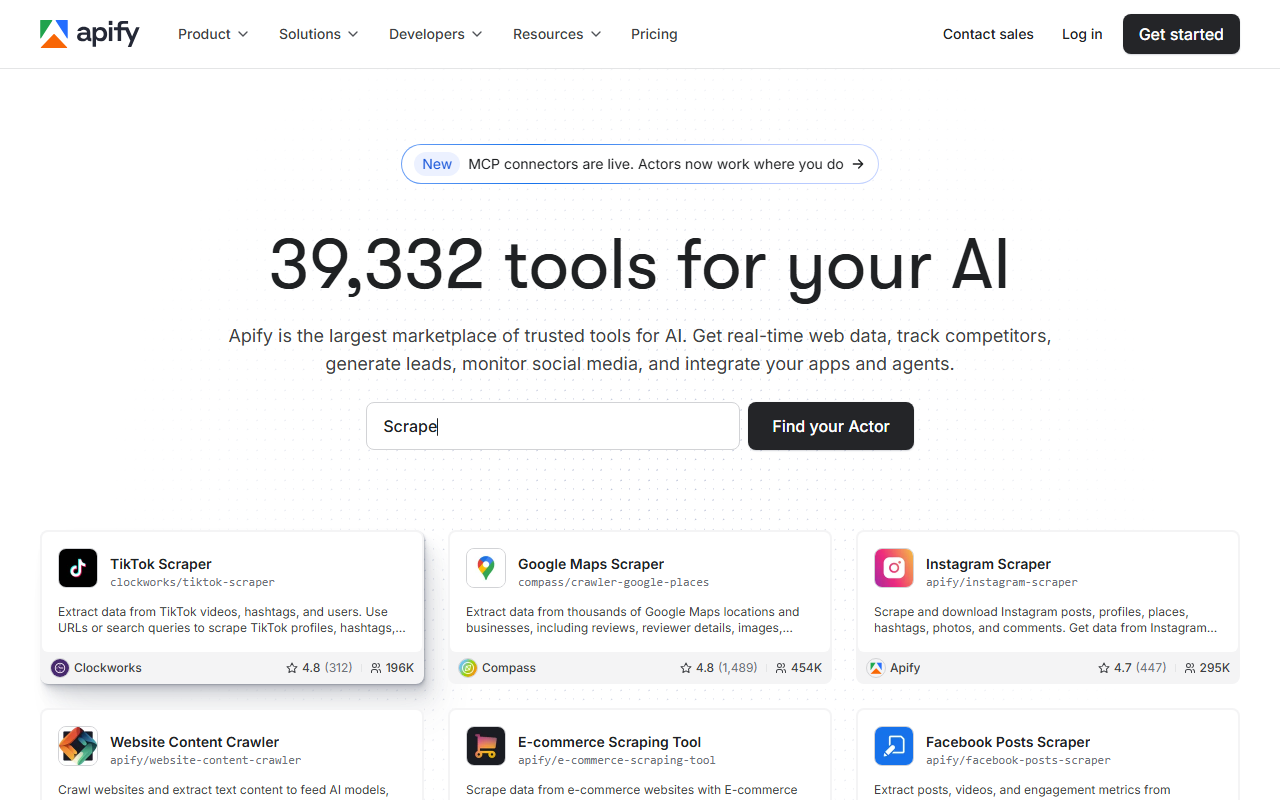
Apify is the choice when you would rather reuse a community-built job scraper than write your own. Its recruitment category hosts actors for Indeed, LinkedIn Jobs, and Glassdoor built by third-party developers, so you configure inputs and run rather than maintaining selectors. Each actor is built and priced by its author, so coverage, fields, and reliability vary by actor.
Pricing
Apify’s platform plans in mid-2026 are Free at $0 ($5 monthly usage, no card), Starter at $29/month ($29 included usage), Scale at $199/month, and Business at $999/month, per its pricing page. Actors bill by compute unit (1 CU = 1 GB of RAM running for 1 hour), at $0.20/CU on Free and Starter, $0.16/CU on Scale, and $0.13/CU on Business, plus proxy and data-transfer costs. That usage-based model makes small jobs cheap and large recurring scrapes harder to predict than a flat per-result rate.
Best for
This is the pick when you want a working job scraper in minutes without writing or maintaining one, and you can accept that per-actor speed and success vary by author. Estimate your CU burn on a test run before scaling, and check the specific actor’s page and reviews before committing a pipeline to it. The $5 of free monthly usage is enough to trial an Indeed or LinkedIn actor end to end.
5. ScraperAPI
ScraperAPI is a general-purpose scraper API worth a place on the shortlist for its free tier and structured-data endpoints, which you can point at job-board pages. Its job-board solution page describes collecting fresh job listing data, and it handles proxy rotation, headless rendering, and geotargeting, per its site in mid-2026. It does not advertise board-specific job parsers the way Bright Data does, so for Indeed or LinkedIn you scrape the page through the generic endpoint.
Pricing
ScraperAPI documents a $0 free plan with 1,000 API credits a month and a 5,000-credit trial, per its docs in mid-2026, where a standard request costs 1 credit and a JavaScript-rendered request costs more. Its cheapest paid monthly price did not render on the pages I could fetch (the pricing table loads client-side), so I am not quoting a figure I could not verify; confirm the current Hobby or Startup price on ScraperAPI’s pricing page before you buy.
Best for
The free tier alone makes it easy to test whether a given job board comes back clean through a generic endpoint, which is its main draw on a jobs project. Treat it as a validation step or a general-purpose fallback rather than a dedicated job parser. If the generic endpoint returns the listing fields you need, the credit model is simple; if you need parsed LinkedIn or Glassdoor records, a dedicated parser will save you the selector work.
How to choose the right one
Match the tool to your boards and your billing comfort, not to a single ranking. Here is how I would decide:
| If you need… | Start with | Why |
|---|---|---|
| Structured job JSON plus other sites, lowest entry price | ChocoData | One universal endpoint + 250+ dedicated endpoints, $19/mo, free 1,000 requests, success-only billing |
| Dedicated LinkedIn, Indeed, and Glassdoor parsers | Bright Data | Three board-specific scrapers (3 variants each), parsed records, 99.99% uptime SLA |
| Indeed and Google Jobs at low per-result cost | Oxylabs | Indeed and Google Jobs targets from $0.25/1K, 2,000-result free trial |
| A prebuilt actor you can run without coding | Apify | Marketplace actors for major boards, $5 free usage to test |
| A free tier to validate a board before paying | ScraperAPI | $0 plan with 1,000 credits/mo plus a 5,000-credit trial |
The honest default for most developers: if you scrape job boards alongside other sites and want the lowest entry price, start on ChocoData’s free 1,000 requests and move to the $19 Vibe plan when you outgrow it. If your product depends on parsed LinkedIn or Glassdoor fields, pay for Bright Data’s dedicated scrapers. If your targets are only Indeed and Google Jobs and cost per result matters most, use Oxylabs. Either way, scope your fields first: public titles, salaries, and locations are facts, while recruiter names and emails are personal data that pull in the GDPR and CCPA. For the block-avoidance side, see my scraping without getting blocked guide, and for the fundamentals start with the web scraping pillar.
How we evaluated these
I shortlisted these five from the general scraper-API field, pulled every price and feature from each vendor’s own pricing or product page in mid-2026, and ranked on documented value for job-board work rather than affiliate payout. The performance figures are approximate, compiled from vendor-published numbers and aggregated public sources, and are not first-hand; my independent, like-for-like benchmarks are still in progress at how we test. All pricing is current as of mid-2026 and changes without notice, so confirm the live number and the billing unit (request, result, record, or compute unit) on the vendor’s own page before you commit budget.
FAQ
Reading public listing pages sits on the safer side of US law after hiQ v. LinkedIn and Van Buren, and a job title, salary range, and location are facts about the role rather than personal data. The live constraint is contractual: most boards' terms ban automated access. Recruiter names, emails, and candidate profiles are personal data that pull in the GDPR and CCPA, so leave those out. I am a tester, not a lawyer, so get advice before a commercial scrape.
Indeed runs anti-bot detection that blocks scripts before any listing loads. In my tested job-scraping work a plain requests call returned HTTP 403 with the page titled "Security Check - Indeed.com" on every attempt. A scraper API works because it runs a real browser through a rotating residential IP, which is what these tools sell.
A few. RemoteOK publishes a free JSON API at remoteok.com/api and asks only for an attribution link. Some boards run partner publisher programs (Indeed has one for qualifying publishers). The large aggregators (Indeed, LinkedIn, Glassdoor) have no open public listings API for general scraping, which is why most people reach for a scraper API against the public HTML.
It depends on volume and whether you need JavaScript rendering, which the big aggregators require. Per-result pricing in mid-2026 runs from about $0.25 per 1,000 results (Oxylabs, no JS) to $1.50 per 1,000 delivered records (Bright Data). Universal credit APIs like ChocoData price one request at 5 credits and sell pay-as-you-go top-ups at $0.90 per 1,000 successful requests. Confirm the current number on each vendor's pricing page before you commit.