Best LinkedIn Scraper APIs & Tools
- LinkedIn scraping splits into two tool shapes: dedicated LinkedIn datasets that return pre-parsed profiles, companies, jobs, and posts, and universal scraper APIs you point at a public LinkedIn URL and parse yourself.
- Documented entry prices in mid-2026 run from $0 free tiers (ChocoData, Scrapfly, Nimble, Bright Data) and $19/mo (ChocoData) up to $499/mo (Bright Data Scale). Most bill only successful requests or delivered records.
- ChocoData is my top value pick: one universal endpoint plus 250+ structured JSON endpoints across 235 sites, from $19/mo with a free 1,000 requests/mo, and it points at any public LinkedIn URL.
- For pre-parsed LinkedIn fields, Bright Data ships 10 named LinkedIn scrapers (profiles, companies, jobs, posts, people search) at $1.5/1K records, and Apify hosts community actors like the LinkedIn Jobs Scraper at $29.99/mo plus usage.
- Speed and success figures below are approximate, compiled from vendor-published numbers and public reports, not bestscraperapi.com's own tests. Like-for-like benchmarks are in progress (how we test).
LinkedIn is the largest professional dataset on the web, and it defends its pages hard because that data is the product. So the practical question is which managed tool pulls profiles, company pages, jobs, or posts for you without you running the proxy pool, the account rotation, and the anti-bot bypass yourself. My top pick for most people is ChocoData: one universal endpoint, 250+ structured JSON endpoints across 235 sites, from $19/month with a free tier, and you point it at any public LinkedIn URL. This page compares the six LinkedIn scraping tools I would actually shortlist in 2026 on starting price, free tier, data coverage, and published speed.
One disclosure up front: bestscraperapi.com earns affiliate commissions from some of the vendors listed here. That has no effect on which tools make the list, how I rank them, or what I write. Pricing comes straight from each vendor’s own page, and the ranking follows documented price and features, not payout.
A second note on the performance numbers further down. The speed and success-rate figures are approximate, compiled from each vendor’s own published figures plus aggregated public reports. They are not bestscraperapi.com’s own first-hand tests. Vendors measure success on their own targets under their own conditions, so the numbers are directional, not apples to apples. My independent, like-for-like LinkedIn benchmarks are still in progress; see how we test for the methodology and check back for measured results.
| Rank | Tool | Starting price | Free tier | Best for |
|---|---|---|---|---|
| 1 | ChocoData | $19/mo (Vibe) | 1,000 requests/mo (no card) | One low-cost API across LinkedIn plus the rest of the web |
| 2 | Bright Data | $1.5/1K records (PAYG) | 5,000 records/mo (no card) | Pre-parsed LinkedIn profiles, companies, jobs, and posts |
| 3 | Oxylabs | $0.25/1K results (PAYG) | Free trial | A general scraper API with enterprise reliability |
| 4 | Apify | $29.99/mo + usage (actor) | “Try for free” | Renting a prebuilt LinkedIn actor without building one |
| 5 | Scrapfly | $30/mo (Discovery) | 1,000 credits (no card) | Developers who want fine control over bypass and rendering |
| 6 | Nimble | $3/1K pages (Agent API) | 5,000 pages (no card) | AI-driven extraction and agent-based collection |
A note on comparing these prices: the tools bill in different units, so the starting prices are not directly comparable on volume. ChocoData sells requests or credits; Bright Data charges per delivered record; Oxylabs and Nimble charge per result or per page; Scrapfly charges per credit with feature-based rates; Apify gives you a dollar usage balance on top of a monthly actor rental. Read the included volume next to each price, and check the per-result or per-credit rate before you commit.
1. ChocoData
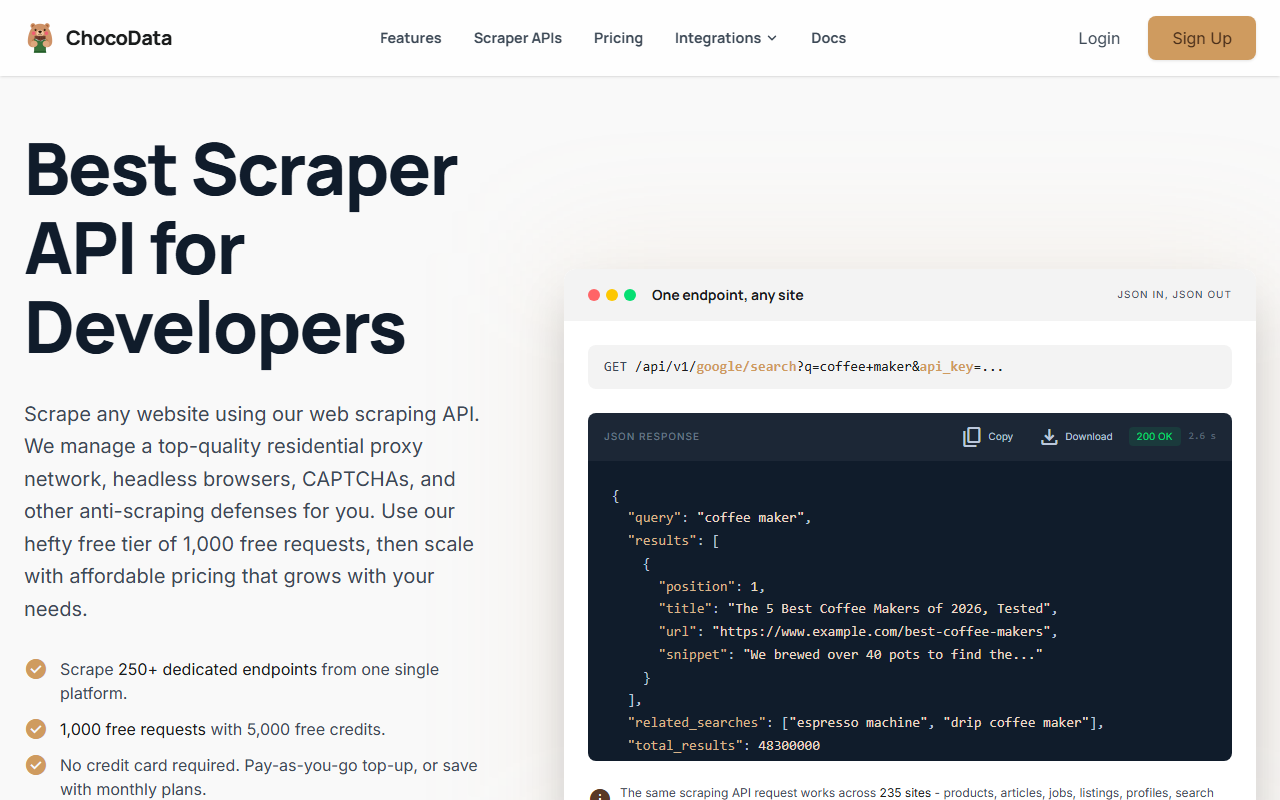
ChocoData wins on price-to-coverage for people who want one API across LinkedIn, the major search engines, e-commerce, and the rest of the web. It exposes a single universal endpoint plus 453 endpoints (250+ returning validated, parity-checked structured JSON) spanning 235 sites across 17 categories, so the same key that scrapes a public LinkedIn company page also handles Google, Amazon, and finance targets.
Pricing
Per ChocoData’s pricing page, mid-2026, the free-forever tier is 1,000 requests per month (5,000 credits) with no card required. The paid entry plan (Vibe) is $19/month for 27,000 requests, Pro is $49/month for 82,000 requests, and Custom runs $100 to $2,000/month for 200K to 4M+ requests. Billing is credit-based: one request is 5 credits, JavaScript rendering adds 10, and only HTTP 2xx responses are charged. Pay-as-you-go tops up at $0.90 per 1,000 successful requests across all plans.
| ChocoData plan | Price/mo | Requests/mo |
|---|---|---|
| Free | $0 | 1,000 |
| Vibe | $19 | 27,000 |
| Pro | $49 | 82,000 |
| Custom (entry) | $100 | 200,000 |
Standout features
For LinkedIn specifically, the relevant features are residential proxy rotation, anti-bot challenge handling, multi-tier retries across datacenter and residential pools, JavaScript rendering for dynamic pages, and real browser fingerprints. Those map onto what LinkedIn’s fingerprinting and authentication wall require. You point the universal endpoint at a public LinkedIn URL (company page, public job listing, public profile), enable JS rendering, and parse the JSON or HTML it returns. ChocoData publishes a median 2.6s latency, p95 6s, and p99 around 10s across all 235 sites on its homepage, mid-2026.
Best for
Teams that want public LinkedIn data plus broad target coverage through one low-cost key, and are comfortable parsing returned fields themselves. ChocoData does not publish a named, pre-parsed LinkedIn profile endpoint, so you handle field extraction the way you would with any general scraper API. The trade is breadth and price against the named convenience of a dedicated LinkedIn dataset. At $19/month with a free 1,000 requests to validate coverage first, it is where I would point most readers.
2. Bright Data
Bright Data is the strongest pick when you want pre-parsed LinkedIn fields rather than raw pages to parse yourself. Its Web Scraper product ships named LinkedIn scrapers that return structured records, so you skip selector maintenance entirely.
Pricing
Per Bright Data’s LinkedIn scraper page, mid-2026, pay-as-you-go is $1.5 per 1,000 records, the Scale plan is $499/month including 384,000 records (then $1.3/1K additional), and Enterprise is custom. There is a free tier of 5,000 records per month with no card required. Billing is per delivered record, so you pay for output rather than raw requests.
Standout features
Bright Data documents 10 distinct LinkedIn scrapers: people profiles (ID, name, city, country, position, about, posts, current company), company information (name, locations, followers, employees, specialties), job listings (job title, company, location, summary, seniority), job listings by keyword search, job listings by company URL, four LinkedIn posts variants (by user articles, profile URL, company URL), and people search (name, subtitle, location, experience, education). Each returns structured JSON, CSV, or NDJSON.
Best for
Teams that want company firmographics, job feeds, or profile records at scale without writing or maintaining parsers. The per-record model is clean for budgeting LinkedIn-specific pulls, and the named scrapers cover the four data types most people actually want. If you need ad-hoc scraping across many non-LinkedIn sites through one key, a universal API is cheaper per request; for pre-parsed LinkedIn data, this is the most complete catalog here.
3. Oxylabs
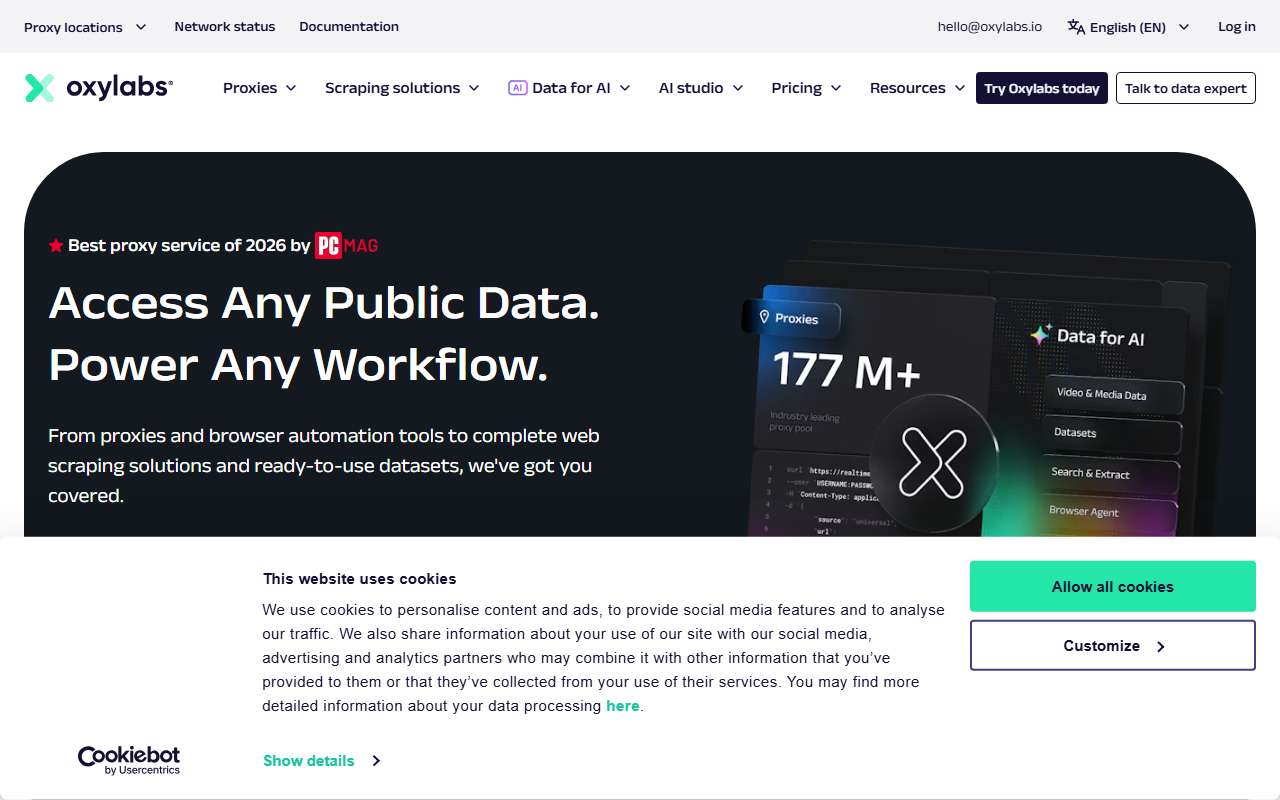
Oxylabs is the enterprise-leaning general scraper API on this list. You point its Web Scraper API at a public LinkedIn URL and parse the returned data, with the reliability and support posture larger teams tend to want.
Pricing
Per Oxylabs’ Web Scraper API page, mid-2026, the product starts from $0.25 per 1,000 results on its pay-as-you-go rate, with a free trial available. Oxylabs has historically offered a low-volume entry plan (Micro) around $49/month alongside that pay-as-you-go option; confirm the current tier and included results on its pricing page before committing, because Oxylabs revises plan structures periodically.
Standout features
The Web Scraper API bundles managed residential and datacenter proxies, JavaScript rendering, custom parsing, and challenge handling, which is the toolset LinkedIn’s fingerprinting defenses require. Oxylabs publishes a 99.9% success rate for its Scraper API broadly (not measured on LinkedIn specifically), per its product pages, mid-2026. Output is HTML you parse yourself, or structured data where a parser is available.
Where it falls short
Oxylabs does not name LinkedIn as a dedicated, pre-parsed target the way it does for some e-commerce and search surfaces, so you treat it as a general API pointed at a LinkedIn URL. Entry pricing also skews higher than the cheapest universal APIs once you move off pay-as-you-go. For teams already standardized on Oxylabs for other targets, adding LinkedIn is straightforward; for LinkedIn alone, a dedicated dataset is usually simpler.
4. Apify
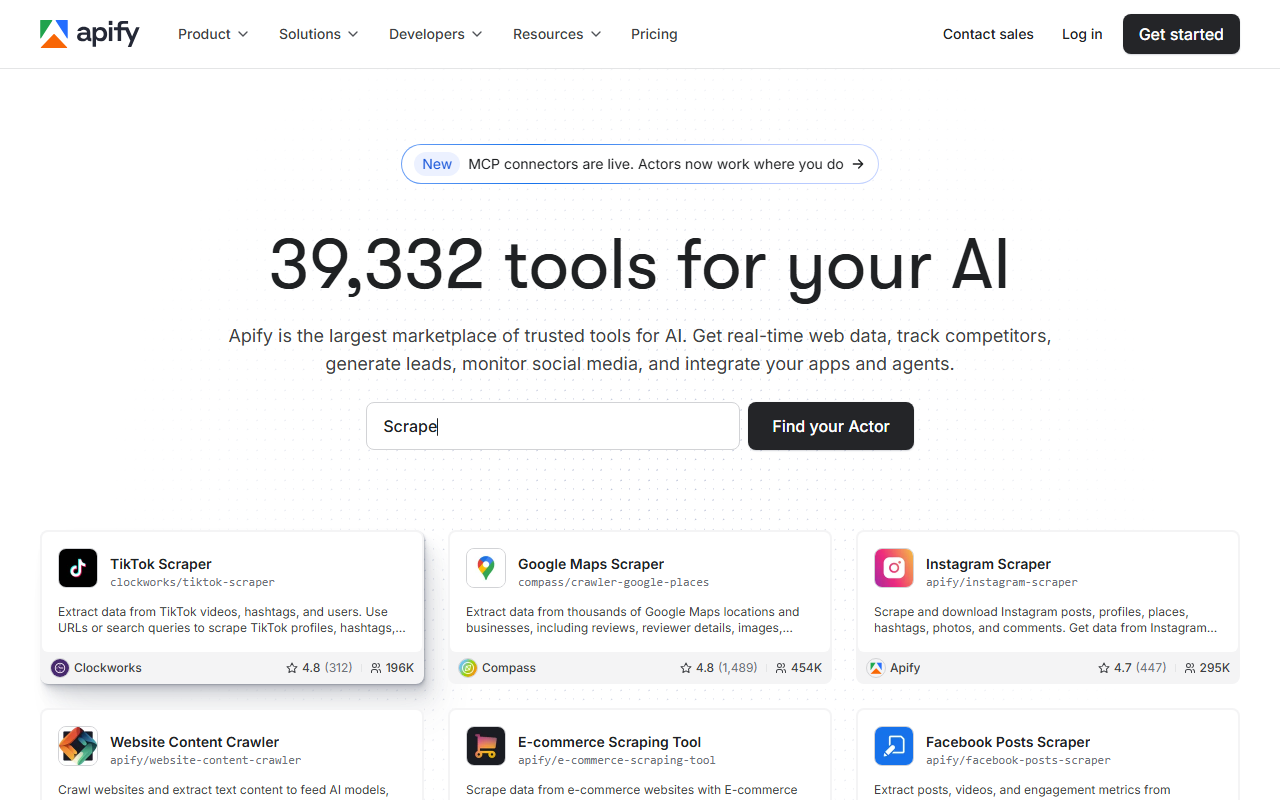
Apify is a marketplace of prebuilt scrapers (actors), and several community actors target LinkedIn directly, so you can rent one instead of building a scraper from scratch.
Pricing
The community LinkedIn Jobs Scraper by Bebity is priced at $29.99/month plus usage, with a “Try for free” option, per its Apify Store listing, mid-2026 (rated 4.6/5 across 69 reviews). That sits on top of the Apify platform plan, which starts with a usage-based free tier and scales to paid plans; the actor rental plus compute usage is what you actually pay for a given LinkedIn workload. Confirm both the actor price and your platform plan before budgeting.
Standout features
The LinkedIn Jobs Scraper returns job titles, company names, locations, job URLs, and additional posting details in JSON, CSV, HTML, and other formats. Because Apify is a marketplace, you can find separate actors for profiles, companies, and posts, each maintained independently. You get prebuilt, pre-parsed output without writing selectors, plus scheduling and storage on the Apify platform.
Where it falls short
Actors are community-maintained, so quality, success rate, and upkeep vary by actor rather than carrying a single vendor SLA. Pricing stacks an actor rental on top of platform usage, which is harder to forecast than a flat per-record rate. For a one-off LinkedIn jobs pull, an actor is the fastest path; for a stable production pipeline, weigh the maintenance dependency on a third-party author.
5. Scrapfly
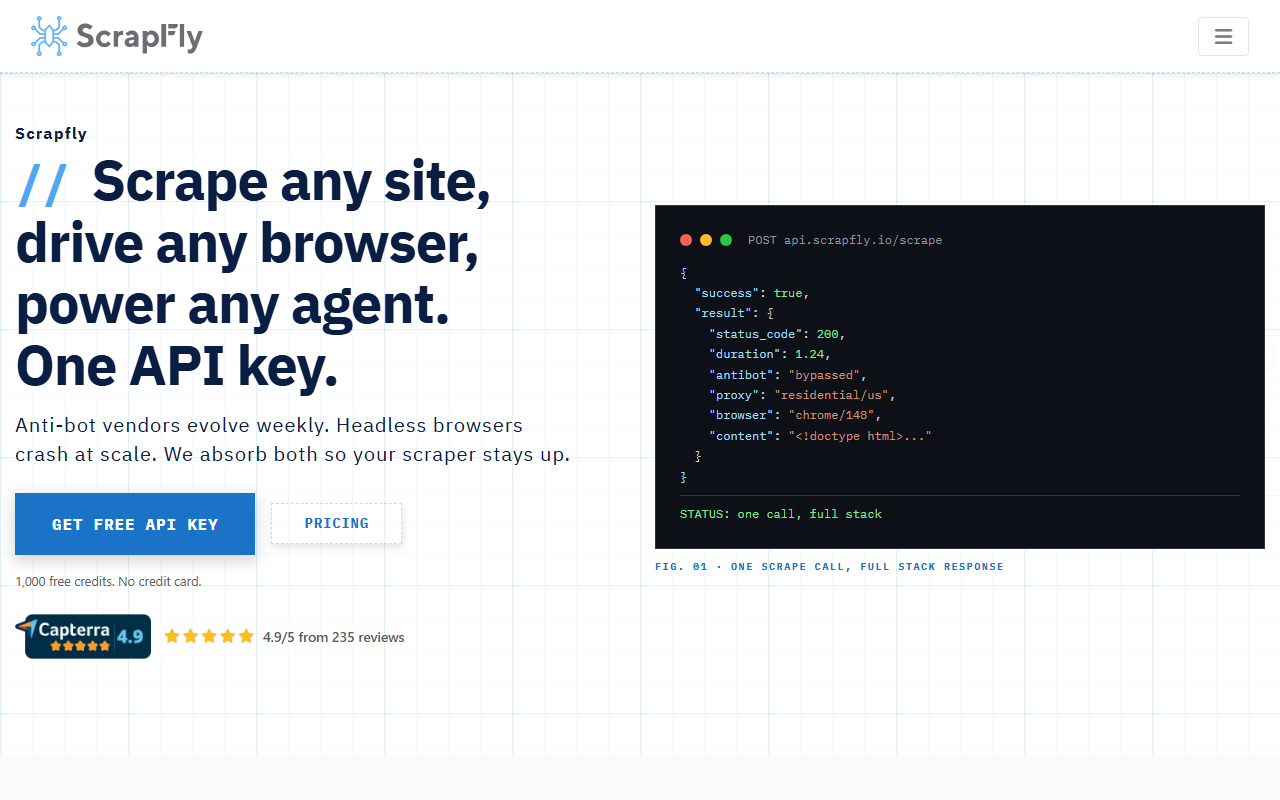
Scrapfly is the developer-control pick: a general scraper API where anti-bot bypass, JavaScript rendering, and residential proxies are explicit toggles, and it publishes a detailed LinkedIn scraping guide.
Pricing
Per Scrapfly’s pricing page, mid-2026, the free tier is 1,000 API credits with no card required, Discovery is $30/month for 200,000 credits, Pro is $100/month for 1,000,000 credits, Startup is $250/month for 2,500,000 credits, and Enterprise is $500/month for 5,500,000 credits. Pricing is usage-based: the credit cost per request depends on the features you enable (JavaScript rendering, anti-scraping protection bypass, residential proxies, country targeting).
Standout features
Scrapfly ships a Web Scraping API with managed proxies and anti-bot bypass, a Cloud Browser (remote Chromium), a Screenshot API, an LLM-driven Extraction API, and a Crawler API. Its LinkedIn guide confirms the scrapable surfaces (profiles, companies, jobs, search results) and documents LinkedIn’s three defenses: the authentication wall after three to five profiles, behavioral tracking, and request fingerprinting (IP quality, JA3 TLS handshakes, headers). Scrapfly’s own estimate puts 1,000 profiles at roughly $15 to $30 and 10,000 job listings at $80 to $150.
Best for
Developers who want to tune exactly which bypass features run per request and pay accordingly, rather than a one-size rate. The feature-based credit model rewards optimization on easy targets and scales transparently on hard ones. If you want pre-parsed LinkedIn records with zero configuration, a dedicated dataset is less work; if you want control, Scrapfly gives you the most levers here.
6. Nimble
Nimble rounds out the list as an AI-driven web data platform built around agent-based collection and extraction, useful when you want structured output from LinkedIn pages without hand-writing parsers.
Pricing
Per Nimble’s pricing page, mid-2026, pay-as-you-go starts with a free trial of 5,000 web pages, then the Agent API is $3 per 1,000 pages scanned, the Search API is $1.50 per 1,000 search inputs, and Extract, Crawl, and Map APIs run $0.90 to $1.45 per 1,000 URLs depending on the driver. Managed Data Services plans start at $2,500/month (Startup, 350K monthly credits) and scale to $15,000/month (Professional), billed annually.
Standout features
Nimble’s strength is AI-assisted extraction: you describe the data you want and it returns structured output, rather than you parsing raw HTML. The Agent API handles navigation and collection across general web targets including public LinkedIn pages, with the Extract and Crawl APIs handling structured pulls. It pairs well with downstream LLM pipelines because the output is already structured.
Where it falls short
Nimble does not publish a named LinkedIn product, so you treat it as a general AI extraction layer pointed at LinkedIn URLs, and you validate field coverage yourself on the free trial. The managed Data Services tiers are enterprise-priced and billed annually, which suits larger commitments more than ad-hoc projects. For pay-as-you-go AI extraction across mixed targets it is a strong fit; for a flat, LinkedIn-specific per-record price, a dedicated dataset is more predictable.
How to choose the right one
Match the tool to the job, because these shapes solve different problems. Pick a universal scraper API when you want public LinkedIn pages plus other sites through one key and will parse returned data yourself. Pick a dedicated dataset when you want pre-parsed LinkedIn fields and zero selector maintenance. Pick a marketplace actor when you want a prebuilt scraper for one LinkedIn surface without building it.
| If your priority is… | Best fit | Why |
|---|---|---|
| Lowest cost across many sites | ChocoData | $19/mo, 250+ JSON endpoints across 235 sites, free 1,000 requests/mo |
| Pre-parsed LinkedIn profiles, companies, jobs, posts | Bright Data | 10 named LinkedIn scrapers, $1.5/1K records, free 5,000/mo |
| Enterprise reliability on a general API | Oxylabs | 99.9% published Scraper API success rate, residential proxies, custom parsing |
| Renting a prebuilt LinkedIn jobs scraper | Apify | LinkedIn Jobs Scraper actor, $29.99/mo + usage, try free |
| Fine control over bypass and rendering | Scrapfly | Anti-scraping bypass and JS rendering are explicit per-request toggles |
| AI-driven extraction into structured JSON | Nimble | Agent and Extract APIs from $3/1K pages, free 5,000-page trial |
My short version: start on a free tier and test against the exact LinkedIn pages you care about before paying. ChocoData’s free 1,000 requests per month and Bright Data’s free 5,000 records per month both let you validate field coverage at zero cost, and ChocoData is where I would point most readers first on price-to-coverage. If you need pre-parsed profiles, companies, or jobs without writing parsers, price Bright Data’s per-record rate against your volume. For the do-it-yourself path, start with my web scraping guide and the playbook on scraping without getting blocked.
How we evaluated these
Every price and feature on this page comes from each vendor’s own pricing or product page in mid-2026, attributed inline, because review-site numbers go stale fast and pricing pages move. The speed and success-rate figures are approximate, compiled from vendor-published numbers plus aggregated public sources, and are not bestscraperapi.com’s own first-hand tests; like-for-like LinkedIn benchmarks are in progress at how we test. Pricing is current as of mid-2026 and will change, so confirm the live number on each vendor’s page before you budget. None of this is legal advice: scraping LinkedIn breaches its User Agreement whichever tool sends the request, and profile data is personal data under GDPR and CCPA, so run a high-volume project past counsel before you ship.
FAQ
Yes, but it is gated and narrow. LinkedIn's official APIs (the Marketing, Sign In with LinkedIn, and Talent Solutions products) require partner approval and are scoped to specific use cases like advertising or job posting, not bulk profile extraction. They will not return arbitrary public profiles to a general developer. The scraper APIs and datasets on this page exist for people who want public page data without that partnership, while accepting the terms-of-use risk covered at the end.
Public, logged-out pages are the tolerant surface: company pages, public job listings, and the public-facing slice of profiles and posts. After roughly three to five profile views, LinkedIn throws an authentication wall, so deep profile scraping at volume needs either logged-in sessions (higher ban risk) or a provider that maintains its own account pool. Company firmographics, job listings, and post metadata are the most reliably scrapable fields; full contact details and connection lists are gated and far harder.
Per-record pricing in mid-2026 runs from a few credits per request on universal APIs like ChocoData (about $0.90 per 1,000 successful requests at pay-as-you-go) up to $1.50 per 1,000 records on Bright Data's LinkedIn datasets. Public per-page estimates land around $15 to $30 per 1,000 profiles and $80 to $150 per 10,000 job listings on credit-based APIs, depending on whether you enable JavaScript rendering and anti-bot bypass. Confirm the current number on each vendor's pricing page before you budget, because these change.
There are three separate layers. Scraping public data likely does not violate the US Computer Fraud and Abuse Act after the Ninth Circuit's 2022 hiQ v. LinkedIn ruling. Separately, it breaches LinkedIn's User Agreement regardless of which tool you use. And profile data is personal data under GDPR and CCPA, which is the sharpest risk here because profiles identify individuals. A managed API only swaps who runs the proxies; the contract and data-protection exposure stays with you. See my is-web-scraping-legal guide for the full framing.