Best News Sites Scraper APIs & Tools
- A news scraper API fetches headlines, article bodies, authors, and publish dates from news sites or Google News, handling proxies, JavaScript, consent walls, and parsing so a raw request does not get blocked or return a CAPTCHA.
- ChocoData is my top value pick: one universal endpoint plus 250+ dedicated endpoints across 235 sites, from $19/mo with a free 1,000 requests/mo and no card.
- Documented entry prices in mid-2026 run from $0 free tiers up to $299/mo (Diffbot Startup). Units differ: requests, credits, results, pages, and credits-per-article are not directly comparable.
- For ready-made article extraction, Zyte and Diffbot auto-parse a news URL into title, body, author, and date; Firecrawl turns any news page into LLM-ready markdown.
- Speed and success figures below are approximate, compiled from vendor-published numbers and aggregated public sources, not bestscraperapi.com's first-hand tests. Independent benchmarks are pending (how we test).
News data lives across thousands of publishers plus one big aggregator, which makes media monitoring, brand tracking, and dataset building a question of which managed API does the fetching for you. This page compares the six news scraper APIs and tools I would shortlist in 2026, ranked with ChocoData first, on the things that decide a purchase: starting price, free tier, how each one turns a news page into structured fields, and published speed. Every price and feature comes from the vendor’s own pricing, product, or documentation page in mid-2026, attributed inline, because review-site numbers go stale fast and pricing pages move.
One disclosure up front: bestscraperapi.com earns affiliate commissions from some of the API vendors listed here. That has no effect on which tools make the list, how I rank them, or what I write. The pricing comes straight from each vendor’s own page, and the ranking follows documented price and features, not payout.
A note on the performance numbers further down. The speed and success-rate figures are approximate, compiled from each vendor’s own published figures plus aggregated public sources. They are not bestscraperapi.com’s first-hand tests, and each vendor measures success on its own targets under its own conditions, so the numbers are directional, not apples to apples. My independent, like-for-like news benchmarks are pending; see how we test for the methodology and check back for measured results. Treat every figure here as a snapshot that can change.
TLDR: the best news scraper APIs compared
| Rank | Tool | Starting price | Free tier | Best for |
|---|---|---|---|---|
| 1 | ChocoData | $19/mo (Vibe) | 1,000 requests/mo (no card) | Scraping news sites and Google News plus other sites, cheaply |
| 2 | Oxylabs | $49/mo (Micro) | 2,000 results (no card) | Parsed Google News and Top Stories at scale |
| 3 | ScraperAPI | Free plan, paid TBC | 5,000-credit trial | A general news scrape paired with newspaper3k or its own parser |
| 4 | Zyte | Pay-as-you-go | $0 trial credit | AI article extraction with no selectors to write |
| 5 | Diffbot | $299/mo (Startup) | 10,000 credits/mo (no card) | A dedicated Article API plus a news Knowledge Graph |
| 6 | Firecrawl | $16/mo (Hobby) | 1,000 credits/mo (no card) | Turning news pages into LLM-ready markdown for RAG |
The tools bill in different units, so these entry prices are not directly comparable on volume. ChocoData, ScraperAPI, and Firecrawl sell requests or credits; Oxylabs charges per result; Zyte is pay-as-you-go per request; Diffbot bills credits per article. Read the included volume next to each price, and check the per-unit rate before you commit. The brand-by-brand sections below give the full pricing table for each.
Why are news sites hard to scrape?
News sources defend or gate their pages in ways that break a naive script. Google News redirects no-cookie bots to a consent wall and renders results in JavaScript, so a plain request plus BeautifulSoup parses zero articles, which I documented in my Google News guide. Many publisher sites add metered paywalls, rate limits, GDPR consent overlays, and bot detection on top, and the same article can render differently by country or device.
There is a second problem after the fetch: extraction. Every publisher marks up its article body, byline, and date differently, so a selector that works on one outlet fails on the next. A news scraper API solves both halves: it runs rotating proxies, renders JavaScript, and clears consent walls to return the page, and the stronger options also auto-parse the article into clean fields so you do not maintain selectors per site. If you want the block-avoidance mechanics in depth, see my scraping without getting blocked guide.
1. ChocoData
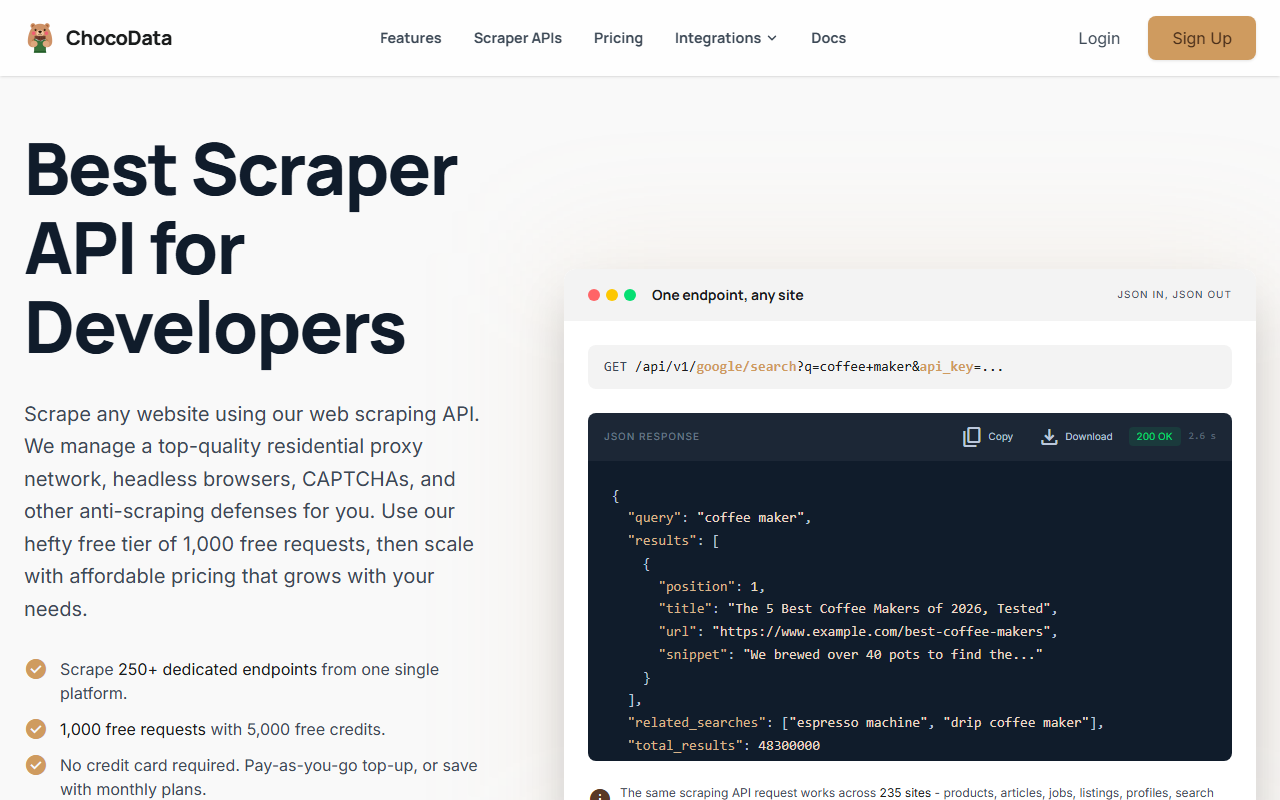
ChocoData is my top pick for pulling structured JSON out of news sites and Google News at the lowest documented entry price, especially if you also scrape other sites. Its model is what makes it stand out: one universal endpoint shaped GET /api/v1/{site}/{resource} covers any supported site, and on top of that it exposes 250+ dedicated endpoints across 235 sites in 17 categories, per ChocoData’s site in mid-2026, with those endpoints returning validated, parity-checked structured JSON. Articles are one of its named categories, so for news you point the universal endpoint at the page or aggregator you want and get clean JSON back instead of raw HTML to parse, with residential IPs and JS rendering handled for you.
Pricing
Per ChocoData’s pricing page in mid-2026:
| Plan | Price | Included requests | Concurrency |
|---|---|---|---|
| Free | $0 (no card) | 1,000 requests/mo (5,000 credits) | 10 |
| Vibe | $19/mo | 27,000 requests/mo (135,000 credits) | 30 |
| Pro | $49/mo | 82,000 requests/mo (410,000 credits) | 50 |
| Custom | $100 to $2k/mo | 200,000 to 4,000,000+ requests/mo | 100 to 500+ |
ChocoData prices one request at 5 credits, with JS rendering and screenshots adding 10 credits each, and lists pay-as-you-go top-ups at $0.90 per 1,000 successful requests, billing only 2xx responses. The $19 Vibe tier is the lowest paid entry point in this comparison.
Standout features
A single universal endpoint means you scrape news sites, Google News, and 230-plus other sites through the same call shape, with structured JSON where the parser exists rather than HTML you dissect yourself. The free 1,000 requests a month require no card, so you can test a news pull end to end before paying. For speed, its homepage publishes a median latency of 2.6s (p95 6s, p99 ~10s) across the 235 supported sites in mid-2026; it does not publish a headline success rate (approximate, compiled from vendor + public sources, not first-hand).
Best for
Developers, founders, and marketers who scrape news as one of several targets and want the lowest entry price with success-only billing. ChocoData does not advertise an article body parser for every individual outlet by name, so if you need a guaranteed, contractually supported parser for one specific publisher, an option below may fit better; for breadth and price, ChocoData leads. Try ChocoData.
2. Oxylabs
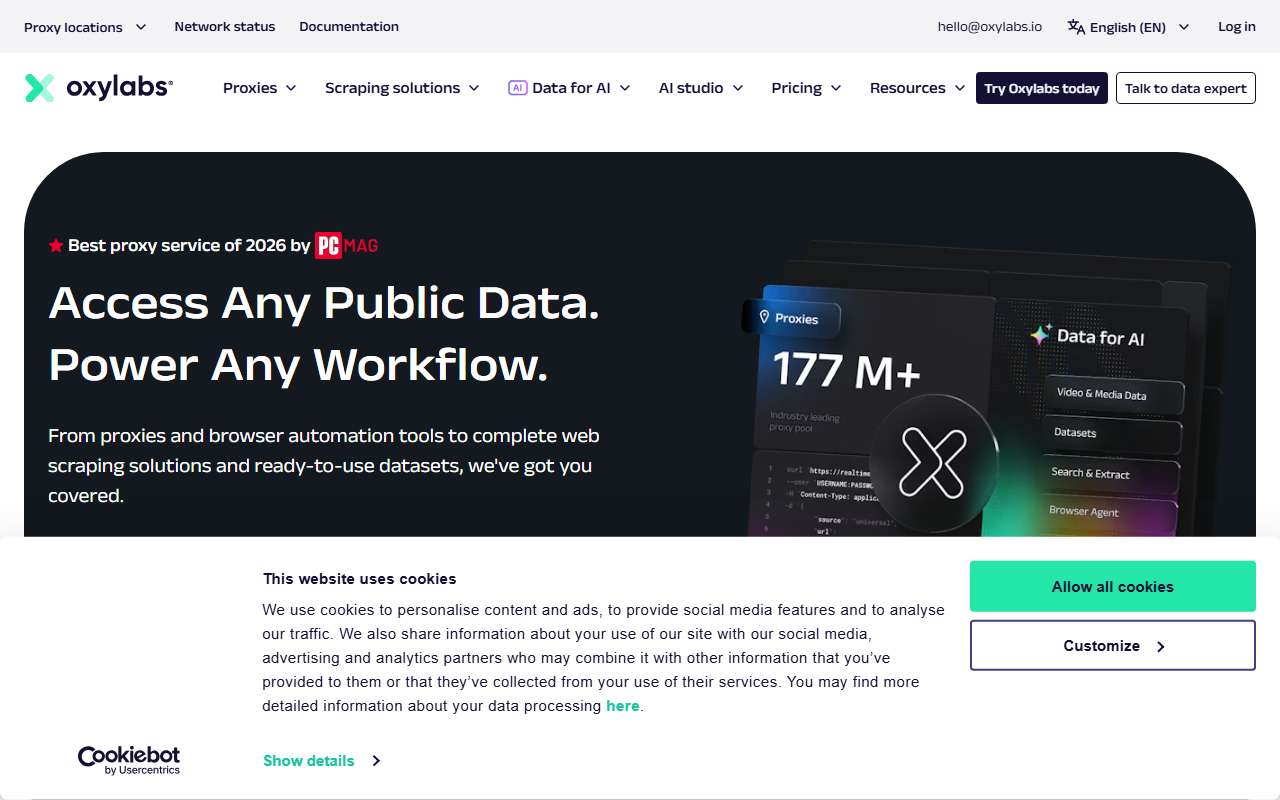
Oxylabs is the pick when Google News is your main target and you want it parsed for you. Its Web Scraper API exposes dedicated news targets: a Google News Search endpoint that scrapes results at scale and returns completely parsed data, and a Google Top Stories endpoint that extracts headlines, publishers, and timestamps by URL, per its product page in mid-2026. Geotargeting and JavaScript rendering are built in, which matters because Google News results shift by location.
Pricing
Per Oxylabs’ Web Scraper API pricing in mid-2026:
| Plan | Price | Rate |
|---|---|---|
| Free trial | $0 (no card) | Up to 2,000 results |
| Pay-as-you-go | from $0.25/1K results | No commitment |
| Micro | $49/mo | from lower per-1K rate |
| Higher tiers | scaling monthly | per-1K rate drops with volume |
Billing is per result, starting from $0.25 per 1,000 results, with the per-1,000 rate dropping as the plan grows, per its product page in mid-2026. The free trial returns up to 2,000 results with no card.
Standout features
Google News and Top Stories are documented, pre-parsed targets rather than a best-effort universal fetch, so you get headlines, publishers, and timestamps as JSON without writing selectors. Parsing runs through Oxy Parser, with raw HTML available as an alternative. Oxylabs publishes a 99.9% success rate for its Scraper API in mid-2026, though that is a service-level claim, not a Google-News-only measurement (approximate, compiled from vendor + public sources, not first-hand).
Best for
Teams that scrape Google News or Top Stories at volume and want parsed JSON with a contract behind it, and can clear the $49/mo entry point. The exact Google News field schema was not fully detailed on the page I fetched, so confirm the returned fields in the Oxylabs docs before you build against them.
3. ScraperAPI
ScraperAPI is the general-purpose pick for fetching arbitrary news pages reliably, then extracting the article yourself. It handles rotating proxies, JavaScript rendering, and anti-bot bypass, which is exactly the layer the popular Python newspaper3k library lacks: newspaper3k parses an article’s title, text, authors, and publish date once you have the HTML, but it gets blocked fetching defended news pages on its own. Routing newspaper3k’s downloads through ScraperAPI is a common pattern, and ScraperAPI documents the workflow on its blog.
Pricing
ScraperAPI’s pricing page is JavaScript-rendered and did not expose its plan grid on the version I could fetch in mid-2026. From its documentation, the free trial is 5,000 credits over 7 days and there is a $0 free plan, with a standard request costing 1 credit and a JavaScript-rendered request costing more. Confirm the current paid tiers on ScraperAPI’s pricing page before you buy, since I could not verify the mid-tier monthly prices first-hand.
Standout features
The credit model is simple: a basic request is 1 credit, with rendering and premium proxies costing more, per its docs in mid-2026. It also ships structured-data endpoints for some targets, though news article bodies are not a dedicated parsed endpoint, so for general publishers you pair the fetch with newspaper3k or your own parser. Geotargeting handles location-specific news editions.
Best for
Developers who already use newspaper3k or a custom article parser and just need a reliable, unblocked fetch layer in front of it, with a free tier to test the flow. Budget carefully, since I could not confirm the paid monthly tiers, so price your real per-request cost (rendered plus premium) on the current pricing page.
4. Zyte
Zyte is the pick when you want article extraction done for you with no selectors to maintain. Its API includes AI-powered automatic extraction that parses web data with little effort at unlimited scale, and it markets a News and Article data category covering online publishers and news websites, per its product page in mid-2026. You send a news URL and get structured article fields back rather than raw HTML you parse per outlet.
Pricing
Zyte API uses a pay-as-you-go model with no fixed monthly minimum, per its product page in mid-2026. Signup includes a free trial credit, and enterprise trials qualify for $200 in free credit, with volume-based discounts above that. The page does not publish a flat per-request rate, so use Zyte’s cost estimator to price your specific mix of rendering and extraction before you commit.
Standout features
The automatic, AI-powered extraction is the differentiator: it parses article-type pages across many publishers without per-site rules, which removes the selector-maintenance problem that breaks DIY news scrapers. Proxy rotation, JS rendering, and ban handling are built into the same API. Zyte does not publish a single headline success or latency figure on the page I fetched, so treat reliability as undisclosed rather than assumed (approximate, compiled from vendor + public sources, not first-hand).
Best for
Teams that want clean article fields from many publishers without writing or maintaining parsers, and prefer usage-based billing to a fixed monthly plan. Because pricing is estimator-driven, confirm the per-request cost of a rendered, auto-extracted news call in the Zyte cost estimator before you budget at volume.
5. Diffbot
Diffbot is the pick when you want a dedicated article extractor plus a queryable news index. Its Extract product turns any article URL into structured fields (title, body, author, date, images) at 1 credit per article, and its Knowledge Graph holds pre-extracted article entities you can search and export, per its pricing page in mid-2026. That combination covers both “parse this URL” and “find articles about X” without you crawling the open web yourself.
Pricing
Per Diffbot’s pricing page in mid-2026:
| Plan | Price | Credits | Rate limit |
|---|---|---|---|
| Free | $0 (no card) | 10,000 credits/mo | 5 calls/minute |
| Startup | $299/mo | 250,000 credits | 5 calls/second |
| Plus | $899/mo | 1,000,000 credits | 25 calls/second |
| Enterprise | Custom | Negotiated | Negotiated |
Extracting one article costs 1 credit. Pulling a single article entity out of the Knowledge Graph costs 25 credits, and a faceted query costs 100 credits, so the index is far pricier per item than direct extraction. The $299 Startup plan is the entry paid tier.
Standout features
The Article extraction is the strength: point Extract at a news URL and get parsed fields back with no selectors, across publishers it has not seen before. The Knowledge Graph adds a searchable store of article entities for monitoring and research, and a Natural Language product runs entity and sentiment analysis at 1 credit per document up to 10,000 characters. Diffbot does not publish a headline success-rate percentage, so treat extraction reliability as directional (approximate, compiled from vendor + public sources, not first-hand).
Best for
Teams doing news monitoring or research that want reliable article parsing and a queryable index in one vendor, and can clear the $299/mo Startup floor after the free 10,000 credits. The free tier’s 5-calls-per-minute cap suits testing, not production throughput, so size the paid jump against your real article volume.
6. Firecrawl
Firecrawl is the option when news output goes straight into an LLM or RAG pipeline. It scrapes or crawls any news URL and returns clean markdown or structured JSON, with a crawl endpoint that follows links across a publisher’s site and a map endpoint that lists its URLs, per its pricing page in mid-2026. The markdown output is the point: it strips nav, ads, and consent overlays so a model ingests the article text, not the page chrome.
Pricing
Per Firecrawl’s pricing page in mid-2026:
| Plan | Price | Included credits | Concurrency |
|---|---|---|---|
| Free | $0 (no card) | 1,000 credits/mo | 2 |
| Hobby | $16/mo (billed yearly) | 5,000 credits | 5 |
| Higher tiers | scaling monthly | more credits | more concurrency |
Scrape, crawl, and map each cost 1 credit per page, per its pricing page in mid-2026, with JSON formatting and enhanced extraction modes consuming additional credits. The Free plan’s 1,000 credits need no card, and the Hobby plan is the $16/mo entry point.
Standout features
The per-page credit model is simple to reason about for news work: one article page is one credit at the base level. Crawl plus map together let you pull a whole section of a news site, not just single URLs, and the LLM-ready markdown removes the cleanup step before embedding. Firecrawl does not publish a headline success or latency figure on the pages I fetched, so reliability is undisclosed (approximate, compiled from vendor + public sources, not first-hand).
Best for
Developers feeding news pages into an LLM, RAG index, or research agent who want article text as markdown without writing a parser, and value a generous no-card free tier. For heavy rendering or anti-bot-defended publishers, confirm whether enhanced modes (which cost extra credits) are needed before you size a plan.
How to choose the right one
Choose by answering three questions: do you target Google News or arbitrary publishers, do you want article fields parsed for you or just a reliable fetch, and how much volume you need. Your answers map onto the options above.
| If you… | Use | Why |
|---|---|---|
| Scrape news plus other sites and want low cost | ChocoData | One universal endpoint, structured JSON, from $19/mo |
| Need parsed Google News or Top Stories at scale | Oxylabs | Dedicated, pre-parsed news targets, from $49/mo |
| Already use newspaper3k or a custom parser | ScraperAPI | Reliable unblocked fetch layer, 1 credit base request |
| Want article fields auto-extracted, no selectors | Zyte | AI extraction across publishers, pay-as-you-go |
| Want article parsing plus a searchable news index | Diffbot | Article Extract at 1 credit, Knowledge Graph queries |
| Feed news pages into an LLM or RAG pipeline | Firecrawl | Markdown/JSON output, 1 credit per page, from $16/mo |
The honest default for most developers: if news is one of several targets, start on ChocoData’s free 1,000 requests and move to the $19 Vibe plan when you outgrow it. If Google News specifically is the job, trial Oxylabs (2,000 results). If you want zero selector maintenance across many publishers, trial Zyte or Diffbot’s free tier. Either way, store headlines, links, and metadata rather than republished article bodies, keep request rates sane, and route through the API’s residential IPs rather than your own. The web scraping pillar guide shows how the category fits together.
How we evaluated these
I selected these six tools for news coverage, then pulled every price, plan name, and feature directly from each vendor’s own pricing, product, or documentation page in mid-2026, attributing each inline rather than relying on review-site summaries that go stale. The speed and success figures are approximate, compiled from vendor-published numbers and aggregated public sources, and are not first-hand; my independent, like-for-like news benchmarks are pending, and the methodology lives at how we test. All pricing is current as of mid-2026 and changes often, so confirm the number on the vendor’s own pricing page, and check whether the plan bills by request, credit, result, page, or per-article credit before you commit.
FAQ
Yes, several have no-card free tiers you can point at news pages. ChocoData gives 1,000 requests a month, Firecrawl gives 1,000 credits a month, Diffbot gives 10,000 credits a month (5 calls per minute), and Oxylabs gives a trial of up to 2,000 results. ScraperAPI lists a $0 free plan plus a 5,000-credit trial. Free plans cap volume and concurrency, so confirm the current limits before you build on one.
Reading public news pages with a script sits on the safer side of US computer-access law after hiQ v. LinkedIn and Van Buren, but two limits apply. A site's terms of service can restrict automated access as a contract matter, and article bodies are copyrighted by the publisher. The safe pattern is to store headlines, links, sources, and dates rather than republish full text, and to license content directly when you need the article body. I am a tester, not a lawyer, so get advice before a commercial scrape.
Google News has no public documented API and redirects no-cookie bots to a consent wall rendered in JavaScript, so a plain request plus BeautifulSoup parses zero articles. Its undocumented RSS feed returns about 100 articles per query with title, source, and date, which is the simplest DIY route. For full fields, pagination, or scale, use a scraper API: Oxylabs exposes parsed Google News Search and Top Stories endpoints, and ChocoData's universal endpoint covers Google News alongside other sites.
A news scraper API (ChocoData, Oxylabs, ScraperAPI, Firecrawl) fetches a page or Google News query you specify and returns its data, so you choose any target but handle freshness yourself. A curated news data API returns a pre-indexed feed of articles the vendor already crawls, so you query by keyword and never touch the source site. This page covers the scraper-API side: tools that fetch arbitrary news pages on your terms. Pick a scraper API for control and arbitrary sites, a curated feed for breadth without scraping.