Best Resale Marketplaces Scraper APIs & Tools
- A resale-marketplace scraper API sends a Depop, Poshmark, Vinted, Mercari, or OfferUp URL through a managed endpoint that rotates IPs, renders JavaScript, and returns listing title, price, condition, size, seller, and photos as JSON.
- Documented entry prices in mid-2026 start at $0 free tiers (ChocoData, Apify, Bright Data, Oxylabs, ScrapingBee) and a lowest paid tier of $19/mo (ChocoData), rising to $49/mo (Oxylabs, ScrapingBee) and $499/mo (Bright Data Scale).
- ChocoData is my top value pick: one universal endpoint plus 250+ dedicated structured-JSON endpoints across 235 sites, from $19/mo with a free 1,000 requests/mo and no card.
- For one resale site with zero code, Apify marketplace actors cover OfferUp, Mercari, Vinted, Poshmark, and Depop, billed per 1,000 results (the OfferUp actor lists from $1.40/1K).
- Speed and success figures below are approximate, compiled from vendor + public sources, not first-hand. Independent like-for-like benchmarks are pending; see /how-we-test.
Resale marketplaces are a goldmine of public pricing data: resellers track sold comps, brands watch how their gear moves secondhand, and analysts size the circular-economy market from live listings. None of the big resale sites (Depop, Poshmark, Vinted, Mercari, OfferUp) ship an open developer API for catalog data, so almost everyone scrapes the rendered pages. My #1 pick is ChocoData: one universal endpoint, 250+ dedicated structured-JSON endpoints across 235 sites, a free tier, and a $19/mo entry price. I compared it against Apify’s resale actors, ScrapingBee, Bright Data, and Oxylabs on the four things that decide a purchase: starting price, free tier, key features, and best fit.
Disclosure: bestscraperapi.com earns affiliate commissions from some of the vendors listed here. That has no effect on which tools make the list, how I rank them, or what I write. Pricing comes straight from each vendor’s own page, and the ranking follows documented price and features.
A note on the performance numbers further down. Speed and success-rate figures are approximate, compiled from vendor + public sources, not first-hand. Vendors measure success on their own targets under their own conditions, so the numbers are directional. My independent, like-for-like resale benchmarks are pending; see how we test.
Best resale marketplace scraper APIs: quick comparison
| Rank | Tool | Starting price | Free tier | Best for |
|---|---|---|---|---|
| 1 | ChocoData | $19/mo (Vibe) | 1,000 requests/mo, no card | Resale data across several sites at a low entry price |
| 2 | Apify (resale actors) | $29/mo platform | $5 usage/mo, no card | One resale site with zero code (OfferUp, Mercari, Vinted, Poshmark, Depop) |
| 3 | ScrapingBee | $49/mo (Freelance) | 1,000 API calls, no card | A managed single-site scraper with rendering |
| 4 | Bright Data | PAYG $1.5/1K records | 5,000 records/mo, no card | Bulk resale datasets billed per delivered record |
| 5 | Oxylabs | $49/mo (Micro) | 2,000 results, no card | Consistent parsed e-commerce fields |
The tools bill in different units, so the starting prices are not comparable on volume alone. ChocoData sells requests in credits; Apify gives a dollar usage balance plus per-actor charges; ScrapingBee sells API credits; Bright Data charges per delivered record; Oxylabs charges per result. Read the included volume next to each price, and check the per-credit, per-record, or per-result rate before you commit.
1. ChocoData
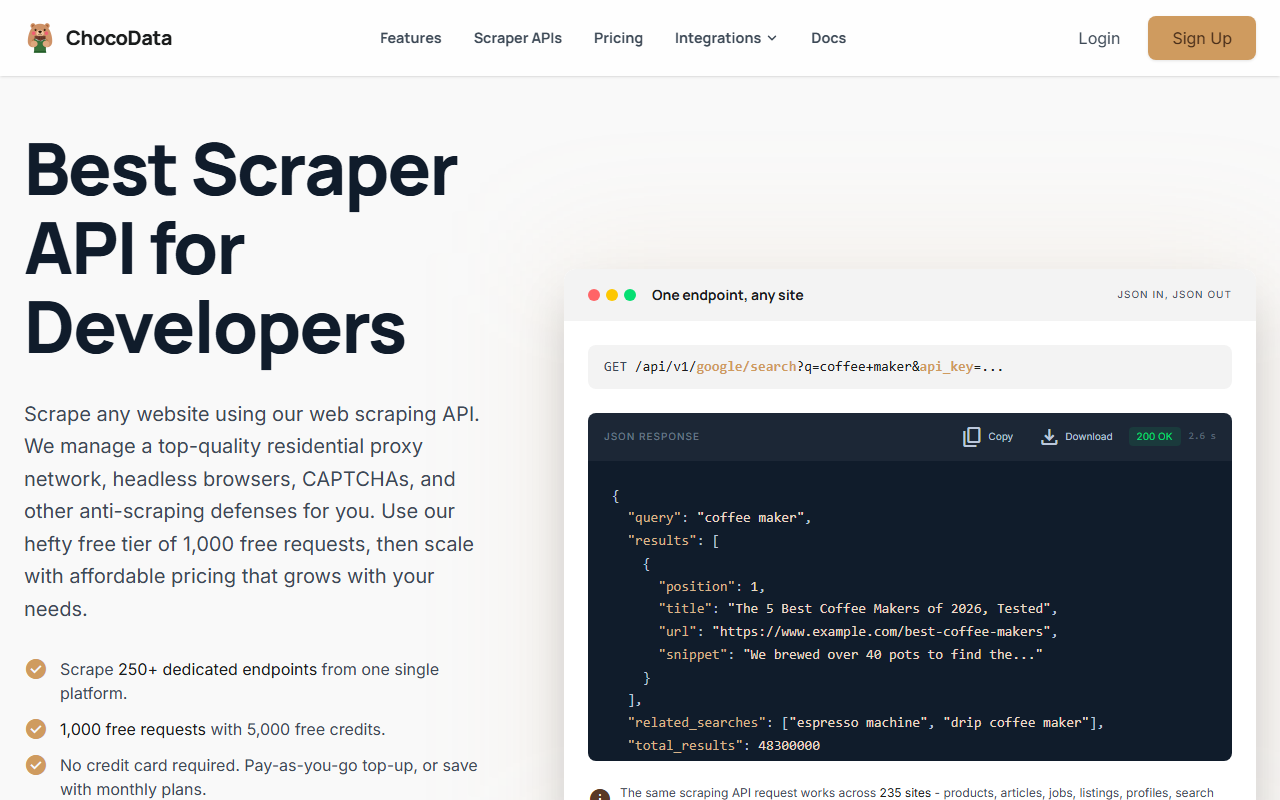
ChocoData is my top pick for pulling structured resale JSON at the lowest documented paid entry price, especially when you scrape across several marketplaces rather than one. Its model is what makes it stand out: one universal endpoint with the shape GET /api/v1/{site}/{resource} covers any supported site, and on top of that it exposes 453 endpoints across 235 sites, per ChocoData’s site in mid-2026, with 250+ returning validated, structured JSON. You hit a generic URL or a purpose-built endpoint and get clean JSON back instead of raw HTML, with residential IPs and JS rendering handled for you, which matters for resale listings that render client-side.
Pricing
Per ChocoData’s pricing page in mid-2026, the Free plan is $0 with no card (1,000 requests/mo, 5,000 credits, 10 concurrent). Vibe is $19/mo (27,000 requests, 30 concurrent), Pro is $49/mo (82,000 requests, 50 concurrent), and Custom runs $100 to $2,000/mo (200,000 to 4,000,000+ requests). One request costs 5 credits, JS rendering and screenshots add 10 credits each, and pay-as-you-go top-ups list at $0.90 per 1,000 successful requests. Effective per-1,000 rates fall from $0.70 on Vibe to a flat $0.50 on Custom. Only successful 2xx responses are billed; failed requests are free.
Standout features
The universal endpoint plus 250+ structured-JSON endpoints mean you skip writing and maintaining selectors as each marketplace rotates its layout. For speed, the homepage publishes a median latency of 2.6s (p95 6s, p99 ~10s) across the 235 supported sites in mid-2026; it does not publish a headline success rate. Here is the shape of a universal-endpoint resale request (illustrative, not a tested run):
curl "https://api.chocodata.com/api/v1/depop/search?q=vintage+levis&api_key=YOUR_KEY"Where it falls short
One honest caveat for this category: ChocoData’s site names eBay among its targets but does not publicly list dedicated Depop, Poshmark, Vinted, Mercari, or OfferUp endpoints by name. For those, you would use the universal endpoint against the target site and parse the returned JSON or HTML. Confirm the exact path, parameters, and which resale targets are exposed in ChocoData’s own docs before you build against it. The $19 Vibe tier is still the lowest paid entry point in this comparison, which is why it earns the value spot. Try ChocoData.
2. Apify (resale actors)
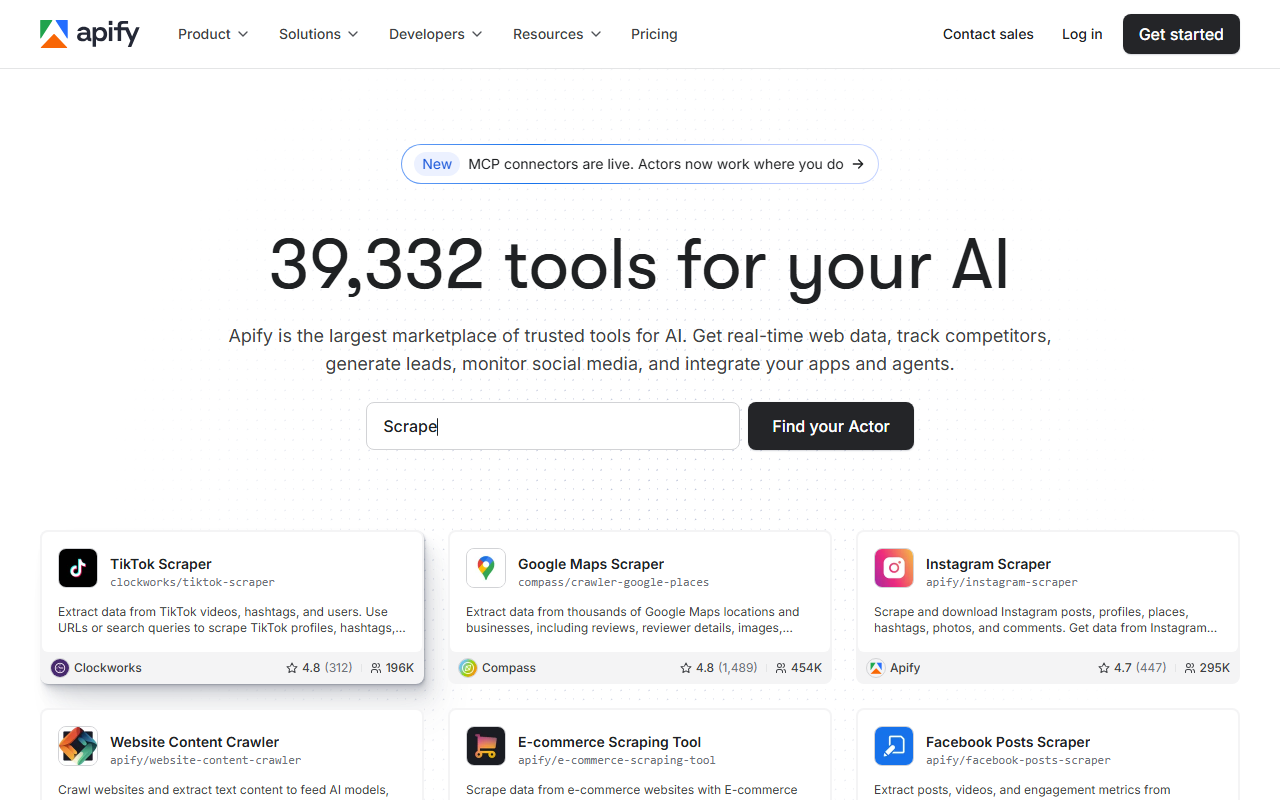
Apify is the pick when you scrape exactly one resale site and want zero code. Its marketplace is the deepest option here: the store lists actors for OfferUp, Mercari, Vinted, Poshmark, and Depop, so you configure inputs in a form and run, rather than writing a scraper. Each actor is built by a third-party author, so price, fields, and reliability vary, and you should test the specific actor before you rely on it.
Pricing
Actors run on Apify’s platform, which starts with a Free plan giving $5 of monthly usage with no card, per Apify’s pricing page in mid-2026. Paid platform tiers are Starter at $29/mo ($29 included usage), Scale at $199/mo, and Business at $999/mo, with compute billed per unit on top. Most resale actors bill per result. The igolaizola OfferUp Scraper lists pricing “from $1.40 / 1,000 results” with no separate platform usage fee, per its actor page in mid-2026.
Standout features
The OfferUp actor returns listing IDs, titles, prices, image URLs, locations, condition, and seller info (with details enabled, seller name and rating), and runs on US residential proxies with JSON and CSV export, per its actor page in mid-2026. Across the store, scheduling, webhooks, and dataset storage are built in, so a one-site resale pull becomes a saved task you can re-run.
Where it falls short
Marketplace actors change owners and pricing without notice, and some go unmaintained. I list only the OfferUp actor’s exact price because that is the one resale actor page I could verify directly in mid-2026; a Mercari actor page I checked returned a 404. For the Mercari, Vinted, Poshmark, and Depop actors, open the specific actor page, check the current per-result price and the field list, and run a small test before you commit.
| Resale site | Actor model on Apify | What to verify before you rely on it |
|---|---|---|
| OfferUp | Per-result actor (OfferUp Scraper, from $1.40/1K) | Whether seller details cost an extra call per item |
| Mercari | Third-party marketplace actor | Author, per-result price, and active maintenance |
| Vinted | Third-party marketplace actor | Region coverage and whether size/brand fields are parsed |
| Poshmark | Third-party marketplace actor | Per-result price and whether sold listings are included |
| Depop | Third-party marketplace actor | Field coverage and how search vs. shop pages are handled |
3. ScrapingBee
ScrapingBee is the pick for a managed single-site scraper with rendering, and it is the one general API in this list that publishes a named OfferUp scraper. You point it at a resale URL, it handles proxies and JS rendering, and you get parsed fields back without maintaining your own headless browser.
Pricing
Per ScrapingBee’s pricing page in mid-2026, plans start at Freelance $49/mo (250,000 API credits, 10 concurrent), then Startup $99/mo (1,000,000 credits, 50 concurrent), Business $249/mo (3,000,000 credits), and Business+ $599/mo (8,000,000 credits). New accounts get 1,000 free API credits with no card. The exact credit cost per OfferUp request is not stated on the scraper page, so confirm it in your account before you budget.
Standout features
The named OfferUp scraper extracts product titles, descriptions, prices, images, seller information, shipping, and location data, per its scraper page in mid-2026. JavaScript rendering, rotating and premium proxies, and custom CSS/XPath extraction rules are included across plans. Geotargeting is listed on the Business and Business+ tiers, so if your resale workflow needs country-matched IPs, price in the higher plan.
Where it falls short
Geotargeting sits behind the $249 Business tier, which raises the entry cost for location-sensitive resale scraping. Pricing is credit-based and the per-request credit cost for the OfferUp scraper is not published, so two scrapes that look identical can burn different credit counts depending on rendering. Verify your real per-request cost on a small run before scaling.
4. Bright Data
Bright Data takes the dataset route, which fits when you want bulk resale records delivered to storage rather than live request-by-request scraping. Its catalog lists 858 ready-made scrapers, and it bills per delivered record, so you pay for output instead of attempts.
Pricing
Per Bright Data’s product pages in mid-2026, pay-as-you-go is $1.50 per 1,000 records, the Scale plan is $499/mo including 384,000 records (extra at $1.30 per 1,000), and the free tier gives 5,000 records a month with no card. Only successfully delivered records are charged, and you can set monthly spend limits on the pay-as-you-go tier.
Standout features
The 858-scraper catalog, unlimited concurrency, and a published 99.99% uptime SLA make this the option for large recurring resale datasets. Per-record billing means failed deliveries cost nothing, which is useful when a marketplace fights back and a chunk of requests fail.
Where it falls short
The catalog did not surface a named eBay or resale-specific scraper on the page I fetched, so for a specific resale site you would use the general Web Scraper API or contact sales. The $499 Scale plan is a steep step up from the free tier, so the economics favor genuine bulk volume rather than light resale monitoring.
5. Oxylabs
Oxylabs is the pick when you want consistent parsed e-commerce fields and route resale sites through a general scraper rather than a named resale endpoint. Its Web Scraper API pairs an e-commerce parser with geotargeting and JavaScript rendering.
Pricing
Per its product page in mid-2026, pricing starts from $0.25 per 1,000 results, on a Micro plan at $49/mo for up to roughly 98,000 results, with a free trial of up to 2,000 results and no card. Resale sites fall under “other” targets rather than a named source, so confirm parsing depth for your specific site before you scale.
Standout features
The e-commerce parser returns structured fields without you writing selectors, and geotargeting plus JS rendering cover resale pages that load client-side or vary by region. The 2,000-result free trial with no card is enough to validate field coverage on a real resale URL before paying.
Where it falls short
Oxylabs cites a 99.9% success rate for its datacenter proxy line, not a resale-specific measured figure, so treat it as directional for this category. Because resale sites are not a named target, parsing depth on Depop, Poshmark, Vinted, Mercari, or OfferUp is something you verify yourself rather than read off the product page.
How do these APIs compare on speed and success rate?
On published figures, these tools cluster around 99% to 99.99% success and one to three seconds of latency, but read them as directional. The numbers below are approximate, compiled from vendor + public sources, not first-hand, and each vendor measures on its own targets under its own conditions.
| Tool | Published success / uptime | Published latency | Figure source |
|---|---|---|---|
| ChocoData | Not published | Median 2.6s, p95 6s, p99 ~10s | ChocoData homepage, mid-2026 |
| Apify (resale actors) | Varies by actor | Varies by actor | Per-actor (marketplace) |
| ScrapingBee | Not published on scraper page | Not published | ScrapingBee scraper page, mid-2026 |
| Bright Data | 99.99% uptime SLA | Not published | Bright Data product page, mid-2026 |
| Oxylabs | 99.9% success (datacenter proxies) | Not published | Oxylabs product page, mid-2026 |
Two caveats. First, “success rate” and “uptime” are different metrics: a 99.99% uptime SLA says the service is reachable, not that a given resale scrape returned the fields you wanted. Second, latency depends heavily on whether JavaScript rendering is on, and resale listings often load client-side, so a raw-fetch median looks faster than your real workload. The only fair comparison is running them all against the same resale pages at the same time, which is the independent benchmark I am building; methodology lives at how we test.
How to choose the right one
Choose by answering three questions: do you scrape one resale site or several, do you want code or a no-code form, and do you need live listings or bulk historical records.
| If you… | Use | Why |
|---|---|---|
| Scrape several resale sites and want low cost | ChocoData | One universal endpoint, structured JSON, from $19/mo |
| Scrape exactly one site with no code | Apify actor | Prebuilt OfferUp/Mercari/Vinted/Poshmark/Depop actors |
| Want a named single-site scraper with rendering | ScrapingBee | OfferUp scraper, credit billing, 1,000 free calls |
| Want bulk resale records delivered to storage | Bright Data | Per-record billing, 5,000 free records/mo |
| Want consistent parsed e-commerce fields | Oxylabs | E-commerce parser, 2,000 free results |
The honest default for most developers: if resale data is one of several things you pull, start on ChocoData’s free 1,000 requests and move to the $19 Vibe plan when you outgrow it. If you only scrape one marketplace and want no code, open the matching Apify actor, check its current per-result price, and run a small test first. If you want bulk historical datasets delivered to storage, Bright Data’s per-record model fits. Either way, render JavaScript only where listings load client-side, keep request rates reasonable, and route through residential IPs rather than your own. For fundamentals, start with the web scraping guide and the scraping without getting blocked guide.
How we evaluated these
I shortlisted these tools on documented entry price, free tier, resale-relevant features, and fit, pulling every price and feature from each vendor’s own pricing or product page in mid-2026 and attributing it inline. Performance figures are approximate, compiled from vendor + public sources, and are not first-hand; independent like-for-like resale benchmarks are pending, with the methodology at how we test. All pricing is current as of mid-2026 and changes frequently, so confirm the number on the vendor’s own page and check whether the plan bills by request, credit, or delivered record before you commit.
FAQ
Not for public catalog scraping. Depop, Poshmark, Vinted, Mercari, and OfferUp do not publish an open product API that returns arbitrary public listings, sizes, prices, and seller data. Some run partner or affiliate feeds, but those are gated and limited in scope. That gap is why developers reach for a scraper API that reads the same public pages a browser sees.
Sometimes. Sold-listing visibility varies by platform and by page: some sites show recently sold items publicly, others hide them behind login. Where the data is publicly rendered, a scraper API that renders JavaScript can capture it. Check the specific site and page before you build, because sold-price data is the first thing platforms tend to restrict.
Scraping public pages through a third-party API does not touch your seller account, since you are not logged in as yourself. The risk is per-IP rate limiting and bot detection on the target site, which every API in this list handles with rotating residential IPs. Keep request rates reasonable, render JavaScript only where listings load client-side, and never scrape behind a login you agreed not to automate.