Best Review Platforms Scraper APIs & Tools
- A reviews scraper API routes requests to sites like Amazon, Google, Trustpilot, Capterra, and Yelp through a managed endpoint that rotates IPs, renders JavaScript, and returns review text, rating, author, and date as JSON.
- Documented entry prices in mid-2026 start at $0 free tiers (ChocoData, ScraperAPI, Apify, Bright Data) and $19/mo (ChocoData), rising to $30/mo (Scrapfly), $49/mo (Oxylabs), and $499/mo (Bright Data Scale). The tools bill in different units, so compare included volume, not just the headline price.
- ChocoData is my top value pick: one universal endpoint plus 453 dedicated endpoints across 235 sites, from $19/mo with a free 1,000 requests/mo.
- For purpose-built review parsing, Oxylabs returns structured review fields (author, rating, content, verified, timestamp, helpful count) and Bright Data ships dedicated Amazon, Yelp, and Glassdoor review scrapers billed per delivered record.
- Speed and success figures below are approximate, compiled from vendor-published numbers and public sources, not first-hand. Independent benchmarks are pending (how we test).
Reviews are some of the most-requested public data on the web: founders track competitor sentiment, marketers pull testimonials, and ML teams build training sets from them. The catch is that the big review platforms either have no public API or cap it hard, so most people scrape the rendered pages. My top pick for the job is ChocoData, and on this page I compare it against five other reviews scraper APIs I would actually shortlist in 2026 (Oxylabs, Bright Data, ScraperAPI, Apify, and Scrapfly) on the things that decide a purchase: starting price, free tier, which review sources they cover, and published speed.
One disclosure up front: bestscraperapi.com earns affiliate commissions from some of the vendors listed here. That has no effect on which tools make the list, how I rank them, or what I write. The pricing comes straight from each vendor’s own page in mid-2026, attributed inline, and the ranking follows documented price and features, not payout.
TL;DR: the reviews scraper APIs at a glance
| Rank | Tool | Starting price | Free tier | Best for |
|---|---|---|---|---|
| 1 | ChocoData | $19/mo (Vibe) | 1,000 requests/mo (no card) | Reviews across many platforms at the lowest entry price |
| 2 | Oxylabs | $49/mo (Micro) | 2,000 results (no card) | Purpose-built review parsing with consistent fields |
| 3 | Bright Data | PAYG $1.50/1K records | 5,000 records/mo (no card) | Bulk review datasets billed per delivered record |
| 4 | ScraperAPI | $0 free plan + trial credits | Free plan + trial credits | A structured Amazon-reviews endpoint plus a free tier |
| 5 | Apify | $29/mo platform (+ actor) | $5 usage/mo (no card) | Reusing a prebuilt actor for Capterra, G2, Trustpilot |
| 6 | Scrapfly | $30/mo (Discovery) | 1,000 credits (no card) | A rendering API to defeat review-page anti-bot walls |
A note before the numbers below. The speed and success-rate figures further down are approximate, compiled from each vendor’s published figures plus aggregated public sources, and are not first-hand. Independent, like-for-like review benchmarks are pending; see how we test for the methodology and check back for measured results.
What is a reviews scraper API?
A reviews scraper API is a managed service you send a review-page URL or a product ID to, and it returns the reviews while handling the parts that break a DIY script. It runs rotating residential proxies, renders JavaScript, solves CAPTCHAs, and retries failures, so you get the review text, rating, author, and date back instead of a block page. The better ones return parsed JSON for specific review page types (Amazon reviews, Google reviews, Capterra) so you skip writing and maintaining selectors as each site rotates its layout.
This category exists because review platforms defend their pages and rarely expose the data through an official feed. Google’s Places API returns at most five reviews per place; Trustpilot and G2 gate full access behind business contracts; Capterra has no public review API at all. Reviews also paginate heavily, so a plain script gets rate-limited and CAPTCHA-walled within a few pages. A scraper API makes that reliable at volume. If you want the fundamentals first, start with the web scraping pillar guide, and the scraping without getting blocked guide for the anti-block side.
1. ChocoData
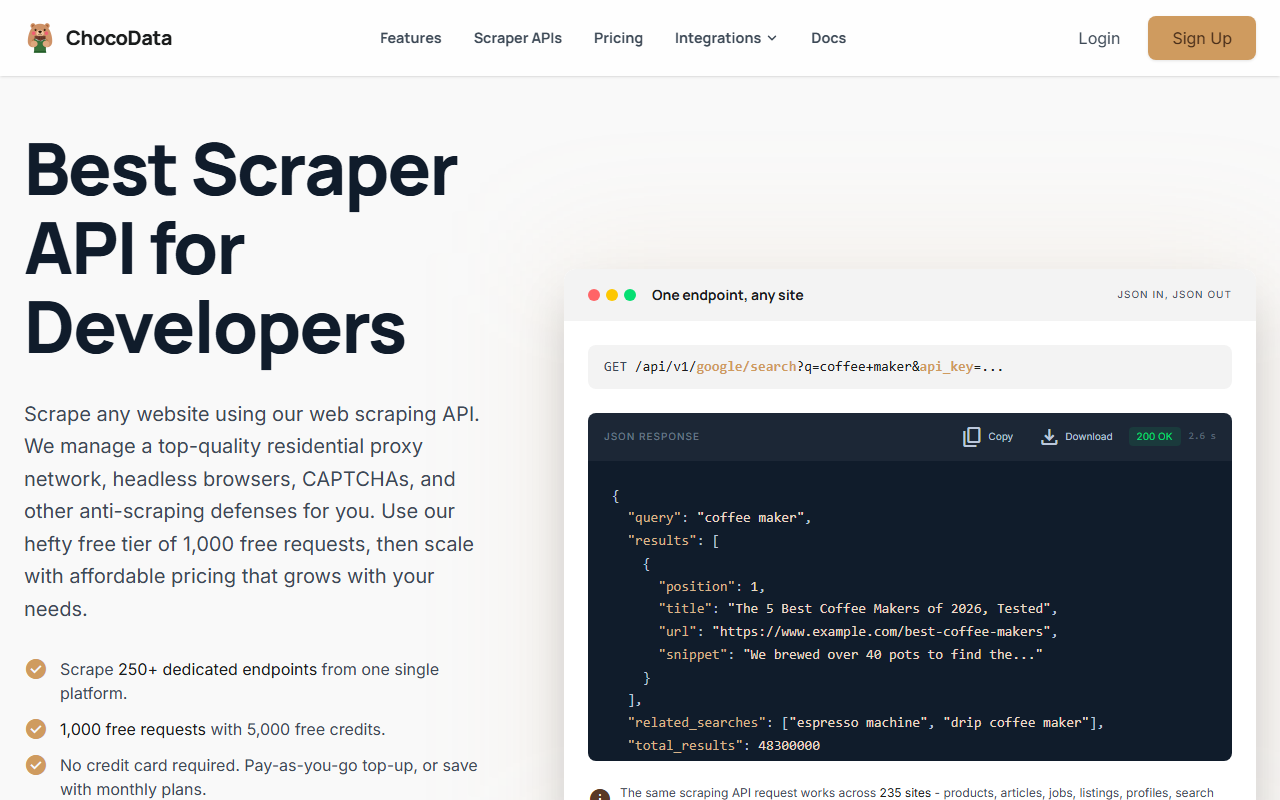
ChocoData is my top pick for pulling structured review JSON at the lowest documented entry price, especially when you scrape reviews across several platforms rather than one. Its model is what makes it stand out: one universal endpoint with the shape GET /api/v1/{site}/{resource}?api_key=... covers any supported site, and on top of that it exposes 453 endpoints across 235 sites, per ChocoData’s site in mid-2026, with 250+ returning validated, parity-checked structured JSON. You hit a generic URL or a purpose-built endpoint and get clean JSON back instead of raw HTML, with residential IPs and JS rendering handled for you, which matters for review widgets that render client-side.
Pricing
Per ChocoData’s pricing page in mid-2026, the Free plan gives 1,000 requests a month (5,000 credits) with no card and access to all 235 targets; Vibe is $19/mo for 27,000 requests at 30 concurrency; Pro is $49/mo for 82,000 requests; and Custom runs $100 to $2,000/mo for 200,000 to 4M+ requests. One request costs 5 credits, JS rendering and screenshots add 10 credits each, and only successful 2xx responses are billed, so failed scrapes cost nothing. Pay-as-you-go top-ups are $0.90 per 1,000 successful requests, and the effective per-1k rate falls from $0.70 on Vibe to a flat $0.50 on Custom. The $19 Vibe tier is the lowest paid entry point in this comparison.
Standout features
The universal endpoint accepts any public URL, so a review page on a site without a named endpoint still returns structured data rather than a 403. ChocoData lists 17 site categories spanning e-commerce, search, social platforms, real estate, finance, and reference sources, per its homepage in mid-2026, which covers most of the platforms reviews live on. It ships official SDKs for Python, Node.js, and Go, plus a CLI and an MCP server for AI agents. On speed, its homepage publishes a median latency of 2.6s, p95 of 6s, and p99 of about 10s across the 235 supported sites; it does not publish a headline success rate.
Best for
Developers and founders who pull reviews from several platforms and want one cheap API with a real free tier to test against. Here is the shape of a universal-endpoint review request (illustrative, not a tested run):
curl "https://api.chocodata.com/api/v1/amazon/reviews?asin=B09V3KXJPB&api_key=YOUR_KEY"Confirm the exact path, parameters, and which review targets are exposed in ChocoData’s own docs before you build against it. Try ChocoData.
2. Oxylabs
Oxylabs is the pick when you want a purpose-built review parser that returns consistent structured fields per review rather than HTML you parse yourself. Per its reviews scraper page in mid-2026, the Web Scraper API returns a clean review object and also exposes a universal source so you can point it at review pages beyond its named targets. It trades ChocoData’s low entry price for deeper, review-specific parsing maintained on the vendor’s side.
Pricing
Per the Oxylabs reviews scraper page in mid-2026, per-result pricing without JavaScript rendering is $0.50 per 1,000 results for Amazon, $1.00 per 1,000 for Google, and $1.15 per 1,000 for other sources, rising to $1.35 per 1,000 with JavaScript rendering on. Subscription tiers are Micro at $49/month, Starter at $99/month, and Advanced at $249/month, with a free trial of up to 2,000 results and no credit card. The Amazon-without-JS rate is the cheapest per-review figure in this comparison if Amazon is your main target.
Standout features
The structured review object includes author, content, id, is_verified, rating, review_from, timestamp, and title, with helpful_count captured when available, per the reviews page in mid-2026. The verified-purchase flag and helpful count are fields you would otherwise scrape and normalise yourself. Oxylabs runs geotargeting across roughly 195 locations, which matters because review sets and ratings can differ by country. It advertises a 99.9% success rate for its Scraper API line, though that is a service-wide claim, not a reviews-only measured figure.
Best for
Teams whose review work centres on one or two big platforms (Amazon especially) and who want named, consistent fields per review without maintaining selectors as the site’s layout rotates. Start on the 2,000-result free trial and confirm current per-source rates on the Oxylabs page before you size a plan.
3. Bright Data
Bright Data fits teams that think in delivered datasets rather than API calls. It ships dedicated review scrapers and pipes the output as files, charging only for records it actually delivers. Pick it when you want bulk historical review data dropped into storage rather than per-request scraping you orchestrate yourself.
Pricing
Per Bright Data’s Web Scraper pricing page in mid-2026, the Scraper API is pay-as-you-go at $1.50 per 1,000 records, with a free tier of 5,000 records a month and no card. The Scale plan is $499/month including 384,000 records, with extra records at $1.30 per 1,000, and Enterprise is custom with volume discounts. Billing is delivery-based: you pay only for successfully delivered records, with no charge for failed deliveries. The $499/mo Scale step is steep for small projects, so most readers start on pay-as-you-go or the free tier.
Standout features
Per its Web Scraper product page in mid-2026, Bright Data lists dedicated Amazon Reviews, Yelp businesses reviews, Glassdoor companies reviews, and Facebook company reviews scrapers, returning fields such as product or business name, rating, rating distribution, and author. Output comes as JSON, NDJSON, or CSV, delivered by webhook or API, or downloaded from the control panel, with unlimited concurrent requests. It publishes a 99.99% uptime SLA, which speaks to availability rather than per-request success.
Best for
Data teams loading large, recurring review datasets (Amazon, Yelp, Glassdoor) into a warehouse or bucket, where per-record billing and managed delivery beat orchestrating requests yourself. The product page showed a promo code at time of capture; treat promos as temporary and confirm the current rate.
4. ScraperAPI
ScraperAPI is the pick when you want a structured Amazon-reviews endpoint plus a credit model that only charges for successful requests, with a free plan to start. It is a general scraper API with structured-data endpoints layered on top, so you can mix raw page fetches with parsed product-and-review pulls under one key.
Pricing
Per ScraperAPI’s documentation in mid-2026, a basic request costs 1 API credit, render=true and premium=true add 10 credits each, and ultra_premium=true adds 30 credits; combined, premium plus render is 25 credits and ultra_premium plus render is 75. You are charged only for successful requests (HTTP 200 and 404). ScraperAPI documents a $0 free plan with trial credits, but its live monthly pricing table did not render on the pages I could fetch, so confirm the current Hobby and higher plan prices on ScraperAPI’s pricing page before you budget.
Standout features
ScraperAPI’s structured Amazon Product API endpoint returns product data and all publicly available reviews via an ASIN, per its docs in mid-2026, with country_code and tld parameters for geographic targeting. That turns Amazon review collection into a single structured call rather than a render-and-parse job. Headless rendering and premium residential routing are available per-request through the credit flags above, so you scale anti-bot strength only on the requests that need it.
Best for
Teams that scrape Amazon reviews specifically and want a parsed endpoint plus pay-only-for-success credit billing, with a free plan to validate before committing. If your review targets extend well beyond Amazon, lean on the general endpoint and parse, or pick a tool with broader named review parsers.
5. Apify
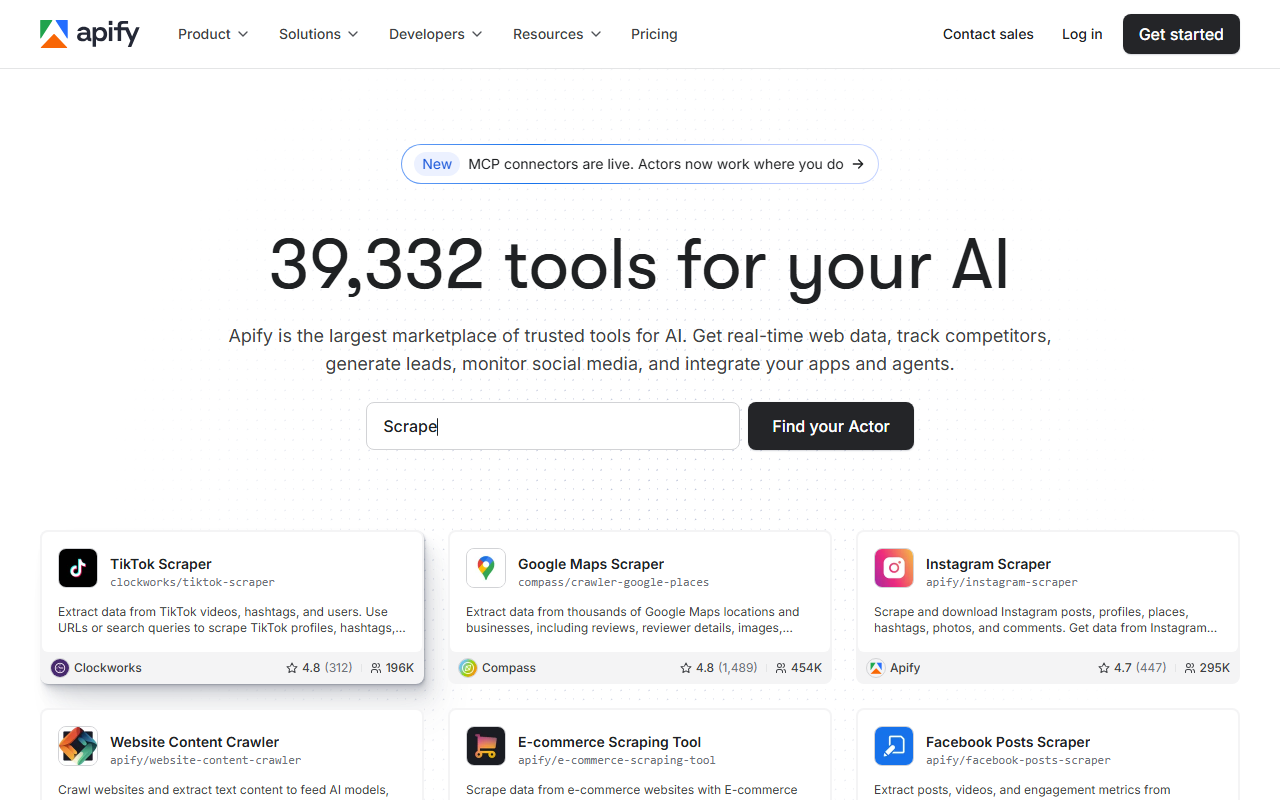
Apify takes the marketplace approach: instead of one API, you run a prebuilt actor. Its store lists review actors for Capterra, Google, Trustpilot, Yelp, G2, and Amazon reviews, which makes it the move when you want a ready-made scraper for a platform the dedicated APIs do not parse natively.
Pricing
Apify actors run on a platform plan plus per-actor cost. Per Apify’s pricing page in mid-2026, the Free plan gives $5 of monthly usage with no card, Starter is $29/month with $29 of included usage, Scale is $199/month, and Business is $999/month; unused usage does not roll over and expires at the end of the cycle. On top of that, the epctex Capterra Scraper rents at $40/month plus usage, per its actor page in mid-2026, and reports roughly 0.07 to 0.08 compute units to scrape 100 listings. Budget both line items: the platform plan and whatever the actor draws down.
Standout features
The epctex Capterra Scraper returns deep review fields, per its actor page in mid-2026: review ID, title, date, pros and cons text, multiple rating dimensions (overall, ease of use, functionality, value for money), reviewer details (company size, industry, job title, time using the product), vendor responses, and incentivisation status. That is richer Capterra structure than the general APIs return. Actors also support scheduling and run on Apify’s managed infrastructure, so you reuse a maintained scraper instead of building one.
Best for
Teams that need reviews from a B2B-software platform (Capterra, G2, Trustpilot) where a prebuilt actor already maps the fields, and who would rather configure an actor than write a parser. Per-actor speed, fields, and reliability vary by author, so test the specific actor on a small run before you rely on it.
6. Scrapfly
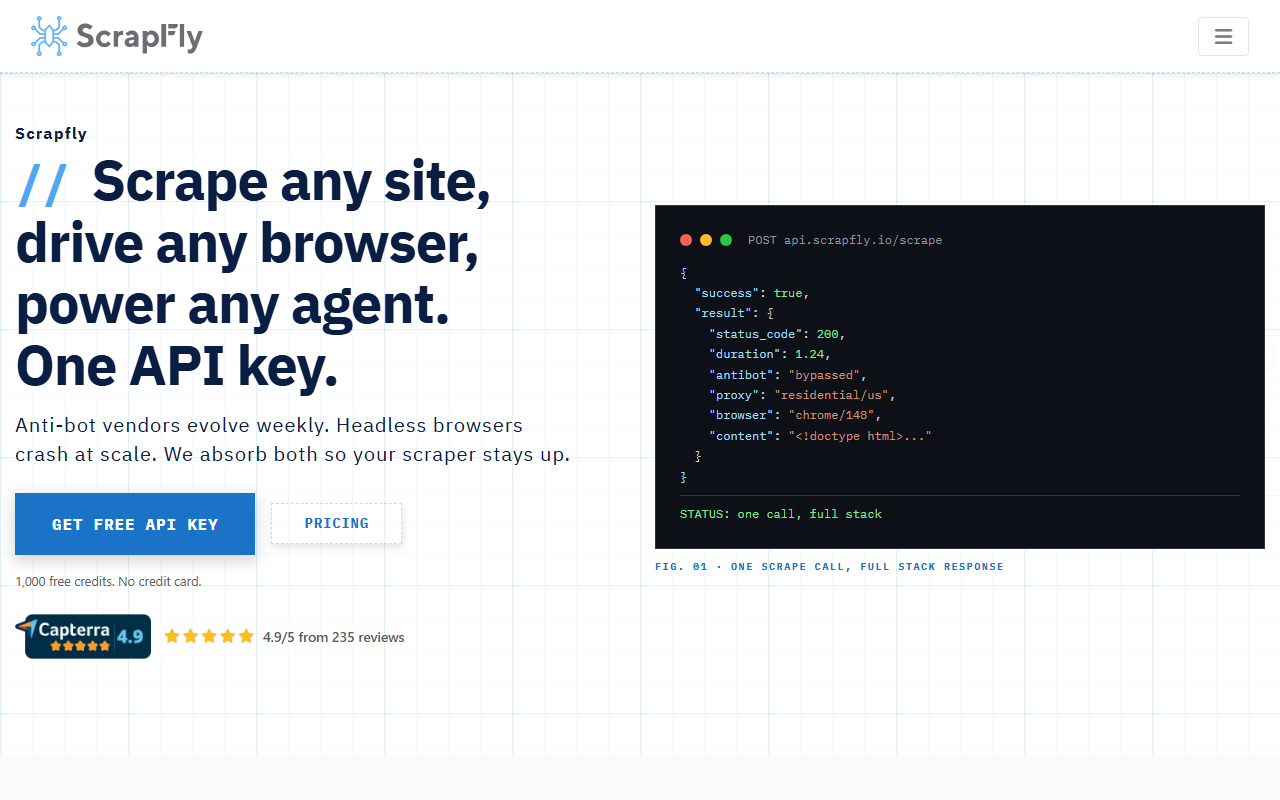
Scrapfly is the pick when you want a general rendering API to get past a review page’s anti-bot defences and parse it yourself. It bundles managed proxies, anti-bot bypass, a cloud browser, and an extraction API behind one endpoint, which suits developers who already write selectors and want control over what they pull.
Pricing
Per Scrapfly’s pricing page in mid-2026, plans start at $30/month (Discovery, 200,000 credits, 5 concurrency) and rise through Pro at $100/month (1,000,000 credits, 20 concurrency), Startup at $250/month (2,500,000 credits, 50 concurrency), and Enterprise at $500/month (5,500,000 credits, 100 concurrency), with a free tier of 1,000 API credits and no card. Per-request credit cost rises when you enable JavaScript rendering, anti-scraping protection bypass (asp), residential proxies, or country targeting, so model your real review-page settings in its estimator before you commit.
Standout features
The cloud browser plus asp anti-bot bypass handles review widgets that load client-side and pages that block cold IPs, and the Extraction API can turn a rendered review page into structured data without separate parsing infrastructure. There is no dedicated per-platform review endpoint, so you write and maintain selectors or extraction rules, but you get fine-grained control over rendering and proxy type per request.
Best for
Developers who want a rendering API to defeat review-site defences and keep control of parsing, especially for platforms without a prebuilt parser elsewhere. Anyone who wants finished review JSON with named fields and no parsing work should pick a dedicated parser (ChocoData, Oxylabs, Bright Data) instead.
How do the reviews APIs compare on speed and success rate?
On published figures, these APIs cluster around 99% to 99.99% reliability claims and a few seconds of latency, but read them as directional, not head-to-head. The numbers below are approximate, compiled from each vendor’s published figures plus aggregated public sources, and are not first-hand. Each vendor measures on its own targets under its own conditions, so a 99.9% from one and a 99.99% from another are not measured the same way.
| Tool | Published success / uptime | Published latency | Figure source | What it means |
|---|---|---|---|---|
| ChocoData | Not published | Median 2.6s, p95 6s, p99 ~10s (across 235 sites) | ChocoData homepage, mid-2026 | Discloses latency percentiles, not a success rate; figure is all-sites |
| Oxylabs | 99.9% success rate | Not published | Oxylabs Scraper API pages, mid-2026 | Success claim is for the Scraper API line, not reviews-only measured |
| Bright Data | 99.99% uptime SLA | Not published | Bright Data product page, mid-2026 | Publishes uptime, not request success rate |
| ScraperAPI | Charges only 200/404 | Not published | ScraperAPI docs, mid-2026 | Bills successful requests; no headline latency in fetched pages |
| Apify (review actors) | Varies by actor | ~0.07-0.08 compute units / 100 Capterra listings | Apify actor page, mid-2026 | Throughput per actor, not a service-wide success rate |
| Scrapfly | Success-based credit model | Not published | Scrapfly pricing/docs, mid-2026 | Bills successful requests; anti-bot and JS add credit cost and time |
Three caveats before you lean on any of these. First, “success rate” and “uptime” are different metrics: a 99.99% uptime SLA says the service is reachable, not that a given review scrape returned the fields you wanted. Second, latency depends heavily on whether JavaScript rendering is on, and review widgets often load client-side, so a raw-fetch median will look faster than your real review workload. Third, these are vendor self-reports on vendor-chosen targets. The only fair comparison is running them against the same review pages at the same time, which is the independent benchmark I am still building; methodology and results live at how we test.
How to choose the right one
Choose by answering three questions: do you scrape reviews from one platform or many, do you need parsed fields or raw HTML, and how much volume do you need. Your answers map cleanly onto the options above.
| If you… | Use | Why |
|---|---|---|
| Scrape reviews across many sites and want low cost | ChocoData | One universal endpoint, structured JSON, from $19/mo, free 1,000 req/mo |
| Need consistent parsed review fields per source | Oxylabs | Author, rating, content, verified, timestamp, helpful count per review |
| Want bulk review records delivered, not requests | Bright Data | Per-record billing, Amazon/Yelp/Glassdoor scrapers, 5,000 free records/mo |
| Scrape Amazon reviews with a parsed endpoint and free tier | ScraperAPI | Amazon Product API returns reviews by ASIN, pay only for 200/404 |
| Need a prebuilt scraper for Capterra, G2, or Trustpilot | Apify | Marketplace actors with deep B2B-review fields, scheduling |
| Want a rendering API to defeat anti-bot and parse yourself | Scrapfly | Cloud browser, asp bypass, extraction API, 1,000 free credits |
The honest default for most developers: if reviews are one of several data types you pull, start on ChocoData’s free 1,000 requests and move to the $19 Vibe plan when you outgrow it. If you only scrape Amazon and need many parsed fields, Oxylabs at $0.50 per 1,000 results (no JS) or ScraperAPI’s Amazon endpoint fit. If you want bulk historical review datasets delivered to storage, Bright Data’s per-record model wins. For B2B-software reviews, an Apify actor saves you building a parser; for everything else behind a hard anti-bot wall, Scrapfly’s rendering API gives you control.
How we evaluated these
Every price and feature on this page comes from each vendor’s own pricing or product page in mid-2026, attributed inline, because review-site copies go stale fast and pricing pages move. The performance figures are approximate, compiled from vendor-published numbers plus aggregated public sources, and are explicitly not first-hand; my independent, like-for-like review benchmarks are pending and will replace the vendor figures once published (see how we test for the methodology). Pricing is current as of mid-2026 and changes frequently, so confirm the number on the vendor’s own page before you commit, and check whether the plan bills by request, credit, or delivered record so you are comparing like with like.
FAQ
Scraping publicly visible reviews sits in a grey area that depends on jurisdiction, the site's terms, and whether you collect personal data. Public, non-personal review text is lower risk than scraping reviewer names and profiles, which can trigger data-protection rules like GDPR and CCPA. A managed API changes who runs the proxies, not who carries the legal duty, which stays with you. Read each platform's terms and my legal overview before you scale, and treat this as engineering guidance, not legal advice.
Most review platforms either have no public reviews API or gate it hard. Google's Places API returns at most five reviews per place and restricts storage; Trustpilot and G2 reserve full review access for paying business customers; Capterra has no public review feed. A scraper API reads the same public pages a browser sees, which is why developers reach for one when the official feed is missing or capped.
Review pages are paginated and rate-limited, so the fast way to get blocked is hammering one IP through hundreds of pages. Every API in this list bundles rotating residential IPs and JavaScript rendering so you do not run a proxy pool yourself. Keep request rates sane, render JavaScript only where the reviews load client-side, and route through the API rather than your own IP. My scraping-without-getting-blocked guide covers the detail.
On documented mid-2026 pricing, ChocoData has the lowest paid monthly entry at $19/mo with a free 1,000 requests/mo, and its universal endpoint points at any supported review page. Per delivered record, Oxylabs is cheapest for Amazon reviews at $0.50 per 1,000 results without JavaScript. Bright Data, ScraperAPI, and Apify all run $0 free tiers to test before you pay. Confirm each number on the vendor's own page, since pricing moves.