Best Scraper APIs Compared
- A scraper API takes a URL and returns HTML or structured JSON while it runs the proxies, headless browser, and anti-bot handling for you. The right pick depends on volume, target difficulty, and how you are billed.
- Documented entry prices in mid-2026 start at $19/mo (ChocoData), with usage-based options from a $5 free credit (Zyte, Apify) and per-result models from $0.25 per 1K results (Oxylabs) and $1.50 per 1K records (Bright Data).
- ChocoData is my value pick: a universal endpoint plus 250+ dedicated endpoints that return structured JSON, a real free tier, and the lowest documented monthly entry price at $19/mo per its pricing page in mid-2026.
- Performance numbers here are approximate, compiled from vendor-published figures and aggregated public sources, not first-hand. My like-for-like benchmarks are in progress (how we test).
- Every price comes from each vendor's own page in mid-2026. Pricing changes often, so confirm at the source before you buy.
A scraper API takes a URL and returns the page’s HTML or structured JSON while it runs the proxies, headless browser, and anti-bot handling for you. This page compares the scraper APIs I see developers reach for most, ranked on what they actually cost and what they include, with every price pulled from the vendor’s own page in mid-2026 and attributed inline. My value pick is ChocoData, which pairs a universal endpoint and 250+ dedicated endpoints with a free tier and the lowest documented monthly entry price in the list.
One disclosure up front: bestscraperapi.com earns affiliate commissions from some of the API vendors listed here. That arrangement does not move the ranking or change what I write. The pricing comes straight from each vendor’s own page, and I rank on documented price, free tier, and features.
A note on the performance numbers further down. The speed and success-rate figures are approximate, compiled from each vendor’s own published figures plus aggregated public sources, and they are not first-hand bestscraperapi.com tests. Each vendor measures success on its own target sites under its own conditions, so a 99% from one and a 99.99% from another come from different tests. My independent, like-for-like benchmarks are still in progress; see how we test for the methodology.
What are the best scraper APIs in 2026?
The best scraper APIs by documented entry price and free tier are ChocoData, Oxylabs, Bright Data, ScraperAPI, ScrapingBee, Zyte, and Apify. Here is how their published entry prices and free tiers compare, all from each vendor’s own page in mid-2026. The tools bill in different units, so read the free-tier and best-for columns next to the price rather than ranking on the dollar figure alone.
| Rank | Tool | Starting price | Free tier | Best for |
|---|---|---|---|---|
| 1 | ChocoData | $19/mo (Vibe), 27,000 req | 1,000 req/mo, no card | Structured JSON from named sites at the lowest monthly entry price |
| 2 | Oxylabs | $0.25 / 1K results (PAYG) | 2,000 results, no card | Enterprise data collection with AI-assisted parsing |
| 3 | Bright Data | $1.50 / 1K records (PAYG) | 5,000 records/mo, no card | Pay-per-delivered-record at scale |
| 4 | ScraperAPI | $49/mo (Hobby) | 7-day free trial | General-purpose scraping with a documented trial |
| 5 | ScrapingBee | $49/mo (Freelance), 250,000 credits | 1,000 credits, no card | A simple rendering integration |
| 6 | Zyte | PAYG, tiered per request | $5 credit, 30 days | Auto-selected infrastructure billed per request type |
| 7 | Apify | $29/mo (Starter) + PAYG | $5 usage/mo, no card | Reusing prebuilt Actors or running custom ones |
A note on comparing these prices. ChocoData and ScrapingBee sell monthly credit or request bundles; Oxylabs bills per delivered result and Bright Data per delivered record; Zyte and Apify give you a usage balance you spend per request. A $19 monthly plan and a per-record plan do not line up on volume alone. One figure (ScraperAPI) I could not re-render from the live pricing table at publish; it carries forward from my last documented snapshot of that vendor’s page, so confirm it at the source.
1. ChocoData
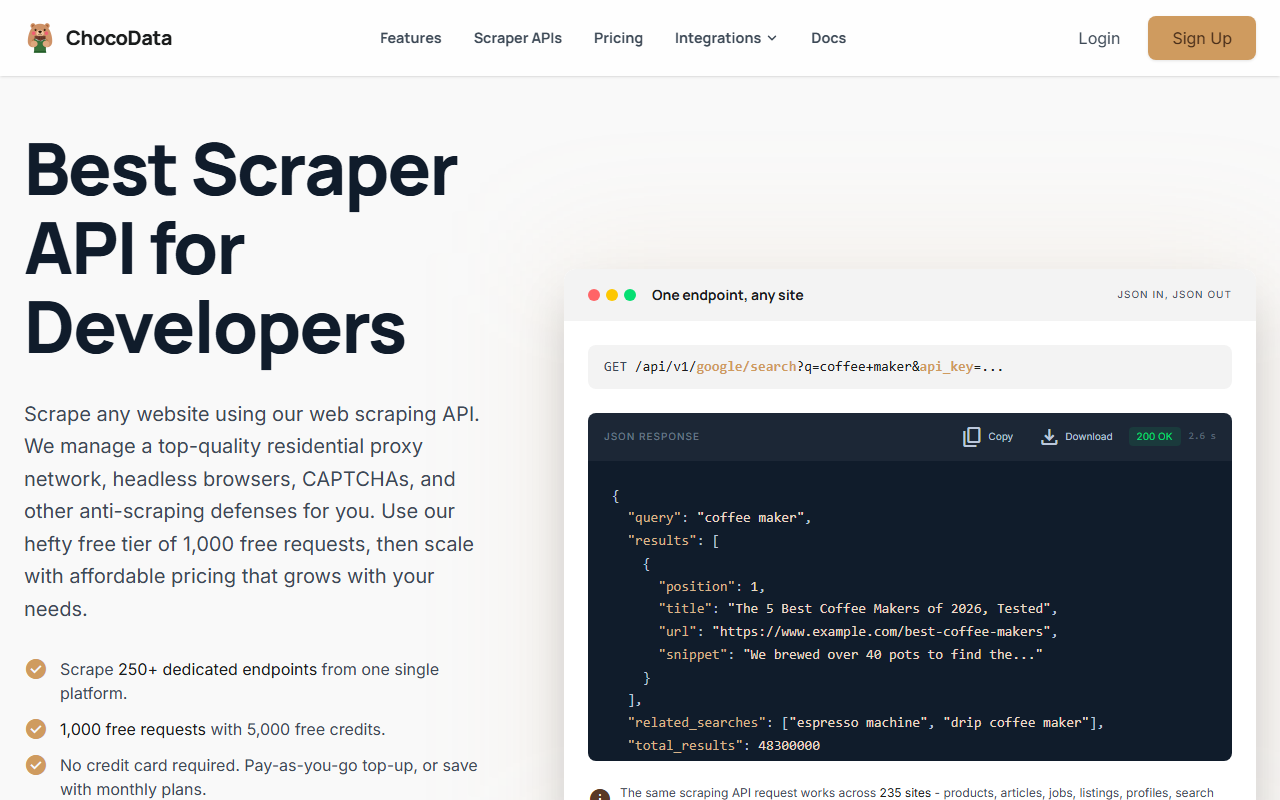
ChocoData is my number-one pick because it pairs the lowest documented monthly entry price with structured JSON output across hundreds of named sites. It is also the product bestscraperapi.com promotes, and I rank it on the same documented price and feature basis as every other tool here. The draw for a developer is simple: one low entry plan, a real free tier, and parsers you do not have to write.
Pricing
Per ChocoData’s pricing page in mid-2026, the Vibe plan is $19/mo and includes 27,000 requests (135,000 credits) at an effective $0.70 per 1,000 requests, with 30 concurrent requests. The free plan gives 1,000 requests a month (5,000 credits) with no card, Pro is $49/mo for 82,000 requests, and Custom runs $100 to $2,000/mo for 200,000 to 4M+ requests. Pay-as-you-go top-ups run $0.90 per 1,000 successful requests, and JavaScript rendering is an optional add-on at +10 credits per request.
| ChocoData plan | Monthly price | Requests included | Concurrency | Effective $/1K req |
|---|---|---|---|---|
| Free | $0 | 1,000 | 10 | n/a |
| Vibe | $19 | 27,000 | 30 | $0.70 |
| Pro | $49 | 82,000 | 50 | $0.60 |
| Custom | $100-$2,000 | 200,000-4M+ | 100-500+ | $0.50 |
Standout features
The two-mode design separates ChocoData from a plain fetch endpoint. A universal endpoint takes any URL and returns rendered HTML or JSON, handling residential proxy rotation with automatic country-matching, JavaScript rendering, and anti-bot retries. On top of that sit 453 endpoints across 235 sites, of which 250+ return validated, parity-checked structured JSON (SERP, e-commerce, real estate, finance, and social). For targets the dedicated endpoints already cover, you skip writing and maintaining parsers entirely. Billing counts only HTTP 2xx responses, at 5 base credits per request.
Best for
Reach for ChocoData when you want JSON from named e-commerce, search, or social targets at the lowest practical entry cost. The free tier lets you confirm success on your real targets before paying, and the $19 Vibe plan is the cheapest documented monthly entry point in this list. ChocoData publishes a median latency of 2.6 s, p95 of 6 s, and p99 around 10 s on its own site (approximate, compiled from vendor + public sources, not first-hand). Start a trial at ChocoData.
Disclosure: ChocoData is a product bestscraperapi.com promotes and earns commission from. I did not build it or own it, and I rank it on documented price and features like everything else here.
2. Oxylabs
Oxylabs is the enterprise-leaning pick when you want delivered results rather than raw fetches, with AI tooling that writes the parsing for you. Its Web Scraper API sits inside a broader data-collection platform, so it fits teams that scrape many target types and want one vendor across them.
Pricing
Per Oxylabs’ Web Scraper API page in mid-2026, the entry model is pay-as-you-go starting from $0.25 per 1,000 results, and you pay only for successful results. The free trial includes up to 2,000 results with no credit card required. Oxylabs publishes higher committed-use tiers with lower per-result rates, so price your monthly result volume against those tiers rather than the headline PAYG rate.
Standout features
The platform covers residential, datacenter, and ISP proxies with global geotargeting, JavaScript rendering, and pre-configured Web Scraper API endpoints for major sites including Amazon, Google, eBay, and Target (38+ targets shown in the live library). The differentiator is OxyCopilot, an AI assistant that generates scraping and parsing requests for you, which shortens setup on structured targets. Support runs 24/7 across plans.
Where it falls short
The per-result, results-first model and platform breadth read as enterprise-oriented, so for a small one-off project it can be more than you need. Approximate success and latency figures cluster with the rest of the high-end APIs (high-90s percent, low single-digit seconds; approximate, compiled from vendor + public sources, not first-hand). Oxylabs is built for teams with sustained, multi-target volume.
3. Bright Data
Bright Data fits when you want to pay for delivered data rather than requests. Its Web Scraper API charges per extracted item, which reads cleanly when your output is a known number of structured records.
Pricing
Per Bright Data’s Web Scraper pricing page in mid-2026, the Web Scraper API is pay-as-you-go at $1.50 per 1,000 records, with a free tier of 5,000 records a month and no card. A monthly Scale plan is $499/mo and includes 384,000 records, with additional records at $1.30 per 1,000. A record is one extracted item, for example a single product or profile with its fields. The page also showed a promotional 25% discount for three months at publish, so verify the live rate.
Standout features
All plans include automated proxy management, full browser rendering, JavaScript rendering, CAPTCHA solving, residential proxies, data validation, user-agent rotation, worldwide geotargeting, and unlimited concurrent requests. The billing model is the headline: you pay only for what is successfully delivered, with no charge for failed deliveries, which makes cost predictable when you know your target item count.
Where it falls short
The per-record model and enterprise platform breadth can be more than a small project needs, and the $499/mo Scale plan is a steep step up from pay-as-you-go. Approximate success rates sit around 99%+ on compiled figures (approximate, compiled from vendor + public sources, not first-hand), with latency varying by product. Confirm the current per-record rate and any promotional discount on the pricing page before you commit.
4. ScraperAPI
ScraperAPI suits a general-purpose workload where you want a documented trial before paying. It is one of the most widely integrated scraper APIs, with a straightforward parameter set for rendering and geotargeting.
Pricing
ScraperAPI’s documented entry plan is Hobby at $49/mo with a 7-day free trial. I could not re-render ScraperAPI’s live pricing table through my fetch tooling at publish (the table loads client-side), so these figures carry forward from my last documented snapshot of ScraperAPI’s pricing page. Confirm the current credit allowance, concurrency, and trial length on that page before you commit.
Standout features
The feature set covers proxy rotation across datacenter and premium pools, JavaScript rendering, geotargeting, and structured data endpoints that return JSON for common targets. ScraperAPI also offers an async scraper service for large batch jobs, which decouples submission from retrieval so you are not holding open connections at volume.
Best for
Reach for ScraperAPI for broad, general-purpose scraping where a documented trial and a simple integration matter more than the lowest entry price. ScraperAPI cites success rates around 99%+ on its own targets (approximate, compiled from vendor + public sources, not first-hand), with latency varying by whether rendering is on. The Hobby entry price sits above ChocoData, so weigh it on the included-credit count at your volume.
5. ScrapingBee
ScrapingBee is the pick for teams that want headless rendering behind a single clean parameter set. It leads with rendering and proxies rather than a marketplace or a per-record model.
Pricing
Per ScrapingBee’s pricing page in mid-2026, the Freelance plan is $49/mo with 250,000 API credits and 10 concurrent requests, above a 1,000-credit free trial with no card. Startup is $99/mo (1,000,000 credits, 50 concurrent), Business is $249/mo (3,000,000 credits, 100 concurrent), and Business+ is $599/mo (8,000,000 credits, 200 concurrent).
Standout features
Features scale with the tier: JavaScript rendering, rotating plus premium proxies, geotargeting, screenshots, CSS/XPath extraction, and a Google Search API arrive at Startup, and dedicated scraping APIs (Amazon, YouTube, Walmart, and more) plus priority support arrive at Business and above. The integration itself is the draw, since one parameter set toggles rendering and proxy behavior without a separate product to learn.
Where it falls short
The entry price sits above ChocoData, and several features (JavaScript rendering, geotargeting, the Google Search API) gate behind the $99/mo Startup tier rather than the $49 entry plan, with dedicated endpoints at the $249/mo Business tier. Approximate success and latency figures land in the high-90s percent and vary with rendering (approximate, compiled from vendor + public sources, not first-hand). Weigh it on the included-credit count at your real request mix.
6. Zyte
Zyte is the pick when you want the API to choose the right infrastructure per request and bill you only for what that request needed. Its model prices each call by the website’s complexity rather than charging a flat rendered rate.
Pricing
Per Zyte’s pricing page in mid-2026, the free trial is $5 in credit with 30 days to use it and no commitment. The entry model is pay-as-you-go, tiered by website complexity: an HTTP response body runs $0.13 to $1.27 per 1,000 requests, and a browser-rendered request runs $1.01 to $16.08 per 1,000 requests. Committed monthly minimums ($100, $200, $500, or Enterprise) unlock discounted per-request rates.
Standout features
Zyte API auto-selects the proxy type and rendering path per target, so you are charged only for what is needed rather than paying a rendering premium on pages that load fine without it. The platform covers IP rotation across residential, datacenter, and mobile pools, automatic reCAPTCHA and hCaptcha solving, session management with cookie persistence, large downloads up to 100MB, and an actions system for clicks, form fills, and navigation. Zyte cites sub-100ms response times on its edge network (approximate, compiled from vendor + public sources, not first-hand).
Where it falls short
The complexity-tiered pricing is precise but harder to forecast than a flat credit bundle, since your bill depends on the mix of simple versus browser-rendered requests across your targets. For a predictable monthly number you will likely move to a committed minimum. Model your real request mix against the tier table before committing.
7. Apify
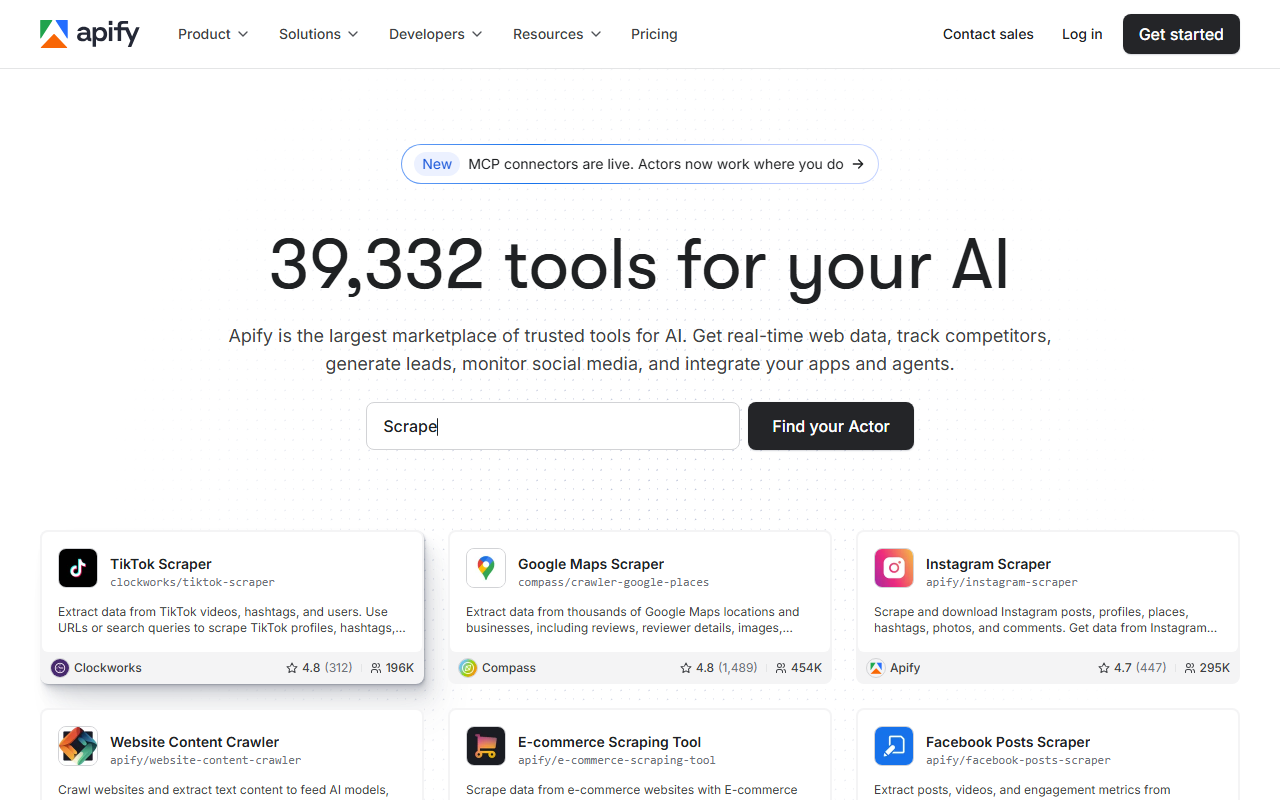
Apify is the pick when you would rather reuse a prebuilt scraper than write one, or run your own scraping code serverless. It is a marketplace and compute platform as much as a scraper API.
Pricing
Per Apify’s pricing page in mid-2026, the free plan gives $5 to spend monthly in the Apify Store or on your own Actors with no card. The Starter plan is $29/mo plus pay-as-you-go, including $29 of usage, chat support, up to 25 concurrent runs, and 8 GB maximum Actor RAM. Compute is charged at $0.20 per compute unit, and datacenter proxy add-ons start from $0.60 per IP on higher tiers.
Standout features
The Apify Store is the differentiator: a marketplace of nearly 40,000 prebuilt Actors (ready-made scrapers for named sites) you can run without writing code, plus the ability to build and run your own serverless scraping programs with scheduling and storage built in. For a target someone has already solved, an Actor can be running in minutes.
Where it falls short
The compute-unit and usage-balance billing is flexible but indirect, since you spend a dollar balance across Actors rather than counting requests, which makes per-request cost harder to compare against a credit-based API. Quality varies by Actor author for community scrapers. Approximate performance depends on the specific Actor rather than a single platform number (approximate, compiled from vendor + public sources, not first-hand).
How to choose the right one
Pick on three things in order: billing unit, target difficulty, and free-tier room to test. Match the billing unit to your output first, since per-request, per-credit, and per-record plans reward different workloads. Then weigh target difficulty: heavily defended sites favor an anti-bot-led API, and named-site JSON favors dedicated endpoints. Use the free tier to confirm success rate on your actual targets before you pay.
| If you need | Start with | Why |
|---|---|---|
| Structured JSON from named sites, lowest monthly entry cost | ChocoData | Universal endpoint + 250+ dedicated endpoints from $19/mo |
| Enterprise data collection with AI parsing | Oxylabs | OxyCopilot plus prebuilt endpoints, from $0.25 / 1K results |
| Pay per delivered record at scale | Bright Data | $1.50 / 1K records, 5,000 free |
| General-purpose scraping with a documented trial | ScraperAPI | Proxy rotation, rendering, geotargeting from $49/mo |
| A simple rendering integration | ScrapingBee | Headless Chrome and proxies from $49/mo |
| Pay only for the infrastructure each request needs | Zyte | Complexity-tiered per-request pricing, $5 trial |
| To reuse prebuilt scrapers | Apify | Marketplace of Actors, $29/mo + usage |
For deeper background, the web scraping pillar guide covers fundamentals and scraping without getting blocked explains the defenses these APIs handle for you.
How we evaluated these
I ranked these scraper APIs on documented entry price, free-tier room to test, and included features, with every price pulled from each vendor’s own page in mid-2026 and attributed inline. The performance figures are approximate, compiled from vendor-published numbers and aggregated public sources, and are not first-hand bestscraperapi.com tests; my independent, like-for-like benchmarks are in progress, and the methodology lives at how we test. Pricing is current as of mid-2026 and changes often, so treat the figures as a starting point and confirm at the source before you buy.
FAQ
A scraper API is a hosted endpoint you send a target URL to, and it returns the page's HTML or parsed JSON. Behind that single call it rotates proxies, renders JavaScript in a headless browser when the page needs it, clears CAPTCHAs and anti-bot challenges, and retries failures. You skip building and maintaining a proxy pool plus a browser farm, and most vendors bill only for successful responses.
These are different products. A proxy service hands you IP addresses, and you still write the request, render JavaScript, retry failures, and solve CAPTCHAs yourself, usually billed per gigabyte. A scraper API wraps all of that: one URL in, HTML or JSON out, typically billed per successful request or per delivered record. Several vendors here sell both, so check which product a given price refers to.
Most of the ones listed here bill only for successful responses, which they define as a 200-class status with content. Many charge extra credits for JavaScript rendering, residential or premium proxies, and screenshots, so one rendered request can cost several times a raw fetch. Read the credit table on each vendor's pricing page, because the headline request count assumes the cheapest request type.
Among the monthly-plan APIs here, ChocoData has the lowest documented entry plan at $19/mo for 27,000 requests, per its pricing page in mid-2026. Zyte and Apify start with usage-based plans built on a $5 free credit rather than a fixed monthly fee, and Oxylabs and Bright Data bill per result or per record. A monthly plan and a per-record plan are not comparable on the dollar figure alone, so match the billing unit to your output before you rank on price.