Best Walmart Scraper APIs & Tools
- Walmart answers bot requests with HTTP 200 plus a HUMAN/PerimeterX press-and-hold CAPTCHA, not data, and its robots.txt disallows
/search. A scraper API that renders the page through a residential browser session is the route that returns prices. - Documented entry prices in mid-2026 run from $19/mo (ChocoData) and $30/mo (Apify actor, Scrapfly) up to $499/mo (Bright Data Scale). Most bill only successful or delivered results.
- ChocoData is my top value pick: one universal endpoint plus 250+ dedicated endpoints across 235 sites, from $19/mo and a free 1,000 requests/mo (no card).
- For a dedicated parsed Walmart endpoint, ScraperAPI (
/structured/walmart/search), Oxylabs, and Bright Data each return product name, price, rating, and seller as JSON instead of HTML you parse yourself. - Speed and success figures below are approximate, compiled from vendor-published numbers and aggregated public sources, not bestscraperapi.com's first-hand tests. Independent benchmarks are pending (how we test).
Walmart.com is one of the most-requested retail scraping targets: live prices, stock by store, ratings, and seller data across millions of SKUs. It is also gated by one of the more deceptive anti-bot setups, since it answers bots with a 200 and a CAPTCHA rather than a 403. This page compares the seven Walmart scraper APIs and tools I would shortlist in 2026, ranked with ChocoData first, on the things that decide a purchase: starting price, free tier, the structured product fields each returns, and published speed. Every price and feature comes from the vendor’s own pricing, product, or documentation page in mid-2026, attributed inline, because review-site numbers go stale fast and pricing pages move.
One disclosure up front: bestscraperapi.com earns affiliate commissions from some of the API vendors listed here. That has no effect on which tools make the list, how I rank them, or what I write. The pricing comes straight from each vendor’s own page, and the ranking follows documented price and features, not payout.
A note on the performance numbers further down. The speed and success-rate figures are approximate, compiled from each vendor’s own published figures plus aggregated public sources. They are not bestscraperapi.com’s first-hand tests, and each vendor measures success on its own targets under its own conditions, so the numbers are directional, not apples to apples. My independent, like-for-like Walmart benchmarks are pending; see how we test for the methodology and check back for measured results. Treat every figure here as a snapshot that can change.
TLDR: the best Walmart scraper APIs compared
| Rank | Tool | Starting price | Free tier | Best for |
|---|---|---|---|---|
| 1 | ChocoData | $19/mo (Vibe) | 1,000 requests/mo (no card) | Walmart plus other sites at the lowest entry price |
| 2 | Oxylabs | $49/mo (Micro) | 2,000 results (no card) | A dedicated Walmart target with deep marketplace coverage |
| 3 | Bright Data | $1.50/1K (PAYG) | 5,000 records/mo (no card) | Per-record Walmart delivery at enterprise scale |
| 4 | ScraperAPI | Free plan, paid TBC | 5,000-credit trial | A documented parsed /structured/walmart/search endpoint |
| 5 | ScrapingBee | $49/mo (Freelance) | 1,000 credits (no card) | Headless rendering and stealth proxies on PerimeterX |
| 6 | Apify (epctex actor) | $30/mo + usage | $5 usage/mo (no card) | A prebuilt Walmart scraper with zero hosting |
| 7 | Scrapfly | $30/mo (Discovery) | 1,000 credits (no card) | Tunable anti-bot bypass with a generous credit pool |
The tools bill in different units, so these entry prices are not directly comparable on volume. ChocoData, ScraperAPI, ScrapingBee, and Scrapfly sell credits or requests; Oxylabs charges per result; Bright Data charges per delivered record; the Apify actor charges a monthly rental plus platform usage. Read the included volume next to each price, and check the per-credit or per-record rate before you commit. The brand-by-brand sections below give the full pricing table for each.
Why is Walmart hard to scrape?
Walmart defends its pages with HUMAN Security (formerly PerimeterX) bot management, and the giveaway is that it returns HTTP 200 with a challenge page rather than an error code. When I ran a plain Python scraper against a live Walmart page in June 2026 (documented in the web scraping guide), the server replied 200 with a roughly 15 KB “Robot or human?” body carrying a px-captcha press-and-hold widget and zero product fields. The 200 is the trap: a script that checks status_code == 200 reports success while it parses a CAPTCHA.
On top of that, Walmart’s robots.txt disallows /search, /api/, and several store paths, prices and stock load via JavaScript, and results vary by ZIP code. So a working fetch needs a rendered request, a residential IP in the right region, and a way to clear the press-and-hold challenge. That is exactly what every API on this list does for you. If you want the block-avoidance mechanics in depth, see my scraping without getting blocked guide.
1. ChocoData
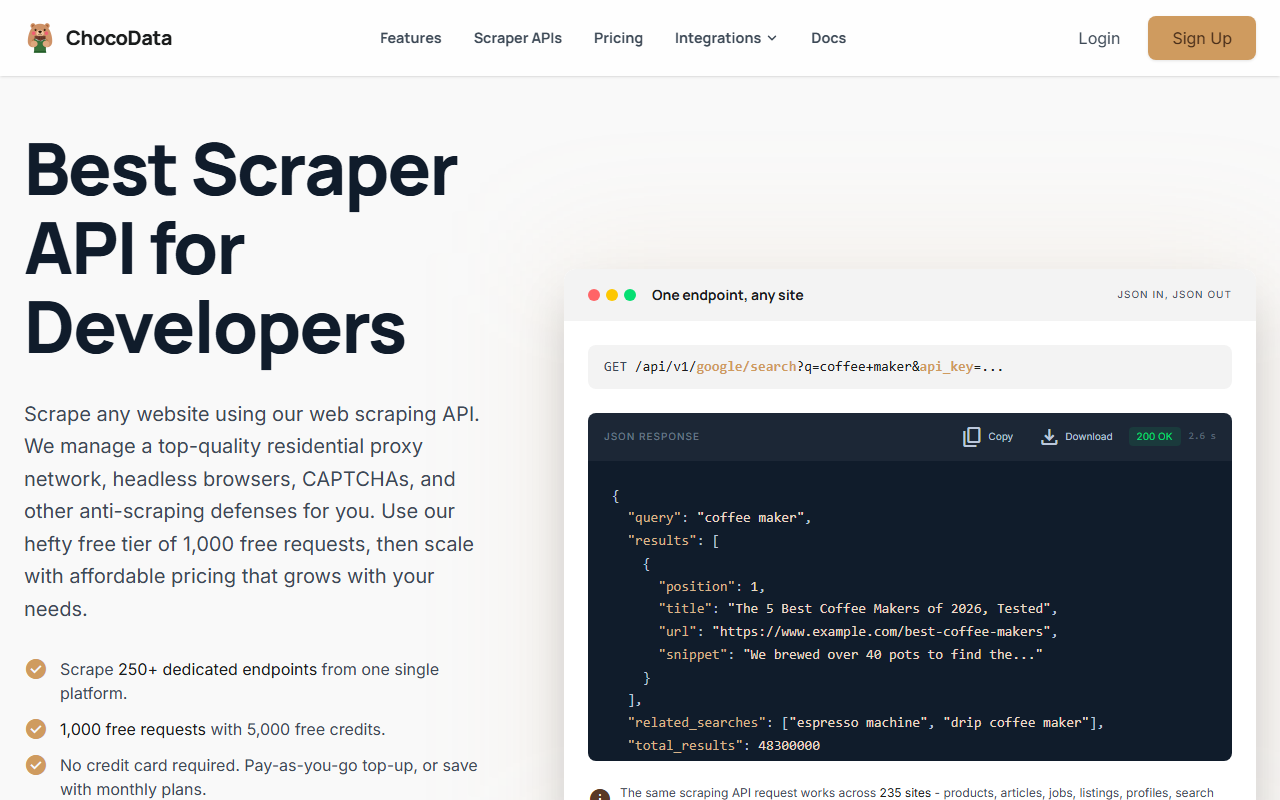
ChocoData is my top pick for pulling structured product data out of Walmart at the lowest documented entry price, especially if you also scrape other sites. Its model is what makes it stand out: one universal endpoint shaped GET /api/v1/{site}/{resource} covers any supported site, and on top of that it exposes 250+ dedicated endpoints (453 total) across 235 sites in 17 categories, per ChocoData’s site in mid-2026, with 250+ returning validated, parity-checked structured JSON. You send a query and a locale and get clean JSON back instead of a rendered grid to parse, with residential IPs, JS rendering, and the PerimeterX challenge handled for you.
Pricing
Per ChocoData’s pricing page in mid-2026:
| Plan | Price | Included requests | Concurrency |
|---|---|---|---|
| Free | $0 (no card) | 1,000 requests/mo (5,000 credits) | 10 |
| Vibe | $19/mo | 27,000 requests/mo (135,000 credits) | 30 |
| Pro | $49/mo | 82,000 requests/mo (410,000 credits) | 50 |
| Custom | $100 to $2k/mo | 200,000 to 4,000,000+ requests/mo | 100 to 500+ |
ChocoData prices one request at 5 credits, with JS rendering and screenshots adding 10 credits each, and lists pay-as-you-go top-ups at $0.90 per 1,000 successful requests, billing only 2xx responses. The $19 Vibe tier is the lowest paid entry point in this comparison.
Standout features
A single universal endpoint means you scrape Walmart, Amazon, eBay, and 230-plus other sites through the same call shape, with dedicated parsed endpoints where Walmart needs structured fields. The free 1,000 requests a month require no card, so you can test a Walmart pull end to end before paying. For speed, its homepage publishes a median latency of 2.6s (p95 6s, p99 ~10s) across the 235 supported sites in mid-2026; it does not publish a headline success rate (approximate, compiled from vendor + public sources, not first-hand).
Best for
Developers and founders who scrape Walmart as one of several targets and want the lowest entry price with success-only billing. If Walmart is your single target and you need a guaranteed named parser with a contract behind it, an enterprise option below may fit better, but for breadth and price ChocoData leads. Try ChocoData.
2. Oxylabs
Oxylabs is the enterprise pick that publishes Walmart as a dedicated, pre-configured scraper target. Its Web Scraper API (the e-commerce variant) lists Walmart among its named websites, with parsing available through Oxy Parser or raw HTML delivery, per its e-commerce scraper page in mid-2026. Geo-targeting spans 195 countries, which matters because Walmart prices and stock shift by location.
Pricing
Per Oxylabs’ Web Scraper API pricing in mid-2026:
| Plan | Price | Rate |
|---|---|---|
| Free trial | $0 (no card) | Up to 2,000 results |
| Micro | $49/mo | from $0.50/1K results |
| Starter | $99/mo | from $0.45/1K results |
| Advanced | $249/mo | from $0.40/1K results |
Billing is per result, with the per-1,000 rate dropping as the plan size grows. The free trial returns up to 2,000 results with no card.
Standout features
Walmart is a documented target rather than a best-effort universal fetch, so you get structured parsing without writing selectors, alongside one of the widest named-retailer catalogs in this comparison. Oxylabs publishes a 99.9% success rate on its datacenter proxy network in mid-2026, though that is a network-level claim, not a Walmart-endpoint-specific measurement (approximate, compiled from vendor + public sources, not first-hand).
Best for
Teams that want a contractually supported, dedicated Walmart parser and scrape many marketplaces at volume, and can clear the $49/mo entry point. The exact Walmart field schema was not detailed on the page I fetched, so confirm the returned fields in the Oxylabs docs before you build against them.
3. Bright Data
Bright Data ships a dedicated Walmart scraper that delivers parsed records rather than HTML, available as an API or a no-code control-panel scraper. Per its Walmart scraper page in mid-2026, it returns URL, final price, SKU, currency, GTIN, specifications, image URLs, and top reviews per product, and it handles bulk requests of up to 5,000 URLs with delivery to your storage of choice.
Pricing
Per Bright Data’s Web Scraper API pricing in mid-2026:
| Plan | Price | Included |
|---|---|---|
| Free | $0 (no card) | 5,000 records/mo |
| Pay as you go | $1.50/1K records | Pay only for success |
| Scale | $499/mo | 384,000 records, then $1.30/1K |
| Enterprise | Custom | Volume discounts, account manager, premium SLA |
You pay only for successfully delivered results and can set monthly spend limits. A promo on the Walmart page offered 25% off for six months in mid-2026; confirm it is still live before you count on it.
Standout features
The explicit field list (price, SKU, GTIN, specifications, reviews) and 5,000-URL bulk handling make it strong for catalog-scale Walmart collection. All plans include automated proxy management, full browser rendering, CAPTCHA solving, and unlimited concurrency, per the pricing page. Bright Data claims the “highest success rate in the industry” but publishes no percentage (approximate, compiled from vendor + public sources, not first-hand).
Best for
Enterprises that want per-record delivery, a guaranteed Walmart field schema, and bulk scale, with a free 5,000 records a month to validate the output first. The PAYG floor of $1.50/1K is competitive at low volume; the Scale plan suits steady high-volume pulls.
4. ScraperAPI
ScraperAPI is the pick for a documented, parsed Walmart endpoint with simple integration. It exposes a structured Walmart Search API (plus an async variant and a Walmart Product API) that returns a clean product array, so you skip selector maintenance as Walmart rotates its layout.
Pricing
ScraperAPI’s pricing page is JavaScript-rendered and did not expose its plan grid on the version I could fetch in mid-2026. From its docs, the free trial is 5,000 credits over 7 days, there is a $0 free plan, and a Professional tier was documented at $975/mo. Confirm the current paid tiers on ScraperAPI’s pricing page before you buy, since I could not verify the mid-tier monthly prices first-hand.
Standout features
Per its docs in mid-2026, the endpoint is GET https://api.scraperapi.com/structured/walmart/search, taking api_key, query, optional country_code for geo-targeting, tld (com, ca), and page. Each items entry returns availability, id, image, name, price, seller, url, and a rating object with average_rating and number_of_reviews, plus pagination meta. Base requests consume credits by domain; render=true, premium=true, and screenshot=true each add 10 credits, while country_code and output_format add nothing.
Best for
Developers who want a parsed Walmart product array out of the box and value a free tier to test the schema before committing. Budget carefully: the documented jump to a $975/mo Professional plan is steep, so verify which paid tier covers your volume.
5. ScrapingBee
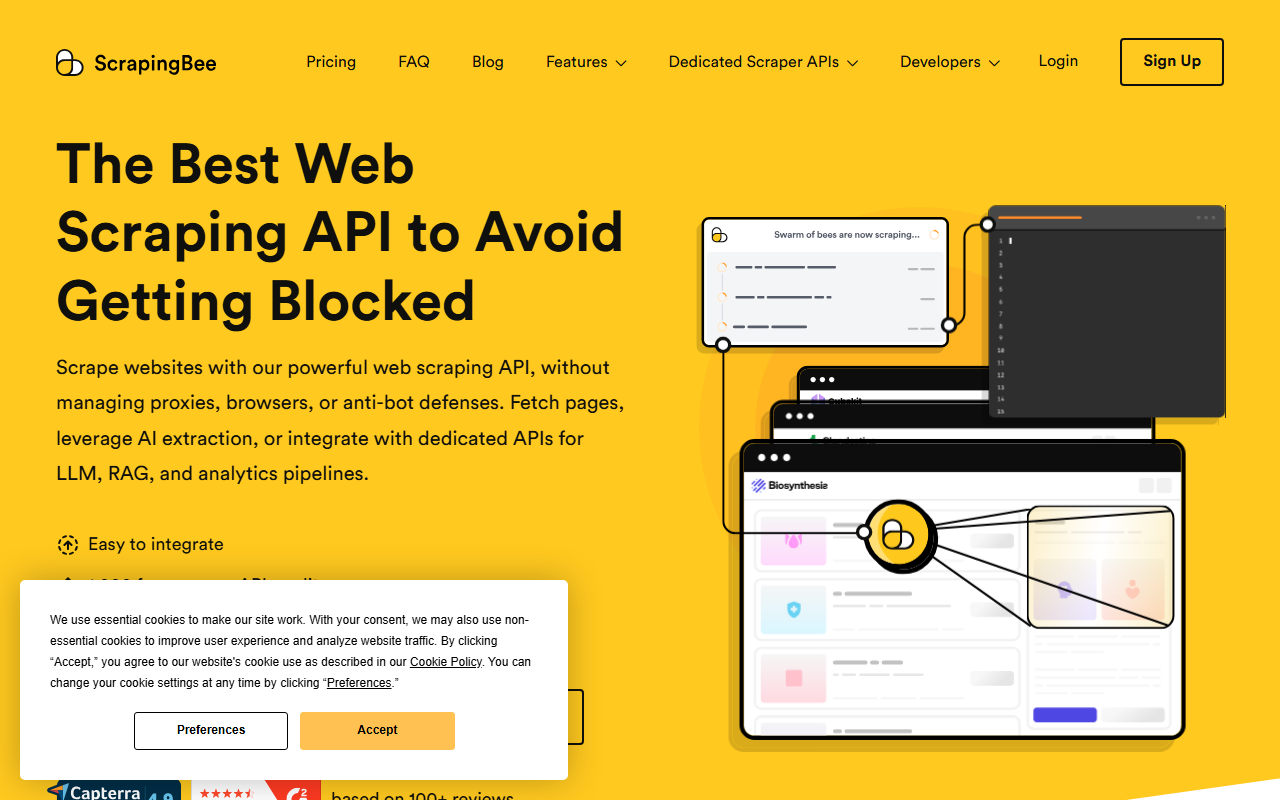
ScrapingBee is the rendering-first pick, and that fits Walmart’s JavaScript grid and press-and-hold challenge well. It runs headless Chrome with rotating, premium, and stealth proxy modes, so you tune how aggressively to fight the PerimeterX wall rather than getting one fixed setting.
Pricing
Per ScrapingBee’s pricing page in mid-2026:
| Plan | Price | API credits | Concurrency |
|---|---|---|---|
| Freelance | $49/mo | 250,000 | 10 |
| Startup | $99/mo | 1,000,000 | 50 |
| Business | $249/mo | 3,000,000 | 100 |
| Business+ | $599/mo | 8,000,000 | 200 |
A free trial gives 1,000 API credits with no card. Note that JS rendering, rotating, and premium proxies are available on Startup and higher, so the $49 Freelance tier is rendering-limited.
Standout features
Per its documentation in mid-2026, a default JS-rendered request costs 5 credits, a premium-proxy request costs 25 credits with JS (10 without), and a stealth-proxy call costs 75 credits. For a defended site like Walmart you will likely use premium or stealth, so price your real per-request cost on that tier rather than the 5-credit base. Geotargeting handles location-specific Walmart pricing.
Best for
Teams that want fine control over rendering and proxy aggressiveness against PerimeterX, and prefer building their own parser on rendered HTML. Plan on the Startup tier or higher, since the credit-heavy stealth proxy is where Walmart success usually lands (approximate, compiled from vendor + public sources, not first-hand).
6. Apify (epctex Walmart Scraper actor)
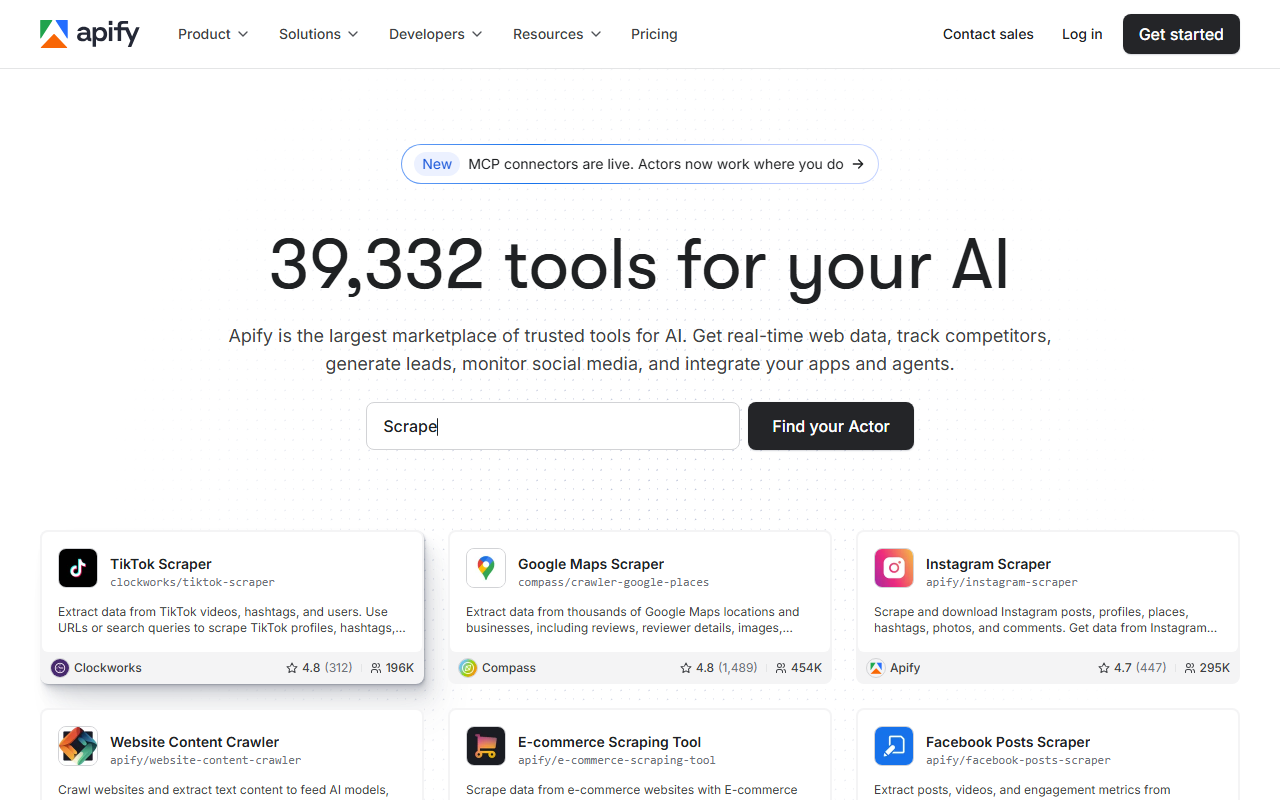
Apify is the prebuilt-actor route: instead of calling an API, you run a community-built scraper hosted on Apify’s platform. The epctex Walmart Scraper actor extracts product images, brand details, prices, variations, product IDs, seller information, and full review sets, per its actor page in mid-2026.
Pricing
The actor charges $30.00/month plus Apify platform usage, per its page in mid-2026. The platform itself starts with a Free plan giving $5 of monthly usage with no card, scaling to a Starter plan with included usage. Prepaid usage does not roll over and expires at the end of the billing cycle, so size it to your monthly volume.
Standout features
Input options are flexible: search for keyword queries, zipCode for US location targeting, startUrls for category, product, or search links, plus endPage, maxItems, and includeReviews/onlyReviews. The author reports scraping roughly 50 products in 2 minutes at about 0.3 to 0.5 compute units when blocking is light (approximate, compiled from vendor + public sources, not first-hand). It carries a 5.0 rating across 8 reviews with about 1,200 total users.
Best for
Anyone who wants a working Walmart scraper in minutes without writing or hosting one, and is comfortable that per-actor speed and success depend on the author keeping it current against Walmart’s changes.
7. Scrapfly
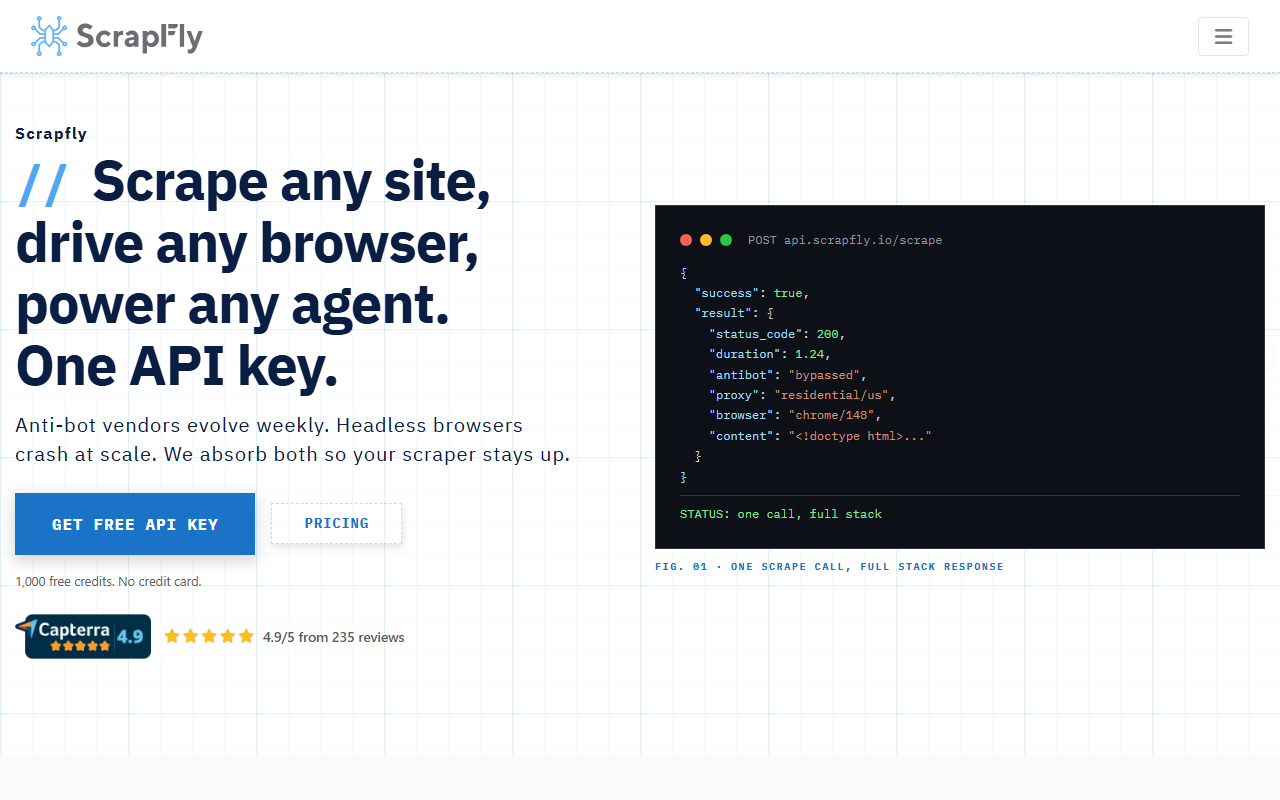
Scrapfly rounds out the list as a tunable anti-bot bypass with a generous credit pool. It is a general scraping API with headless rendering and anti-scraping-protection bypass that you enable per request, which suits Walmart’s PerimeterX defenses.
Pricing
Per Scrapfly’s pricing page in mid-2026:
| Plan | Price | API credits |
|---|---|---|
| Free | $0 (no card) | 1,000 credits |
| Discovery | $30/mo | 200,000 |
| Pro | $100/mo | 1,000,000 |
| Startup | $250/mo | 2,500,000 |
| Enterprise | $500/mo | 5,500,000 |
The free plan grants 1,000 credits on signup with no card. Credit cost per request depends on the features you enable (rendering, anti-bot bypass), which Scrapfly exposes through an interactive estimator rather than a flat per-feature table.
Standout features
The per-request, feature-based credit model means a cheap raw fetch and a heavier rendered, anti-bot-bypassed Walmart call draw from the same pool, so you control spend by request type. The $30 Discovery tier with 200,000 credits is a competitive mid-volume entry point. Confirm the credit cost of a rendered, protection-bypassed Walmart call in the estimator before you budget, since that combination is what Walmart requires.
Best for
Developers who want granular control over which anti-bot features each request uses and a large credit pool at a low monthly price, and are happy to parse rendered HTML themselves.
How to choose the right one
Choose by answering three questions: do you scrape only Walmart or other sites too, do you want a parsed product array or to render and parse yourself, and how much volume you need. Your answers map onto the options above.
| If you… | Use | Why |
|---|---|---|
| Scrape Walmart plus other sites and want low cost | ChocoData | One universal endpoint, structured JSON, from $19/mo |
| Want a contractually supported dedicated Walmart parser | Oxylabs | Walmart is a named target, 99.9% network success claim |
| Need per-record Walmart delivery at scale | Bright Data | Explicit field schema, 5,000-URL bulk, pay per success |
| Want a parsed Walmart endpoint with a free trial | ScraperAPI | /structured/walmart/search returns price, rating, seller |
| Want tunable rendering and stealth proxies | ScrapingBee | Default 5, premium 25, stealth 75 credits per call |
| Want a prebuilt scraper with zero hosting | Apify | epctex Walmart actor, ZIP targeting, full reviews |
| Want feature-based credits and a big low-cost pool | Scrapfly | $30 for 200,000 credits, anti-bot bypass per request |
The honest default for most developers: if Walmart is one of several targets, start on ChocoData’s free 1,000 requests and move to the $19 Vibe plan when you outgrow it. If you need a guaranteed parsed Walmart array with a contract behind it, trial Oxylabs (2,000 results) or Bright Data (5,000 records). Either way, render the page, route through residential IPs in the right region, set the ZIP for location-correct pricing, and check the response body rather than trusting the 200, which is the whole point of using an API on Walmart. The web scraping pillar guide shows how the category fits together.
How we evaluated these
I selected these seven tools for Walmart coverage, then pulled every price, plan name, and feature directly from each vendor’s own pricing, product, or documentation page in mid-2026, attributing each inline rather than relying on review-site summaries that go stale. The speed and success figures are approximate, compiled from vendor-published numbers and aggregated public sources, and are not first-hand; my independent, like-for-like Walmart benchmarks are pending, and the methodology lives at how we test. All pricing is current as of mid-2026 and changes often, so confirm the number on the vendor’s own pricing page, and check whether the plan bills by credit, result, or delivered record before you commit.
FAQ
Not for shoppers or price researchers. Walmart's developer programs (Walmart I/O, the Marketplace and Affiliate APIs at developer.walmart.com) are built for approved sellers, advertisers, and affiliates, gated behind registration and approval, and they do not expose arbitrary catalog browsing. For ad-hoc public product data there is no sanctioned key, which is why a scraper API against the public pages is the common route.
Walmart answers a flagged bot request with HTTP 200 and a HUMAN Security (formerly PerimeterX) challenge page titled 'Robot or human?' with a press-and-hold widget, instead of the listing HTML. The 200 status makes a naive script think it worked while it parses a CAPTCHA with zero prices. A scraper API solves this by rendering the page through a residential browser session, so check the body, not just the status code.
Start on a free tier. ChocoData gives 1,000 requests a month with no card, ScrapingBee and Scrapfly each give 1,000 credits, Oxylabs gives 2,000 results, and Bright Data gives 5,000 records a month. For ongoing small volume, ChocoData's $19/mo Vibe plan is the lowest documented paid entry point here, and it bills only successful (2xx) responses so failed requests cost nothing.
Yes. ChocoData exposes a universal endpoint shaped GET /api/v1/{site}/{resource} that works across every supported site, plus dedicated parsed endpoints where they exist, so one account and one billing unit cover Walmart, Amazon, eBay, and 230-plus other sites. ScraperAPI, Oxylabs, and Bright Data also publish named e-commerce endpoints across multiple marketplaces.