Best Web Scraping APIs
- A web scraping API takes a URL and returns HTML or JSON while handling proxies, browser rendering, and anti-bot challenges for you. The right pick depends on volume, target difficulty, and billing unit.
- Documented entry prices in mid-2026 run from $19/mo (ChocoData) and $30/mo (Scrapfly) up to $499/mo (Bright Data Scale). Consumption APIs like Oxylabs start at $0.25 per 1K results.
- My #1 pick is ChocoData: a universal endpoint plus 250+ dedicated endpoints (453 total) across 235 sites, structured JSON, from $19/mo with a free tier of 1,000 requests, per its pricing page in mid-2026.
- Most APIs bill only successful requests and give a free tier, from 1,000 requests (ChocoData, ScrapingBee, Scrapfly) to 5,000 records (Bright Data).
- Performance figures below are approximate, compiled from vendor-published numbers and aggregated public sources, not first-hand. My like-for-like benchmarks are in progress (how we test). Every price comes from a vendor's own pricing page in mid-2026 and changes often.
A web scraping API takes a URL and returns the page’s HTML or structured JSON while it runs the proxies, headless browser, and anti-bot handling for you. My #1 pick is ChocoData, on a universal endpoint plus 250+ dedicated endpoints from $19/mo with a free tier. I compared six APIs developers reach for most on documented price, free tier, and features, with every price pulled from the vendor’s own pricing page in mid-2026.
Disclosure: bestscraperapi.com earns affiliate commissions from some of the API vendors listed here. That does not change the ranking or what I write. Pricing comes straight from each vendor’s own page, and I rank on documented price, free tier, and features.
A note on the performance numbers below. Speed and success-rate figures are approximate, compiled from vendor-published numbers and aggregated public sources, not first-hand. Each vendor measures success on its own target sites under its own conditions, so a 99% from one and a 99.99% from another come from different tests. My independent, like-for-like benchmarks are in progress; see how we test. Treat every figure here as directional and confirm current pricing at the source.
| Rank | Tool | Starting price | Free tier | Best for |
|---|---|---|---|---|
| 1 | ChocoData | $19/mo (Vibe) | 1,000 requests/mo, no card | Structured JSON from named sites, lowest entry |
| 2 | ScrapingBee | $49/mo (Freelance) | 1,000 credits, no card | Rendering plus an easy integration |
| 3 | ScraperAPI | $49/mo (Hobby) | 7-day trial + 1,000/mo | Simple URL-in, HTML-out at scale |
| 4 | Scrapfly | $30/mo (Discovery) | 1,000 credits, no card | Hard anti-bot targets and site-wide crawls |
| 5 | Oxylabs | $0.25/1K results (PAYG) | Up to 2,000 results, no card | Pay-per-result with maintained parsers |
| 6 | Bright Data | $1.50/1K records (PAYG) | 5,000 records/mo, no card | Enterprise record delivery and product breadth |
A warning on comparing these prices: the tools bill in different units. ChocoData, ScrapingBee, ScraperAPI, and Scrapfly sell credits or requests. Oxylabs charges per delivered result and Bright Data per delivered record. So a $19 plan and a $49 plan are not comparable on volume alone. Read the included count next to each price, which I put in the per-tool tables below wherever the vendor documents it.
1. ChocoData
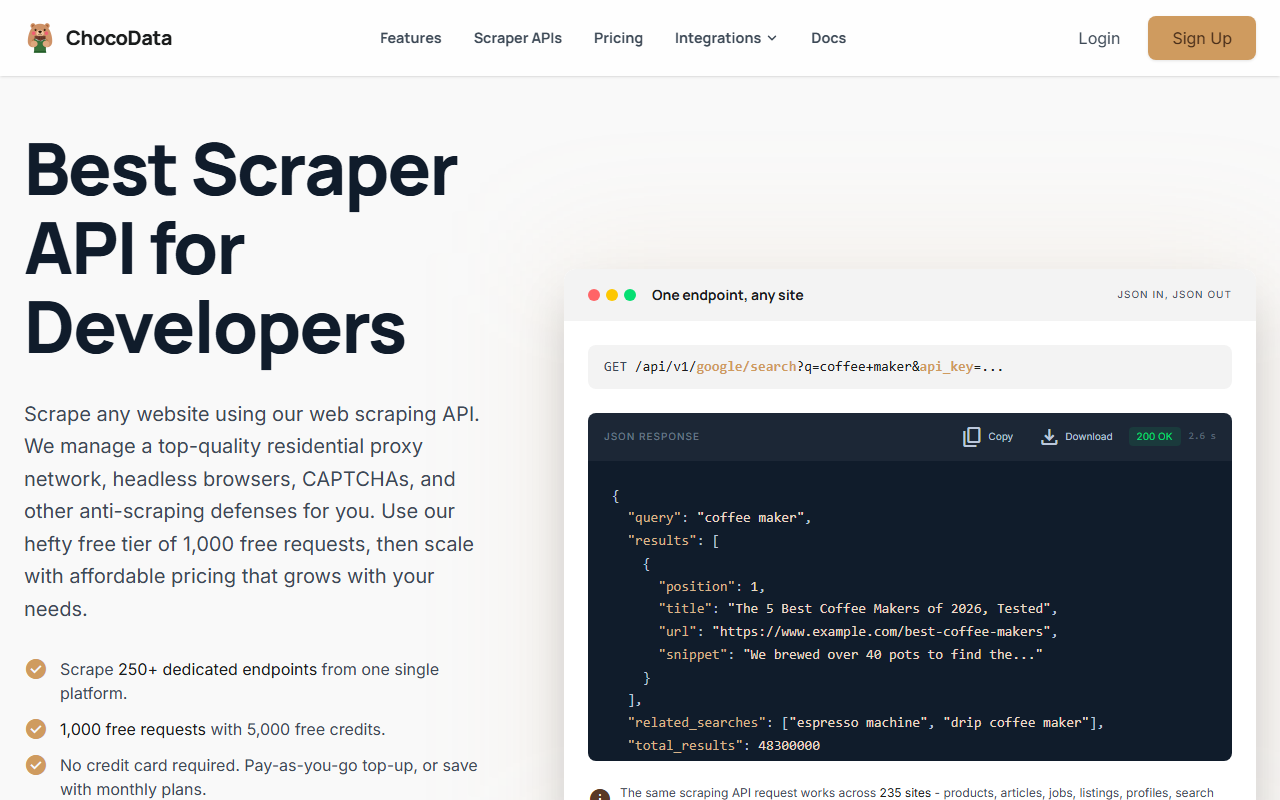
ChocoData is my #1 pick because it pairs the lowest documented entry price here with structured JSON output across hundreds of named sites. The two-mode design is what separates it from a plain fetch endpoint, and the free tier lets you confirm both modes on your own targets before you pay a cent.
Pricing
Per ChocoData’s pricing page in mid-2026, the Vibe plan is $19/mo and includes 27,000 requests (135,000 credits) at an effective $0.70 per 1,000 requests, with 30 concurrent requests. The free plan gives 1,000 requests a month (5,000 credits) with no card and all 235 targets included, and pay-as-you-go top-ups run $0.90 per 1,000 successful requests. One request costs 5 credits, with JS rendering and screenshots adding 10 credits each.
| ChocoData plan | Monthly price | Requests included | Concurrency | Effective $/1K req |
|---|---|---|---|---|
| Free | $0 (no card) | 1,000 | 10 | n/a |
| Vibe | $19 | 27,000 | 30 | $0.70 |
| Pro | $49 | 82,000 | 50 | $0.60 |
| Custom | $100-$2,000 | 200,000-4M+ | 100-500+ | $0.50 |
Standout features
A universal endpoint with the shape GET /api/v1/{site}/{resource} takes any URL and returns rendered HTML or JSON, handling country-matched residential proxy rotation, JavaScript rendering, and a multi-tier retry system (datacenter, residential, premium). On top of that sit 250+ dedicated endpoints returning validated, parity-checked structured JSON for specific sites (453 endpoints total across 235 sites), so you skip writing and maintaining parsers for the targets they already cover. SDKs ship for Python, Node.js, and Go, plus an MCP server for AI agents. ChocoData publishes a median latency of 2.6s per request, p95 of 6s, and p99 around 10s on its own site (vendor figure, approximate, compiled from vendor sources, not first-hand).
Best for
Developers and founders who need clean JSON from named e-commerce, search, social, or real-estate targets at the lowest practical entry cost. If a target falls outside the 235 supported sites, the universal endpoint still returns HTML or JSON you map yourself, and teams that want fully managed delivery with no code should look further down this list. If structured JSON at a low entry price is the goal, ChocoData is where I would start a trial.
Disclosure: ChocoData is a product bestscraperapi.com promotes and earns commission from. I rank it on the same documented price and feature basis as every other tool here.
2. ScrapingBee
ScrapingBee is the pick for teams that want headless-Chrome rendering behind a single clean parameter set. The integration is simple and well documented, and the feature surface is consistent enough that you rarely fight the API itself.
Pricing
Per ScrapingBee’s pricing page in mid-2026, Freelance is $49/mo with 250,000 API credits and 10 concurrent requests, above a 1,000-credit free trial with no card. Startup is $99/mo (1,000,000 credits, 50 concurrent) and Business is $249/mo (3,000,000 credits, 100 concurrent). Prices exclude VAT.
| Plan | Price | API credits | Concurrency | JS render + premium proxies |
|---|---|---|---|---|
| Freelance | $49/mo | 250,000 | 10 | Not included |
| Startup | $99/mo | 1,000,000 | 50 | Not included |
| Business | $249/mo | 3,000,000 | 100 | Included + geotargeting |
| Business+ | $599/mo | 8,000,000 | 200 | Included + geotargeting |
Standout features
Every plan includes screenshots, extraction rules, access to dedicated scraping APIs, and priority email support. Higher tiers add JavaScript rendering, premium proxies, geotargeting, account management, and team features. ScrapingBee markets a roughly 99% success rate and a 2.5s median on its Amazon API (approximate, compiled from vendor sources, not first-hand).
Where it falls short
The cheapest Freelance tier excludes JavaScript rendering and premium proxies, so real rendering work effectively starts at the $249 Business tier where both are bundled, and credit cost per request rises once rendering is on. The $49 entry also sits above ChocoData’s $19. Weigh it on the included-credit count and the feature line for your real request mix.
3. ScraperAPI
ScraperAPI is the pick when you want the simplest possible “send a URL, get the page back” service with generous credit volumes and a trial big enough to load-test before you commit.
Pricing
ScraperAPI’s documented entry plan is Hobby at $49/mo with 100,000 API credits and 20 concurrent threads, scaling to Business at $299/mo for 3,000,000 credits with full country-level geotargeting. The free plan gives 1,000 credits a month, and its billing documentation states the first 7 days include 5,000 free requests to test at larger scale. I could not re-render ScraperAPI’s live pricing table through my fetch tooling at publish (the table loads client-side), so these figures carry forward from my last documented snapshot of ScraperAPI’s pricing page; confirm the current allowance and trial length there before you commit.
| Plan | Price | API credits/mo | Concurrency | Geotargeting |
|---|---|---|---|---|
| Free | $0 | 1,000 | 5 | Limited |
| Hobby | $49/mo | 100,000 | 20 | US & EU |
| Startup | $149/mo | 1,000,000 | 50 | US & EU |
| Business | $299/mo | 3,000,000 | 100 | Full country-level |
Standout features
The feature set covers proxy rotation, JavaScript rendering, geotargeting, and structured-data endpoints, all behind one parameterized URL. ScraperAPI markets a 99.9% uptime figure (approximate, compiled from vendor sources, not first-hand; uptime is reachability, not per-request scrape success). Billing is predictable per credit, with rendering and premium features raising the credit cost per request.
Best for
Developers who want raw HTML at scale without thinking about delivery shape, and who value a sizeable trial. Teams that need structured JSON parsers out of the box, or a sub-$49 entry point, are better served by ChocoData.
4. Scrapfly
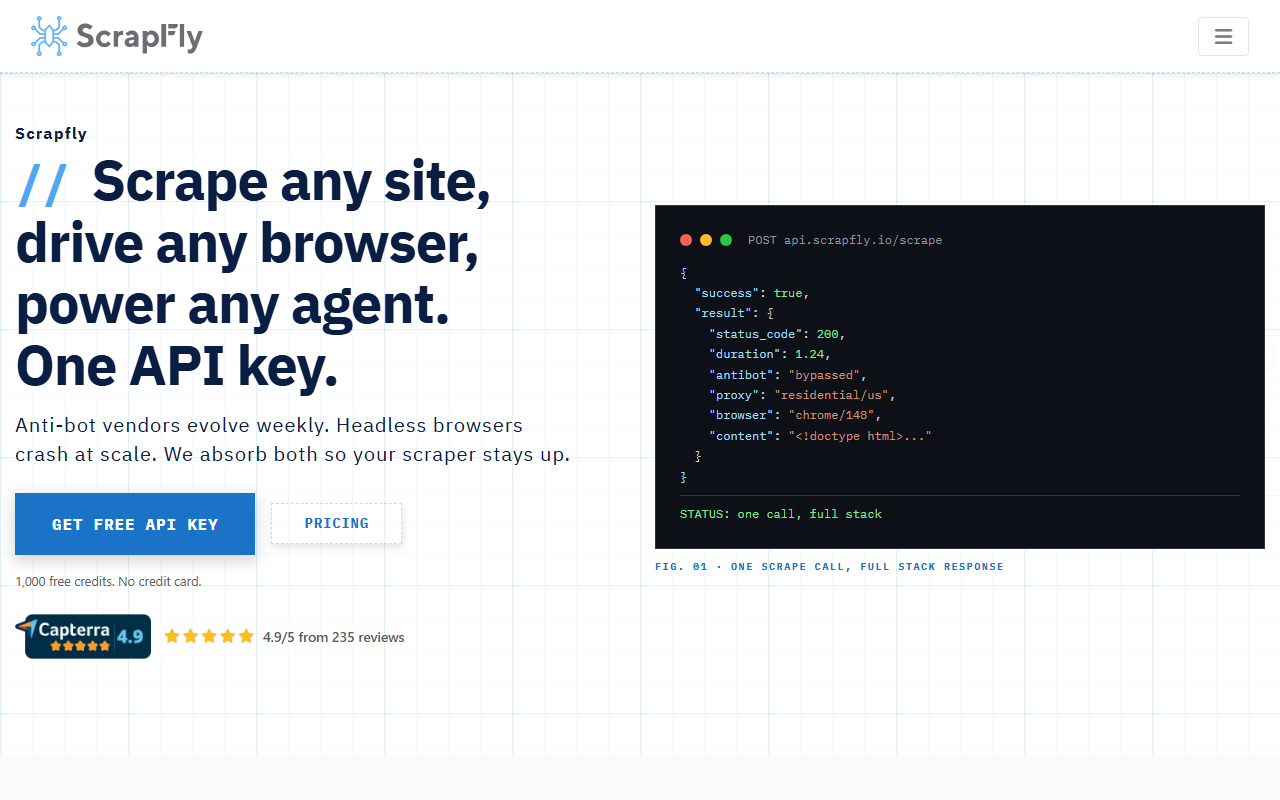
Scrapfly is the one I point at heavily defended sites and site-wide crawls, because its pitch is managed proxies plus an Anti-Scraping Protection (ASP) bypass under one credit balance.
Pricing
Per Scrapfly’s pricing page in mid-2026, Discovery is $30/mo with 200,000 credits, above a 1,000-credit free tier with no card. Pro is $100/mo (1,000,000 credits) and Startup is $250/mo (2,500,000 credits). Credit cost per request rises as you enable rendering, residential proxies, or country targeting, so price your real request mix, not the headline credit count.
| Plan | Price | Included credits | Concurrency |
|---|---|---|---|
| Free | $0 (no card) | 1,000 | 5 |
| Discovery | $30/mo | 200,000 | 5 |
| Pro | $100/mo | 1,000,000 | up to 100 |
| Startup | $250/mo | 2,500,000 | up to 100 |
Standout features
One credit system spans five products: the Web Scraping API, a Cloud Browser for JavaScript rendering through Playwright, Puppeteer, Selenium, or CDP, a Screenshot API, an LLM-driven Extraction API, and a Crawler API. The Crawler API is the standout for site-wide jobs: from one seed URL it recursively discovers, scrapes, and extracts every page, applying anti-bot bypass, proxy rotation, and JS rendering uniformly. Pro and above switch to pay-as-you-go once included credits run out, while Free and Discovery enforce hard quotas.
Best for
Teams hitting hard anti-bot defenses, or anyone who needs to crawl an entire site behind one consistent bypass and credit pool. For a plain raw-fetch workload on easy targets, a cheaper per-request plan can win.
5. Oxylabs
Oxylabs is the strongest pick when you want to pay only for results you actually receive and you scrape major sites that already have a maintained parser.
Pricing
Per Oxylabs’ Web Scraper API page in mid-2026, the API starts at $0.25 per 1,000 results on a consumption model, with a free trial of up to 2,000 results and no credit card. You pay only for successful results, which makes the headline rate easy to read but the monthly total harder to forecast than a flat plan.
| Aspect | Detail (Oxylabs product page, mid-2026) |
|---|---|
| Starting price | $0.25 per 1,000 results (consumption) |
| Free trial | Up to 2,000 results, no card |
| Billing | Pay only for successful results |
| Output | Parsed JSON via Oxy Parser, or raw HTML |
Standout features
The platform ships site-specific parsers for major targets (Amazon, Google, and 38+ more), returning parsed JSON with a variable number of fields per target (Oxylabs markets 129 data points for an Amazon product and 269 for a Google Search result). JavaScript rendering and global geotargeting are built in. Oxylabs markets a 99.9% success rate on its datacenter proxies (approximate, compiled from vendor sources, not first-hand; the figure is for proxies, not the Scraper API itself).
Where it falls short
Consumption pricing makes the monthly bill harder to predict than a flat credit plan, and the platform is heavier than ChocoData for a simple side project. It fits teams scraping big e-commerce and search targets that want per-result economics; anyone wanting a low flat monthly fee should look at ChocoData or Scrapfly first.
6. Bright Data
Bright Data is the pick when you need enterprise breadth and per-record delivery economics rather than per-request billing.
Pricing
Per Bright Data’s Web Scraper pricing page in mid-2026, the Web Scraper API is pay-as-you-go at $1.50 per 1,000 records with pay-for-success billing, and the Scale plan is $499/mo including 384,000 records (then $1.30 per 1,000). A free tier offers 5,000 records a month with no card. A record is one extracted item, for example a single product or profile with its fields.
| Plan | Price (Bright Data pricing page, mid-2026) | Records |
|---|---|---|
| Free tier | $0, no card | 5,000 records/mo |
| Pay-as-you-go | $1.50 per 1,000 records | Metered |
| Scale | $499/mo (then $1.30/1K) | 384,000 included |
| Enterprise | Custom | Volume discounts, account manager |
Standout features
Billing is outcome-based: you are charged for delivered records, not attempts. The API ships full browser rendering, automated CAPTCHA solving, residential proxies, and unlimited concurrency across all plans, with JSON or CSV output. The wider catalog (Web Unlocker, SERP API, prebuilt scraper templates for 200+ sites) is the reason to choose Bright Data over a single-product vendor. It markets a 99.99% uptime SLA (approximate, compiled from vendor sources, not first-hand; uptime is reachability, not scrape success).
Best for
Enterprises that want record-based delivery and a one-vendor catalog across scraping and proxies. The $1.50/1K record rate is among the higher unit prices here and the $499 Scale entry is steep for small projects, so solo developers and early startups watching the monthly minimum should start cheaper.
How to choose the right one
Pick on three things in order: billing unit, target difficulty, and free-tier room to test. Match the billing unit to your output first, because per-request, per-credit, and per-record plans reward different workloads. Then weigh target difficulty: heavily defended sites favor an anti-bot-led API, named-site JSON favors dedicated endpoints, and a plain raw-fetch job favors the cheapest per-credit plan. Use the free tier to confirm success rate on your actual targets before you pay.
| If you need | Start with | Why |
|---|---|---|
| Structured JSON from named sites, low entry cost | ChocoData | Universal endpoint + 250+ dedicated endpoints from $19/mo |
| A simple rendering integration | ScrapingBee | Headless Chrome behind a clean API |
| Raw HTML at scale with a big trial | ScraperAPI | Large credit volumes, 7-day 5,000-request trial |
| To beat hard anti-bot defenses or crawl whole sites | Scrapfly | ASP bypass plus a Crawler API from $30/mo |
| To pay only per delivered result | Oxylabs | $0.25/1K results, maintained site parsers |
| Per-record delivery at enterprise scale | Bright Data | $1.50/1K records, broad product catalog |
For deeper background, the web scraping guide covers fundamentals and scraping without getting blocked explains the defenses these APIs handle for you.
How we evaluated these
I ranked these APIs on documented entry price, free tier, and feature set, with every price and feature pulled from each vendor’s own pricing or product page in mid-2026 and attributed inline. Performance figures are approximate, compiled from vendor-published numbers and aggregated public sources, not first-hand; my independent, like-for-like benchmarks are in progress and the methodology lives at how we test. Pricing is current as of mid-2026 and changes often, so confirm the figure on the vendor’s own page, and check whether each one bills by request, credit, or delivered record before you compare them.
FAQ
No. A proxy service gives you IP addresses to route requests through, and you still write the request, render JavaScript, retry failures, and solve CAPTCHAs yourself, billed per gigabyte of traffic. A web scraping API wraps all of that: you send one URL, it rotates proxies, renders the page in a headless browser when needed, clears anti-bot challenges, and returns HTML or parsed JSON, billed per successful request. Several vendors here sell both, so check which product a price refers to.
Most of the ones listed here bill only for successful responses, which they define as a 200-class status with content. Many charge extra credits for JavaScript rendering, residential or premium proxies, and screenshots, so one rendered request can cost several times a raw fetch. Read the credit table on each vendor's pricing page, because the headline request count assumes the cheapest request type.
Sometimes. Many dynamic sites load data from an internal JSON endpoint your browser already calls, and hitting that directly is faster and more stable than parsing HTML. It works when the endpoint is reachable without rotating identities. Once the target rate-limits you, requires tokens, or throws anti-bot challenges, you are back to running proxies and a headless browser yourself, which is the work these APIs absorb.
For an open-ended monthly allowance with no card, ChocoData gives 1,000 requests per month and Scrapfly and ScrapingBee each give 1,000 credits. Bright Data is the most generous on volume at 5,000 records per month. ScraperAPI runs a time-boxed trial instead of a permanent free allowance. Use whichever free tier covers your real targets long enough to confirm success rate before you pay.