Best Web Scraping Services & Companies
- A web scraping service runs proxies, headless browsers, and anti-bot for you. Two shapes exist: self-serve scraper APIs (you send a URL, write the code) and managed data delivery (a vendor ships the dataset on a schedule).
- My top pick is ChocoData: one universal endpoint plus 250+ dedicated endpoints across 235 sites, returning validated JSON, from $19/mo with 1,000 free requests and no card.
- Documented entry prices in mid-2026 run from $19/mo (ChocoData) to $499/mo (Bright Data Scale). Consumption services price per result, from $0.13/1K requests (Zyte) and $0.25/1K results (Oxylabs).
- Every service here has a free entry point: from $5 credit (Zyte, Apify) to 2,000 results (Oxylabs) to 5,000 records (Bright Data) to 1,000 requests (ChocoData, ScraperAPI, ScrapingBee).
- All prices come from each vendor's own pricing page in mid-2026. Pricing changes often, so confirm at the source before you buy.
A web scraping service runs the hard infrastructure of data collection for you: proxy rotation, headless browsers, CAPTCHA solving, and retries. My top pick for most developers and founders is ChocoData, and below I compare it against six other services worth paying for in mid-2026, ranked on documented value for the price. I judged them on entry price, free tier, billing model, the breadth of supported sites, and whether they return clean structured data or raw HTML you parse yourself.
Disclosure: bestscraperapi.com earns affiliate commissions from some of the services listed here. That does not change which ones make the list or what I write about them. Pricing comes straight from each vendor’s own page, and the ranking follows the value logic, not the payout.
Best web scraping services at a glance
Here is the shortlist, with documented entry price, free tier, and the niche each service wins. All figures come from each vendor’s own pricing or product page in mid-2026. The ranking leads with the cheapest reliable self-serve entry point and moves toward higher-touch and managed options.
| Rank | Service | Starting price | Free tier | Best for |
|---|---|---|---|---|
| 1 | ChocoData | $19/mo (Vibe) | 1,000 requests/mo, no card | Structured JSON from named sites, lowest entry |
| 2 | Oxylabs | $0.25/1K results (PAYG) | 2,000 results, no card | Pay-per-result with site parsers |
| 3 | Bright Data | $1.50/1K records (PAYG) | 5,000 records/mo, no card | Enterprise scale and product breadth |
| 4 | Zyte | $0.13/1K requests (PAYG) | $5 credit, 30 days | Auto-extraction, difficulty-based pricing |
| 5 | ScraperAPI | $49/mo (Hobby) | 1,000/mo + 5,000 for 7 days | Simple URL-in, HTML-out at scale |
| 6 | ScrapingBee | $49/mo (Freelance) | 1,000 credits, no card | Rendering plus easy integration |
| 7 | Apify | $29/mo (Starter) | $5 usage/mo, no card | Reusing prebuilt scrapers (Actors) |
A warning on comparing these prices: the services bill in different units. ChocoData, ScraperAPI, and ScrapingBee sell credits or requests. Oxylabs and Bright Data charge per delivered result or record. Zyte gives you a dollar balance priced by site complexity. Apify gives you a dollar usage balance you spend across products. A $19 plan and a $49 plan are not comparable on volume alone, so read the included count next to the price, which I put in each service’s table below wherever the vendor documents it.
If you want the fundamentals before you choose, start with the web scraping pillar guide. If you are weighing building it yourself, the guide to scraping without getting blocked shows what a service spares you.
How do these services compare on speed and success rate?
On published figures the leading services cluster around 99% success and one to three seconds of latency. Read these as directional rather than head-to-head. The numbers below are approximate, compiled from each vendor’s own published figures plus aggregated public sources, and they are not first-hand. Each vendor measures on its own target sites under its own conditions, so a 99% from one and a 99.99% from another are not measured the same way. My independent, like-for-like benchmarks are still in progress; see how we test.
| Service | Published success / uptime | Published latency | Figure source | What it means |
|---|---|---|---|---|
| ChocoData | Not published | Median 2.6s, p95 6s, p99 ~10s | ChocoData homepage, mid-2026 | Discloses latency percentiles, not a success rate |
| Oxylabs | 99.9%+ success (marketed) | Not published | Oxylabs product page, mid-2026 | Publishes a success claim, not latency |
| Bright Data | Pay-for-success billing | Not published | Bright Data pricing page, mid-2026 | Bills only delivered records, no headline SLA shown |
| Zyte | High success (marketed) | Tiered by site complexity | Zyte pricing page, mid-2026 | Cost and speed scale with target difficulty |
| ScraperAPI | 99.9% uptime (marketed) | Not published | ScraperAPI site, mid-2026 | Uptime figure, not per-request success |
| ScrapingBee | 99% success rate | 2.5s median (Amazon API) | ScrapingBee homepage, mid-2026 | Latency figure is for one product API |
| Apify | Varies by Actor | Varies by Actor | Per-Actor (marketplace) | No single number; depends on the scraper used |
Three caveats before you lean on any of these. First, “success rate” and “uptime” are different metrics: a 99.99% uptime SLA says the service is reachable, not that a given scrape returned the data you wanted. Second, latency depends heavily on whether JavaScript rendering is on, because a rendered request is far slower than a raw fetch, so a median measured without rendering will look better than your real workload. Third, these are vendor self-reports on vendor-chosen targets. The only fair comparison runs all of them against the same sites at the same time, which is the independent benchmark I am still building; the methodology lives at how we test.
1. ChocoData
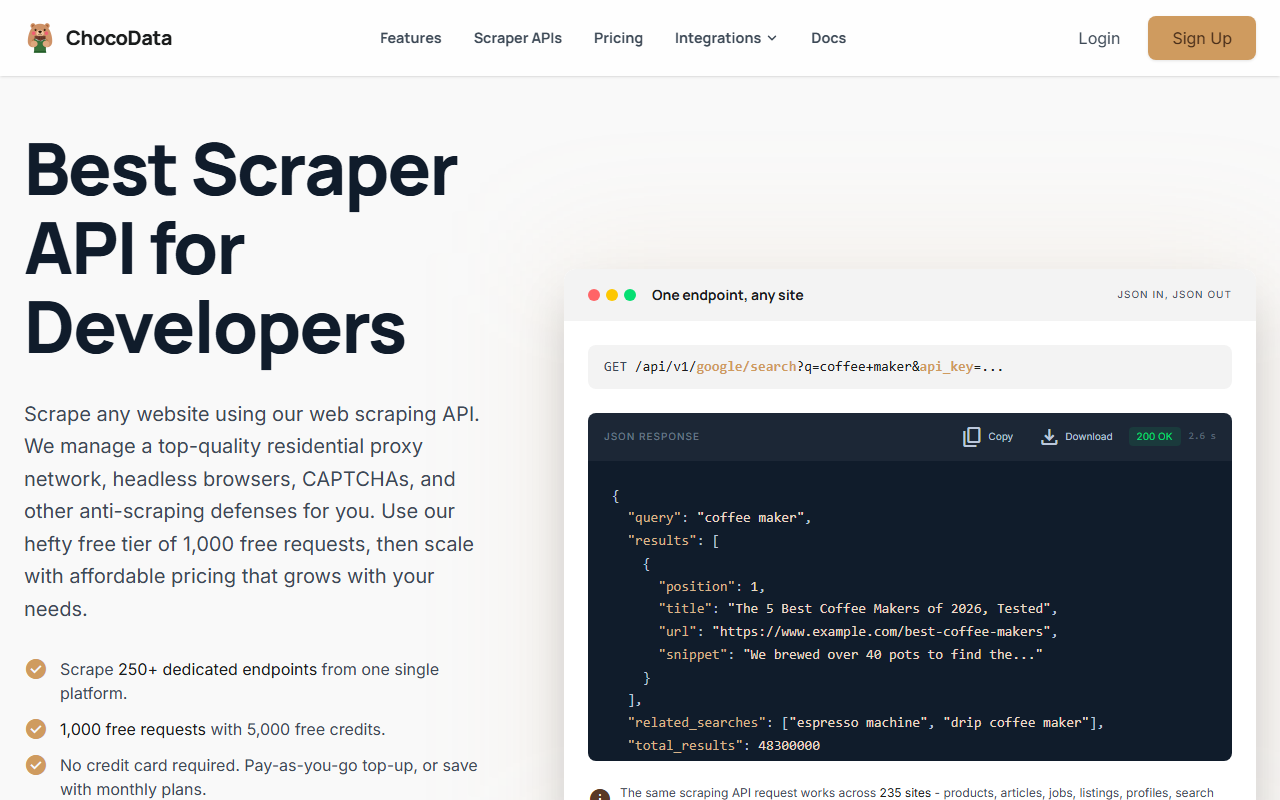
ChocoData is my top pick for getting clean, structured JSON out of named sites at the lowest documented entry price of any service here. Its model is what sets it apart: one universal endpoint with the shape GET /api/v1/{site}/{resource} covers any supported site, and on top of that it exposes 453 endpoints across 235 sites, with 250+ returning validated, parity-checked structured JSON, per ChocoData’s site in mid-2026. You hit a generic URL or a purpose-built endpoint for, say, a product page or search results, and get clean fields back instead of raw HTML you have to parse.
Pricing
Per ChocoData’s pricing page in mid-2026, the Free plan is $0 with 1,000 requests per month and no card, Vibe is $19/month for 27,000 requests, Pro is $49/month for 82,000 requests, and Custom tiers run from $100 to $2,000/month for 200,000 up to 4,000,000+ requests. One request costs 5 credits, with JS rendering and screenshots adding 10 credits each, and pay-as-you-go top-ups are listed at $0.90 per 1,000 successful requests. Only successful (2xx) responses are billed.
| Plan | Price | Included requests | Concurrency | Best for |
|---|---|---|---|---|
| Free | $0 (no card) | 1,000/mo (5,000 credits) | 10 | Testing the API |
| Vibe | $19/mo | 27,000/mo | 30 | Solo devs and side projects |
| Pro | $49/mo | 82,000/mo | 50 | Small teams in production |
| Custom | $100 to $2k/mo | 200,000 to 4,000,000+/mo | 100 to 500+ | Scale with SLA |
Standout features
The universal endpoint means you are never blocked by a missing parser: any supported site answers a generic request. The 250+ dedicated endpoints return validated JSON across search, e-commerce, social, real estate, and finance targets, so common jobs need zero parsing on your side. ChocoData ships SDKs for Python, Node.js, and Go plus a CLI and an MCP server, and its homepage publishes a median latency of 2.6s (p95 6s, p99 ~10s) across the 235 supported sites. There is no published headline success rate.
Best for
ChocoData fits developers and founders who need structured data from common targets without paying enterprise minimums. The $19 Vibe tier is the lowest paid entry point of any service in this comparison, and the free tier is enough to prove a target is reachable before you spend a cent. Skip it if you need fully managed delivery with no code, or coverage of an obscure site outside the 235 supported targets. Try ChocoData.
2. Oxylabs
Oxylabs is the strongest pick when you want to pay only for results you actually receive and you scrape major sites that have a maintained parser. Its Web Scraper API runs on a consumption model with site-specific parsers (Amazon, Google, eBay and more) returning parsed JSON, which Oxylabs markets as roughly 12 to 269 data points per target depending on the site, plus a Universal Source for sites without a dedicated parser.
Pricing
Per Oxylabs’ product page in mid-2026, the Web Scraper API starts at $0.25 per 1,000 results on pay-as-you-go, and you pay only for successful results. A free trial covers up to 2,000 results with no credit card.
| Aspect | Detail (Oxylabs product page, mid-2026) |
|---|---|
| Starting price | $0.25 per 1,000 results (consumption) |
| Free trial | Up to 2,000 results, no card |
| Billing | Pay only for successful results |
| Features | JS rendering, global geotargeting, Oxy Parser structured output |
Standout features
Oxylabs leans on mature parsers for major commerce and search sites, so structured output is reliable on those targets. JavaScript rendering, global geotargeting, and pagination are built in, and the network behind it is one of the larger commercial proxy pools. The consumption model means a slow month costs little, which suits spiky workloads.
Where it falls short
Consumption pricing makes the monthly bill harder to forecast than a flat plan, and the lightest entry gates some features. For a simple side project it is heavier than ChocoData, and there is no sub-$19 flat tier to anchor a small budget. Oxylabs publishes a marketed success claim above 99.9% but no public latency figure, so plan on testing your own targets.
3. Bright Data
Bright Data is the pick when you need enterprise breadth and per-record delivery economics. Beyond the Web Scraper API it sells a wider catalog (Web Unlocker, SERP API, prebuilt datasets), which is the reason to choose it over a single-product vendor when you want one account across scraping and proxies.
Pricing
Per Bright Data’s pricing page in mid-2026, the Web Scraper API runs pay-as-you-go at $1.50 per 1,000 records with pay-for-success billing, the Scale plan is $499/month including 384,000 records (then $1.30 per 1,000 above that), and Enterprise is custom. A free tier offers 5,000 records per month with no credit card.
| Plan | Price (Bright Data pricing page, mid-2026) | Records |
|---|---|---|
| Free tier | $0, no card | 5,000/mo |
| Pay-as-you-go | $1.50 per 1,000 records | Metered |
| Scale | $499/mo (then $1.30/1K) | 384,000 included |
| Enterprise | Custom | Volume discounts, account manager |
Standout features
Per-record pay-for-success billing means failed deliveries cost nothing, and the API markets unlimited concurrency. The breadth of the catalog is the real draw: if a project later needs a SERP API, an unlocker, or an off-the-shelf dataset, it is the same vendor and the same billing. That consolidation is worth a premium for larger teams.
Where it falls short
At $1.50 per 1,000 records, the unit price is among the higher ones here, and the Scale plan’s $499 entry is steep for small projects. The breadth that helps enterprises adds product-selection complexity for a solo developer who just wants one endpoint. Watch the monthly minimum if you are an early startup.
4. Zyte
Zyte is the pick when you want the service to decide how hard a target is and charge accordingly. Zyte API uses consumption pricing tiered by site complexity, and its AI extraction returns structured fields without you writing per-site parsers, which lowers maintenance on sites that change layout.
Pricing
Per Zyte’s pricing page in mid-2026, HTTP responses run $0.13 to $1.27 per 1,000 requests and browser-rendered pages run $1.01 to $16.08 per 1,000 requests, with monthly commitment tiers at $100, $200, and $500 that lower the unit rate. New users get $5 in free credit with 30 days to test and no commitment.
| Aspect | Detail (Zyte pricing page, mid-2026) |
|---|---|
| HTTP requests | $0.13 to $1.27 per 1,000 |
| Browser-rendered | $1.01 to $16.08 per 1,000 |
| Commitment tiers | $100, $200, $500, Enterprise |
| Free credit | $5, 30 days, no commitment |
| Features | Ban handling, CAPTCHA solving, JS rendering, AI parsing |
Standout features
You pay in proportion to target difficulty, so easy sites stay cheap and you only pay the high rate when a page genuinely needs a browser. AI auto-extraction reduces parser maintenance, ban handling and CAPTCHA solving are built in across every tier, and there is no overage penalty above your commitment. The 30-day window on the free credit is the most generous trial here.
Where it falls short
Browser-rendered pages on hard sites can reach $16.08 per 1,000, the widest price ceiling in this list, and complexity-based billing is harder to forecast than a flat credit pack. The commitment tiers nudge you toward a monthly minimum once you are past testing.
5. ScraperAPI
ScraperAPI is the pick when you want the simplest possible “send a URL, get the page back” service with generous credit volumes. It is a raw-HTML service first: you point it at a URL, it handles proxies and rendering, and you parse the result.
Pricing
Per ScraperAPI’s pricing page in mid-2026, Hobby is $49/month for 100,000 API credits and 20 concurrent threads, scaling to Business at $299/month for 3,000,000 credits with full country-level geotargeting. The free plan gives 1,000 credits per month, and the docs state the first 7 days include 5,000 free requests to test at larger scale.
| Plan | Price | API credits/mo | Concurrency | Geotargeting |
|---|---|---|---|---|
| Free | $0 | 1,000 | 5 | Limited |
| Hobby | $49/mo | 100,000 | 20 | US & EU |
| Startup | $149/mo | 1,000,000 | 50 | US & EU |
| Business | $299/mo | 3,000,000 | 100 | Full country-level |
| Scaling | $475/mo | 5,000,000 | 200 | Full country-level |
Standout features
Integration is about as simple as scraping gets: one request parameter and you are running. Credit volume per dollar is strong at the Startup tier and up, the documented 7-day trial of 5,000 requests lets you test real scale, and billing is predictable per credit. Uptime is marketed at 99.9%.
Where it falls short
The entry tier limits geotargeting to US and EU, and full country-level targeting starts at Business ($299). Rendering and premium features raise the credit cost per request, so a rendered workload burns the allowance faster than the headline credit count suggests. The $49 entry is higher than ChocoData’s $19, and you parse HTML yourself rather than getting structured JSON.
6. ScrapingBee
ScrapingBee is the pick when headless-Chrome rendering and a clean, well-documented API matter more than the lowest price. Every plan includes screenshots, extraction rules, and a Google Search API, so a lot of common work is covered out of the box.
Pricing
Per ScrapingBee’s pricing page in mid-2026, Freelance is $49/month for 250,000 API credits and 10 concurrent requests, Startup is $99/month for 1,000,000 credits, Business is $249/month for 3,000,000 credits with JS rendering, premium proxies, and geotargeting, and Business+ is $599/month for 8,000,000 credits. New users get 1,000 free API credits with no credit card.
| Plan | Price | API credits | Concurrency | JS render / premium / geo |
|---|---|---|---|---|
| Freelance | $49/mo | 250,000 | 10 | Not included |
| Startup | $99/mo | 1,000,000 | 50 | Not included |
| Business | $249/mo | 3,000,000 | 100 | Included |
| Business+ | $599/mo | 8,000,000 | 200 | Included |
Standout features
The headless rendering is reliable, and the API is among the easiest to integrate, with clear docs and consistent response shapes. ScrapingBee publishes a 99% success rate and a 2.5s median response time on its Amazon API, and the included Google Search API means SERP jobs need no extra vendor.
Where it falls short
The cheaper Freelance and Startup tiers exclude JS rendering and premium proxies, so real rendering work starts at the $249 Business plan, which is steep next to services that bundle rendering lower. Credit costs rise with rendering, so the headline credit count overstates rendered volume.
7. Apify
Apify is the pick when someone has already built the scraper you need. It is a marketplace of prebuilt “Actors” (serverless scrapers for specific sites) plus a platform to run your own, with tens of thousands of Actors in the store.
Pricing
Per Apify’s pricing page in mid-2026, the Free plan includes $5 of monthly usage, Starter is $29/month with $29 of included usage, Scale is $199/month, and Business is $999/month, all on a pay-as-you-go model for usage beyond the prepaid amount. Unused usage credits expire at the end of each billing cycle and do not roll over. The free plan needs no credit card.
| Plan | Price | Included monthly usage | Support |
|---|---|---|---|
| Free | $0 | $5 | Community |
| Starter | $29/mo | $29 | Chat |
| Scale | $199/mo | $199 | Priority chat |
| Business | $999/mo | $999 | Account manager |
Standout features
Tens of thousands of ready-made Actors mean no build for common targets: rent one, set inputs, and run. The platform is flexible for custom scrapers too, with scheduling, storage, and a proxy add-on, and billing is transparent usage-based across the whole platform. For a one-off scrape of a known site, this is often the fastest path to data.
Where it falls short
Per-Actor quality and success rates vary because many are community-built, so there is no single guaranteed number across the marketplace. Usage credits expire monthly, and pay-as-you-go cost is harder to predict than a flat credit plan. If you want one vendor-maintained API with a single success rate, a dedicated scraper API fits better.
How to choose the right one
Choose by answering three questions: do you want to write code, how predictable does the bill need to be, and how defended are your targets. Your answers map cleanly onto the services above.
| If you… | Pick | Why |
|---|---|---|
| Want structured JSON from named sites cheaply | ChocoData | Universal endpoint plus 250+ dedicated endpoints from $19/mo |
| Want to pay only per delivered result | Oxylabs or Bright Data | Consumption billing, pay for success |
| Scrape a mix of easy and hard sites | Zyte | Pricing scales with target difficulty |
| Want simple URL-in, HTML-out at scale | ScraperAPI | Large credit volumes, easy integration |
| Need reliable JavaScript rendering | ScrapingBee | Headless Chrome with a clean API |
| Need a scraper that already exists | Apify | Marketplace of prebuilt Actors |
| Do not want to write any code | Managed delivery (Bright Data, Oxylabs) | Vendor builds and ships the dataset |
The honest default for most developers and founders: start on a free tier of a self-serve API, prove the data you need is reachable, then upgrade on the service whose billing unit matches your workload. Move to fully managed data delivery only when maintenance, rather than money, is the constraint, because that is what managed delivery actually buys you.
How we evaluated these
I shortlisted these seven services on documented value: entry price, free tier, billing model, breadth of supported sites, and whether the service returns structured data or raw HTML. Every price and feature figure comes from each vendor’s own pricing or product page, read in mid-2026 and attributed inline, because pricing pages move and third-party numbers go stale fast. The speed and success-rate figures are approximate, compiled from vendor-published numbers plus aggregated public sources, and are not first-hand; my independent like-for-like benchmarks are still in progress, with the full methodology at how we test. All pricing is current as of mid-2026 and changes frequently, so confirm the live number on each vendor’s own page before you commit, and check whether the service bills by request, credit, delivered record, or managed project so you are comparing like with like.
FAQ
A scraper API gives you an endpoint: you send a URL or a query, write the integration code, and the service returns HTML or JSON while managing proxies and anti-bot. A managed data delivery service is done-for-you: you describe the dataset, the vendor builds and maintains the scraper, and you receive files or feeds on a schedule with no code on your side. APIs cost less and give you control; managed delivery costs more and removes maintenance.
Self-serve scraper APIs start around $19 to $49 per month for the entry tier, per the vendors' pricing pages in mid-2026 (ChocoData $19, Apify $29, ScraperAPI $49, ScrapingBee $49). Consumption services price per result or request, from $0.13 per 1,000 HTTP requests (Zyte) and $0.25 per 1,000 results (Oxylabs) up to several dollars per 1,000 browser-rendered requests. Fully managed data projects are quoted per dataset and typically start in the hundreds to thousands of dollars per month.
Most general scraper APIs accept any URL and return the rendered page, so technically yes for public pages. The harder question is reliability on heavily defended sites, where success rates and cost per request vary a lot. Services that publish dedicated endpoints for named sites (ChocoData, Oxylabs, Bright Data) tend to be more reliable on those specific targets because the parser is maintained for that site's layout.
Using a service to collect publicly available data is generally legal in the US, but the lawful line depends on what you scrape and how you use it, not on the vendor you hire. Scraping personal data, copyrighted content, or data behind a login raises real legal questions, and outsourcing the requests does not transfer that responsibility. Treat the legal guide as required reading before any commercial project and get your own legal advice for anything involving personal or copyrighted data.