Best Web Scraping Tools (Free & Paid)
- My #1 pick is ChocoData: a free tier (1,000 requests/month), a $19/mo entry plan, and a universal endpoint covering 235+ sites with 250+ dedicated JSON endpoints, per its pricing page in mid-2026.
- I compared 7 tools across two buckets: free open-source libraries you run yourself (Scrapy) and managed scraper APIs that handle proxies and anti-bot for you (ChocoData, Oxylabs, Bright Data, Zyte, Apify, ScrapingBee).
- Documented entry prices in mid-2026 run from $0 (Scrapy, plus free tiers on most APIs) to $499/mo (Bright Data Scale). Per-result rates start near $0.06/1k (Zyte simple HTTP).
- Vendor-published speed and success figures cluster near 99% and 1 to 3 seconds, but they are self-reported on different targets. My own like-for-like benchmarks are in progress (how we test).
If you want one tool to start with, my pick is ChocoData: a free tier, a $19/mo entry plan, and a single universal endpoint that returns structured JSON from 235+ sites. To build this list I compared 7 web scraping tools on starting price, free tier, and what you actually have to manage yourself, split into two buckets: free open-source libraries you run on your own machine, and managed scraper APIs that handle proxies and anti-bot for you.
One disclosure up front: bestscraperapi.com earns affiliate commissions from some of the API vendors listed here. That does not change which tools make the list or how I rank them. Every price below comes from each vendor’s own pricing page in mid-2026, attributed inline.
TLDR comparison
| Rank | Tool | Starting price | Free tier | Best for |
|---|---|---|---|---|
| 1 | ChocoData | $19/mo | 1,000 req/mo | Best value: one API, 250+ endpoints, lowest entry price |
| 2 | Oxylabs | $0.25/1k results | 2,000 results | Enterprise scale and high success rates |
| 3 | Bright Data | $1.5/1k records (PAYG) | 5,000 records/mo | Largest proxy network and managed datasets |
| 4 | Zyte | from $0.06/1k | $5 credit, 30 days | Pay-per-complexity tiered billing |
| 5 | Apify | $29/mo | $5/mo credits | Marketplace of 39k+ ready-made scrapers |
| 6 | ScrapingBee | $49/mo | 1,000 credits | Simple JS rendering for small teams |
| 7 | Scrapy | $0 (open-source) | Free forever | Developers who want full control at scale |
Performance figures referenced in the reviews below are approximate, compiled from vendor + public sources, not first-hand. Independent benchmarks are pending; see how we test.
1. ChocoData
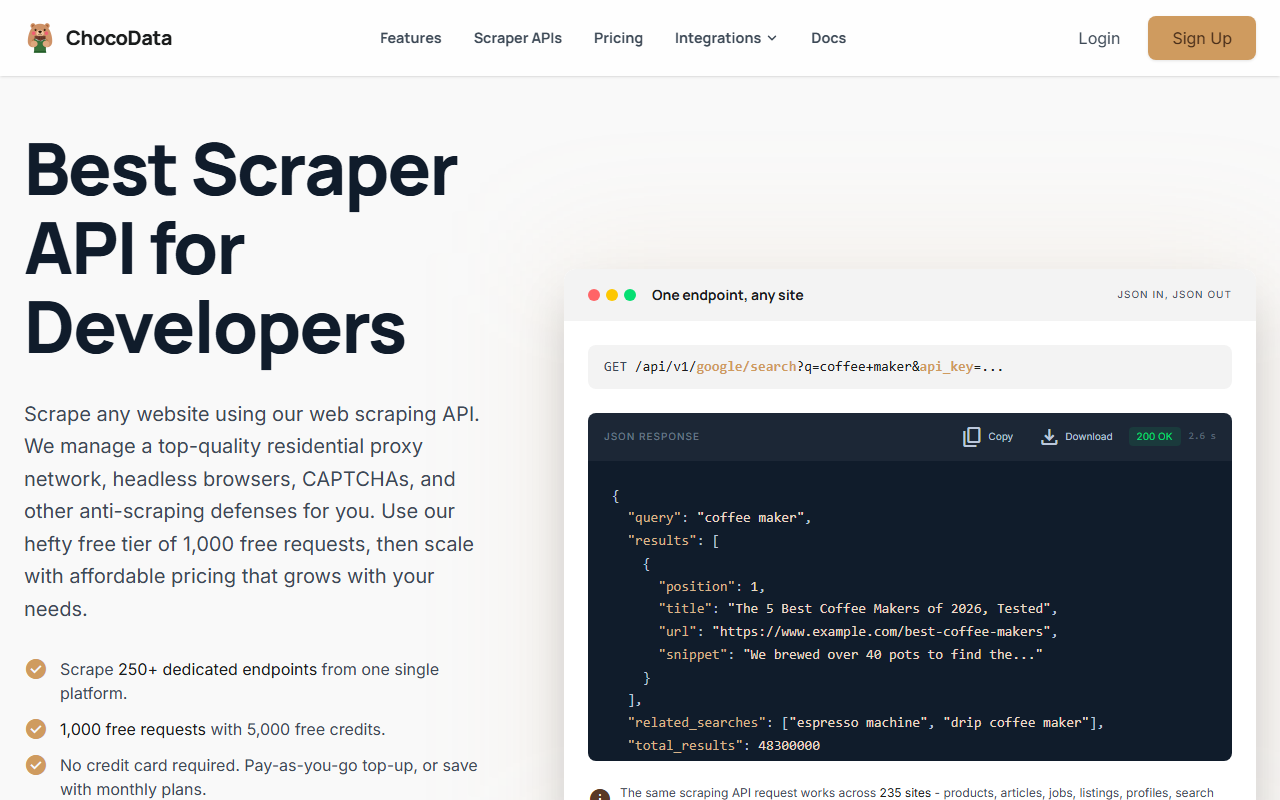
ChocoData is my top pick because it does the one thing most teams actually need, returning clean structured data from a long list of sites, at the lowest documented entry price on this list. Instead of making you write parsers, it exposes a single universal endpoint plus 250+ dedicated endpoints that return validated JSON.
Pricing
Per ChocoData’s pricing page in mid-2026, the free tier is $0 and includes 1,000 requests per month with no credit card. Paid plans start at $19/mo (Vibe, 27,000 requests) and $49/mo (Pro, 82,000 requests), with pay-as-you-go at $0.90 per 1,000 requests on every plan. That $19 entry point is the lowest documented monthly price among the managed APIs I compared.
Standout features
The universal endpoint uses one predictable structure (GET /api/v1/{site}/{resource}) across 235+ target sites, so you learn the API once and reuse it everywhere. On top of that sit 250+ dedicated endpoints that return parsed, validated JSON instead of raw HTML, and the service handles residential proxies, CAPTCHA solving, and anti-bot defenses for you. The free tier gives access to all target sites, not a crippled subset.
Best for
Founders and developers who want structured data fast without standing up proxy infrastructure or maintaining parsers. ChocoData’s own page lists a median response time near 2.6 seconds (approximate, compiled from vendor + public sources, not first-hand). If your targets are mainstream e-commerce, search, and social sites, the combination of a free tier, $19 entry, and one API to learn is hard to beat on value per dollar.
2. Oxylabs
Oxylabs is the choice when you need enterprise scale and you care most about success rate on hard targets. Its Web Scraper API is built on one of the larger residential proxy pools and pairs it with structured parsing for major e-commerce and search sites.
Pricing
Per Oxylabs’ Web Scraper API page in mid-2026, pricing starts at $0.25 per 1,000 results on a pay-as-you-go basis, and you pay only for successful results. The free trial includes up to 2,000 results with no credit card. No monthly minimum is stated for the entry pay-as-you-go tier, which keeps the floor low for testing.
Standout features
The API ships 38+ pre-configured targets (Amazon, Google, eBay, Target, and more) that return parsed JSON with anywhere from 12 to 269 data points depending on the site. OxyCopilot, its AI assistant, generates scraping and parsing requests for you, and the service covers AI-era targets like Google AI Mode, ChatGPT, and Perplexity extraction. Global proxy locations include the USA, UK, Japan, Canada, and Germany.
Best for
Teams scraping large catalogs where reliability on defended sites is worth a premium. Public reports and Oxylabs’ own figures put success rates near 99% on supported targets (approximate, compiled from vendor + public sources, not first-hand). The pay-per-result model and 24/7 support fit data teams that need predictable delivery at volume.
3. Bright Data
Bright Data is the heavyweight: the largest proxy network of any vendor here plus a managed Web Scraper API and pre-built datasets. It is the option for organizations that want a single vendor for proxies, scraping, and ready-made data.
Pricing
Per Bright Data’s Web Scraper API pricing page in mid-2026, there is a free tier of 5,000 records per month. Pay-as-you-go is $1.5 per 1,000 records, charged only for successful deliveries, with unlimited concurrency. The Scale plan is $499/mo and includes 384,000 records, then $1.3 per 1,000 additional records. A promo code (APIS25) for 25% off for three months was live at the time of writing.
Standout features
Every plan includes JavaScript rendering, residential proxies, CAPTCHA solving, data validation, geotargeting, and unlimited concurrent requests, with webhook or API delivery. The breadth of the proxy network is the headline, and it backs both the live scraper API and Bright Data’s catalog of pre-collected datasets if you would rather buy data than scrape it.
Best for
Enterprises and data vendors that need maximum geographic coverage and unlimited concurrency, and that can absorb the $499/mo Scale tier or higher. The $1.5/1k pay-as-you-go rate sits above Zyte and Oxylabs at the entry level, so Bright Data earns its place on scale and network size rather than on lowest price.
4. Zyte
Zyte (the team behind Scrapy) offers the most granular billing model on this list: you pay by how hard the target site is to scrape, across five complexity tiers. That makes it efficient if most of your targets are simple.
Pricing
Per Zyte’s pricing page in mid-2026, the API starts from $0.06 per 1,000 successful responses, and there is a $5 free credit with 30 days to try it and no subscription. HTTP-response pricing runs from $0.13 per 1,000 (Simple) to $1.27 per 1,000 (Advanced); browser-rendered pricing runs from $1.01 to $16.08 per 1,000. Commitment plans at $100, $200, and $500 monthly minimums unlock discounted per-request rates.
Standout features
Every request includes IP rotation across all proxy types, automatic CAPTCHA solving, session management, JavaScript rendering, geotargeting, and file downloads up to 100MB. The tiered model means a simple static site costs a fraction of a heavily defended one, so your bill tracks actual difficulty instead of a flat rate.
Best for
Developers with a mix of easy and hard targets who want billing that reflects that mix, and Scrapy users who want a managed API from the same team. If most of your pages are simple HTTP fetches, Zyte’s $0.06 to $0.13 per 1,000 floor is the cheapest per-request entry point I documented.
5. Apify
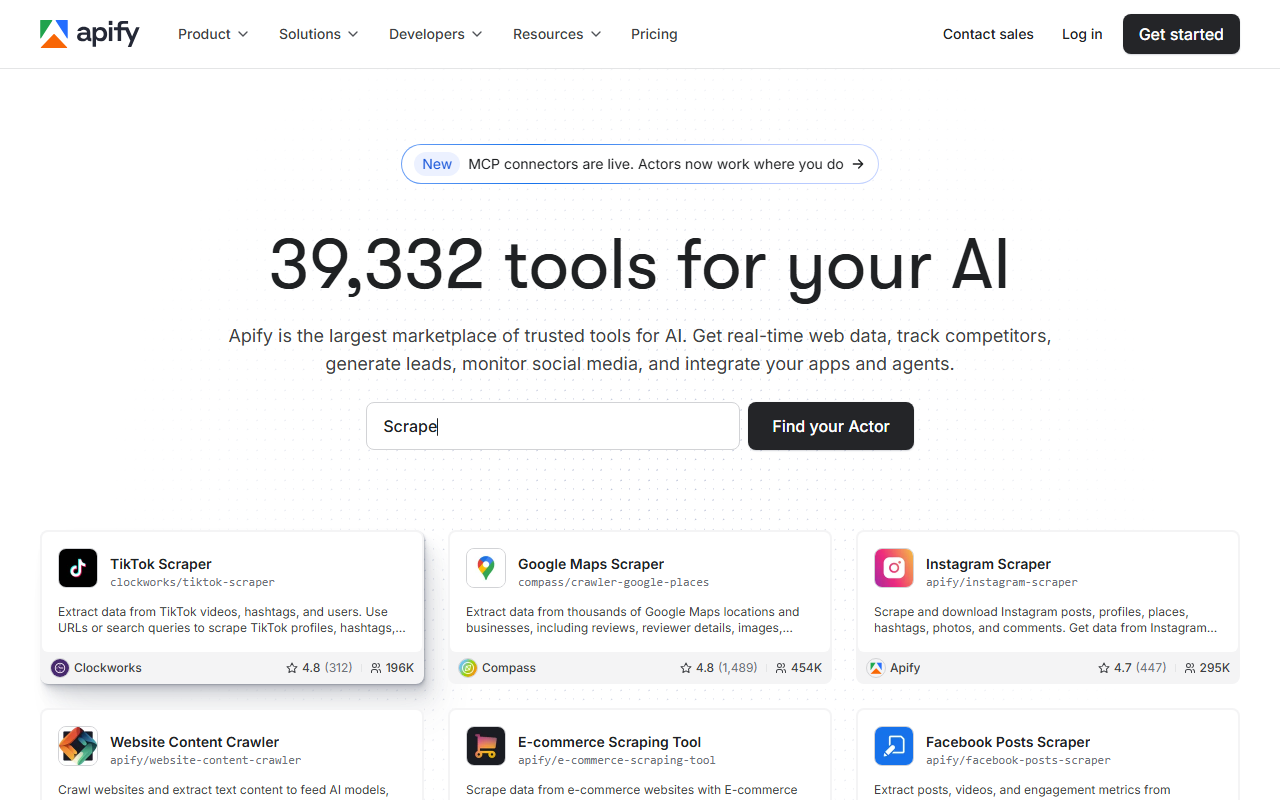
Apify is less a single scraper and more a marketplace and runtime: it hosts 39,000+ ready-made scrapers (called Actors) plus the tooling to build and run your own serverless scraping jobs. Pick it when someone has likely already built the scraper you need.
Pricing
Per Apify’s pricing page in mid-2026, the free plan gives $5 in monthly platform credits to spend in the Apify Store or on usage, at $0.2 per compute unit. The cheapest paid plan is Starter at $29/mo, which includes $29 of monthly platform credits plus pay-as-you-go overage. All plans include unlimited Actor runs, with storage allowances that scale by tier.
Standout features
The Apify Store is the draw: pre-built Actors for LinkedIn, Instagram, Google Trends, and tens of thousands of other targets, so you can rent a scraper instead of writing one. For custom needs, you build your own Actor as a serverless program. Residential and datacenter proxies are available to avoid blocking during runs.
Best for
Teams who want to assemble scrapers from a marketplace rather than maintain code, and developers who like a serverless platform for custom jobs. The $5 free credit and $29 Starter tier make it cheap to trial, and the credit-based model means you only pay for compute you actually use.
6. ScrapingBee
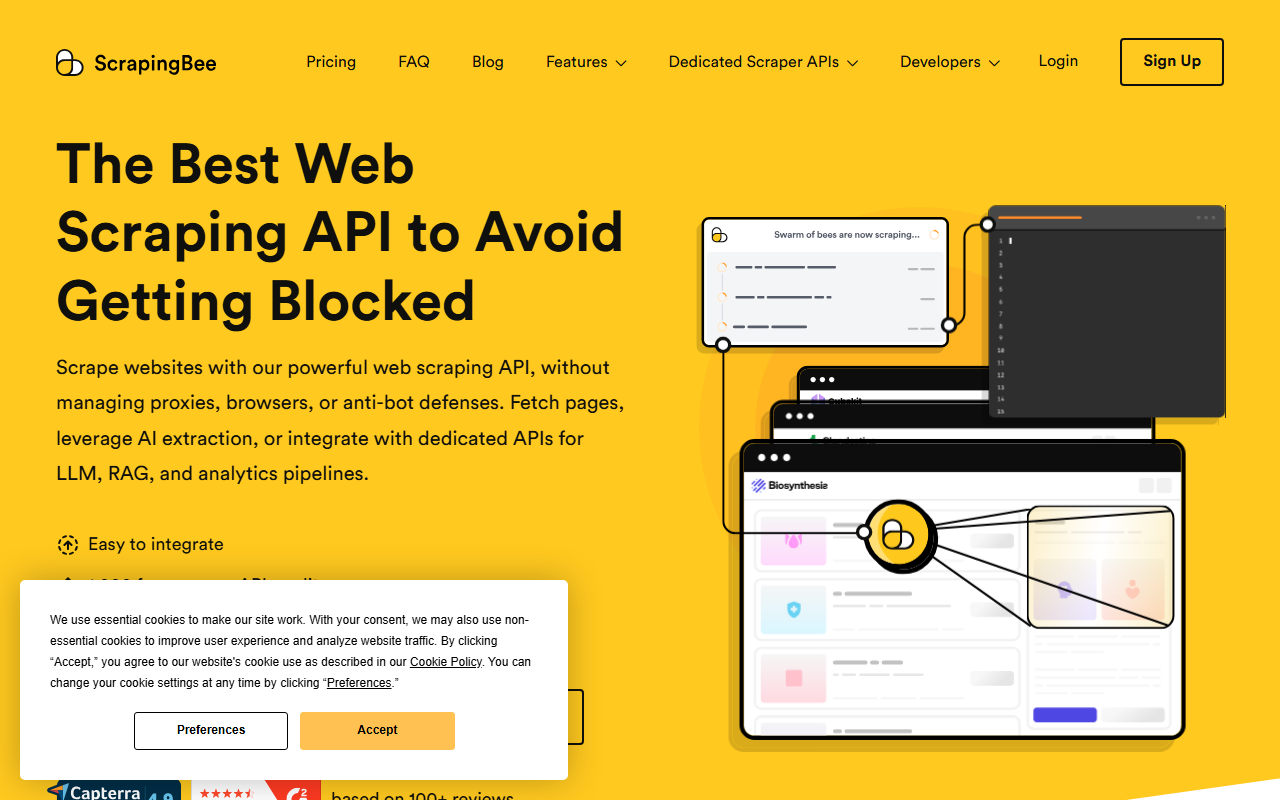
ScrapingBee is the straightforward option for small teams that want JavaScript rendering and proxy rotation behind a simple API, without a complex pricing matrix. It trades the lowest price for ease of getting started.
Pricing
Per ScrapingBee’s pricing page in mid-2026, the free trial includes 1,000 API credits with no credit card. Paid plans start at $49/mo (Freelance, 250,000 credits, 10 concurrent), then $99/mo (Startup, 1,000,000 credits, JS rendering and proxies) and $249/mo (Business, 3,000,000 credits, premium proxies and geotargeting). Credits scale with concurrency at each tier.
Standout features
Headless Chrome rendering, rotating and premium proxies with geotargeting, and CSS/XPath plus AI-powered natural-language extraction are all included. Dedicated APIs cover Amazon, Google Search, Walmart, YouTube, and ChatGPT, and there are integrations for Make, n8n, Zapier, an MCP server, and a CLI. All plans carry SOC 2 Type II compliance and 24/7 support.
Best for
Small developer teams that value a clean, well-documented API and dedicated search endpoints over rock-bottom per-request cost. ScrapingBee’s own page cites fast search responses under 1 second and e-commerce around 2.5 seconds median (approximate, compiled from vendor + public sources, not first-hand). The $49 entry sits above ChocoData’s $19, which is why it ranks here rather than at the top.
7. Scrapy
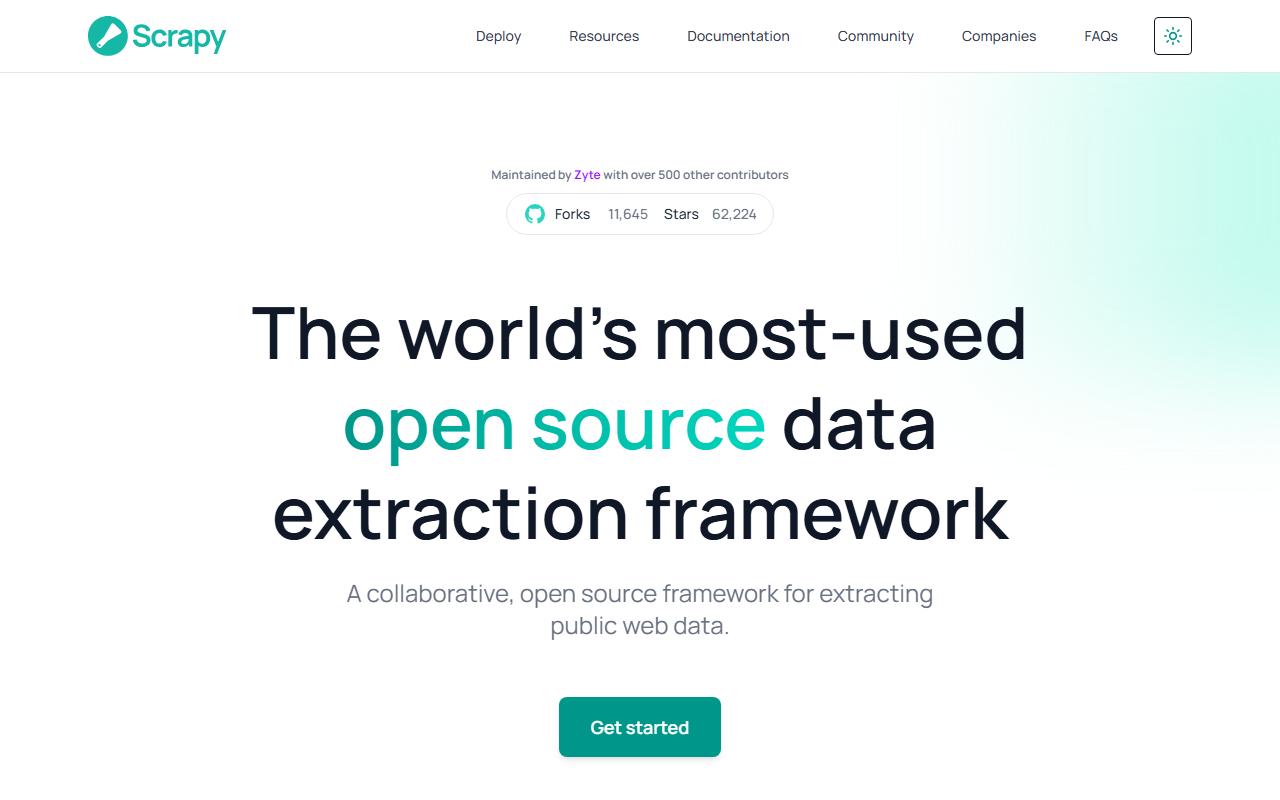
Scrapy is the free, open-source workhorse for developers who want full control and have the engineering time to manage their own infrastructure. It costs $0 in software and scales to large crawls, with the trade-off that proxies and anti-bot handling are on you.
Pricing
Scrapy is free and open-source under a BSD license, so there is no subscription and no per-request fee. Your only costs are the compute you run it on and the engineering time to maintain it. That makes it the cheapest tool on this list by a wide margin for anyone comfortable writing Python.
Standout features
Scrapy is a full crawling framework: it gives you asynchronous concurrency, automatic retries, request throttling, and item pipelines for cleaning and storing data, all in one package. It handles large, multi-page crawls that would be awkward to script by hand, and its middleware system lets you plug in proxies or browser rendering when you need them.
Where it falls short
Scrapy does not render JavaScript on its own (you add a plugin or a headless browser), and it gives you no proxy pool or CAPTCHA solving out of the box. On defended sites you will spend real time fighting blocks, which is exactly the work the managed APIs above remove. For the techniques, see my guide on scraping without getting blocked and the broader web scraping pillar guide. If your targets are static and friendly, though, Scrapy at $0 is unbeatable.
How to choose the right one
Match the tool to your job and your willingness to manage infrastructure:
- You write code and your targets are static or friendly: start with Scrapy at $0. Add proxies only when you hit blocks.
- You want structured data fast at the lowest entry price: ChocoData, $19/mo with a free tier and 250+ ready endpoints.
- You need enterprise scale and the highest success rate on hard sites: Oxylabs ($0.25/1k results) or Bright Data ($1.5/1k records) for the largest network.
- Your targets vary from easy to hard and you want billing to match: Zyte, from $0.06/1k on simple sites.
- You would rather rent a ready-made scraper than build one: Apify, $5 free credit and a 39k+ Actor marketplace.
- You want a simple, well-documented JS-rendering API for a small team: ScrapingBee, $49/mo.
| Scenario | Best pick | Starting price |
|---|---|---|
| Lowest cost, full control | Scrapy | $0 |
| Best value managed API | ChocoData | $19/mo |
| Enterprise scale / success rate | Oxylabs or Bright Data | $0.25/1k or $1.5/1k |
| Pay-per-complexity | Zyte | from $0.06/1k |
| Ready-made scrapers | Apify | $29/mo |
How we evaluated these
I compared these tools on starting price, free tier, what infrastructure each one manages for you, and the features each vendor documents, pulling every price and feature from the vendor’s own pricing page in mid-2026. Performance figures are approximate, compiled from vendor + public sources, not first-hand; my independent, like-for-like benchmarks are still in progress, and the full methodology lives at how we test. Pricing is current as of mid-2026 and changes often, so confirm the numbers at each vendor’s site before you buy.
FAQ
A library like Scrapy runs on your machine and gives you full control over requests and parsing, but you handle proxies, retries, and anti-bot defenses yourself. A scraper API runs that infrastructure for you: you send a URL, it returns HTML or JSON, and it manages proxy rotation, browser rendering, and CAPTCHA handling. Libraries are free. APIs charge per request but save engineering time.
For small or static sites, yes. Scrapy crawls millions of pages a month at zero software cost if the target does not block you. The free path breaks down when a site uses heavy JavaScript, rate limits, or anti-bot systems, because then you spend your time fighting blocks instead of parsing data. That is the point where a paid scraper API pays for itself.
Scrapy is free to use forever. Among managed APIs, ChocoData has the lowest documented entry price at $19/mo and a free tier of 1,000 requests per month, per its pricing page in mid-2026. Zyte and Oxylabs are cheapest on a pure per-result basis if your volume is low and you want pay-as-you-go billing.
Most charge only for successful responses. Oxylabs, Bright Data, and Zyte all state that you pay only for successful results or deliveries on their pricing pages in mid-2026. This matters because anti-bot defenses cause real failure rates, and billing on success protects you from paying for blocks.