Best YouTube Scraper APIs & Tools
- YouTube scraping tools split into two shapes: dedicated YouTube parsers that return video, channel, comment, and transcript JSON (Apify, Bright Data, Decodo) and universal scraper APIs you point at any public YouTube URL (ChocoData, Oxylabs, ScraperAPI).
- Documented entry prices in mid-2026 run from $0 free tiers (ChocoData, Bright Data, Apify, ScraperAPI, Decodo, Oxylabs) and $19/mo (ChocoData, Decodo) up to $499/mo (Bright Data Scale). Per-result rates start near $0.25/1,000 (Oxylabs) and $1.50/1,000 (Bright Data).
- ChocoData is my top value pick when YouTube is one target among several: a universal endpoint plus 250+ dedicated endpoints across 235 sites, from $19/mo with a free 1,000 requests/mo, pointed at any public YouTube URL.
- For purpose-built YouTube parsers, Apify's YouTube Scraper returns videos, channels, search, full comments, and transcripts from $2.40/1,000 videos, and Bright Data ships seven-plus YouTube scrapers from $1.50/1,000 records.
- Speed and success figures below are approximate, compiled from vendor-published numbers and public reports, not bestscraperapi.com's own tests. Like-for-like benchmarks are in progress (how we test).
YouTube is the second-most-visited site on the web, and almost none of the data devs want sits in its raw HTML: titles, view counts, durations, upload dates, channel stats, and comments all render client-side from a JSON blob. So the practical question is which managed service pulls videos, channels, search results, comments, or transcripts for you without you reverse-engineering YouTube’s InnerTube API and running the proxy pool yourself. My top value pick is ChocoData when YouTube is one of several targets, with Apify and Bright Data as the purpose-built parsers; this page compares those plus Oxylabs, ScraperAPI, and Decodo on the four things that decide a purchase: starting price, free tier, YouTube coverage, and published speed. Every price and feature comes from the vendor’s own pricing or product page in mid-2026, attributed inline, because review-site numbers go stale fast and pricing pages move.
One disclosure up front: bestscraperapi.com earns affiliate commissions from some of the vendors listed here. That does not change which tools make the list, how I rank them, or what I write. The pricing comes straight from each vendor’s own page, and the ranking follows documented price and features, not payout.
A second note on the performance numbers further down. The speed and success-rate figures are approximate, compiled from each vendor’s own published figures plus aggregated public reports. They are not bestscraperapi.com’s own first-hand tests. Vendors measure success on their own targets under their own conditions, so the numbers are directional. My independent, like-for-like YouTube benchmarks are still in progress; see how we test for the methodology and check back for measured results.
What are the best YouTube scraper APIs in 2026?
The shortlist below compares the documented entry price, free tier, YouTube coverage, and best fit for each tool. All figures are from each vendor’s own pricing or product page in mid-2026.
| Rank | Tool | Starting price | Free tier | Best for |
|---|---|---|---|---|
| 1 | ChocoData | $19/mo (Vibe) | 1,000 requests/mo (no card) | Scraping public YouTube plus other sites through one low-cost API |
| 2 | Apify YouTube Scraper | From $2.40/1,000 videos | $5 usage/mo (no card) | A prebuilt YouTube actor with transcripts and comments, no build |
| 3 | Bright Data | Pay-as-you-go $1.50/1,000 records | 5,000 records/mo (no card) | Structured YouTube datasets at scale with per-record delivery |
| 4 | Decodo | $19/mo (Starter) | 2,000 requests (no card) | Named YouTube templates (transcript, metadata, channel) at a low monthly price |
| 5 | Oxylabs | From $0.25/1,000 results | 2,000 results (no card) | Lowest per-result rate for pointing a general API at YouTube |
| 6 | ScraperAPI | Free $0 (1,000 credits/mo) | 1,000 credits/mo + 7-day 5,000-credit trial | A credit-based general API with a free tier to prototype against |
A note on comparing these prices: the tools bill in different units, so the starting prices are not directly comparable on volume. ChocoData, ScraperAPI, and Decodo sell requests or credits; Bright Data and Oxylabs charge per delivered record or result; Apify gives you a dollar usage balance and the YouTube Scraper then bills per result. Read the included volume next to each price, and check the per-result or per-credit rate before you commit.
A second note on what “covers YouTube” means. Apify, Bright Data, and Decodo are purpose-built for YouTube and return named fields per object type. ChocoData, Oxylabs, and ScraperAPI are general scraper APIs you point at a YouTube URL or query and then parse the response. Whichever you pick, scraping YouTube breaches its Terms of Service, covered at the end of this page.
1. ChocoData
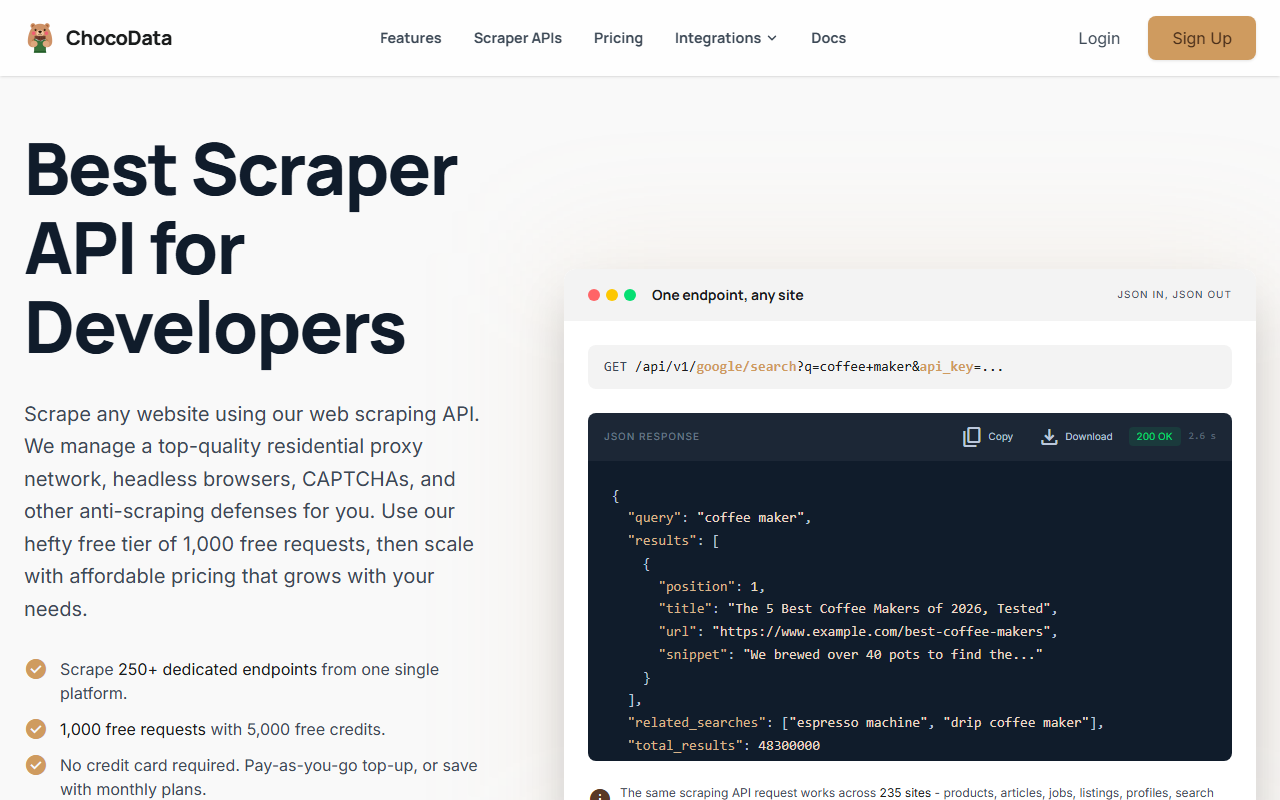
ChocoData is my top value pick when YouTube is one target among several, because one universal endpoint plus 250+ dedicated endpoints across 235 sites covers YouTube and the rest of your scraping from a single low-cost API. Per ChocoData’s own pricing page in mid-2026, paid plans start at $19/mo (Vibe, 27,000 requests, 30 concurrent) with a free tier of 1,000 requests/mo and no credit card, plus pay-as-you-go at $0.90 per 1,000 successful requests on any plan. You only pay for 2xx responses, and the pay-as-you-go balance does not expire.
Pricing
Per ChocoData’s pricing page in mid-2026: Free at $0 (1,000 requests/mo, 5,000 credits, 10 concurrent, no card), Vibe at $19/mo (27,000 requests, 30 concurrent), Pro at $49/mo (82,000 requests, 50 concurrent), and Custom from $100 to $2,000/mo (200,000 to 4,000,000+ requests, 100 to 500+ concurrent). One request costs 5 credits, JS rendering and screenshots add 10 credits each, and pay-as-you-go top-ups run $0.90 per 1,000 successful requests with a balance that never expires. The $19 Vibe tier is the lowest paid entry in this comparison.
Standout features
The call shape is one REST pattern, /api/v1/{site}/{resource}?api_key=..., and the universal endpoint accepts any public URL, so you point it at a YouTube channel, watch, or search page and get JSON back with residential IPs, anti-bot handling, retries, and optional JS rendering done for you. ChocoData publishes 250+ dedicated endpoints (453 endpoints in total) across 235 sites in 17 categories, with the dedicated set returning validated, parity-checked structured JSON. Its homepage reports median latency of 2.6s, p95 of 6s, and p99 of about 10s, measured across all supported sites rather than YouTube alone.
Where it falls short
ChocoData lists a social-platforms category among its 235 targets but does not publish a named per-field YouTube endpoint, so treat YouTube here as universal-endpoint coverage of public pages. You extract from the page JSON rather than receive guaranteed named video, comment, or transcript fields. Comments and transcripts that load through YouTube’s gated InnerTube and timedtext endpoints are not guaranteed via a single universal fetch. For developers and founders scraping YouTube alongside e-commerce, search, or other social pages, that trade buys one cheap API across the whole job. Teams that need a contractually guaranteed per-field YouTube comment or transcript dataset fit a dedicated parser better. See ChocoData at chocodata.com.
2. Apify YouTube Scraper
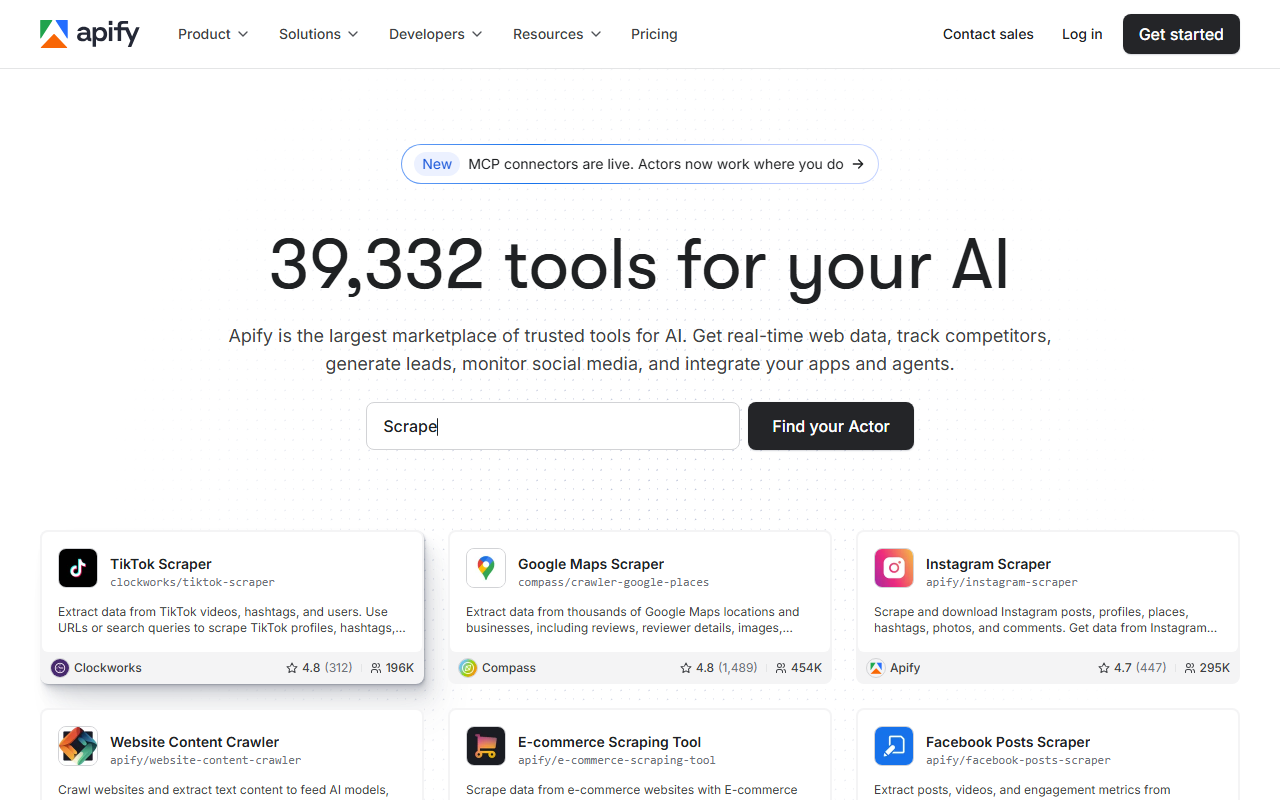
Apify’s YouTube Scraper (by streamers) is the pick when you want a ready-made YouTube parser you run on demand, because it returns videos, channels, search results, full comments, and transcripts as structured JSON without you walking YouTube’s JSON blob. Per the actor’s page in mid-2026, it bills pay-per-event from $2.40 per 1,000 videos and can extract up to 20,000 videos per URL. The actor’s page shows a 4.8/5 rating across 169 reviews and roughly 87,000 users, which are marketplace stats, not my test.
Pricing
The actor charges from $2.40 per 1,000 videos on top of an Apify platform plan, per its page and Apify’s pricing page in mid-2026: Free at $0 with $5 of monthly usage and no card, Starter at $29/mo with $29 of included usage, Scale at $199/mo, and Business at $999/mo. The compute rate per unit drops from $0.20 on Free and Starter to $0.16 on Scale and $0.13 on Business. For deep comment threads, Apify’s separate YouTube Comments Scraper bills $0.90 per 1,000 comments. The $5 free credit covers a small test run.
Standout features
Per the actor page in mid-2026, it returns video fields (title, URL, views, likes, duration, release date, thumbnails), channel fields (subscriber count, total videos and views, location, join date, monetization status), keyword search with filters, full comment text with author and date, and transcripts or subtitles (auto-generated and manual) in SRT, WEBVTT, and XML. It filters by Shorts and streams, exports JSON, CSV, Excel, HTML, and XML, and accepts up to 20,000 videos per URL, which a quota-limited official API does not.
Where it falls short
Pay-per-event on top of a platform plan makes total cost harder to predict at scale than a flat monthly request bill. Unused monthly usage credits expire each billing cycle. Very large comment pulls run through the separate comments scraper, so a full profile-plus-comments view stitches two actors. For anyone who wants YouTube JSON today across videos, channels, search, and transcripts, the actor earns its premium. Teams chasing the lowest unit cost at very high volume, or warehouse-style bulk delivery, fit Bright Data better.
3. Bright Data
Bright Data is the pick for YouTube data at dataset scale with enterprise-shaped delivery, because it ships seven-plus dedicated YouTube scrapers and pipes the output into pipelines. Per Bright Data’s Web Scraper API product page in mid-2026, it lists YouTube videos by keyword, by channel URL, by hashtag, by explore page, and by podcast URL, plus a YouTube channels scraper and a comments scraper. It publishes a 99.99% uptime figure rather than a request success rate.
Pricing
Per the Web Scraper API page in mid-2026: pay-as-you-go at $1.50 per 1,000 records (charged only for successful deliveries), a Scale plan at $499/mo including 384,000 records with additional records at $1.30 per 1,000, and custom enterprise pricing with volume discounts. The free tier is 5,000 records a month with no credit card. The $499/mo Scale plan is a steep step up from pay-as-you-go for smaller projects.
Standout features
Output comes as JSON, NDJSON, or CSV, with webhook or API delivery and bulk handling up to 5,000 URLs per job. The seven-plus YouTube scrapers return named fields per object type, so a videos-by-channel job returns parsed video records and a comments job returns parsed comment records with no selector work on your side. That spread of dedicated endpoints plus per-record billing is the real draw for data teams loading large, recurring YouTube datasets. Solo developers or students who need a few thousand records occasionally will find the enterprise onboarding heavier than a single API key.
4. Decodo
Decodo, formerly Smartproxy, is the pick for named YouTube templates at a low monthly price, because its Web Scraping API ships 100+ ready-made templates that include dedicated YouTube coverage. Per Decodo’s scraping page in mid-2026, the YouTube templates named on the page are YouTube Transcript, YouTube Metadata, YouTube Channel, YouTube Search, YouTube Search Max, and YouTube Subtitles, which puts it closer to a per-field parser than the other general APIs here.
Pricing
Per Decodo’s scraping page in mid-2026: a free tier of 2,000 requests, a Starter plan at $19/mo (38,000 requests at $0.50 per 1,000 standard), and a Professional plan marked most popular at $99/mo (707,000 requests at $0.14 per 1,000 standard, 50 req/s). Only successful responses are billed. The $19 Starter ties ChocoData for the lowest monthly entry on this list, and the volume rate drops to $0.14 per 1,000 at the Professional tier.
Standout features
The named YouTube templates mean you call a transcript or metadata endpoint and get parsed output back rather than raw HTML to walk, which is rare among general scraper APIs at this price. Results come as HTML, JSON, CSV, XHR, PNG, or Markdown. For budget-conscious teams that want both turnkey YouTube templates and a broad library for other targets, Decodo covers a lot at $19/mo. Watch the fine print: premium proxies and JS rendering can be billed separately on some tiers, so headline rates can understate real cost, and the depth of each YouTube template is worth confirming against your exact fields before you commit. Decodo is not pictured here because I have no homepage screenshot on file for it.
5. Oxylabs
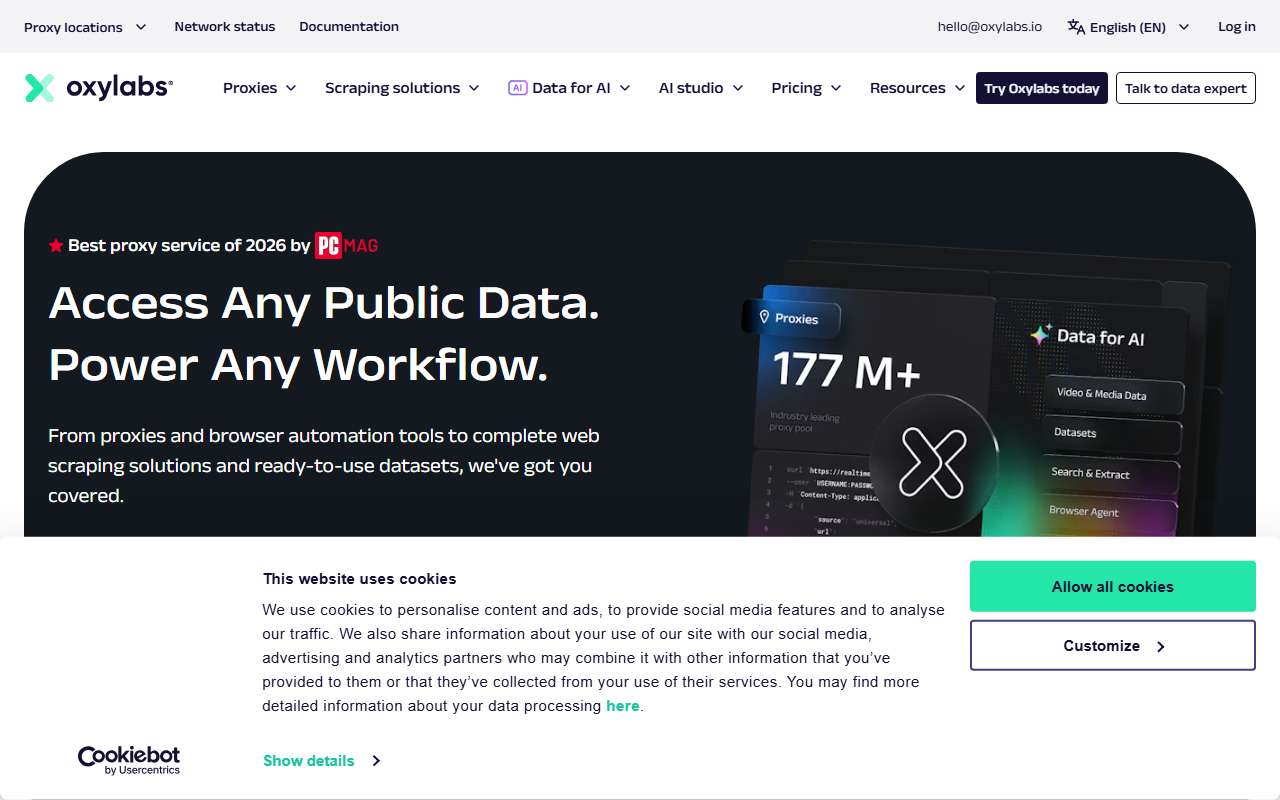
Oxylabs is the pick when per-result price is the deciding factor and you are comfortable parsing YouTube yourself, because its Web Scraper API starts from $0.25 per 1,000 results, the lowest documented floor here. Per Oxylabs’ Web Scraper API page in mid-2026, the free trial includes up to 2,000 results, you pay only for successful results, and no credit card is required.
Pricing
Pricing is per-result rather than a fixed monthly subscription on the entry plan, at $0.25 per 1,000 results, per the Web Scraper API page in mid-2026, with the 2,000-result trial and no card. The $0.25 floor is a starting figure; the effective rate depends on plan and target complexity, so confirm your tier before budgeting.
Where it falls short
YouTube is not in Oxylabs’ published target library, which lists Google, Bing, Amazon, eBay, Etsy, Walmart, Target, Booking, and others, so there is no dedicated YouTube parser. You point the general endpoint at YouTube URLs, get the page back with residential proxies, JS rendering, and geotargeting handled, and extract the fields yourself, the same model as ChocoData’s universal endpoint without a named YouTube category. Comments and transcripts behind gated endpoints are not delivered by a general fetch. That suits developers who want the cheapest per-result rate and will write their own selectors. Anyone wanting named YouTube fields or comment threads with zero parsing work should look at Apify, Bright Data, or Decodo.
6. ScraperAPI
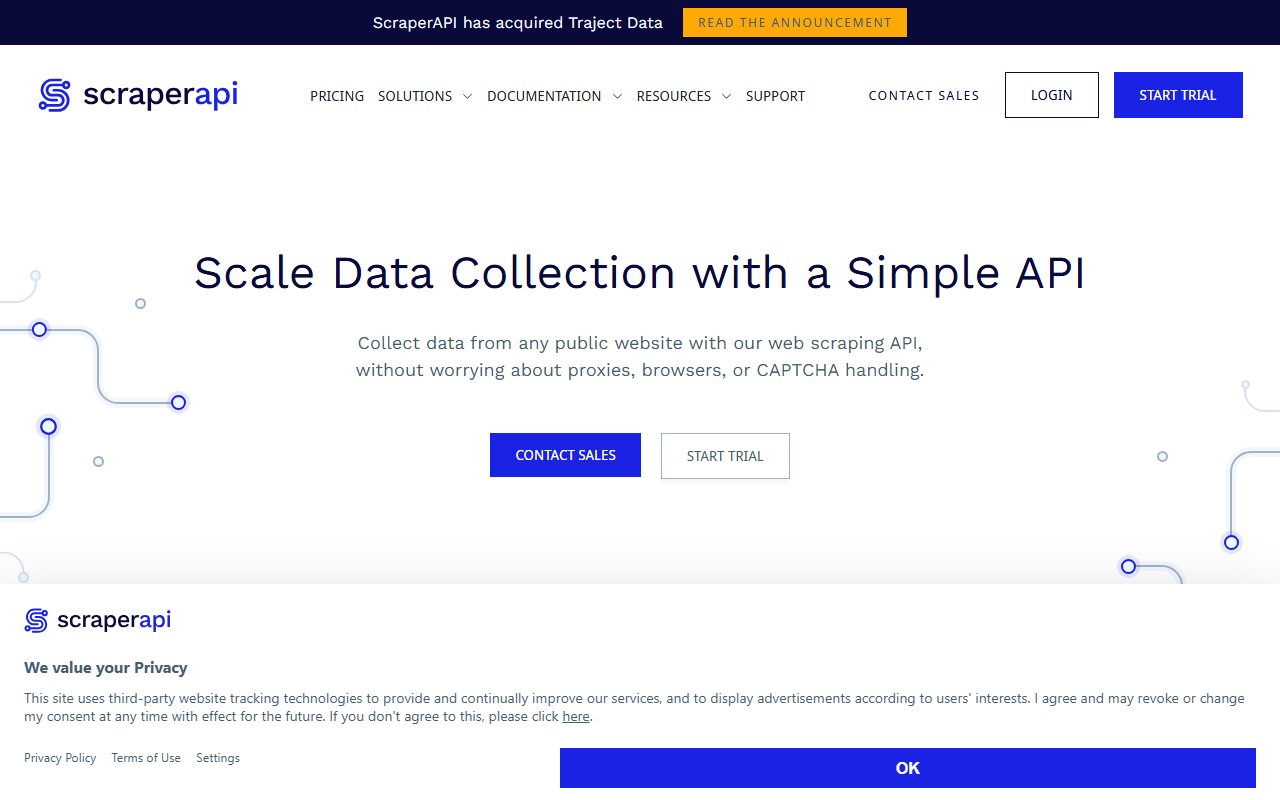
ScraperAPI is the pick when you want a credit-based general API with a no-card free tier to prototype against YouTube, because it offers a free plan of 1,000 credits per month and handles proxies, JS rendering, and geotargeting behind one endpoint. Per ScraperAPI’s documentation in mid-2026, there is also a 7-day trial with 5,000 free API credits, and its Hobby plan is $49/mo for 100,000 API credits.
Pricing
Per ScraperAPI’s documentation in mid-2026: a free plan of 1,000 API credits per month, a 7-day trial adding 5,000 credits, and a Hobby plan at $49/mo for 100,000 API credits, all credit-based and billed on successful requests. I could not load the full paid-plan ladder above Hobby from the pricing page during this update because it renders client-side, so confirm tier pricing above Hobby directly at the source.
Where it falls short
ScraperAPI exposes a Structured Data Endpoint for select domains, but YouTube is not confirmed among them, so for YouTube you point the standard endpoint at a URL and parse the returned HTML and JSON yourself. That makes it most useful here as a cheap way to validate that YouTube pages render and parse the way you expect before committing to a dedicated parser, or as the fallback when you already run ScraperAPI for other targets. It is less suited to deep comment or transcript extraction than the purpose-built scrapers above. For developers validating a YouTube parse cheaply, or existing ScraperAPI users, the free tier makes it easy to start.
How to choose the right one
Pick by job shape, since the tools bill and parse differently. The matrix below maps common scenarios to the tool I would start with, using documented mid-2026 pricing and features.
| Your scenario | Start with | Why |
|---|---|---|
| YouTube is one of several sites you scrape | ChocoData | One endpoint, 235 sites, $19/mo, free 1,000 requests |
| You want YouTube JSON today, no build | Apify YouTube Scraper | Prebuilt actor with transcripts and full comments, from $2.40/1,000 |
| Large recurring datasets into a pipeline | Bright Data | Seven-plus YouTube scrapers, per-record delivery, 5,000 free records/mo |
| Named transcript or metadata templates, low price | Decodo | $19/mo Starter, named YouTube templates, 2,000 free requests |
| Lowest per-result rate, willing to parse | Oxylabs | From $0.25/1,000 results, 2,000-result free trial |
| Prototype a YouTube parse for free | ScraperAPI | No-card 1,000-credit/mo plan plus a 5,000-credit trial |
| Just need clean video/channel/search JSON | Official YouTube Data API | Free to 10,000 units/day, no scraping needed |
If budget is the only constraint and YouTube is one target among many, ChocoData’s $19/mo plus free tier is the lowest documented entry that still covers it, with Decodo tying that monthly price if you want named YouTube templates. For named per-field YouTube objects, especially transcripts or deep comment threads with zero selector work, Apify or Bright Data earn their per-result premium. And if your needs fit the official API’s 10,000-unit daily quota, that is the cleanest and cheapest path of all, with a scraper API winning only once you exhaust the quota or need fields and depth the API gates. For the do-it-yourself route, start with my how to scrape YouTube walkthrough, the web scraping pillar guide, and scraping without getting blocked before pointing anything at YouTube at volume.
How we evaluated these
I shortlisted these six tools by matching them to the four buying criteria above (starting price, free tier, YouTube coverage, and published speed), then transcribed every price and feature from each vendor’s own pricing or product page in mid-2026, attributed inline. The performance figures are vendor-published or aggregated from public reports and are directional only, since each vendor measures success on its own targets under its own conditions; my own like-for-like YouTube benchmarks are still in progress, with the methodology at how we test. All pricing is current as of mid-2026 and changes frequently, so re-check the linked source before you commit budget, and confirm whether a plan bills by request, credit, or delivered record so you compare like with like.
FAQ
For most projects, yes, start there. The YouTube Data API v3 returns clean JSON for videos, channels, playlists, and search, free up to a 10,000-unit daily quota. A scraper API earns its place once you exhaust that quota, need fields the API omits, want bulk search or comment depth the API rate-limits, or need transcripts the API gates. The tools on this page handle the proxy rotation and JSON extraction that a raw scraper would force you to maintain yourself.
At mid-2026 list rates, roughly $24 on Apify's YouTube Scraper ($2.40 per 1,000 videos) or $15 on Bright Data's pay-as-you-go scrapers ($1.50 per 1,000 records), before any subscription discount. On a universal credit API like ChocoData, 10,000 successful requests cost about $9 at the $0.90/1,000 pay-as-you-go rate, or less inside a monthly plan. Oxylabs lists $0.25 per 1,000 results as its floor. Confirm the current number on each vendor's pricing page before budgeting, because these change and billing units differ.
Dedicated parsers can. Apify's YouTube Scraper extracts full comment text and transcripts, and offers a separate YouTube comments scraper at $0.90 per 1,000 comments for deeper threads. Bright Data ships a YouTube comments scraper, and Decodo names YouTube Transcript and Subtitles templates. On a universal API you point at a watch page, comments and transcripts load through YouTube's gated InnerTube and timedtext endpoints, so you get those only if the API exposes them, otherwise you extract what is in the page JSON. See my how-to-scrape-youtube guide for the raw mechanics.
Three separate layers apply. Scraping public YouTube data likely does not violate the US Computer Fraud and Abuse Act after the Ninth Circuit's hiQ v. LinkedIn reasoning on public pages. Separately, it breaches YouTube's Terms of Service, which prohibit automated access except through the API, so the exposure is breach of contract and account termination. And channel and comment data tied to people is personal data under GDPR. A managed API changes who runs the proxies; the contract and privacy duties stay with you.