Best ZoomInfo & Apollo Scraper APIs & Tools
- ZoomInfo and Apollo scraping splits into two tool shapes: universal scraper APIs you point at any ZoomInfo or Apollo URL, and B2B providers that sell company records from their own database via API.
- Documented entry prices in mid-2026 run from $0 free tiers (ChocoData, Scrape.do, Bright Data, Scrapfly) and $19/mo (ChocoData) up to $499/mo (Bright Data Scale). Most bill only successful requests.
- ChocoData is my top value pick: one universal endpoint plus 250+ dedicated endpoints across 235 sites, from $19/mo with a free 1,000 requests/mo, and it points at any public ZoomInfo or Apollo URL.
- For a named ZoomInfo target, Oxylabs, Bright Data, and Apify all ship dedicated ZoomInfo company scrapers; Scrapfly publishes a working ZoomInfo tutorial.
- Speed and success figures below are approximate, compiled from vendor-published numbers and public sources, not first-hand. Like-for-like benchmarks are in progress (how we test).
ZoomInfo and Apollo are two of the largest B2B contact databases on the web, and both defend their pages hard because the data is their product. The practical question is which managed API pulls company profiles for you without you running the proxy pool, the anti-bot bypass, and the JavaScript rendering yourself. My top pick is ChocoData: one universal endpoint, 250+ dedicated endpoints across 235 sites, and a $19/mo entry price. I compared six tools on the things that decide a purchase: starting price, free tier, ZoomInfo and Apollo coverage, and published speed.
One disclosure up front: bestscraperapi.com earns affiliate commissions from some of the vendors listed here. That has no effect on which tools make the list, how I rank them, or what I write. The pricing comes straight from each vendor’s own page, and the ranking follows documented price and features, not payout.
The speed and success-rate figures further down are approximate, compiled from vendor-published numbers plus aggregated public sources, and they are not first-hand. Vendors measure success on their own targets under their own conditions, so the numbers are directional. My independent, like-for-like B2B benchmarks are still in progress; see how we test for the methodology.
| Rank | Tool | Starting price | Free tier | Best for |
|---|---|---|---|---|
| 1 | ChocoData | $19/mo (Vibe) | 1,000 requests/mo (no card) | Scraping public ZoomInfo and Apollo plus 235 other sites through one low-cost API |
| 2 | Oxylabs | $49/mo (Micro) | 2,000 results (no card) | A general scraper API with a documented, named ZoomInfo target |
| 3 | Bright Data | $1.5/1K records (PAYG) | 5,000 records/mo (no card) | A named ZoomInfo companies scraper plus structured datasets at scale |
| 4 | Apify | $20/mo actor + usage | $5 platform usage/mo (no card) | Reusing a prebuilt, pre-parsed ZoomInfo company actor |
| 5 | Scrapfly | $30/mo (Discovery) | 1,000 credits (no card) | Developers who want fine control over anti-bot bypass and rendering |
| 6 | Scrape.do | $29/mo (Hobby) | 1,000 requests/mo (no card) | A low-cost general API to point at ZoomInfo or Apollo URLs |
1. ChocoData
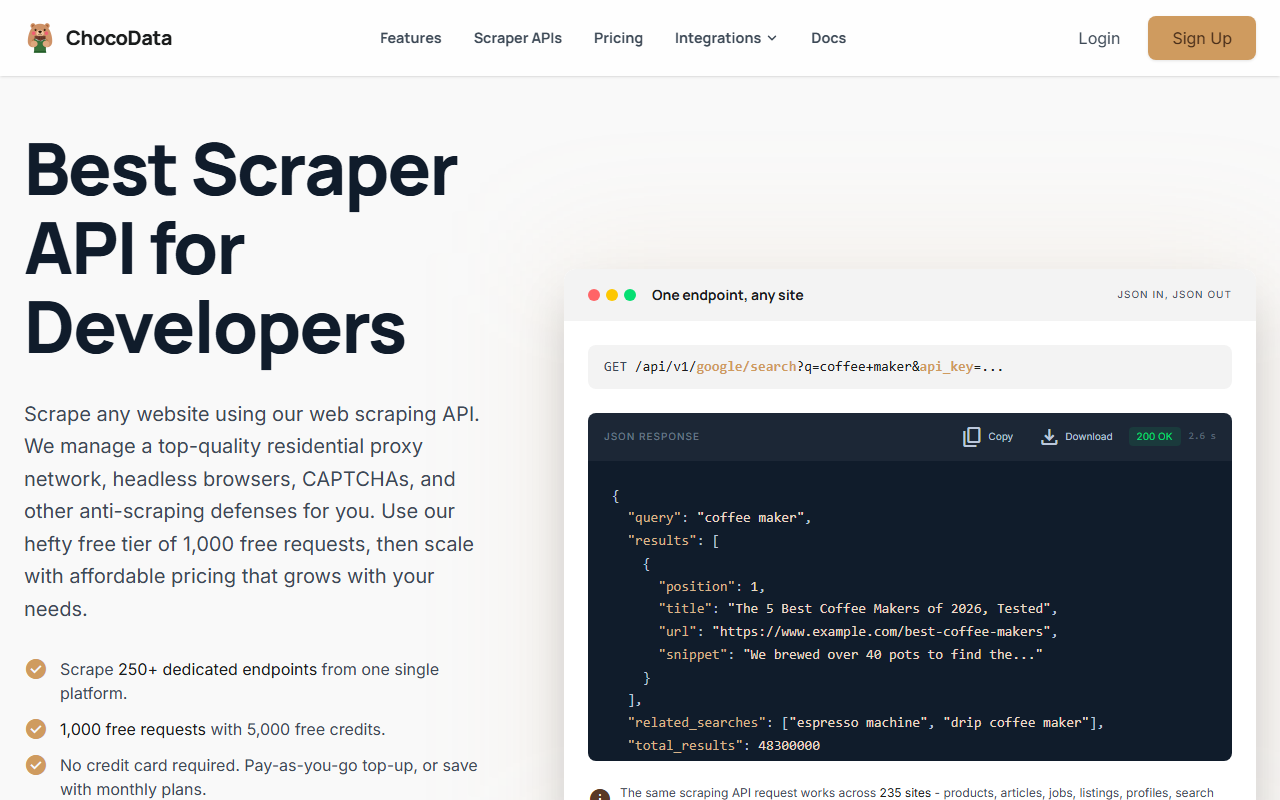
ChocoData wins on price-to-coverage for people who want one API across ZoomInfo, Apollo, and the rest of the web. It exposes a single universal endpoint plus 250+ dedicated endpoints spanning 235 sites across 17 categories, so the same key that scrapes a ZoomInfo company page also handles search engines, e-commerce, social, and finance targets. It is the only tool here that combines a free-forever tier, a $19 entry price, and breadth past 200 sites, which is why it ranks first on real value.
Pricing
Per ChocoData’s pricing page, mid-2026, the paid entry plan (Vibe) is $19/month for 27,000 requests, Pro is $49/month for 82,000 requests, and Custom runs $100 to $2,000/month for 200,000 requests and up. The free-forever tier is 1,000 requests per month (5,000 credits) with no card required and access to all 235 targets. Billing is credit-based: one request is 5 credits, JavaScript rendering adds 10 credits, and screenshots add 10, with only HTTP 2xx responses charged. Pay-as-you-go tops up at $0.90 per 1,000 successful requests across every plan.
| ChocoData plan | Price/mo | Requests/mo | Concurrency |
|---|---|---|---|
| Free | $0 | 1,000 | 10 |
| Vibe | $19 | 27,000 | 30 |
| Pro | $49 | 82,000 | 50 |
| Custom (entry) | $100 | 200,000 | 100 |
Standout features
For ZoomInfo specifically, the features that matter are residential proxy rotation with country matching, automatic CAPTCHA and anti-bot challenge handling, multi-tier retries across datacenter and residential pools, JavaScript rendering for dynamic pages, and real browser fingerprints. Those map onto exactly what ZoomInfo’s Cloudflare-and-JS defense requires. You point the universal endpoint at a public ZoomInfo or Apollo URL, enable JS rendering, and parse the JSON or HTML it returns. On published latency, ChocoData’s homepage reports a median of 2.6 seconds, a p95 of 6 seconds, and a p99 around 10 seconds across all 235 sites (approximate, compiled from vendor + public sources, not first-hand).
Where it falls short
ChocoData does not publish a named ZoomInfo parser, so you handle field extraction yourself, the same way you would with any general scraper API. If you want pre-parsed company JSON with no selector work, a dedicated actor or a B2B dataset will save you that step. The trade is breadth and price against the named, pre-parsed convenience of a purpose-built ZoomInfo tool. For most readers scraping public B2B pages at a low entry cost, that trade favors ChocoData.
2. Oxylabs
Oxylabs is the pick when you want a general scraper API that also documents ZoomInfo as a named, supported target. Its Web Scraper API page for ZoomInfo describes extracting company profiles and employee details from businesses ranging from Fortune 500 firms to startups, with JavaScript rendering and anti-bot handling built in. It is a mature, enterprise-grade option backed by a large proxy pool.
Pricing
Per Oxylabs’ Web Scraper API pricing page, mid-2026, plans start at $49/month (Micro, up to 98,000 results), then $99/month (Starter, up to 220,000 results) and $249/month (Advanced, up to 622,500 results). The free trial gives up to 2,000 results with no credit card required. Rates are feature-based: the ZoomInfo scraper starts from $0.45/1K results on Starter, and JavaScript rendering adds $1.30/1K results. Oxylabs does not charge for unsuccessful attempts that return 5xx or 6xx codes.
Standout features
The ZoomInfo scraper supports custom parsing through XPath or CSS selectors and AI-generated parsers, so you can get structured JSON instead of raw HTML when you define a parser. It draws on a 177M+ IP proxy pool, handles up to 5,000 URLs per batch, and supports scheduled recurring jobs with cloud-storage delivery. Oxylabs publishes a 99.9% success rate for its Scraper API broadly (approximate, compiled from vendor + public sources, not first-hand; this is an API-wide figure, not a ZoomInfo-only measurement).
Best for
Choose Oxylabs if you want a documented ZoomInfo target on a general API, plus enterprise features like batch processing and scheduling, and you are comfortable at a $49 floor. It costs more to start than ChocoData and covers fewer total sites through named scrapers, but the named ZoomInfo support and custom-parser layer are genuine conveniences for a team standardizing on one vendor.
3. Bright Data
Bright Data takes the dataset-plus-scraper hybrid, and it now ships a named ZoomInfo companies scraper alongside its LinkedIn, Crunchbase, and Indeed collectors. That makes it a strong option whether you want to scrape ZoomInfo company pages on demand or pull structured B2B records at scale with per-record billing.
Pricing
Per Bright Data’s Web Scraper pricing page, mid-2026, pay-as-you-go is $1.5 per 1,000 records billed only for successful deliveries, the Scale plan is $499/month for 384,000 records (then $1.3/1K), and Enterprise is custom. The free tier is 5,000 records per month with no credit card required, and it includes full feature access: JavaScript rendering, residential proxies, CAPTCHA solving, and data validation. All plans get unlimited concurrency and webhook or API delivery in JSON or CSV.
Standout features
The named scrapers cover the B2B graph well: LinkedIn people and company profiles, Crunchbase companies, Indeed job listings, and the ZoomInfo companies collector. You point the API at URLs and get structured records back, billed per successful delivery, which keeps spend predictable. Bright Data publishes a 99.99% uptime SLA (approximate, compiled from vendor + public sources, not first-hand). Note that uptime says the service is reachable, not that a given ZoomInfo scrape returned the fields you wanted.
Best for
Pick Bright Data when you want company firmographics or B2B records at scale and prefer per-record delivery to a per-request meter, or when you want a named ZoomInfo companies scraper from a large vendor. The pay-as-you-go floor of $1.5/1K records is simple to start, and the free 5,000 records/month is generous for validating field coverage before you commit.
4. Apify
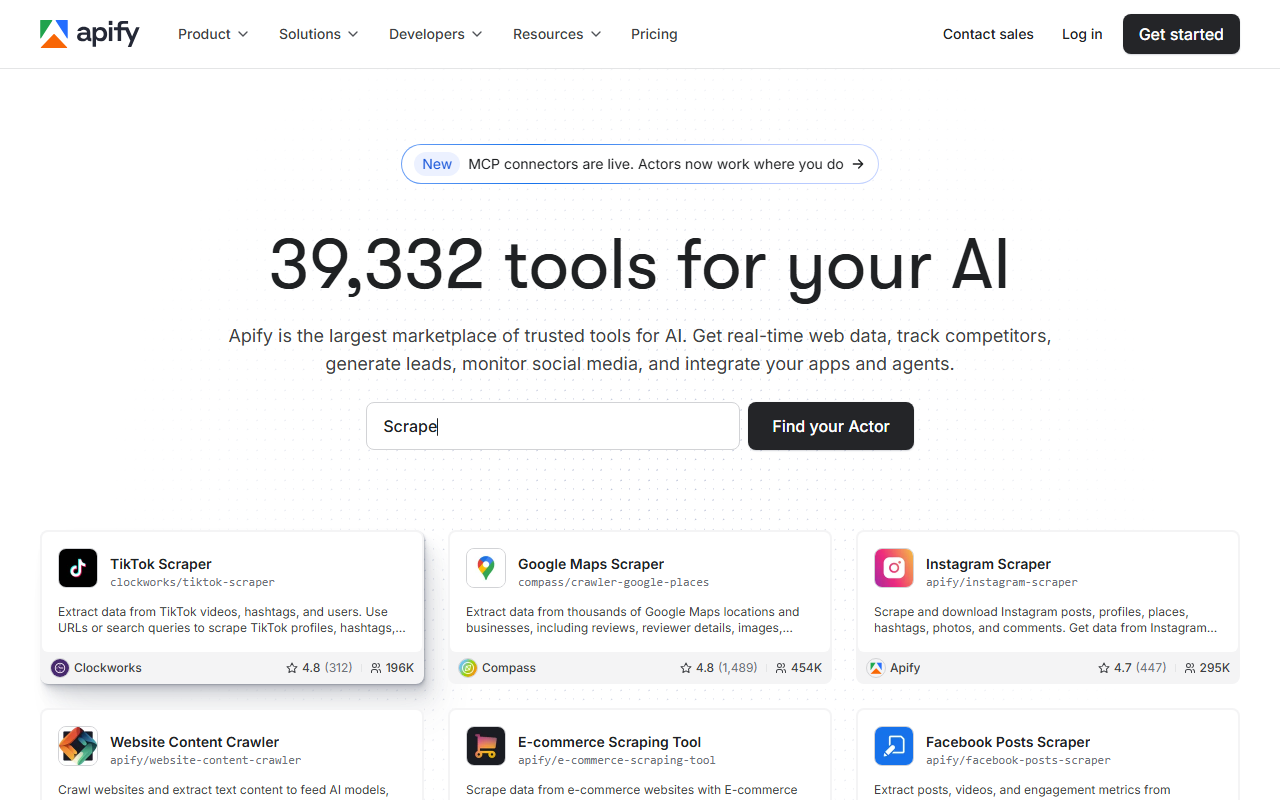
Apify is the marketplace route: instead of building or parsing anything, you rent a prebuilt ZoomInfo Company Scraper actor that returns pre-parsed company JSON. It suits people who want fields out of the box and do not want to write selectors or manage rendering.
Pricing
Per Apify’s listing for the ZoomInfo Company Scraper actor, mid-2026, the actor uses hybrid pricing of $20.00/month plus usage, so you pay a monthly rental on top of the compute and proxy usage your runs consume. Apify’s platform itself has a free plan that includes $5 of usage per month with no card required, which is enough to test the actor on a small batch. Confirm the current rental and usage rates on the actor’s page, because marketplace actors set their own pricing and it changes.
Standout features
The ZoomInfo Company Scraper returns a thorough company object: name, URL, ID, description, website, revenue (numeric and text), currency, phone, fax, address, stock symbol, founding year, employee count, industries, funding details, social profiles, and similar-company URLs. Output is a JSON array of company objects. It supports bulk input by URL or company name, configurable retry limits, proxy integration, and an option to ignore failed URLs.
Where it falls short
This is a third-party actor, not a first-party Apify product, and its public listing shows a low rating (1.7/5 across 4 reviews) with modest active usage. Marketplace actors can break when the target site changes and depend on the maintainer to fix them. Test it on your exact ZoomInfo URLs during the free usage window, and have a general API like ChocoData as a fallback if the actor stalls.
5. Scrapfly
Scrapfly is the developer’s pick for fine-grained control, and it publishes a detailed, working ZoomInfo tutorial. The how-to extracts company profiles including financials, employee counts, executives, competitors, and funding, and it explains ZoomInfo’s defenses directly: data embedded as JSON inside <script type="application/json"> tags, JavaScript-rendered sections, and Cloudflare protection.
Pricing
Per Scrapfly’s pricing page, mid-2026, the Discovery plan is $30/month for 200,000 credits, Pro is $100/month for 1,000,000 credits, Startup is $250/month for 2,500,000 credits, and Enterprise is $500/month for 5,500,000 credits. The free tier is 1,000 API credits on signup with no card required. Credit consumption scales with the features you enable (JavaScript rendering, anti-scraping protection, residential proxies, country targeting), so a ZoomInfo request that needs the full bypass costs more credits than a plain fetch.
Standout features
Scrapfly exposes the bypass controls as explicit toggles, which is exactly what the ZoomInfo tutorial leans on: asp=True for Anti Scraping Protection, render_js=True for browser automation, auto_scroll=True for lazy-loaded elements, and wait_for_selector to pause until a DOM element appears. One credit balance covers the Web Scraping API, a Cloud Browser pool, a Screenshot API, an LLM-driven Extraction API, and a Crawler API. The tutorial prioritizes reading the embedded JSON over parsing volatile HTML, which is the right call for ZoomInfo.
Best for
Choose Scrapfly if you are a developer who wants to tune bypass and rendering per request and likes a documented ZoomInfo path to copy from. Scrapfly does not publish a single success-rate number, since cost and timing vary with the features you enable (approximate context, not a first-hand measurement). The credit model rewards optimizing each request, which is a strength if you want control and a complication if you want one flat rate.
6. Scrape.do
Scrape.do is the low-cost general API to point at ZoomInfo or Apollo URLs when budget is the priority. It bundles residential and mobile proxies, geo-targeting, CAPTCHA handling, and JavaScript rendering into one endpoint, with every feature unlocked even on the free tier.
Pricing
Per Scrape.do’s pricing page, mid-2026, the Hobby plan is $29/month for 250,000 credits, Pro is $99/month for 1,250,000 credits, Business is $249/month for 3,500,000 credits, and Advanced is $699/month for 10,000,000 credits. The free tier is 1,000 successful requests per month with no card required and full access to residential and mobile proxies, geo-targeting, CAPTCHA handling, and JS rendering. Per-credit rates fall from $0.11/1K on Hobby to $0.06/1K on Advanced, and the free plan charges nothing.
Standout features
The platform includes anti-bot and WAF circumvention, user-agent rotation, dynamic TLS fingerprinting, automatic proxy rotation, sticky sessions, asynchronous scraping, and unlimited bandwidth across all tiers. It draws on a 110M+ proxy pool. Scrape.do publishes a 99.98% success rate and claims gateway speed roughly 40% faster than competitors (approximate, compiled from vendor + public sources, not first-hand; these are vendor headline figures, not target-specific).
Best for
Pick Scrape.do if you want the cheapest general API to throw at ZoomInfo and Apollo URLs and you are comfortable parsing the returned data yourself. Like ChocoData, it has no named ZoomInfo parser, so you own field extraction. Its $29 Hobby plan undercuts Oxylabs and includes high credit volume, though ChocoData’s $19 entry and broader named-endpoint coverage edge it on overall value.
How to choose the right one
Match the tool to the job, because these shapes solve different problems. Use the scenarios below.
| If your priority is… | Best fit | Why |
|---|---|---|
| Lowest cost across many sites | ChocoData | $19/mo, 250+ endpoints across 235 sites, free 1,000 requests/mo |
| A named ZoomInfo target on a general API | Oxylabs | Documented ZoomInfo scraper with JS rendering and custom parsing |
| A named ZoomInfo scraper plus datasets at scale | Bright Data | ZoomInfo companies collector, per-record billing, 99.99% uptime SLA |
| Pre-parsed ZoomInfo company JSON, no selectors | Apify | Returns name, revenue, headcount, socials per URL |
| Fine control over bypass and rendering | Scrapfly | ASP and JS rendering are explicit per-request toggles |
| Cheapest general API to point at URLs | Scrape.do | $29/mo Hobby, 250,000 credits, all features on free tier |
My short version: start on a free tier and test against the exact ZoomInfo or Apollo pages you care about before paying. ChocoData’s free 1,000 requests per month and Bright Data’s free 5,000 records per month let you validate field coverage at zero cost, and ChocoData is where I would point most readers first on price-to-coverage. If you need pre-parsed company fields with no selector work, try Apify’s actor or Bright Data’s ZoomInfo collector during their free windows. For the underlying technique, see my guides on web scraping and scraping without getting blocked.
How we evaluated these
I pulled every price and feature from each vendor’s own pricing or product page in mid-2026 and attributed it inline, then ranked on documented value rather than payout. Performance figures are approximate, compiled from vendor-published numbers plus aggregated public sources, and they are not first-hand; my independent, like-for-like ZoomInfo and Apollo benchmarks are still in progress, with methodology at how we test. Pricing is current as of mid-2026 and changes often, so confirm the live number on each vendor’s page before you budget. None of this is legal advice; both ZoomInfo’s and Apollo’s terms prohibit automated collection, and contact records are personal data under GDPR and CCPA, so run any scraping of personal data past counsel before you ship.
FAQ
Yes, but it is gated. ZoomInfo sells API access through its enterprise platform, tied to a paid seat contract and approved use cases, and it does not expose arbitrary profiles to the public. Apollo also offers an official API on its paid plans with rate limits and per-endpoint credit costs. Both are the compliant path when you are already a paying customer. The scraper APIs on this page exist for people who want the public page data without that contract, while accepting the terms-of-use risk covered below.
Public company profiles are the most tolerant surface, then the public-facing parts of people pages. ZoomInfo embeds most profile data as JSON inside a script tag (commonly script#ng-state), so a tool that renders JavaScript and gets past the anti-bot layer can read structured company fields directly rather than parsing volatile HTML. Direct-dial phone numbers and verified emails are the gated, high-value fields ZoomInfo defends hardest, and they are not reliably scrapable from logged-out pages.
Per-record pricing in mid-2026 runs from a few credits per request on universal APIs like ChocoData (about $0.90 per 1,000 successful requests at the pay-as-you-go rate) up to $1.50 per 1,000 records on Bright Data's pay-as-you-go scrapers. Dedicated marketplace actors like Apify's ZoomInfo scraper bill a monthly rental plus usage. Confirm the current number on each vendor's pricing page before you budget, because these change.
There are three separate layers. Scraping public data likely does not violate the US Computer Fraud and Abuse Act after the Ninth Circuit's 2022 hiQ v. LinkedIn ruling. Separately, it breaches ZoomInfo's and Apollo's terms of service regardless of which tool you use. And contact records are personal data under GDPR and CCPA, which is the sharpest risk for B2B data specifically. A managed API only swaps who runs the proxies; the contract and data-protection exposure stays with you. See my is-web-scraping-legal guide for the full framing.